
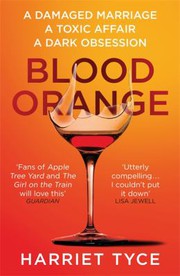
Blood Orange
2,469-word summary 11 min read 326 pages in the book
- First published
- 2019
- Publisher
- Wildfire
- Pages
- 326
- ISBN
- 9781472252746
Reading options
What's inside (9 sections)
I came to this one through a recommendation, with only the vaguest sense that it was a courtroom thriller and that the author had once worked in the law herself. That second detail turned out to matter. Harriet Tyce spent years as a criminal barrister before she wrote fiction, and the legal parts of this book have the fussy, procedural texture of someone who has actually sat in those rooms. Blood Orange came out in 2019, published in Britain by Wildfire, an imprint of Headline, and in the United States by Grand Central Publishing. The paperback I read runs to 326 pages. It became a Richard and Judy WHSmith Winter Book Club pick, sold heavily during the lockdown year of 2020, and has since been translated into twenty-two languages. Quibi and World Productions, the team behind Line of Duty and Bodyguard, picked it up for television. It is a debut, and it reads like one in both good and less flattering ways.
The jacket copy is assembled from three first-person fragments. One voice says she will have just one more drink and then end it. Another says she killed her husband and should be locked up. A third says it knows what the first voice has been doing and will not stop until she has lost everything. Those three lines are a fair map of the book. There is the woman drinking too much, the woman accused of murder, and the person watching from the shadows. Tyce lets those strands braid together, and the pleasure of the story is watching her pull the braid apart.
A night at chambers that goes too far
Alison Bailey is the protagonist, a criminal barrister who has been practising for more than fifteen years. She is ambitious and, by the account of almost everyone who reviews her, very good at her job. She is also drinking far too much and conducting an affair with a colleague, Patrick, the solicitor who instructs her. The book opens on an evening when she intends to have a single drink after work and go home. Instead she stays in London with her colleagues, one drink becomes another, and she ends up back at chambers with Patrick, who has been flirting with other women all evening. They have sex on her desk. He leaves. She does not go home at all.
The next morning her husband Carl and their six-year-old daughter Matilda come looking for her and find her there. Carl is a psychotherapist, and the book takes a certain relish in making him the calm, competent parent in contrast to Alison. That first morning sets the pattern. Carl cooks for friends while Alison nurses a hangover. She embarrasses him in front of the guests. The following day he shows her a video of what she did, a flat, deliberate piece of evidence presented without much expression. When she fails to wake in time to take Matilda to a castle outing, he honours the promise himself and questions, quietly and repeatedly, whether she can be trusted with the child. He turns his nose up at a stew she spends the afternoon cooking.
I found this section uncomfortable in exactly the way it is meant to be. Carl looks reasonable on the page. He is the one making the video, keeping the schedule, noting the failures. Alison looks chaotic and unreliable. Tyce is careful to let you see both the genuine damage Alison is doing and the way Carl builds a case against her out of every small slip. Alison herself wonders how she slept so late given how much she drank. That tiny puzzle is the first thread the novel quietly pulls.
The client who wants to plead guilty
The case that gives the book its title and its engine arrives soon after. Patrick is the instructing solicitor on Alison's first murder trial, and the defendant is Madeline Smith, a forty-four-year-old wealthy woman found by her cleaner sitting beside her stabbed husband, Edwin, in the bedroom of their multi-million-pound townhouse in Clapham. Madeline does not deny stabbing him. She insists on pleading guilty. She says she drank around half a bottle of gin that night and cannot remember what happened after. Her son James had visited for the weekend but went back to boarding school the night before Edwin's body was found.
Alison and Patrick take a train down to Beaconsfield, where Madeline is staying with her sister Francine, to interview her. This is the part of the book where Tyce's legal background shows most clearly. The visits, the instructions, the way a barrister weighs a client who will not help her own defence, all of it is handled with a precision that never feels like research dumped onto the page. Madeline's insistence on guilt is the central mystery. Why would someone who may have been abused fight to be convicted rather than tell the truth?
On the train back, Patrick sends Alison into the carriage toilet for a sexual encounter. She goes, even while telling herself the affair is over. She believes Carl is doing the school pick-up, but he denies it, and she turns up late to collect Matilda. That small domestic defeat lands harder than the courtroom material, because by now you can see how thoroughly Alison's two lives are tangled. The affair with Patrick is both a professional arrangement and a personal disaster, and she cannot keep the two apart.
Two lives running side by side
The middle of the book is where the two stories start to speak to each other. As Alison works through what really happened in the Clapham bedroom, she begins to uncover that Madeline's life was not the comfortable picture the newspapers assumed. Madeline was being abused by Edwin. The wealthy marriage, the townhouse, the good schools, all of it had a private violence underneath. Tyce draws this without sentiment. The point is not that Madeline is a victim in a simple sense. The point is that her account of her own life, like Alison's, has been shaped by fear and by the stories other people told about her.
What Alison is doing, in effect, is reading Madeline's case as a mirror. Each detail she uncovers about Edwin and Madeline prompts a harder look at Carl and herself. This is the structural idea of the novel, and it is a sound one. The legal thriller and the domestic thriller are not two separate plots glued together. They are the same story told at two temperatures, one in the cold language of evidence and the other in the hot, confused language of a marriage. Alison begins to understand herself by understanding her client, which is a tidy way to describe it but is genuinely how the chapters feel as they accumulate.
The book is divided into twenty-five chapters, with a prologue and a section labelled five months later at the end. That short closing chapter is doing a job. It lets Tyce jump past the immediate wreckage and show where the people land, which gives the ending a cooler, more settled feel than the feverish chapters before it.
Messages, videos and the sense of being watched
Running alongside the murder case is a campaign of harassment against Alison. Messages arrive from an unknown sender who claims to know about the affair. There are more videos of her behaviour, recorded without her knowledge. She goes so far as to visit an Apple Store to ask how someone could have installed spying software on her phone. The question she is really asking, of course, is who in her life would want to do such a thing, and the reader is several steps ahead of her by then.
The atmosphere here is pure domestic surveillance, and Tyce handles the escalation well. At first a message feels like a prank from a jealous colleague. Then the videos keep coming. Then the allegations surface. A woman named Caroline Napier, a client of Carl's, accuses Patrick of rape. The accusation arrives at exactly the moment when Alison's loyalty to Patrick is already fraying, and it is hard to know whether to believe it. This is where the book's #MeToo label comes from, and it is also where the book is at its most morally tangled, because everyone in this tangle has a reason to lie.
The Washington Independent Review of Books called Carl a sententious fussbudget of a husband and described Alison as a workaholic, briskly competent barrister who after hours is a fall-down drunk in an abusive affair. It called both Carl and Patrick deplorable. The Guardian went further, describing Carl as an appalling, self-righteous prig who had been gaslighting her, with a strain of parental showboating. That review filed the book under smart #MeToo noir, which seems about right. The noir part is the point. Nobody here is innocent, and the person who appears most responsible may be the one least willing to admit it.
What Carl was really doing
The revelation, when it comes, reclassifies almost everything that went before. Carl was the one sending the messages. Carl had been drugging Alison, which explains the mornings she could not account for and the sleep that was too deep for the amount she drank. Carl was the psychologist who encouraged the rape allegations against Patrick, using Caroline Napier as his instrument. The husband who cooked dinner and kept the school schedule and filmed his wife's drunken mistakes was running a systematic campaign to destroy her, and the calm reasonableness of his manner was the weapon.
That turn is the payoff the book has been loading toward, and it works because Tyce has been careful about the small details. The early questions about Alison's reliability, the video shown after the dinner party, the missed school run, the wine she cannot account for, all of it reframes once you know what Carl was doing. It is satisfying in the way a good twist should be, where the answer was there all along and you simply lacked the key.
By the time Alison reaches this understanding, the damage is done. Patrick has committed suicide. Carl has asked for a divorce. There is no clean victory here, and I appreciated that. The book is not interested in letting Alison win a case and walk away. What she gets is knowledge, and the cost of that knowledge is the rest of her life. Madeline's case and Alison's marriage converge on the same ugly fact: the person who looks most composed in the room may be the one who has done the most harm.
Where the book strains
I want to be fair about what does not work. The opening chapters lean hard on Alison's drinking, and for a while it feels like the novel is going to be a study of a woman hitting bottom rather than the thriller the jacket promises. That is not a flaw in itself, but the pace is uneven. The domestic scenes in the first third are long, and the murder case takes a while to get moving. Readers who want a fast legal puzzle from page one may be tested.
There is also a certain heaviness in the way Carl is drawn. By the time the revelation arrives, he is less a person than a function, a machine for making Alison's life miserable. The Guardian's phrase about him being a prig captures this. A villain who is that consistent stops being interesting as a character, even if he remains effective as a plot device. Patrick is barely better, presented as a man whose charm curdles the moment he gets what he wants. The book asks you to accept that Alison would be drawn to both of these men for fifteen years, and it does not do much to explain the attraction beyond her drinking and her ambition.
The prose is competent rather than distinctive. There are good sentences, particularly in the courtroom material, but Tyce is not writing for the music of the language. She is writing to keep the pages turning, and for long stretches that is exactly what a thriller should do. The book has been compared with Apple Tree Yard and The Girl on the Train, and those comparisons are fair. If those are books you enjoyed, this one will probably work for you. If you found them manipulative, you will likely feel the same way here.
One more caveat. The book relies on a final twist about who was watching whom, and the chapter labelled five months later is meant to settle the score. For my money it wraps things up a little too neatly after a story that had been content to stay messy. A thriller is allowed to resolve its plot, of course, but the sudden tidiness sits oddly beside the confusion of the earlier chapters.
What stays after the last page
For all that, I finished it in a single sitting and would hand it on. Blood Orange is a sharp, mean book about a woman who is very good at her job and very bad at reading the two men closest to her. Tyce knows the courts from the inside, and that knowledge gives the legal chapters a weight that most domestic thrillers cannot match. The best thing in the book is the way the murder case keeps reflecting Alison's marriage back at her, so that solving one becomes a way of seeing the other.
The book is a debut, and it has a debut's energy. It is too long in the early going, its villains are drawn in broad strokes, and its ending is tidier than its middle. But it is also genuinely propulsive, and its central idea, that the story a woman tells about her own life can be written for her by someone else, is stronger than the machinery used to deliver it. Tyce went on to write The Lies You Told, and after reading this you can see why she had somewhere to go. There is a raw skill here that a lot of more polished books lack.
I would give it to a reader who likes their thrillers domestic and their domestic stories dark. I would warn them that the first fifty pages ask for patience. I would not hand it to someone who wants a clean, comfortable mystery with a detective who has her act together. Alison Bailey does not have her act together, and that is the whole point. What she has, by the end, is a clearer view of the people who were using her, which is a small and hard-won thing. That is the honest ending Tyce gives her, and it is better than a tidy one.
FAQ
Is Blood Orange based on the author's own experience?
Harriet Tyce worked as a criminal barrister before turning to fiction, and that background shows in the legal detail. The story itself is a work of fiction, not a memoir.
Is Blood Orange part of a series?
It is a standalone debut published in 2019. Tyce followed it with a second novel, The Lies You Told, but Blood Orange has no series order.
Who is the person sending Alison the messages?
The sender turns out to be Alison's husband, Carl. He had been drugging her, filming her behaviour and encouraging a rape allegation against her lover Patrick.
Similar books
We Live Here Now
After a near-fatal fall, a woman moves with her husband to a remote Dartmoor house where strange events happen only when she is alone, and a raven watches from…
2,016-word summary · 9 min read
The Flight Attendant
A flight attendant wakes in a Dubai hotel beside a dead man she may have killed, and spends the rest of the novel lying to everyone who could help her.
2,496-word summary · 11 min read
The Divorce
A Long Island mother is evicted by her hedge-fund husband on their anniversary, and a twisty custody fight hides an older secret about her son.
2,227-word summary · 10 min read

The Widow
A widow of a suspected criminal faces reporters and police while hiding what her marriage really cost.
2,599-word summary · 12 min read
The Wives
A woman who sees her husband only on Thursdays tracks down his other wives and learns her marriage is not what she believed.
2,454-word summary · 11 min read
You Are Not Alone
A lonely New Yorker witnesses a subway suicide and falls in with the dead woman's friends, where a makeover and a framed murder hide a hidden mastermind.
2,588-word summary · 12 min read
The Reversal
Mickey Haller prosecutes a child killer's retrial with ex-wife Maggie and half-brother Harry Bosch on his team.
2,056-word summary · 9 min read
The Maid's Diary
A cleaner who snoops through her wealthy clients' lives finds a secret that could destroy them, while a detective investigates a bloody waterfront house with…
3,459-word summary · 15 min read
The Love of My Life
Emma loves her husband Leo and their little girl. Then Leo, an obituary writer, starts filing the facts of her life, and the woman he thinks he married begins…
2,803-word summary · 12 min read
The Cellar
Abducted in her small English town, sixteen-year-old Summer is locked in a cellar with three other girls. Their captor calls himself Clover and wants a perfect…
2,551-word summary · 11 min read
The Brass Verdict
Mickey Haller takes over a murdered lawyer's caseload and a Hollywood double-murder trial, with Harry Bosch circling the edges.
2,672-word summary · 12 min read
Eight Perfect Murders
A Boston bookseller's old blog post listing eight perfect fictional murders becomes the blueprint for a real killer, and the narrator knows more than he admits.
2,292-word summary · 10 min read
The Tenant
A marketing VP loses his job and rents out a room, and his Manhattan brownstone becomes a trap built from planted evidence, old identities and staged…
2,264-word summary · 10 min read

What She Knew
Rachel lets her eight-year-old son run ahead in a Bristol park, and the nine-day search turns her into a suspect in the public eye.
2,952-word summary · 13 min read

The Beach House
A young valet is beaten to death at a Hamptons party, and his law-student brother spends a year building a case against the family that covered it up.
2,049-word summary · 9 min read

4th of July
Lindsay Boxer shoots two armed teenagers in self-defense, faces a wrongful-death trial, and spends her leave chasing a string of throat-slashing murders in…
2,192-word summary · 10 min read

Still Missing
A realtor is abducted at a Vancouver Island open house and held for more than a year. Told through therapy sessions, the novel follows her escape and the hunt…
2,466-word summary · 11 min read

Echo Burning
Reacher hitches a ride with a Texas woman who wants her abusive husband killed, then has to prove she did not murder him when he comes home.
2,209-word summary · 10 min read
The End of Her
A sleep-deprived mother of twins faces a stranger's accusation that her husband murdered his first wife in Shari Lapena's domestic suspense novel.
2,383-word summary · 11 min read

Strange Sally Diamond
Sally Diamond takes her dying father's joke literally and burns his body, then learns her whole childhood was built on a kidnapping and a lie.
2,411-word summary · 11 min read
The Therapist
A couple moves to a gated street where the previous therapist was murdered in their house.
2,437-word summary · 11 min read
The Racketeer
A jailed lawyer trades a judge murder secret for freedom and revenge.
2,434-word summary · 11 min read
The Night Swim
A true crime podcaster covers a rape trial while probing an old drowning in a small town.
2,260-word summary · 10 min read
The Last House on Needless Street
A lonely man, a cat and a mysterious neighbor pull you into a house full of buried trauma.
2,627-word summary · 12 min read
The Judge's List
Lacy Stoltz hunts a sitting judge who murders off his list.
2,513-word summary · 11 min read
The Guardians
A innocence lawyer reopens a prison murder where the wrong man waits on death row.
2,564-word summary · 11 min read
In My Dreams I Hold a Knife
College friends reunite ten years after a murder with a trap set.
2,252-word summary · 10 min read
The Silent Wife
A Chicago psychologist watches her twenty-year partnership collapse when Todd leaves for Natasha, then plans murder.
2,591-word summary · 12 min read
Presumed Innocent
Rusty Sabich must solve coworker Carolyn Polhemus's murder while hiding his affair with her, then stands accused himself in Turow's 1987 Kindle County debut.
2,726-word summary · 12 min read
Every Last Secret
A wealthy wife tracks a possible affair, but dinners, therapy, and a sudden death expose buried secrets across two polished suburban marriages and force her to…
2,687-word summary · 12 min read