
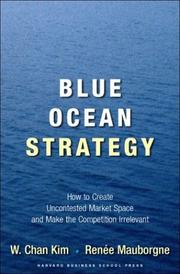
Blue Ocean Strategy: How to Create Uncontested Market Space and Make the Competition Irrelevant
2,333-word summary 10 min read 240 pages in the book
- First published
- 2004
- Publisher
- Harvard Business School Press
- Pages
- 240
- ISBN
- 9781591396192
Reading options
What's inside (9 sections)
I picked up Blue Ocean Strategy: How to Create Uncontested Market Space and Make the Competition Irrelevant expecting another book about beating rivals harder. It argues the opposite. W. Chan Kim and Renée Mauborgne, both professors at INSEAD, first published it in 2004 through Harvard Business School Press, and the hardcover I read runs 240 pages with ISBN 9781591396192. The premise is that a company should stop fighting in a crowded market and create a new one where the competition has no meaning.
The book has had a long life. It has been translated into more than forty languages and sold over three and a half million copies. It made bestseller lists at the Wall Street Journal and BusinessWeek, was named one of Fast Company's best books of 2005, won a prize at the Frankfurt Book Fair, and was ranked the number one strategy book of 2005 by Strategy and Business. An expanded edition came out in 2015, followed by Blue Ocean Shift in 2017 and Beyond Disruption in 2023. That is an unusual record for a management book, and it is worth asking why it caught on.
Part of the answer is the authors themselves. Kim and Mauborgne teach at INSEAD, and their work grew out of consulting rather than purely academic research. That shows in the prose. The book is written for somebody with a job and a deadline, not for a seminar. Each idea arrives with a tool, a diagram, and at least one company that supposedly made it work. Managers are more likely to remember a framework they can redraw from memory than a statistical argument they have to look up, and this book is built out of memorable frameworks.
Red oceans and the idea of value innovation
Kim and Mauborgne set up a simple opposition. A red ocean is an industry where companies fight each other for the same customers. The water turns red because the competition is bloody, and the standard advice is to beat the other guy on price, features, or marketing. They trace that habit to military thinking. Strategy becomes a battle, and winning means taking market share from someone else.
A blue ocean is an uncontested market space. The company does not try to defeat its rivals. It makes them irrelevant by creating demand that did not exist before. The authors call the mechanism value innovation, and it has two halves that are supposed to happen at once: differentiation and low cost. Most managers believe they must choose. You can be cheap or you can be distinctive, but not both. The whole book is an argument that this trade-off is a mental habit rather than a law.
I found that claim more interesting than a lot of the vocabulary around it. The phrase "make the competition irrelevant" sounds like a slogan until you think about what it would actually require. It means a product that a customer cannot compare to anything else on the shelf, because the thing that makes it valuable is not the thing the industry competes on. That is a demanding standard, and the book is at its best when it admits how demanding it is.
The metaphor does get stretched. Red oceans and blue oceans are evocative, but the book keeps returning to them where a plain word would have done. There are moments when a decision is called blue because it is good, and the label does no work beyond approval. I would have preferred fewer waves and more argument. That said, the core distinction holds up. An industry that competes only on the factors everyone already agrees about really does trap its customers in a narrow set of choices, and escaping that trap is a real strategic act.
The canvas and the four actions
The first practical tool is the strategy canvas. You plot the factors an industry competes on across the horizontal axis and the level each company offers on the vertical one. The point is to see the shape of the competition, because companies in the same industry tend to produce nearly identical curves. They all invest in the same things at roughly the same levels and then wonder why nobody stands out.
The second tool is the four actions framework. Ask which factors should be raised above the industry standard, which should be reduced below it, which should be eliminated altogether, and which should be created from nothing. Eliminate and reduce are the parts that matter most to me. Most strategy exercises add things. This one asks what a company can stop doing, which is where the cost savings come from. Raise and create supply the differentiation. Together they are how value innovation becomes a set of decisions rather than a mood.
The framework is easy to understand and easy to draw on a whiteboard, which I think explains a good deal of the book's success. A manager can use it in an afternoon. That is also a warning. A framework this portable can be used superficially, and I suspect a lot of blue ocean projects are just a list of things to cut with a nicer name.
The created factor is the one that separates a real blue ocean move from simple cost cutting. Eliminating an expensive feature lowers your costs, but a competitor can copy that in a quarter. Creating something an industry has never offered changes what the buyer is comparing. The book is clear that the four actions have to work together, and that a company which only reduces and eliminates has saved money without creating new demand. That is a useful correction to the way value innovation gets quoted in conference talks.
Four principles for finding the space
The middle of the book gives four formulation principles. The first is to reconstruct market boundaries, and the authors offer six paths to do it. Look across industries, across strategic groups, across the chain of buyers, across complementary products and services, across functional or emotional appeal, and across time. The examples are drawn from many different fields, and the point is that boundaries are assumed rather than given.
The second principle is to focus on the big picture rather than the numbers. This is where the strategy canvas gets used as a visual exercise. The authors want a team to draw the current state and a proposed future state before anyone starts arguing about forecasts. I like this in theory. In practice, a picture can hide the numbers just as easily as a spreadsheet can hide the story.
The third principle is to reach beyond existing demand. Kim and Mauborgne divide non-customers into three tiers. The first tier is people who almost use your product but do not. The second is people who know about it and refuse it. The third is people who have never considered it because it is outside their world. The argument is that the largest pool of growth is in the third tier, and that looking at those people reveals what an industry takes for granted. This is the most useful part of the book for anyone doing customer research.
The fourth principle is to get the strategic sequence right. A new idea needs exceptional utility, a price that buyers will accept, a target cost that leaves a margin, and a plan for the hurdles to adoption. The order matters. The authors want utility first, then price, then cost, then adoption. It is a way of stopping a company from building something wonderful that nobody will pay for.
I found the third tier of non-customers the most portable idea in the book. Ask who has never considered your product and why, and you may discover that the reason is not price or awareness but a piece of the offer that assumes something about the customer's life. That question can be asked by a small business as easily as a large one. You do not need a new market model to benefit from it. The six paths are more abstract, but the same habit applies: list the boundaries your industry treats as fixed, then test each one.
Tipping point leadership and fair process
The last part moves from choosing a strategy to getting people to carry it out. Kim and Mauborgne name four hurdles. The cognitive hurdle is that people do not understand why change is needed. The resource hurdle is that the money is not there. The motivational hurdle is that nobody wants to do the work. The political hurdle is that powerful people will block it.
Their answer is tipping point leadership, borrowed from the idea that a small number of people can shift an entire system. Leaders are told to focus effort on the people and activities that have the biggest effect, to use symbolic actions, and to make the need for change visible in a way that argument cannot. Fair process is the companion idea. People accept a decision they dislike if the process was open, if their views were heard, and if the reasons were explained afterward.
I found this section less persuasive than the analytical chapters. The concept of a tipping point is vivid, but the advice gets general quickly. Show the problem, use symbols, listen to people, explain decisions. That is reasonable management advice, and it does not need the ocean metaphor to make sense. The book's reputation rests on the earlier tools, not on this part.
Fair process is the better of the two ideas, because it is specific about what people object to. Employees rarely mind a decision they dislike as much as they mind being excluded from the conversation and then given no reason. The authors ask managers to invite views before the decision, to show that those views were considered, and to explain the outcome afterward. I have seen that work in ordinary offices. It costs nothing and it prevents a great deal of quiet sabotage, which is exactly the political hurdle the book worries about.
The examples that carry the argument
The most cited case is Nintendo's Wii. Sony and Microsoft were competing on processing power and graphical fidelity, pouring money into a race that Nintendo could not win on those terms. Nintendo built a console around motion controls and new ways to play instead. The hardware was cheaper to make than the rivals' machines, and the controller brought in players who had never bought a games console. The Wii sold over a hundred million units, far beyond its competitors. It is a clean example of value innovation, and the authors also point to the Nintendo DS and the Switch.
The book uses many other examples across industries, from circuses to wine, and the range is part of the appeal. You get the sense that the framework travels. Reception was strong. BusinessWeek asked why companies need so much persuasion to stay out of shark-infested waters, and the Business Strategy Review said the book challenges everything a reader thought they knew about strategy. It was named a best business book of the decade by Thinkers50 in 2011.
The concept itself came out of a consulting project for Philips in the 1990s, led by the management scholar C. K. Prahalad. Kim worked with consultants from the Mac Group on tools that eventually became a series of Harvard Business Review articles and then this book. That history matters because it explains why the writing is so practice-oriented. These ideas were tested on managers before they were tested in a journal.
What the critics say
The largest criticism is that the book is descriptive rather than prescriptive. It collects examples of companies that succeeded and then explains them through the blue ocean lens. There is no control group, so there is no way to know how many companies tried the same approach and failed. The examples were chosen to tell a winning story, and a theory built only on winners cannot tell you what to avoid. Nintendo is the strongest case, and one strong case is not a method.
A second criticism is that market boundaries are not as fixed as the framework assumes. Research on boundary work shows that markets are made and remade constantly by the firms and customers in them. If boundaries are porous, then the six paths are less a map of stable territory than a way of describing what a company decides to notice. That is still useful, but it is a smaller claim than the book makes.
A third criticism is that key ideas were already available. Gary Hamel and C. K. Prahalad wrote about creating and dominating emerging opportunities, which they called white space, in Competing for the Future in 1996. Critics argue that blue ocean strategy is a successful act of branding a set of existing concepts with a sticky name. I think that is partly fair and partly unkind. A sticky name is not nothing, and a framework that managers can actually use has value even if its parts are not new.
Who I would give it to
I would give this book to a manager stuck in an industry where every competitor looks the same. The four actions framework is worth an afternoon on its own, and the three tiers of non-customers changed how I think about the people a product never reaches. The writing is clear, the examples are varied, and the central question is a good one.
I would warn that reader not to treat the cases as proof. The book gives you a way to ask a better question, not a guarantee of a new market. Read it alongside something more skeptical about why firms fail. On its own it can make a hard-won success look like the inevitable result of filling in a grid. The Wii worked. Filling in the four actions framework does not make you Nintendo.
FAQ
When was Blue Ocean Strategy first published?
W. Chan Kim and Renée Mauborgne published it in 2004 through Harvard Business School Press. The hardcover runs 240 pages with ISBN 9781591396192.
What is a blue ocean?
It is an uncontested market space where a company's offering makes competitors irrelevant instead of beating them on the same factors.
What is the main criticism of the book?
Critics argue it explains successful companies after the fact, with no control group and examples chosen to support the theory.
Similar books
Built to Last: Successful Habits of Visionary Companies
Collins and Porras compare eighteen durable companies with their rivals and find habits like clock building, core ideology, and home grown management.
2,132-word summary · 9 min read
Creativity, Inc.: Overcoming the Unseen Forces That Stand in the Way of True Inspiration
Pixar's president on why the studio that made Toy Story nearly broke itself, and the daily habits that kept the creativity coming.
2,179-word summary · 10 min read
The Hard Thing About Hard Things
A founder and CEO writes about the parts of running a company that no framework can fix, from layoffs and demotions to the loneliness of the job.
2,161-word summary · 10 min read
The Five Dysfunctions of a Team
New CEO Kathryn unites warring execs through trust, conflict, and care.
2,029-word summary · 9 min read
Good to Great: Why Some Companies Make the Leap... and Others Don't
A five-year study of 11 companies that leapt ahead shows Level 5 leaders, right people, hedgehog focus and flywheel momentum explain lasting gains.
2,374-word summary · 11 min read
Flash Boys: A Wall Street Revolt
Michael Lewis follows a Canadian trader and his band of Wall Street outsiders as they discover how speed was used to rig the stock market, then build an…
3,009-word summary · 13 min read

Emotional Intelligence 2.0
Bradberry and Greaves turn emotional intelligence into four learnable skills, a self-assessment and dozens of strategies, while their headline numbers rest on…
3,276-word summary · 15 min read

The Ride of a Lifetime: Lessons Learned from 15 Years as CEO of the Walt Disney Company
Bob Iger's 2019 memoir on leading Disney through Pixar, Marvel, Lucasfilm and a global rebuild, told through the lessons he learned along the way.
2,475-word summary · 11 min read
Extreme Ownership: How U.S. Navy SEALs Lead and Win
Two retired Navy SEALs turn their Ramadi combat experience into a blunt leadership creed: the leader owns everything, and the team follows when the why is…
2,368-word summary · 11 min read
The E-Myth Revisited
Gerber argues that most small businesses are run by technicians who own a job rather than a business, and that the fix is a system that runs without them.
2,169-word summary · 10 min read

The Total Money Makeover: A Proven Plan for Financial Fitness
Dave Ramsey lays out seven Baby Steps, from a $1,000 starter fund to a paid-off house, with the debt snowball at the center.
2,663-word summary · 12 min read

The Magic of Thinking Big
Schwartz's 1959 self-help classic argues that success follows from the size of your thinking, supported by sales anecdotes, vocabulary drills and goal setting.
2,579-word summary · 11 min read

The World Is Flat: A Brief History of the Twenty-first Century
Thomas L. Friedman's 2005 bestseller argues that technology, trade, and open borders leveled the global playing field, and it names the ten forces that did it.
2,369-word summary · 11 min read
Dare to Lead
Research on courage shows how leaders build trust through vulnerability and clear values.
2,442-word summary · 11 min read
Think Again
Adam Grant argues for holding views loosely and testing them like a scientist, moving past preacher, prosecutor, and politician habits at work and in debate.
3,204-word summary · 14 min read
The Black Swan
Taleb argues rare shocks shape history more than models admit, and urges safer exposure over prediction.
2,588-word summary · 12 min read
The Millionaire Next Door
Stanley and Danko survey wealthy Americans and find frugal savers living next door, not big spenders, in this 1996 money study.
2,466-word summary · 11 min read
SuperFreakonomics: Global Cooling, Patriotic Prostitutes And Why Suicide Bombers Should Buy Life Insurance
Levitt and Dubner apply incentives to prostitutes, suicide bombers, doctors, and climate fixes with cheeky data.
2,007-word summary · 9 min read

Predictably Irrational
Behavioral economist Dan Ariely shows why we overpay, procrastinate, and misjudge through simple experiments.
2,183-word summary · 10 min read

The One Minute Manager
A young seeker learns three one minute habits from a plainspoken boss: clear goals, quick praise, and fast fair correction.
2,997-word summary · 13 min read

Moneyball
Oakland buys walks and patience to win 103 games on a small payroll in Lewis's 2003 baseball story.
2,955-word summary · 13 min read
The Big Short: Inside the Doomsday Machine
Outsiders who read the bonds shorted subprime and watched the machine eat itself in 2008.
2,194-word summary · 10 min read

Lean In
Sit at the table, negotiate, share home load, and change offices while knowing advice skews elite.
2,005-word summary · 9 min read
Zero to One: Notes on Startups, or How to Build the Future
Thiel argues monopolies create value through vertical progress, not by copying competition.
2,582-word summary · 11 min read
The Lean Startup
Ries lays out Build-Measure-Learn, MVPs, pivots and validated learning for building companies under extreme uncertainty.
2,581-word summary · 11 min read
Getting to Yes: Negotiating Agreement Without Giving In
Fisher and Ury propose negotiating on interests rather than positions, using fair standards and a clear alternative if no deal is reached.
2,231-word summary · 10 min read
Careless People
A former New Zealand diplomat recounts seven years at Facebook, from a Myanmar launch to a hospital bed where the job followed her between contractions.
2,413-word summary · 11 min read
Breakneck: China's Quest to Engineer the Future
Dan Wang argues that America is run by lawyers and China by engineers, from a bicycle ride through Guizhou to the human cost of the one-child policy.
2,281-word summary · 10 min read
Apple in China
A former Financial Times reporter argues that Apple poured about $275 billion into China, training a generation of engineers and leaving itself dependent on…
2,094-word summary · 9 min read

Abundance
Two journalists argue that rules written to fix the abuses of the 1970s now block the housing, energy and clean construction the 2020s need, and propose a…
2,306-word summary · 10 min read