
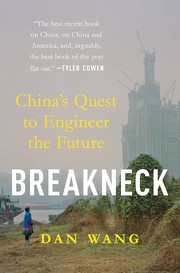
Breakneck: China's Quest to Engineer the Future
2,281-word summary 10 min read 288 pages in the book
- First published
- 2025
- Publisher
- W. W. Norton & Company
- Pages
- 288
- ISBN
- 9781324106036
Reading options
What's inside (8 sections)
I picked this book up because a friend kept quoting one line from it at dinner, and I wanted to know whether the line held up once it had a few hundred pages behind it. The line is Wang's organizing claim: America is run by lawyers, and China is run by engineers. It is deliberately provocative, and the whole book is an attempt to earn it. Dan Wang published Breakneck with W. W. Norton in August 2025; my copy runs 288 pages, and it is part report from a country he knows well and part argument about what kind of country he wants his own to become.
Wang grew up in China, worked there for years as a technology analyst, and then left again. He writes now as a research fellow at the Hoover Institution. That history matters, because he is neither an outsider peering in nor a booster writing apologetics. He has the vocabulary of someone who lived inside the system and the distance of someone who can describe it to a stranger. He argues that the old Cold War categories no longer tell us much. The useful contrast, in his telling, is between an engineering state and a lawyerly society.
One thing I did not expect from a book with such a blunt thesis was how much room Wang leaves for uncertainty. He is a strong claim maker, but he keeps returning to what the evidence can and cannot show. That combination of bold framing and careful qualification is the book's best habit, and it is the reason I trusted the reporting even when the argument made me want to argue back.
The engineers and the lawyers
The claim is easier to state than to prove, so Wang spends the opening chapters building it from biographies and habits of mind. Chinese leaders, he notes, have often been trained as engineers. Hu Jintao was a hydraulic engineer. Wen Jiabao was a geologist. These are not trivial details to him. He thinks a person trained to solve technical problems comes to see a country as a large problem to be solved, with inputs, bottlenecks, and outputs.
America, he says, began as a society of debaters and lawyers. The Declaration of Independence reads like a legal case, most of the founders and early presidents were lawyers, and the habits of argument built into the founding documents never really left. He points to the Biden White House and observes that it was full of Yale Law graduates. The point is not that one country has smart people and the other has slow ones. It is that the two ruling classes are trained to see different things and to value different kinds of solutions.
I found this section convincing in a way I did not expect. The professions Wang names are not decorative. An engineer and a lawyer approach a bridge, a law, or a budget with genuinely different instincts, and when enough engineers or enough lawyers occupy the top jobs, the whole government starts to feel like their trade.
It is worth saying what this framing leaves out, because the omission shapes everything that follows. Wang is writing about the people at the top, the leaders and the senior officials, and not about the millions of people who live under them. A country can be described as an engineering state by looking at who holds the levers, and still be a place where most encounters with government feel like paperwork and waiting. The book's China is a picture from the summit, and from that height the bridges look especially impressive.
A bicycle ride through Guizhou
The chapter I keep recommending to people is the one about Wang's 2021 bicycle ride through Guizhou. It is the most vivid thing in the book and the clearest example of his method, which is to put a concrete scene in front of the reader and then explain the incentives behind it. Guizhou is a poor province in the southwest, not a place associated with futuristic infrastructure. Wang rides through it and finds half a dozen high-speed rail links, new highways, multiple airports, and something like forty-five of the world's hundred tallest bridges.
He makes the comparison that started the argument in my head. The infrastructure in this poor Chinese province was better than what he was used to in California. A bridge in Guizhou goes up because the state can decide to build it, find the money, move the people if it must, and put it up on a schedule that would be unimaginable in California, where a project of the same size would spend a decade in environmental review and court challenges. Wang is careful about the word "better." He means the physical thing works, trains run on time, and the road connects places that were previously isolated.
The ride itself matters to the argument. Wang is not flying in to inspect a showpiece and leave. He is on a bicycle, moving at a speed that lets him see the ordinary roads and the smaller towns between the big projects. It is a way of reporting that insists the infrastructure is part of daily life rather than a display for visitors. When he describes a county that was hard to reach and now has rail, he is describing a change in how people live rather than a line on a map.
From the scene he moves to the incentives. Local officials in China gain GDP figures and promotion prospects from monumental projects, so they have a reason to propose them. State-owned construction lobbies constantly pitch another mega-project, and an engineer-led government is disposed to listen. The result is what he calls monumentalism: enormous works that genuinely improve some lives and that also serve the careers of the people who ordered them. He does not pretend the two motives can be separated cleanly.
What the engineering mindset breaks
If the book stopped with bridges and rail lines, it would be a travelogue with a thesis. Wang insists on the other half, and the chapters about the human cost are the hardest in the book. He argues that the same habit of mind that builds high-speed rail also produced the one-child policy, and he tells the story through a detail I had never encountered. A mathematician who had worked in the missile industry persuaded Deng Xiaoping that population trajectories could be managed the way missile trajectories are managed, with models, targets, and corrections. That idea, applied over decades, produced forced sterilizations and forced abortions on a scale that is difficult to hold in your head.
Wang also writes about detention camps and forced assimilation in Tibet and Xinjiang. He writes about the hukou system, the household registration rules that restrict internal movement and tie millions of people to a place they may no longer live. These are not footnotes to the infrastructure story. They are the same story seen from the other side, a state that treats people as variables in a plan.
There is a temptation, reading these chapters, to treat them as a separate section of the book, the dark part you get through before the argument resumes. I do not think Wang wants that. He keeps the human cost next to the engineering achievements on purpose, and the uncomfortable proximity is the point. A governing style that delivers railways and one that delivers forced sterilization are, in his telling, expressions of the same confidence that a plan can be made and imposed.
I want to be fair to the book here. Wang is not writing an attack piece disguised as analysis, and he does not claim to have discovered these abuses. He is making a connection between a governing temperament and the policies it can produce. The connection is the argument, and whether you accept it determines how the rest of the book lands. A reader who thinks the comparison is strained will find the rest of the book strained too.
India, housing, and what America might borrow
Wang broadens the lens in the middle of the book. He compares China with India, and he looks hard at Chinese housing, which has been oversupplied on a scale that has left whole cities of empty apartments. Mass transit is his stronger example. The trains and metros work, they move enormous numbers of people, and they were built in a political environment that could tolerate the disruption of building them. He asks what America could learn from this without importing the repression that came with it. That question animates the later chapters more than any other.
It is a hard question, and the book is better at posing it than at answering it. Wang can show what China built; he is on less sure ground when he tries to say which American rules should bend. Still, the question is the right one for anyone who has watched a transit line take twenty years to plan. He is asking whether a society that has made it easy to stop things has forgotten how to start them, and that is a question worth sitting with even if his answer is incomplete.
To answer it, he goes back into American history. He describes how lawyers shifted from deal-makers to regulators after the 1960s, when trust in technocracy collapsed and the watchword in progressive circles became, in his phrase, "Sue the bastards." The legal profession that once helped make deals now had a different job, which was to stop things, to sue, to litigate, to demand process. Wang thinks this produced a kind of gridlock, and he thinks it explains why American infrastructure projects crawl while Chinese ones appear almost overnight. He is writing about a real shift, but he is also writing about something that irritates him, and the irritation is part of the book's energy.
The ending is qualified. Wang does not say that either country is doomed to stasis. He says the contest that matters is which system works best for the people living inside it, and he leaves open the possibility that both systems can change. I appreciated the modesty of that ending after so much bold claiming. It kept the book from turning into a manifesto.
The parts I would argue with
A book with a thesis this clean invites resistance, and I felt it while reading. Wang's America section is less convincing than his China section. He knows China from the inside and America from a distance, and the chapters on American lawyers and regulators read more like a columnist's argument than like reported chapters. Jordan McGillis made the same point in City Journal, praising the vivid, often autobiographical reporting while finding the treatment of America thinner. Noah Smith noted that the book has company: it sits near Abundance and Why Nothing Works, other recent books asking why building has become so hard. That kinship is useful, but it also means some of Wang's examples will be familiar to readers who have already met them elsewhere.
The reception was strong without being uniform. Yuan Yi Zhu wrote in The Times that it was easily one of the best books on China published this year. Tunku Varadarajan in The Wall Street Journal called it brilliant and said it was equal parts gripping and depressing, which seems exactly right to me. The "depressing" part is not a flaw. Wang's willingness to put the bridges and the detention camps in the same book is the reason to take him seriously, even when I want to push back on a simplification.
There is also the risk in any framing this tidy. Real countries are run by mixtures of professions, and China's engineers do not all think alike, any more than America's lawyers do. Wang knows this, and he writes around the edges of it, but the central line is a line, and lines flatten. I caught myself nodding at the engineering-state idea and then wondering how much of what I was nodding at was the force of the phrase rather than the evidence behind it.
What I tell people now
I tell people two things, and they pull in different directions. First, read it for Guizhou, because that chapter will change the way you think about what a bridge can be. Second, read the one-child chapter slowly, because it is the place where the book's clever idea shows its teeth. Those two chapters together are the whole argument, and they are a better argument than any summary of the thesis.
I also tell people to read it as the work of someone who left. Wang's China is the China of a person who grew up there, worked there, and then chose to live elsewhere, and that gives the book a texture that a foreign correspondent's account would not have. It also gives him a blind spot or two, since a person who leaves sees the place he left with a clarity that can harden. The best pages hold both the affection and the anger at once, and they do not resolve the tension into a lesson.
The question I am left with is not whether Wang is right about lawyers and engineers. It is whether a country can keep the useful part of the engineering instinct, the part that builds and connects and plans, without accepting the part that turns people into numbers. Wang ends hopeful on that, and I am not sure I share the hope. But I finished the book more willing to ask the question, and for a work of nonfiction that is a considerable thing.
FAQ
When was Breakneck published and by whom?
Dan Wang's Breakneck was published by W. W. Norton & Company in 2025, running 288 pages in the first edition.
What does Wang mean by 'America is run by lawyers, and China is run by engineers'?
He means the two countries are led by people trained in different habits of mind. Chinese leaders have often studied engineering, while America's founders and many of its leaders have been lawyers.
Does Wang think America should copy China's model?
No. He asks what America can learn from China's capacity to build without importing the repression that accompanied it, and he ends on a note of qualified optimism.
Similar books
Apple in China
A former Financial Times reporter argues that Apple poured about $275 billion into China, training a generation of engineers and leaving itself dependent on…
2,094-word summary · 9 min read
The World Is Flat: A Brief History of the Twenty-first Century
Thomas L. Friedman's 2005 bestseller argues that technology, trade, and open borders leveled the global playing field, and it names the ten forces that did it.
2,369-word summary · 11 min read
Flash Boys: A Wall Street Revolt
Michael Lewis follows a Canadian trader and his band of Wall Street outsiders as they discover how speed was used to rig the stock market, then build an…
3,009-word summary · 13 min read
Careless People
A former New Zealand diplomat recounts seven years at Facebook, from a Myanmar launch to a hospital bed where the job followed her between contractions.
2,413-word summary · 11 min read
Abundance
Two journalists argue that rules written to fix the abuses of the 1970s now block the housing, energy and clean construction the 2020s need, and propose a…
2,306-word summary · 10 min read
Nudge: Improving Decisions About Health, Wealth, and Happiness
Thaler and Sunstein show how defaults, framing, and social cues steer choices, and argue for choice architecture with an opt-out.
3,146-word summary · 14 min read
Prisoners of Geography: Ten Maps That Tell You Everything You Need to Know About Global Politics
Tim Marshall explains how mountains, rivers, coasts, and resources shape the choices of nations, from Russia's flat borders to the chokepoints of the South…
2,328-word summary · 10 min read
21 Lessons for the 21st Century
Twenty one essays on work, liberty, truth, and meaning when algorithms flood the world with noise.
2,101-word summary · 9 min read
Zero to One: Notes on Startups, or How to Build the Future
Thiel argues monopolies create value through vertical progress, not by copying competition.
2,582-word summary · 11 min read
One Day, Everyone Will Have Always Been Against This
From a viral 2023 post, Omar El Akkad builds a furious short argument about Western promises, silence and complicity during the Gaza war.
2,218-word summary · 10 min read
Motherland: A Feminist History of Modern Russia, from Revolution to Autocracy
A feminist history of modern Russia told through women's lives, from the revolutionaries of 1917 to Pussy Riot and the politics of today.
2,191-word summary · 10 min read
Source Code
Bill Gates's first memoir retells his Seattle childhood, from a grandmother's Ritz crackers to nights sneaking out to code. It stops just before the MS-DOS…
2,473-word summary · 11 min read
Mountains Beyond Mountains: The Quest of Dr. Paul Farmer, a Man Who Would Cure the World
Tracy Kidder travels with Dr. Paul Farmer from Haiti to Peru, tracing how a Harvard doctor built a health system for the poor and what that work cost him.
3,095-word summary · 14 min read
Men Explain Things to Me
A short collection of essays that begins with a man explaining Solnit's own book to her and expands into an argument about who gets believed, who gets heard…
2,019-word summary · 9 min read

I Am America (And So Can You!)
Stephen Colbert's 2007 debut extends his Colbert Report pundit into print, a mock-conservative tour of American life with margin notes, stickers and Fun Zones.
2,635-word summary · 12 min read
Digital Minimalism: Choosing a Focused Life in a Noisy World
Cal Newport argues that willpower cannot beat an attention economy designed against you, and offers a thirty day reset to rebuild your digital habits around…
2,701-word summary · 12 min read
Blue Ocean Strategy: How to Create Uncontested Market Space and Make the Competition Irrelevant
Two INSEAD professors argue that companies win by creating uncontested markets rather than fighting rivals, and give managers tools to do it.
2,333-word summary · 10 min read
All or Nothing: How Trump Recaptured America
Wolff's fourth Trump book reconstructs the 2024 campaign and the return to the White House from Mar-a-Lago sources, phone monologues and unnamed confidants.
2,248-word summary · 10 min read
1929
Sorkin's narrative history of the 1929 crash opens on 1 February of that year, seven months before the fall, and follows bankers and speculators through to…
2,953-word summary · 13 min read
107 Days
Kamala Harris's memoir of the 107 days between Biden's withdrawal and Election Day, drawn from a journal kept during a campaign she believes she was best…
2,132-word summary · 9 min read

Long Walk to Freedom
Mandela's account of a Thembu childhood, a law practice, a banned movement, twenty-seven years in prison, and the negotiation that ended apartheid.
2,454-word summary · 11 min read

Nothing to Envy
Barbara Demick follows six defectors from Chongjin through the North Korean famine, showing how ordinary people lived, believed, and finally left.
2,068-word summary · 9 min read

In Order to Live: A North Korean Girl's Journey to Freedom
A young North Korean girl crosses the Yalu, survives trafficking in China, and rebuilds her life in Seoul in this unsparing memoir.
2,027-word summary · 9 min read

Too Much and Never Enough: How My Family Created the World's Most Dangerous Man
Mary L. Trump's 2020 memoir traces how a cold, zero-sum Queens household shaped her uncle, and uses family tax documents to challenge his self-made story.
2,059-word summary · 9 min read

Infidel
Ayaan Hirsi Ali's memoir of a Somali childhood, a forced marriage, a Dutch asylum claim, and the political fight that followed the murder of Theo van Gogh.
2,041-word summary · 9 min read
The Total Money Makeover: A Proven Plan for Financial Fitness
Dave Ramsey lays out seven Baby Steps, from a $1,000 starter fund to a paid-off house, with the debt snowball at the center.
2,663-word summary · 12 min read

Down and Out in Paris and London
Orwell's account of washing dishes in Paris hotels and tramping through London does not ask for pity, only for a clear look at how poverty actually works.
2,282-word summary · 10 min read

The Girl with Seven Names: A North Korean Defector's Story
Hyeonseo Lee crossed the frozen Yalu River at seventeen, spent years hidden in China, escaped to South Korea, and later returned to rescue her family.
2,404-word summary · 11 min read
The Wright Brothers
David McCullough tells the story of two self-taught Ohio brothers, working largely alone and out of a bicycle shop, who solved the problem of flight before…
2,027-word summary · 9 min read
America (The Book): A Citizen's Guide to Democracy Inaction
Jon Stewart and the Daily Show writers turn a high school civics textbook inside out, with a foreword from beyond the grave.
2,511-word summary · 11 min read