
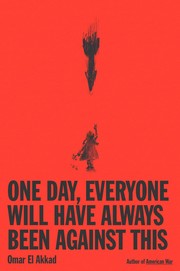
One Day, Everyone Will Have Always Been Against This
2,218-word summary 10 min read 208 pages in the book
- First published
- 2025
- Publisher
- Knopf
- Pages
- 208
- ISBN
- 9780593804148
Reading options
What's inside (8 sections)
There is a particular kind of book that starts with a single sentence on a screen and turns it into an argument you cannot put down. Omar El Akkad's nonfiction debut is that kind of book. In October 2023, three weeks into the bombardment of Gaza, he posted a message on social media that began with the promise of a safer time to come, when calling a thing what it is would carry no cost. He imagined a day when everyone would claim to have always been against it. The post was viewed more than ten million times, and the title of this book comes straight from it.
Knopf published the result in February 2025 at 208 pages, and it went on to win the 2025 National Book Award for Nonfiction. It is a short, angry book, and it knows exactly what it is. El Akkad is not trying to surprise you with a hidden thesis. He is trying to make a case that he believes his readers already half understand and would prefer not to say out loud. Whether that is brave or merely repetitive is the question at the heart of the divided response to it. I finished it convinced that the force is real, and also that the book leaves certain arguments untouched on purpose.
A life arranged around arrival and disillusionment
El Akkad was born in Egypt and grew up in Qatar. He moved to Canada as a teenager and now lives in the United States. Before this book he worked as a journalist and wrote two novels, American War and What Strange Paradise. That mixture of backgrounds matters, because the book is built out of the distance between what he was told about the West and what he saw when he got there.
He describes arriving in the West believing it stood for freedom and justice for all. Then he spent two decades reporting on the War on Terror, on Ferguson, on climate change and on Black Lives Matter protests. Each assignment, in his telling, chipped away at the story he had been given. The corollary to the promise of freedom was that some people were never meant to be included in it. He finally watched the slaughter in Gaza, and what had been a slow accumulation of doubts became a conclusion he could no longer set aside.
The conclusion is stark. Much of what the West promises, he argues, is a lie, and there have always been entire groups of human beings it never intended to treat as fully human. He names Arabs and Muslims and immigrants, but he also points toward whoever falls outside the boundaries of privilege. The book's movement is from a young man's faith in a set of ideals to a grown man's certainty that those ideals have always been applied selectively. It is a bleak arc, and El Akkad does nothing to soften it.
What makes the personal material work is that he does not present himself as a neutral observer. He tells you where he came from, what he believed and how he came to change his mind. This is not a report dressed up as a memoir, and it is not a memoir pretending to be a history. It is a writer working through a moral break in his own life and using the news of two decades as the evidence.
His years as a journalist are visible in the way he handles that evidence. He is good at the brief, sharp observation, the detail that stands in for a whole system. His novels show up too, in the pacing and in the attention to how a person justifies a decision to himself. The book borrows a novelist's empathy for people under pressure and a reporter's eye for the exact phrase that exposes a double standard. That combination is what the National Book Foundation judges were getting at, and it is the reason the book reads more like literature than like an opinion piece.
The future tense as a device
The most distinctive thing about the book is its grammar. El Akkad writes largely in the future tense. He describes a day that will come, when it is safe to name what happened and too late to do anything about it. On that day, everyone will have always been against the killing. This is the device critics keep returning to, and Joe Stanek in the Chicago Review of Books said it gives the book the feeling of prophecy.
The effect is unsettling because it places the reader in a future that has already been decided. There is no suspense about whether people will eventually claim they opposed the war, because the author has already told you they will. What remains is the question of what you do with that knowledge now, while the words still carry a cost. The future tense is less a prediction than a trap. It closes off the comfortable exit of assuming that things will be different later.
He also uses that distance to set up painful contrasts. He writes about images of children being killed in Gaza and sets them against the ordinary safety of his own children playing far from a war zone. The comparison is not subtle, and it is not meant to be. It is there to make the reader feel the gap between the lives that are protected and the lives that are not. The book returns often to the fact of his own children, and that parental perspective is what keeps the argument from floating free of a human being.
Who the book is arguing with
El Akkad aims this book chiefly at Western centrists and liberals who stayed silent, or who found reasons to qualify their concern. That choice of audience is deliberate and it shapes everything. He is not writing for people who already agree with him and want confirmation. He is writing for readers who think of themselves as decent and who believed the promises he grew up believing. The anger is aimed at the silence of bystanders, and especially at people whose comfort depends on the systems he is describing.
That focus explains the book's double standard argument. He writes about the gap between the lofty ideals the West announces and the bloodstained reality of its actions, and about the way allies such as the United States and Israel are held to a different standard from enemies. A country branded an adversary is judged harshly for the same behavior that is excused in a friend. For El Akkad, this is not a footnote to the central issue. It is the mechanism that allows the ideals to survive as language while being abandoned in practice.
The book also argues that violent resistance by indigenous or colonized people tends to be celebrated only after it has failed. That is a hard claim, and it is one of the places where the book's compression shows. He offers it as part of an accumulative case rather than as a thesis to be defended in detail. Readers who want the argument unfolded slowly will not find it here. What they will find is a writer placing one grievance beside another and asking you to see the pattern.
This is why the book's structure matters. It is not reported narrative. It is a series of chapters that move between the author's life and a larger history of promises and betrayals, and the energy comes from repetition and moral pressure rather than from new information. Each section returns to the same central charge from a slightly different angle. That can feel powerful, and at times it feels like the book is preaching to a room it has already convinced.
What the book is actually about
Beneath the argument about Gaza and Western hypocrisy, the central subject is complicity. El Akkad keeps asking what it means to be a citizen of the United States and a father at a time of mass killing. He is not only interested in the people who pull the triggers or issue the orders. He is interested in the person who watches, who pays taxes, who holds a passport and goes to work, and who finds a way to keep living an ordinary life while something terrible is done in his name.
That is a more difficult subject than it first appears, because complicity is not an action you can point to. It is a condition. The book's future tense captures this nicely. The point is not what you will say years from now, when saying it is cheap. The point is what you refuse to accept now, when acceptance would be easier. El Akkad writes as someone who has tried to carve out some possibility for himself and his family inside a time of carnage, and he does not pretend to have found a clean answer.
This is why the reviews were so strong on the book's emotional force. Dina Nayeri in The Guardian called it passionate, poetic and sickening, and full of well-earned rage. Fintan O'Toole in the New York Times Book Review described it as a distraught but eloquent cry against our tolerance for other people's calamities. The National Book Foundation's judges praised the way it combines a novelist's empathy with a journalist's eye, and called the result beautiful, heartbreaking, messy and singularly profound. Those responses point to the same quality: this is a book that feels its argument rather than merely stating it.
Brian Tanguay in the California Review of Books called it a brave book and a scathing polemic, and compared it with James Baldwin's The Fire Next Time. That comparison gets at both the tone and the ambition. El Akkad wants to write the kind of moral book that will not let its reader off the hook, and he is willing to be unpopular in doing it. He was also more sceptical than some others about whether people would act when confronted with injustice, which seems to me the honest reading of the book's own future tense.
The pushback, and what it misses
The dissent was sharp. David Mikics wrote in Tablet that in a sane culture the book would be dismissed as a one-sided diatribe. That complaint echoes a broader charge: that El Akkad's polemic leaves little room for argument or qualification. It is a fair description of the book's method. He is not building a balanced case with opposing views represented fairly. He is making a case, and he expects you to argue with it elsewhere.
I think that criticism lands on one level and misses on another. It lands because the book really does compress complicated histories into a single moral line, and there are places where a reader might want more evidence or more willingness to entertain an opposing view. It misses because the compression is the point. A short book of 208 pages cannot be both a broad report and a sustained moral argument, and El Akkad is transparent about which one he is writing. He has said, in effect, that this is a work of committed moral prose.
There is also the question of what a polemic is for. This book is not trying to win over someone who denies the premise. It is trying to shake loose the people who accept the premise in public and set it aside in private, and for that audience repetition is a feature rather than a bug. Each chapter returns to the same charge because the author believes the charge needs to be said again, in a different register, until it becomes hard to ignore. Whether that is effective depends on whether you think moral clarity is worth more than a carefully balanced argument.
What he is not writing is a neutral account. Readers who come expecting one will feel manipulated, and there is a real question about how well a book like this persuades someone who does not already share its premises. The answer, I suspect, is that it mostly speaks to the already persuaded, and that its real function is to give language to a feeling that decent liberals have been trying not to name. That is a limited ambition, but it is not a worthless one.
Who should read it
This is a book for readers who want an argument they can feel, and who are willing to be uncomfortable while they read it. It is short, direct and written with considerable skill, and it will stay with you longer than many books three times its length. If you want a careful survey of the conflict with all sides represented, this is not that book, and it does not claim to be.
What I took from it was the power of that single grammatical choice. By writing in the future tense, El Akkad makes the reader think about the person they will later claim to have been. It is a neat trick and a serious one, because it turns the act of reading into a small test of honesty. The book may not change your mind about the politics. It will make it harder to pretend that your own comfort has nothing to do with the question.
FAQ
What is the title referring to?
It comes from a post El Akkad wrote in October 2023 imagining a future day when people who stayed silent would claim they had always opposed the killing in Gaza.
Is this a memoir or a work of journalism?
Neither in the usual sense. It is a short work of moral argument that moves between El Akkad's own life and the larger history of Western promises and betrayals.
Did it win any awards?
Yes, it won the 2025 National Book Award for Nonfiction.
Similar books
All or Nothing: How Trump Recaptured America
Wolff's fourth Trump book reconstructs the 2024 campaign and the return to the White House from Mar-a-Lago sources, phone monologues and unnamed confidants.
2,248-word summary · 10 min read
Nothing to Envy
Barbara Demick follows six defectors from Chongjin through the North Korean famine, showing how ordinary people lived, believed, and finally left.
2,068-word summary · 9 min read
Mountains Beyond Mountains: The Quest of Dr. Paul Farmer, a Man Who Would Cure the World
Tracy Kidder travels with Dr. Paul Farmer from Haiti to Peru, tracing how a Harvard doctor built a health system for the poor and what that work cost him.
3,095-word summary · 14 min read
Men Explain Things to Me
A short collection of essays that begins with a man explaining Solnit's own book to her and expands into an argument about who gets believed, who gets heard…
2,019-word summary · 9 min read
Hiroshima
In 1946 John Hersey followed six ordinary people through the atomic bombing of Hiroshima and its aftermath, using a plain style that made the reporting feel…
2,991-word summary · 13 min read
Apple in China
A former Financial Times reporter argues that Apple poured about $275 billion into China, training a generation of engineers and leaving itself dependent on…
2,094-word summary · 9 min read
Abundance
Two journalists argue that rules written to fix the abuses of the 1970s now block the housing, energy and clean construction the 2020s need, and propose a…
2,306-word summary · 10 min read
Nudge: Improving Decisions About Health, Wealth, and Happiness
Thaler and Sunstein show how defaults, framing, and social cues steer choices, and argue for choice architecture with an opt-out.
3,146-word summary · 14 min read

Why I'm No Longer Talking to White People About Race
Reni Eddo-Lodge traces black British history and shows how institutions, culture, and everyday assumptions keep producing racial inequality.
2,071-word summary · 9 min read
Catch and Kill: Lies, Spies, and a Conspiracy to Protect Predators
Ronan Farrow recounts how NBC killed his Harvey Weinstein reporting, then how The New Yorker published it and helped ignite #MeToo.
2,057-word summary · 9 min read
How to Be an Antiracist
Kendi blends memoir and history to argue that fair policy, not self fixing, creates an equal society.
2,513-word summary · 11 min read
Cleopatra: A Life
Pulitzer winner Schiff restores Cleopatra as a capable ruler, from Ptolemy debts and Caesar to Antony, Actium, and her death in 30 BC, built from coins and…
3,586-word summary · 16 min read
The Psychopath Test
A journalist scores CEOs and Broadmoor men on the Hare checklist.
1,937-word summary · 9 min read
21 Lessons for the 21st Century
Twenty one essays on work, liberty, truth, and meaning when algorithms flood the world with noise.
2,101-word summary · 9 min read
Universality
Natasha Brown's short second novel turns a lockdown fracas over a gold bar into a sharp satire of money, identity and public argument.
2,302-word summary · 10 min read
The Lord of the Rings: Weapons and Warfare
An illustrated 2003 companion that breaks down the weapons, armies and battles of Middle-earth using film production art, maps and commissioned battle plans.
2,297-word summary · 10 min read
The Guns of August
Tuchman narrates the first month of World War I, from a 1910 royal funeral to the Marne, and the decisions that trapped Europe.
2,405-word summary · 11 min read
Shadow of the Hegemon
Battle School graduates return to Earth in 2197, where Achilles kidnaps Ender's Jeesh and Bean works to free them while Peter Wiggin plays for the title of…
2,093-word summary · 9 min read
Motherland: A Feminist History of Modern Russia, from Revolution to Autocracy
A feminist history of modern Russia told through women's lives, from the revolutionaries of 1917 to Pussy Riot and the politics of today.
2,191-word summary · 10 min read
I Must Betray You
In 1989 Romania, a seventeen-year-old is forced to inform on an American diplomat's family and records the truth in a hidden notebook.
2,258-word summary · 10 min read
Eating Animals
A new father's question about what to feed his son becomes a wide-ranging investigation of factory farming, food labels, and the stories we tell about meat.
2,100-word summary · 9 min read
The Spirit Catches You and You Fall Down: A Hmong Child, Her American Doctors, and the Collision of Two Cultures
Anne Fadiman's account of a Hmong girl's epilepsy and the two cultures that tried to treat her, literary journalism about translation, trust and the limits of…
2,972-word summary · 13 min read
I Am America (And So Can You!)
Stephen Colbert's 2007 debut extends his Colbert Report pundit into print, a mock-conservative tour of American life with margin notes, stickers and Fun Zones.
2,635-word summary · 12 min read
Careless People
A former New Zealand diplomat recounts seven years at Facebook, from a Myanmar launch to a hospital bed where the job followed her between contractions.
2,413-word summary · 11 min read
Breakneck: China's Quest to Engineer the Future
Dan Wang argues that America is run by lawyers and China by engineers, from a bicycle ride through Guizhou to the human cost of the one-child policy.
2,281-word summary · 10 min read
107 Days
Kamala Harris's memoir of the 107 days between Biden's withdrawal and Election Day, drawn from a journal kept during a campaign she believes she was best…
2,132-word summary · 9 min read
London Falling
A nineteen-year-old falls from a London balcony in 2019, and a New Yorker writer traces the lies, money and menace around his death.
2,371-word summary · 11 min read
The Zookeeper's Wife: A War Story
The directors of the Warsaw Zoo hid roughly three hundred Jews in empty cages and outbuildings after the German invasion, while Jan worked for the resistance.
2,065-word summary · 9 min read

Long Walk to Freedom
Mandela's account of a Thembu childhood, a law practice, a banned movement, twenty-seven years in prison, and the negotiation that ended apartheid.
2,454-word summary · 11 min read

In Order to Live: A North Korean Girl's Journey to Freedom
A young North Korean girl crosses the Yalu, survives trafficking in China, and rebuilds her life in Seoul in this unsparing memoir.
2,027-word summary · 9 min read