
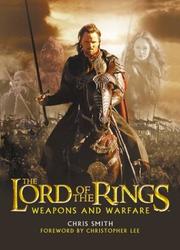
The Lord of the Rings: Weapons and Warfare
2,297-word summary 10 min read 218 pages in the book
- First published
- 2003
- Publisher
- Houghton Mifflin
- Pages
- 218
- ISBN
- 9780618390991
Reading options
What's inside (9 sections)
- A companion built for the space between page and screen
- Blades, mail and the objects people remember
- The battles taken apart, one encounter at a time
- The other side of the field
- A thousand images and the people who made them
- Where the companion loses its footing
- Who should actually read it
- Key takeaways
- FAQ
I picked this book up because I had watched the extended editions of the films more times than I care to admit, and I wanted something that lived in the gap between the movies and the novels. What I found was neither a novel nor a standard guidebook. It is a large, glossy reference volume published in 2003, the year the third film reached cinemas, and it treats Tolkien's war as though someone could file a military report on it. That premise sounds odd when you describe it. In the hand, it works better than it has any right to.
A companion built for the space between page and screen
Chris Smith had spent five years as the Tolkien editor at HarperCollins before he wrote this, and that experience shows in the way he moves between the source text and Peter Jackson's films without getting precious about either one. The cover title is short, but the first edition carries the subtitle An Illustrated Guide to the Battles, Armies and Armor of Middle-earth. That subtitle is a fair description of what is inside. This is an inventory organized around the things people who love the story tend to argue about: who carried which blade, how a particular army was dressed, and what a siege actually looked like when the cameras were rolling.
The timing matters. In 2003 the film trilogy had just finished, and there was a large appetite for anything that could extend the experience a little longer. Smith's answer was a companion that drew on the production material behind the movies rather than on Tolkien's prose alone. Christopher Lee, who played Saruman, wrote the foreword, and Richard Taylor of Weta Workshop contributed an introduction. Those two names tell you where the book's sympathies sit. It is as much about the making of a cinematic war as it is about the war itself, and that double focus is its defining feature.
The result is a book you can read in two very different ways. You can skim it as a picture book, which is how a lot of readers will use it, or you can read the text closely and come away with a genuinely detailed account of how the conflict was staged across both page and screen. It does not demand that you choose between the two versions of the story. That is a small kindness, and it is one of the reasons the book has lasted longer than most film tie-ins from the same year.
Smith's background also explains the book's tone. He had worked with writers as different as Robin Hobb and Stephen King, and he writes with the confidence of someone who has spent years around fantasy authors and their readers. He knows which details this audience cares about, and he knows that a fan will happily accept a page of careful explanation if it is attached to a good picture. The chapters are short and self-contained, which makes the volume easy to dip into. You can open it at any point, spend ten minutes on a single battle or a single suit of armour, and close it again without feeling that you have lost the thread.
Blades, mail and the objects people remember
The opening sections deal with the personal equipment of war, and this is where the book is at its most straightforward. Smith walks through the swords, daggers, bows and armour that define the important characters, pairing a short piece of description with images drawn from the films and from the workshop that built them. Anduril gets the attention you would expect. So do Sting, Narsil and the mithril shirt that Frodo wears beneath his travelling clothes.
What lifts this above a simple catalogue is the willingness to explain why an object matters narratively. The mithril shirt is not interesting because it is light and strong, though it is both. It is interesting because it turns a quiet act of loyalty into a physical fact that a reader can picture. The book keeps making that move, taking a prop and tracing the scene that gave it weight. A blade stops being a blade and becomes the moment a character decides who he is.
The armour section is particularly good on the difference between the peoples of the story. Rohan's riders, Gondor's infantry, the Uruk-hai and the armies of Mordor are each treated as distinct fighting cultures with their own gear and habits. Smith does not invent these distinctions; he pulls them out of descriptions scattered through the novels and then shows how the film designers turned them into something you can see. If you have ever wondered how someone decides what a soldier from Rohan should look like next to a soldier from Gondor, this is the book that answers that question in pictures.
There is a pleasing amount of attention paid to the unglamorous tools of war as well. Siege ladders, battering rams, catapults and the great gate at Minas Tirith all get their due. The book understands that a battle is decided as much by logistics and engineering as by heroic individuals, and it gives those details room. That is a refreshing change from retellings that only want to talk about the famous duels.
Bows and arrows receive the same careful treatment as the swords, which is welcome because archery is easy to overlook in a story dominated by famous blades. The book looks at the different kinds of bows carried by the peoples of the story and at the way archery is used in specific fights, from the opening encounters to the defence of the walls. Even the simple act of equipping an army becomes interesting when it is laid out this clearly, and the matching illustrations make the comparison immediate rather than abstract.
The battles taken apart, one encounter at a time
The largest portion of the book is given over to the major conflicts, and here Smith commits to a method. Each encounter is introduced, then examined through specially commissioned battle plans that show where forces were positioned and how the fighting moved. The text then works through what happened and why it mattered. This is the part of the book that justifies its existence, because the plans give you a view of the action that neither the novels nor the films can provide on their own.
Helm's Deep is the obvious showcase. The book lays out the geometry of the hornburg, the position of the defenders and the way the attacking force pressed the assault, then connects that layout to the choices the characters make under pressure. The Pelennor Fields get similar treatment, with the separate threads of the battle tracked until they converge at the gate. The Black Gate receives less space but is handled with the same care, and the smaller fights at Weathertop and in the Mines of Moria are folded in as examples of a different kind of combat.
Reading these chapters in order is like watching a war documented by someone who has access to both the generals and the film crew. Smith is careful about the difference between what Tolkien wrote and what Jackson put on screen, and he flags the places where the two diverge instead of smoothing them over. That honesty is useful. It stops the book from pretending that the films are a direct transcription of the novels, which is a temptation that many companions of this era could not resist.
The battle plans themselves are the kind of feature that either delights you or leaves you cold. I found them absorbing. They reward the reader who likes to orient himself, who wants to know where Aragorn stood when the wall broke and how the riders arrived when they did. If diagrams are not your thing, you can ignore them and lose very little, because the prose accounts stand on their own. But they are the book's best idea, and they are executed with real clarity.
The other side of the field
One of the smarter choices Smith makes is to give the enemy's war machine the same attention he gives the heroes. The armies of Mordor and Isengard are not treated as a faceless crowd but as forces with their own equipment, their own methods and their own chain of command. The Uruk-hai in particular come across as a deliberately engineered fighting force, and the book connects their design to the broader industrial quality of Saruman's warfare. That framing gives the conflict a texture that a simple good-versus-evil account would miss.
The great siege engines built for the assault on Minas Tirith are handled with real interest. Smith describes the scale of the preparations and the way the attackers meant to break the city, then sets those plans against the defence mounted inside the walls. It is the closest the book comes to pure military history, and it is some of its strongest writing. You can feel the logic of the siege, the way each side tries to answer the other, and the desperate arithmetic of defenders who know they are outnumbered.
This is also where the book's approach proves its worth. By concentrating on material rather than morality, Smith avoids the trap of turning the story into a sermon. The orcs get described the way an arms inspector might describe a threatening arsenal, and the effect is more unsettling than any amount of villainous dialogue would be. The enemy is dangerous because it is organized, not because it is loud.
A thousand images and the people who made them
The illustrations are the other half of the experience, and the publisher's description of roughly a thousand photographs, paintings, maps, sculptures and sketches is not marketing inflation. The book is dense with visual material, and much of it had not been published before this volume appeared. Concept art, costume studies, models and behind-the-scenes photographs sit beside stills from the finished films, which means you can watch an idea travel from a sketch to a finished shot across a few pages.
That is where the Weta connection pays off. Richard Taylor's involvement gives the book access to the workshop's design process, and the images of armour and weapons in various stages of construction are among the most interesting things here. You see a sword as a drawing, then as a prop, then in a character's hand. For anyone with even a passing interest in how a fantasy film is assembled, that sequence is worth the price of admission on its own.
The maps deserve a mention too. These are not the clean, elegant maps of the novels but working documents, full of terrain and movement, designed to explain a battle rather than to decorate a front endpaper. They suit the book's purpose exactly.
Where the companion loses its footing
This is not a flawless book, and the criticisms are not hard to find. The first is structural. Because Smith has organized the material by topic and battle, there is very little narrative momentum. You cannot read it the way you would read a history, following one argument from start to finish. It is a reference work, and it sometimes reads like one, with a rhythm of introduction, plan, explanation and illustration that becomes predictable after a hundred pages.
The second problem is tone. The book was published at the height of the film trilogy's popularity, and a few passages slip into the breathless register of a promotional brochure. The foreword and introduction are effusive, and Smith's own prose occasionally follows them into a kind of uncritical enthusiasm. If you want a cool analysis of the politics of the war, or a skeptical account of how the films changed the story, you will not find it here. This book admires its subject, and it never pretends otherwise.
There is also a question of audience. The uninitiated will struggle. The book assumes you already know who is fighting whom and why a particular name matters. It is not a place to start with Tolkien, and it is not a replacement for reading the novels or watching the films. Readers looking for a first introduction will find themselves surrounded by names and references that carry no weight yet.
Finally, at a little over two hundred pages in the first edition, it is not a short book, but it is not a long one either. The generous illustrations take up a great deal of space, so the actual text is thinner than the page count suggests. Some readers have felt shortchanged by that ratio, especially if they were expecting a dense scholarly study. I think the balance is about right, but it is worth knowing what you are buying.
Who should actually read it
For anyone who loves the films and wants to understand how their battles were imagined and built, this is close to essential. It gives the visual side of the story a seriousness that tie-in books rarely receive, and the battle plans offer a way of seeing the action that is genuinely new. Readers who enjoy military history, costume design or the mechanics of filmmaking will find plenty to keep them turning pages.
For a Tolkien scholar, the book is likely to feel slight. It does not offer new textual readings, and it is more interested in the films than in the novels. But Smith never claims to be writing scholarship. He is writing a companion, and he does that job with real care and an obvious affection for the material. Read it for what it is, a handsome and intelligent guide to a war that never happened, and it delivers exactly what it promises.
FAQ
Is this a novel or a guide to the films?
It is an illustrated nonfiction companion published in 2003, not a novel. It examines the weapons, armies and battles of the films and the source novels with chapter-length analysis and diagrams.
Does it cover Tolkien's books or only the movies?
Both. Smith draws on Tolkien's descriptions and on the production design of Peter Jackson's films, and he points out where the two differ rather than treating them as the same thing.
Do I need to know the story before reading it?
Yes. The book assumes familiarity with the characters and battles, so it works better as a companion after reading the novels or watching the films than as an introduction.
Similar books
The Guns of August
Tuchman narrates the first month of World War I, from a 1910 royal funeral to the Marne, and the decisions that trapped Europe.
2,405-word summary · 11 min read
One Day, Everyone Will Have Always Been Against This
From a viral 2023 post, Omar El Akkad builds a furious short argument about Western promises, silence and complicity during the Gaza war.
2,218-word summary · 10 min read
The Elements of Style
William Strunk Jr.'s tiny 1918 classroom primer, revised and expanded by E. B. White in 1959, became the handbook generations of writers turn to for clearer,…
2,501-word summary · 11 min read
Hiroshima
In 1946 John Hersey followed six ordinary people through the atomic bombing of Hiroshima and its aftermath, using a plain style that made the reporting feel…
2,991-word summary · 13 min read

The Zookeeper's Wife: A War Story
The directors of the Warsaw Zoo hid roughly three hundred Jews in empty cages and outbuildings after the German invasion, while Jan worked for the resistance.
2,065-word summary · 9 min read
Lone Survivor: The Eyewitness Account of Operation Redwing and the Lost Heroes of SEAL Team 10
Marcus Luttrell's account of the 2005 SEAL mission in Afghanistan that killed three of his team and left him alone.
2,144-word summary · 10 min read
Divergent: Official Illustrated Movie Companion
An oversize behind-the-scenes guide to the 2014 Divergent film, with casting stories, costume and set design, and scores of photos.
2,524-word summary · 11 min read

Bury My Heart at Wounded Knee: An Indian History of the American West
Dee Brown's 1970 retelling of the American West from the point of view of the people it destroyed.
2,233-word summary · 10 min read
How to Cook Everything: Simple Recipes for Great Food
Bittman's 1998 doorstop taught a generation that dinner is a technique, not a recipe, with master recipes and variations instead of rigid instructions.
2,027-word summary · 9 min read
Killing Lincoln
Booth plots as Lincoln pushes war end and reunion in 1865.
2,486-word summary · 11 min read
Eats, Shoots & Leaves
Truss defends commas with jokes about pandas and posters.
2,423-word summary · 11 min read
Cleopatra: A Life
Pulitzer winner Schiff restores Cleopatra as a capable ruler, from Ptolemy debts and Caesar to Antony, Actium, and her death in 30 BC, built from coins and…
3,586-word summary · 16 min read
The Splendid and the Vile
Larson follows Churchill circle through Blitz year with diaries and bombing nights.
2,038-word summary · 9 min read
Band of Brothers
Easy Company, 506th Airborne, from Toccoa training through D-Day, Holland, Bastogne, and Hitler's Eagle's Nest.
2,685-word summary · 12 min read
American Sniper: The Autobiography of the Most Lethal Sniper in U.S. Military History
Navy SEAL sniper Chris Kyle recounts Texas roots, SEAL training, four Iraq tours, and the strain combat placed on his marriage and health.
2,011-word summary · 9 min read
Dead Wake
Larson tracks Lusitania, U-20, and Room 40 toward May 1915 sinking.
2,471-word summary · 11 min read
Days of Love and Rage
Six Syrians build a short democracy in Manbij, then watch inequality and ISIS undo it.
2,022-word summary · 9 min read
A Long Way Gone: Memoirs of a Boy Soldier
A Sierra Leone boy flees rebels, becomes a child soldier at thirteen, and fights his way back through rehab.
2,434-word summary · 11 min read
The Hiding Place: The Triumphant True Story of Corrie Ten Boom
The Ten Booms hide Jews in Haarlem, suffer Ravensbruck, lose Betsie, and learn forgiveness.
2,593-word summary · 12 min read
The Story of Art
Gombrich traces art from cave painting to modernism with clear stories and famous images.
2,520-word summary · 11 min read
Unbroken
Louis Zamperini survives a Pacific crash, sharks and POW camps after running in the Berlin Olympics.
3,263-word summary · 15 min read
Zeitoun
A Syrian-American contractor rides out Hurricane Katrina by canoe, rescuing neighbors and stray dogs, until a routine arrest turns into twenty-three days…
2,097-word summary · 9 min read
The True True Story of Raja the Gullible (and His Mother)
A gay philosophy teacher in Beirut revisits six decades of Lebanese history, family trauma, and his thorny bond with his mother.
2,274-word summary · 10 min read
The Teacher of Nomad Land
In 1941 Iran, an orphaned boy straps a chalkboard to his back and sets off to teach nomads, hoping to keep his little sister with him.
2,534-word summary · 11 min read
The Pianist
A Polish pianist endures the Warsaw Ghetto, the Umschlagplatz, and life hidden in the ruins of the 1944 uprising, until a German officer asks him to play.
2,481-word summary · 11 min read
The Long Haul
Greg Heffley's summer road trip goes sideways with a towed boat, a live pig, and a family in a purple van.
2,311-word summary · 10 min read

The Last Bookshop in London
A woman who has never cared for reading takes a job in a dusty London bookshop as the Blitz begins, and finds her place in it.
2,264-word summary · 10 min read
The Innocent Man: Murder and Injustice in a Small Town
Grisham's first nonfiction book tells how Ron Williamson lost eleven years on death row for a murder he did not commit in Ada, Oklahoma.
2,245-word summary · 10 min read
The Hidden Life of Trees
A German forester argues that trees communicate through root networks and that forests thrive when left largely undisturbed.
2,078-word summary · 9 min read
The Gashlycrumb Tinies
Edward Gorey's 1963 alphabet book marches twenty-six children through a series of very bad endings, in thirteen rhyming couplets and a handful of unnervingly…
2,200-word summary · 10 min read