
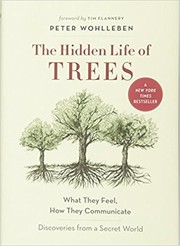
The Hidden Life of Trees
2,078-word summary 9 min read 272 pages in the book
- First published
- 2015
- Publisher
- Greystone Books
- Pages
- 272
- ISBN
- 9781771642484
- Original title
- Das geheime Leben der Bäume
Reading options
What's inside (10 sections)
The walk that changed
I read The Hidden Life of Trees in the middle of a cold February, which may be why it got under my skin. I had been walking the same stretch of woods for years without ever thinking much about what the trees were doing. After this book, the same walk felt different. A stand of beeches stopped looking like a row of organisms competing for light and started looking like a neighborhood with histories and grudges. Whether or not you accept every claim Peter Wohlleben makes, the book changes what you notice. That is its real achievement, and it is also the source of the trouble that followed it.
The book appeared in German in 2015 as Das geheime Leben der Bäume, with the subtitle asking what trees feel and how they communicate. The English translation by Jane Billinghurst came out in 2016 from Greystone Books, and the edition I have runs to two hundred and seventy-two pages. It became a bestseller and set off an argument that is still going in forestry departments. Wohlleben is a German forester who has spent his career managing forests and working with visitors, and he writes from that double perspective. He knows how forests are run, and he has decided that the way we run them is mostly wrong.
The forester who listens
Wohlleben's background matters because he is not an outsider looking for wonder. He trained in forestry and managed land. At some point in that work he became convinced that the standard practices of modern forestry, especially planting single-species plantations and harvesting with heavy machinery, were destroying something that had taken centuries to build. He began writing books that argued for a different relationship with forests, ones that mixed his own experience with popular science.
That mixture is the reason the book reads the way it does. One chapter will describe something he watched happen in a stand of trees he knows well. The next will summarize research from the wider scientific literature. He is not writing a textbook, and he is not pretending to. He is a practitioner making a case, and the case is emotional as much as it is technical. He wants readers to feel that a forest is a community rather than a crop. Once you feel that, the management arguments follow almost on their own.
The tone is calm and often affectionate. Wohlleben writes about trees the way a naturalist might write about a familiar group of animals, giving them intentions and habits and long memories. Some readers find this charming. Some find it infuriating. Both reactions are reasonable, and the book gives plenty of evidence for each.
Trees that talk
The central claim of The Hidden Life of Trees is that trees communicate. Not in words, obviously, and not in any way a person would recognize as conversation, but through chemical signals and through networks of fungi that connect the roots of different trees. Those networks, often called mycorrhizal networks, let trees exchange nutrients and pass information about threats. When insects attack one tree, neighboring trees can begin producing defensive chemicals before the insects reach them. A tree that is struggling can receive sugar from a neighbor that has light to spare.
Wohlleben describes this in terms that make it vivid. The forest floor is not a collection of separate root systems competing in the dark. It is a web, and the web has routes and hubs. Some trees, usually the oldest and largest, act as connectors, linking many others. When those trees are removed, the network loses its structure. His point is that trees are connected in more than an abstract ecological sense. The connection has direction and consequence, and cutting the hub trees out of a forest does damage that a count of remaining trees would never show.
I found these chapters fascinating, and I also found myself wanting more detail than the book provides. Wohlleben writes about the research in a way that smooths over the arguments among scientists about how strong these effects are and how they are measured. He presents the network as an established fact with clear implications. The scientists who study these systems in detail are more cautious, and some of the specific examples he uses are contested. If you read the book as an invitation to look more carefully at forests, it is wonderful. If you read it as a settled account of how trees behave, you are taking it further than its evidence carries.
Mothers, children, and the social life of a forest
The chapters on kinship are where Wohlleben's anthropomorphism does its most persuasive work. He describes mother trees that recognize their own seedlings and direct more resources to them than to unrelated seedlings nearby. He describes trees that shade the ground to protect young growth, and fallen trunks that become nurseries for the next generation. A dead tree, in this account, is not waste. It is a nurse, holding water and nutrients and giving the next generation a place to start.
The idea of a forest as a family is powerful, and it is easy to see why the book connected with so many readers. It turns a walk in the woods into a story with relationships in it. The old tree at the edge of a clearing is more than an old specimen. It is the one the others depend on. A patch of seedlings is not a crop. It is a group of children being looked after. This is the emotional core of the book, and it is also what annoys the scientists who objected to it.
The objection is not that trees are unrelated to each other. Of course they are related, and of course there is competition and exchange. The objection is that words like "mother," "friend," and "care" carry assumptions about intention and feeling that the evidence does not support. A tree that sends sugar toward a seedling may be following a chemical gradient, not making a decision to feed its young. Wohlleben knows this in the back of his mind, but he writes as though the distinction does not matter. For a general reader I think it mostly does not, as long as the metaphor is recognized as a metaphor. The trouble starts when it is taken literally.
Slow time and the question of feeling
One of the most striking ideas in the book is that trees experience time differently. A tree that lives for centuries operates on a scale we can barely imagine. Wohlleben asks what a forest looks like from a perspective where a human lifetime is a brief event. He writes about trees responding to seasons, about the way a stand can seem to sleep at night, and about how damage that happens in an afternoon may shape a tree's growth for decades. The slowness is not presented as a limitation. It is a different way of being alive.
This is also where the book reaches its most controversial claim, which is that trees feel. Wohlleben argues that trees experience something like pain or stress when they are damaged, and that they respond to threats in ways that go beyond simple reflex. He is careful to say that this is not feeling in the human sense. He is not suggesting that trees suffer the way an animal suffers. But he does argue that the boundary between plant and animal responsiveness is less sharp than we usually assume.
I found this part of the book more suggestive than convincing. The evidence for plant responses to damage is real, but the step from a response to a feeling is a big one, and Wohlleben takes it quickly. He is at his best when he describes what can be observed. He is on shakier ground when he tells us what it feels like from the tree's point of view, because nobody can verify that. The book is honest about being an argument rather than a report, but it does blur the line more than it admits.
The case against how we manage forests
Wohlleben's ethic is practical and blunt. Forests should be left as undisturbed by humans as possible. Monoculture plantations, where a single species is planted in rows and harvested on a schedule, are bad for the soil, bad for the network of roots and fungi, and bad for the animals that live there. Heavy machinery compacts the ground and tears up the systems that hold the forest together. Clear cutting removes the hub trees and the shelter that the rest of the stand depends on.
His alternative is to manage, if you must manage at all, by imitating the forest rather than replacing it. That means keeping mixed species, retaining old trees and dead wood, and letting natural processes do more of the work. Wohlleben does not argue that humans should never set foot in a forest again. He manages land himself. His argument is that we have confused growing timber with growing a forest, and that the two are not the same project.
These chapters are the most useful part of the book for anyone who owns land or makes decisions about it. They are concrete in a way the more speculative chapters are not. The criticism of plantations is grounded in what anyone can see walking through one. A plantation is quiet in a way a healthy forest is not. The point does not need a scientific paper to make sense, though the book supplies plenty of research to back it up.
The argument that followed
The Hidden Life of Trees was a huge popular success and a lightning rod among scientists. Forestry researchers criticized the book for using real research to support an ethic and a spiritual program that the research did not establish. In 2017, two German scientists started an online petition asking their colleagues to challenge Wohlleben publicly. Its title, roughly translated, was "Even in the forest: facts instead of fairy tales, science instead of Wohlleben." Sharon Kingsland, writing in the Bulletin of the Ecological Society of America in 2018, examined the dispute and the broader questions it raised about how science is communicated to the public.
I think both sides have a point. The scientists are right that a bestseller which presents contested ideas as settled makes their work harder, and that anthropomorphism can mislead people about what forests actually need. Wohlleben is right that the technical literature often fails to give people a reason to care, and that a book which makes readers love a forest may do more practical good than a careful paper nobody outside the field reads. The argument is not going to be settled by one book or one petition. It is an argument about who gets to speak for science and how much simplification is acceptable when the goal is to change behavior.
The book also spawned sequels, The Inner Life of Animals in 2016 and The Secret Network of Nature in 2017, which together with this one form a trilogy about the natural world. There have been adaptations too, including a documentary film and a French comic version. That reach is part of what made the scientific criticism so sharp. This is not a small book that a few people read. It is shaping how a lot of people think about forests.
What I took away
I finished The Hidden Life of Trees more attentive and more skeptical than I started. I am more attentive because Wohlleben taught me to look at a stand of trees as a system with a history, to notice the old trees and the dead wood and the gaps where light gets in. I am more skeptical because I now know how much of what sounds like fact in popular science depends on which studies an author chooses and how firmly they are willing to state them.
The book is worth reading for the way it changes your attention, and it should be read with the arguments about it in mind. Take the ecological lessons seriously. Take the claims about what trees feel as speculation that happens to be beautifully told. The forest does not need us to believe it is a family in order to be worth protecting, but it helps if we can see that it is more than a crop. Wohlleben's great service is making that hard to forget.
FAQ
When was The Hidden Life of Trees published?
It first appeared in German in 2015 as Das geheime Leben der Bäume. Jane Billinghurst's English translation was published by Greystone Books in 2016.
Do trees really communicate?
The book describes chemical signals and fungal root networks that can pass nutrients and warnings between trees. Some of Wohlleben's stronger claims remain debated by scientists.
Why was the book criticized?
Forestry scientists said Wohlleben used real research to support an ethic the evidence did not establish. A 2017 German petition called for more scientists to challenge him publicly.
Similar books
Braiding Sweetgrass
A Potawatomi botanist braids plant science with family stories to argue for gratitude and return gifts to the living world.
2,410-word summary · 11 min read

Animal, Vegetable, Miracle: A Year of Food Life
A family eats only local for a year from their Virginia farm.
2,270-word summary · 10 min read
On the Origin of Species
Darwin's 1859 case for evolution by natural selection, from Beagle finches and breeding pigeons to fossils and anatomy.
2,589-word summary · 12 min read
The Anthropocene Reviewed: Essays on a Human-Centered Planet
John Green reviews ordinary parts of human life on a five-star scale, turning geese, keyboards, and sunsets into a warm memoir about attention.
2,982-word summary · 13 min read
The Omnivore's Dilemma
Four meals traced from corn fields to foraging show what industrial food costs and what else is possible.
1,918-word summary · 9 min read
North Sun, or, the Voyage of the Whaleship Esther
In 1878 New Bedford, a worn-out captain is sent north after a whaleship and the son-in-law of a powerful whaling family who chose to stay in Alaska.
2,314-word summary · 10 min read
How to Change Your Mind
Pollan blends the history of psychedelic research, his own guided trips, and current neuroscience to ask what these drugs reveal about consciousness.
2,466-word summary · 11 min read
Eating Animals
A new father's question about what to feed his son becomes a wide-ranging investigation of factory farming, food labels, and the stories we tell about meat.
2,100-word summary · 9 min read
Brief Answers to the Big Questions
A short posthumous collection in which Hawking answers ten big questions about God, the universe, time, and humanity's future.
2,464-word summary · 11 min read
Migrations
A woman released on parole travels to Greenland to follow the last Arctic terns on a final migration toward Antarctica.
2,296-word summary · 10 min read
Everything Is Tuberculosis
John Green tells the story of a boy with tuberculosis in Sierra Leone and argues that a disease curable since the 1950s still kills a million people a year…
2,015-word summary · 9 min read
Abundance
Two journalists argue that rules written to fix the abuses of the 1970s now block the housing, energy and clean construction the 2020s need, and propose a…
2,306-word summary · 10 min read
The Body: A Guide for Occupants
Bill Bryson tours the human body from atoms to aches, mixing wonder at how we work with a sharp account of how our lives cut that short.
2,249-word summary · 10 min read

1491: New Revelations of the Americas Before Columbus
Charles C. Mann gathers archaeology, ecology, and demography to argue that the Americas before Columbus were older, fuller, and more deliberately shaped than…
2,712-word summary · 12 min read
Moonwalking with Einstein: The Art and Science of Remembering Everything
A journalist spends a year training for the U.S. Memory Championship and discovers that extraordinary memory is mostly technique, attention, and a lot of…
2,027-word summary · 9 min read
Once There Were Wolves
A biologist reintroduces fourteen wolves to the Scottish Highlands while protecting her traumatized twin sister, then finds a body in the snow that could…
2,682-word summary · 12 min read
Breath: The New Science of a Lost Art
Journalist James Nestor investigates how modern humans learned to breathe badly, and what researchers, athletes, and breathwork practitioners have found about…
2,011-word summary · 9 min read

The Elegant Universe: Superstrings, Hidden Dimensions, and the Quest for the Ultimate Theory
Brian Greene explains relativity, quantum mechanics, and the promise of string theory without requiring a physics degree.
2,110-word summary · 9 min read
Flight Behavior
Dellarobia Turnbow is stuck in a Tennessee farm marriage until a valley full of monarch butterflies, and the scientist who comes to study them, force her to…
2,051-word summary · 9 min read

Attached
A psychiatrist and a psychologist explain adult attachment styles and show how anxious, avoidant, and secure patterns shape dating, conflict, and the search…
2,157-word summary · 10 min read

The Emperor of All Maladies
A biography of cancer from Galen to chemo through one doctor cases.
2,255-word summary · 10 min read
Hidden Figures
Black women computers at Langley launch rockets past Jim Crow.
2,385-word summary · 11 min read
God Is Not Great
Hitchens argues religion poisons life across history and texts.
2,545-word summary · 11 min read
The Hot Zone
Ebola and Marburg move from African outbreaks to a Virginia monkey house and an Army response in suits.
2,291-word summary · 10 min read
In Defense of Food
Pollan argues we stopped eating food and started eating nutrients, and offers a plain way back.
2,320-word summary · 10 min read
Predictably Irrational
Behavioral economist Dan Ariely shows why we overpay, procrastinate, and misjudge through simple experiments.
2,183-word summary · 10 min read
Invisible Women: Data Bias in a World Designed for Men
Data treating men as default harms women in medicine, work, transit, and design, with fixes from studies worldwide.
2,316-word summary · 10 min read
Emotional Intelligence
Goleman argues self awareness and empathy shape success more than IQ alone.
2,026-word summary · 9 min read
A Beautiful Mind
Mathematician John Nash's brilliant game theory rise, schizophrenia collapse, and Nobel return, with wife Alicia's care.
2,142-word summary · 10 min read
Cosmos
Sagan tours galaxies, evolution, and Alexandria to argue for science.
2,416-word summary · 11 min read