
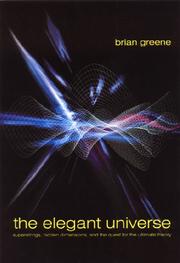
The Elegant Universe: Superstrings, Hidden Dimensions, and the Quest for the Ultimate Theory
2,110-word summary 9 min read 448 pages in the book
- First published
- 1999
- Publisher
- W. W. Norton
- Pages
- 448
- ISBN
- 9780393046885
Reading options
What's inside (11 sections)
I read The Elegant Universe the summer after my first physics course, which was a mistake and also the best possible timing. The course had given me equations. The book gave me pictures. Brian Greene is a theoretical physicist, and he writes like someone who remembers what it felt like not to understand. He uses violins, garden hoses, ants, and elevators to explain ideas that usually arrive as walls of calculus. By the end, I did not understand string theory. I understood why anyone would spend a life on it.
Greene published the book in 1999 through W. W. Norton. The hardcover runs 448 pages. A revised edition appeared in 2003 with a new preface, and the book was adapted into a three-part NOVA documentary. It was a finalist for the Pulitzer Prize and won the Royal Society Prize for Science Books. Those awards are a clue to what the book does well. It is not just a summary of physics. It is an argument about why the search for a unified theory matters.
Two pillars
The book begins with a problem. Modern physics rests on two theories that have both been tested to extraordinary precision. General relativity describes gravity and the large-scale structure of the universe. Quantum mechanics describes the behavior of matter and energy at the smallest scales. Both work. Both cannot be the final answer, because they contradict each other in the places where they meet.
Greene spends the first third of the book explaining those two theories. He starts with special relativity, which grew out of Einstein's attempt to reconcile the laws of electromagnetism with the principle that physics should look the same to all observers moving at constant speed. The consequence is that space and time are not separate. They are a single flexible fabric. Moving clocks run slow. Moving rulers contract. The speed of light is the same for everyone.
Then he moves to general relativity, which turns gravity into geometry. Mass and energy curve spacetime, and objects follow the curves. The image of a bowling ball on a trampoline is familiar, and Greene uses it carefully. He also uses Einstein's elevator, a thought experiment about a person in a closed room who cannot tell whether the room is accelerating or sitting in a gravitational field. The equivalence principle is the seed of the whole theory.
The quantum
The quantum section is where the book becomes strange. Greene starts with Planck's idea that energy is emitted in discrete packets, then moves to Einstein's explanation of the photoelectric effect, then to the double-slit experiment. Light behaves like a wave and like a particle. Electrons do too. The act of measurement changes what is measured. Heisenberg's uncertainty principle says that certain pairs of properties cannot both be known precisely.
Greene is good at explaining why this is not just a philosophical puzzle. The uncertainty principle is a quantitative rule. It sets limits on how tightly an electron can be confined, and those limits determine the structure of atoms. Quantum mechanics is the reason atoms do not collapse. It is also the reason they emit light at specific frequencies. The theory is weird, but it is not vague.
The book's best quantum chapter is the one on the conflict between general relativity and quantum mechanics. The conflict is not a matter of taste. When physicists try to calculate the gravitational field of a quantum particle, the math produces infinities. The infinities can be tamed for the other forces, but not for gravity. The problem is that gravity is described by the geometry of spacetime, and quantum mechanics says that spacetime itself is subject to uncertainty at very small scales. The two theories cannot both be right in their current forms.
Greene also explains why the conflict is so hard to test. The scale at which quantum gravity matters is the Planck scale, a distance so small that no particle accelerator can reach it. The energies required are astronomical. This is not a temporary technical problem. It is a feature of the universe. The theory of everything, if it exists, describes a regime that is almost impossible to probe directly.
The chapter on experimental signatures is more hopeful. Greene discusses ways in which string theory might leave traces: supersymmetric particles at colliders, extra dimensions that modify gravity at short distances, cosmic strings, and gravitational waves. Some of these ideas have been tested. Others remain out of reach. The book is honest that the theory's predictions are not yet sharp enough to be decisive. That honesty is one of its virtues.
Strings
String theory is Greene's answer. The idea is simple to state and hard to believe. The fundamental constituents of matter are not point particles. They are tiny loops or strands of energy. Different vibrations of the same string produce different particles. An electron is one vibration. A photon is another. A graviton, the hypothetical quantum of gravity, is another. The theory gives a natural home to gravity because the graviton appears in the spectrum of string vibrations.
Greene uses the image of a violin string throughout the book. A violin string can produce many notes, but the notes are determined by the string's tension, length, and vibration. The universe is a kind of instrument. The particles are the notes. The laws of physics are the score.
The theory also requires supersymmetry, a symmetry between matter particles and force particles. Supersymmetry predicts a partner for every known particle. None of those partners has been observed, which is one of the reasons string theory is still unconfirmed. Greene is honest about this. He presents supersymmetry as a beautiful idea that might be true, not as a settled fact.
Extra dimensions
The book's most memorable chapters are about extra dimensions. The idea goes back to Kaluza and Klein, who tried to unify gravity and electromagnetism by adding a fifth dimension. The fifth dimension is curled up so small that we do not notice it. Greene uses the image of a garden hose. From far away, a hose looks like a line. Up close, it has a circular dimension. The extra dimensions of string theory are like that, but there are more of them, and they are curled into complicated shapes called Calabi-Yau spaces.
The shape of the extra dimensions determines the properties of the particles we observe. Different shapes produce different masses and different forces. This is one of the theory's strengths and one of its weaknesses. It can produce many possible universes. It does not obviously single out ours.
Greene also introduces M-theory, a conjectured eleven-dimensional framework that unifies the five versions of string theory. M-theory is not a complete theory. It is a network of dualities, a set of mathematical translations between different descriptions of the same physics. Greene presents it as a clue that the different string theories are approximations of something deeper.
The chapter on "tearing the fabric of space" is where Greene becomes a character in his own story. He describes his work on flop transitions, a process in which the shape of the extra dimensions changes in a way that looks like space is tearing and repairing itself. The mathematics is technical, but the image is striking. Space is not a fixed stage. It can change its topology. The laws of physics survive the change.
Black holes and cosmology
The later chapters apply string theory to black holes and the early universe. Greene explains Bekenstein and Hawking's work on black hole entropy. A black hole has a temperature and emits radiation. The laws of thermodynamics apply to it. String theory offers a way to count the microscopic states that produce that entropy, at least in certain cases. The calculation is one of the theory's few concrete successes.
The cosmology chapters are more speculative. Greene discusses the Big Bang, inflation, and the possibility that string theory can explain what happened before the singularity. He is careful to label speculation as speculation. The book is not a promise that string theory will answer every question. It is a tour of the questions that make the theory worth pursuing.
The prose
Greene is a good writer. He has a gift for the well-placed analogy, and he knows when to stop explaining and let the reader sit with an idea. The book is long, but it is not dense. The chapters are short, and each one has a clear question. The mathematical appendix is there for readers who want it, but the main text does not require calculus.
The book is also generous. Greene credits the physicists who did the work. He tells the story of the field as a series of arguments, mistakes, and lucky guesses. He does not pretend that science is a straight line from ignorance to truth. He shows how ideas are abandoned and revived, and how personal rivalries shape which theories get attention.
Where it creaks
The obvious problem is that the book is old. It was published in 1999, and the field has changed. The Large Hadron Collider did not find supersymmetric particles. The landscape problem has become more pressing. Some physicists have argued that string theory has not delivered on its promises. Others have continued to work on it. The book does not anticipate those debates, because it was written before they became central.
The book is also more confident than the evidence warrants. Greene presents string theory as the most promising path to unification, which was a reasonable view in 1999. A reader in the present should treat that confidence as historical. The theory is still unconfirmed. Its critics are not cranks. The book would be stronger if it gave more space to the possibility that string theory is wrong.
Some of the analogies are stretched. The violin metaphor is useful, but it can make the theory seem simpler than it is. The extra-dimensional imagery is vivid, but it can leave readers with the impression that the dimensions are just tiny places you could visit if you had a small enough spaceship. They are not. They are part of the mathematical structure of the theory.
The book also predates the landscape debate. In the years since publication, physicists have found that string theory appears to have an enormous number of possible vacuum states, perhaps 10^500 or more. Each state corresponds to a different set of physical laws. Critics argue that this makes the theory untestable, because it can accommodate almost any observation. Supporters argue that the landscape is a feature, not a bug, and that selection effects or quantum cosmology might pick out our universe. Greene has written about this elsewhere, but The Elegant Universe does not anticipate the argument. A reader who wants the full picture should pair it with later books and critiques.
Why read it now
The Elegant Universe is still the best popular introduction to string theory that I know. It explains the problem, the history, and the ideas with clarity and enthusiasm. It does not replace a textbook, and it does not settle the debate. It gives you a map of the territory.
The book also captures a moment in the history of physics. The 1990s were a time of great optimism about string theory. The theory had produced surprising connections between apparently different ideas. It seemed to be converging on something. That optimism did not last. Reading the book now is a lesson in how scientific confidence works and how it can be undone by experiment.
I recommend it to anyone who wants to understand why physicists talk about extra dimensions, vibrating strings, and a theory of everything. I also recommend it to anyone who wants to understand the limits of popular science. Greene is honest about what we do not know, but he is also an advocate. The reader should bring both curiosity and skepticism.
What stays with me
What stays with me is the image of the universe as a kind of music. It is an old idea, older than string theory, but Greene gives it a modern form. The particles are notes. The laws are harmonics. The extra dimensions are the shape of the instrument. It is a beautiful picture, and beauty is one of the reasons physicists keep working on the theory.
Beauty is not proof. The history of physics is full of beautiful ideas that turned out to be wrong. The Elegant Universe is a record of that tension. It is a book about a theory that might be the final answer, and might not be. That uncertainty is what makes it worth reading.
FAQ
Is The Elegant Universe for beginners?
Yes, it assumes no calculus and explains the ideas through analogies, though some chapters are demanding.
Does it prove string theory?
No. It presents string theory as the most promising path to unification, not as a confirmed theory.
Is the book outdated?
It predates the Large Hadron Collider and later debates about the landscape, so pair it with newer sources.
Similar books
Astrophysics for People in a Hurry
Tyson condenses the Big Bang, dark matter, and exoplanets into twelve short chapters for busy readers.
2,314-word summary · 10 min read
A Brief History of Time
Hawking walks from ancient spheres to big bang, black holes, and time arrows without equations.
2,210-word summary · 10 min read
Cosmos
Sagan tours galaxies, evolution, and Alexandria to argue for science.
2,416-word summary · 11 min read
What If?: Serious Scientific Answers to Absurd Hypothetical Questions
Randall Munroe of xkcd answers absurd science questions with real physics, rough math and stick figures, from relativistic baseball to draining the oceans.…
2,932-word summary · 13 min read
Einstein: His Life and Universe
Isaacson traces Einstein from patent clerk to world fame using newly opened papers, through 1905, relativity, exile, and the long unified theory search.
2,773-word summary · 12 min read
Surely You're Joking, Mr. Feynman!
Feynman drums, cracks safes, and learns by doing from Los Alamos to Caltech classrooms.
1,946-word summary · 9 min read

Moonwalking with Einstein: The Art and Science of Remembering Everything
A journalist spends a year training for the U.S. Memory Championship and discovers that extraordinary memory is mostly technique, attention, and a lot of…
2,027-word summary · 9 min read
The Wright Brothers
David McCullough tells the story of two self-taught Ohio brothers, working largely alone and out of a bicycle shop, who solved the problem of flight before…
2,027-word summary · 9 min read
Breath: The New Science of a Lost Art
Journalist James Nestor investigates how modern humans learned to breathe badly, and what researchers, athletes, and breathwork practitioners have found about…
2,011-word summary · 9 min read

Attached
A psychiatrist and a psychologist explain adult attachment styles and show how anxious, avoidant, and secure patterns shape dating, conflict, and the search…
2,157-word summary · 10 min read
The World Is Flat: A Brief History of the Twenty-first Century
Thomas L. Friedman's 2005 bestseller argues that technology, trade, and open borders leveled the global playing field, and it names the ten forces that did it.
2,369-word summary · 11 min read

The Emperor of All Maladies
A biography of cancer from Galen to chemo through one doctor cases.
2,255-word summary · 10 min read
Hidden Figures
Black women computers at Langley launch rockets past Jim Crow.
2,385-word summary · 11 min read
God Is Not Great
Hitchens argues religion poisons life across history and texts.
2,545-word summary · 11 min read
The Hot Zone
Ebola and Marburg move from African outbreaks to a Virginia monkey house and an Army response in suits.
2,291-word summary · 10 min read
On the Origin of Species
Darwin's 1859 case for evolution by natural selection, from Beagle finches and breeding pigeons to fossils and anatomy.
2,589-word summary · 12 min read
In Defense of Food
Pollan argues we stopped eating food and started eating nutrients, and offers a plain way back.
2,320-word summary · 10 min read
Predictably Irrational
Behavioral economist Dan Ariely shows why we overpay, procrastinate, and misjudge through simple experiments.
2,183-word summary · 10 min read
Invisible Women: Data Bias in a World Designed for Men
Data treating men as default harms women in medicine, work, transit, and design, with fixes from studies worldwide.
2,316-word summary · 10 min read
Emotional Intelligence
Goleman argues self awareness and empathy shape success more than IQ alone.
2,026-word summary · 9 min read
A Beautiful Mind
Mathematician John Nash's brilliant game theory rise, schizophrenia collapse, and Nobel return, with wife Alicia's care.
2,142-word summary · 10 min read
The Anthropocene Reviewed: Essays on a Human-Centered Planet
John Green reviews ordinary parts of human life on a five-star scale, turning geese, keyboards, and sunsets into a warm memoir about attention.
2,982-word summary · 13 min read
Braiding Sweetgrass
A Potawatomi botanist braids plant science with family stories to argue for gratitude and return gifts to the living world.
2,410-word summary · 11 min read
A World Appears
Pollan traces consciousness from plant sentience to AI feeling and the self, with gardens, labs, trips and hard questions along the way.
3,108-word summary · 14 min read
21 Lessons for the 21st Century
Twenty one essays on work, liberty, truth, and meaning when algorithms flood the world with noise.
2,101-word summary · 9 min read
The Selfish Gene
Dawkins argues genes are the units of selection, recasting kinship, conflict and altruism through replicators, game theory and memes.
2,439-word summary · 11 min read
Why We Sleep: Unlocking the Power of Sleep and Dreams
A Berkeley sleep scientist explains how sleep shapes memory, mood, and health, and what happens when we miss it.
2,755-word summary · 12 min read

Modern Romance
A comedian and a sociologist combine interviews, focus groups, and Reddit stories to explain why dating feels harder now.
2,322-word summary · 10 min read
Factfulness
A doctor shows why we misread global trends and offers ten habits for seeing progress clearly.
2,247-word summary · 10 min read
The Omnivore's Dilemma
Four meals traced from corn fields to foraging show what industrial food costs and what else is possible.
1,918-word summary · 9 min read