
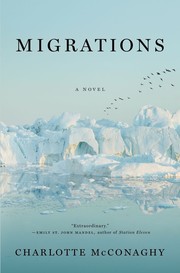
Migrations
2,296-word summary 10 min read 272 pages in the book
- First published
- 2020
- Publisher
- Flatiron Books
- Pages
- 272
- ISBN
- 9781250204011
Reading options
What's inside (6 sections)
The first line of this novel is a small, cold sentence that stayed with me long after I finished: "The animals are dying. Soon we will be alone here." I read Migrations over two days in a single hungry stretch, and that line is the key to almost everything that follows. It is 2020 book, published by Flatiron Books, and in Britain it came out under a different title, The Last Migration. The story is set in a near future where the natural world has thinned almost to nothing. But the book is not really a warning about the future. It is a novel about grief, about a woman who cannot stay anywhere, and about the possibility that following a bird across an ocean might count as a kind of prayer.
Franny Stone is a researcher, and the publisher's description of her is the best short summary I have found: she is the kind of woman who is able to love but unable to stay. She turns up in Greenland with her research gear and one purpose. She wants to tag the last Arctic terns in the world and follow them on what may be their final migration south to Antarctica. The opening chapters are told in a voice that keeps starting sentences with the word "Once," as if Franny is trying to talk herself into a story that will make her actions reasonable. Once, her husband found a colony of storm petrels on the Atlantic coast. Once, when the animals were going, really and truly going, she decided to follow a bird over an ocean. The repetition gives the book a fable-like weight, and it also tells you that Franny is not being straightforward with herself. She has reasons, and then she has other reasons underneath them.
A woman with a net and a plan
The book drops you straight into the cold. Franny is out on the ice by herself, setting basket traps over the nesting terns to fit tiny tracking devices onto their legs. She has been out six days. Her tent blew into the sea the night before. Birds have pecked her skull and hands more than a dozen times, and she has three banded terns to show for it. The scene where she catches one of them is the most vivid thing in the opening chapter. She feels the bird's heart beating inside her palm, fast and fragile, and notices its red beak and black cap and forked tail. She apologizes to the bird as she works, and she is honest about what she is doing: branding it, pressing her human self upon it. This is a woman who does not sentimentalize her own tenderness. She can be brutal and gentle in the same paragraph, and McConaghy never smooths that over.
From the nesting grounds Franny drives to Tasiilaq to find a boat. She has already asked seven captains and been refused seven times. Sailors do not like untrained strangers on board, and they especially do not like their routines disrupted now that their way of life is under threat. The boat she fixes on is the Saghani, an Inuit word for raven. Its captain is Ennis Malone, born in Alaska forty-nine years ago, married to Saoirse, with two young children. His vessel is one of the last legally certified to fish for Atlantic herring, and he carries a crew of seven. There is a lovely passage where Franny sits in a hotel room with ugly yellow carpet and a view of the fjord, hunting through a folder of facts about him on her laptop, trying to work out how to approach him. She asks the receptionist where the best pub is, gets a suggestion and a giggle, and feels ancient.
At the harbor bar, with a dozen snoozing dogs tied to the pipes outside and an old man in a T-shirt leaning against the wall, she finds Ennis. She talks her way onto the boat. It is one of the more satisfying small victories in the book, mostly because McConaghy makes you feel how much is at stake for Franny. If this captain says no, the whole plan collapses, and the plan is the only thing holding her together.
Life on the Saghani
Once at sea, the novel changes rhythm. Franny learns knots and the other necessities of fishing, and she discovers that hard work quietens the noise in her head. She can sleep when she is working. The sea sections are the ones that reviewers praised most, and I think they are right. There is a physical intelligence to these pages, a sense of what it is like to be cold and tired and useful on a boat. McConaghy is good on the small talk and the silences of a working crew, and the bond that forms between Franny and the men feels earned rather than arranged. They are suspicious of her at first, then amused, then protective. Hillary Kelly, writing in the Los Angeles Times, called this the novel's strongest and most vibrant thread, and I would not argue with her.
The calm does not last. A storm blows up, a cable strikes one of the crewmen, and his heart stops. A defibrillator brings him back, but he needs proper care, and he is from Newfoundland, so Ennis changes course to get him to a hospital. This is the moment the book starts to tighten like a screw. They go ashore, and Franny notices a man watching her strangely. Authorities have prohibited fishing because the oceans are running out of fish, and the crew's livelihood has become a crime. When Franny leaves a bar that night, the man who was staring at her pulls her into a dark street. He blames her and her crew for what they are doing to the seas, and he tries to rape her. She kicks him, loosens his grip, pulls a knife from her shoe, and stabs him in the neck. Ennis arrives and drags her away, and the whole boat flees the port.
I want to note how fast this happens, and how little the book lingers on it. McConaghy keeps the pace high through the middle chapters, and the effect is that you read on with your stomach clenched. The violence is not there to shock. It is there to force Franny and the crew past the point of no return, and to make the sea the only place where she can be safe. After that, the boat starts to come apart. The autopilot fails, the navigation goes, the water pumps give out, and the computer holding her tracking data dies. They cannot stop anywhere because of the new rules, and when they finally have to, the police are waiting and searching for Franny. The crew lies for her. She and Ennis jump into the water and swim for shore, and from there they steal a yacht and keep going south.
What happened to Niall
The novel does not tell its backstory in a straight line. It arrives in pieces, in the fractured chapters that reviewers singled out for praise. The central fact is this. Four years earlier, Franny was in a car crash. She has said she wanted to destroy herself, but she did not manage it. Instead she killed her husband Niall and an innocent woman, and then she confessed to murder. She served time and was released on parole twelve months ago, on the promise that she would stay in Ireland. The crash is the wound under all the travel. She is not running toward the terns so much as running from what she did, and the religion of the book, if it has one, is that you cannot outrun a dead husband.
Her husband's mother showed her Niall's grave, and from that Franny learned how he had wanted to be laid to rest. His ashes were to be scattered with the Arctic terns. That is the origin of the whole voyage: a wife who killed her husband fulfilling the last instruction his mother could give her. The Washington Post called the book a story about grief, an intimate tale of anguish set against the incalculable bereavements of climate change, and that seems exactly right. Franny's guilt and the world's loss are the same shape at different scales. She is a person who cannot stop destroying what she loves, living in a world that is doing the same thing on a grander scale. Michael Christie, reviewing the book for the New York Times, described it as a story about our mingling sorrows, both personal and global, and the survivor's guilt left in their wake. That is the cleanest account of its design I have read.
The book was McConaghy's first adult novel. She had written young adult fiction before and felt stuck, and a trip to Iceland, where she watched ice fall from the glaciers, shook her out of it. She wrote for two and a half years without stopping. In interviews she said she wanted to move from despair and apathy into a place of hope, love and action. That ambition shows in the ending, which tries deliberately to give the reader somewhere to stand.
The structure deserves a word of its own. The chapters are short, and the timeline keeps folding back on itself, so that a detail you skimmed early on returns later with a weight you did not expect. Some readers find this frustrating, but I thought it mimicked the way Franny's mind works, circling the same event because it cannot look at it directly. The New York Times review called the book a clever reimagining of Moby-Dick, and although that comparison initially struck me as a stretch, it holds up. There is the obsessive chase, the small crew on a boat, the captain with a private grievance, and a natural force that refuses to be reduced to a symbol. Franny is no Ahab exactly, but she has that same dangerous clarity of purpose, the sense of a person who has decided that one thing matters more than anyone else's comfort. The sea gives McConaghy room to be both a nature writer and a novelist of obsession, and she uses it.
The ice and the terns
Franny and Ennis take the stolen yacht as far as it will go, and then they walk. Antarctica is not the end of the book so much as the place where the book stops pretending to be a thriller. On the third day of walking, they come upon hundreds of terns covering the ice in front of them. It is the payoff the whole journey has been pointing toward, and McConaghy does not over-explain it. Ennis turns and starts walking back to the boat so that Franny can be alone. She scatters Niall's ashes as he wanted, and then she slides into the cold water with the intention of dying there. In the water she hears her husband's voice in her head and changes her mind. She decides that she will show him that some endangered animals can be saved, that it is not over. A helicopter finds her and pulls her out.
The last chapter jumps six years forward. Franny is released from prison a second time and drives to Scotland with her father. That is where the book leaves her, still moving. I have mixed feelings about this stretch of the novel. Fiona Wright, writing in the Guardian, admired the brooding, otherworldly atmosphere but thought that it begins to feel laboured and mannered as the book goes on, and that the neatness of the ending sits awkwardly with the ambiguity of everything before it. I share that unease. The march across the ice toward a wall of terns is close to being too perfect an image, and the rescue by helicopter arrives with a tidiness the rest of the novel has not earned. There is also a romantic element that some readers found predictable, though here it is handled so lightly that it barely registers beside the larger story.
And yet I forgave it. The reason I forgave it is that McConaghy's treatment of extinction is not abstract. The book is full of specific creatures, storm petrels and terns and herring and the pollinators that governments in this world have decided are worth saving while letting others go. The grief of losing them is described with the same attention as Franny's grief for Niall, and that is what makes the ending work as well as it does. The title works on two levels. It names the migration of the birds and the migration of a woman who cannot stay anywhere, and the book keeps both in view. The publisher called it an ode to a disappearing world and a page-turner about the possibility of hope against all odds. Both descriptions fit. It was longlisted for the Dublin Literary Award and made Amazon's best books of 2020, and it is easy to see why a novel this muscular and this sad would travel.
What I keep coming back to is the tern with the tracker on its leg, the one Franny holds until its heart stops her with its tiny beating. That scene has more of the book in it than any of the big confrontations. It is about the wish to follow something and the guilt of interfering with it, about love and brandings and the terrible smallness of a human hand around a wild thing. McConaghy understands that wanting to save something and wanting to possess it can look identical from the inside. Franny spends the whole novel trying to tell the difference, and the book is generous enough to let her keep trying.
FAQ
Is Migrations part of a series?
No. It is a standalone novel, and McConaghy's later book Wild Dark Shore tells a different story set in a different place.
Why is the book called The Last Migration in Britain?
Chatto & Windus published it under that title in the UK. The American edition from Flatiron Books uses the title Migrations.
What inspired the novel?
A trip to Iceland, where McConaghy watched ice fall from glaciers, pushed her to write her first adult book after years of young adult fiction.
Similar books
Wild Dark Shore
On a remote island between Tasmania and Antarctica, a family guards a vast seed bank until a storm washes a stranger ashore and the radios go dead.
2,449-word summary · 11 min read
Once There Were Wolves
A biologist reintroduces fourteen wolves to the Scottish Highlands while protecting her traumatized twin sister, then finds a body in the snow that could…
2,682-word summary · 12 min read
North Sun, or, the Voyage of the Whaleship Esther
In 1878 New Bedford, a worn-out captain is sent north after a whaleship and the son-in-law of a powerful whaling family who chose to stay in Alaska.
2,314-word summary · 10 min read
My Side of the Mountain
Sam Gribley leaves a crowded New York apartment for the Catskills, builds a home in a tree and trains a falcon to help him survive.
2,242-word summary · 10 min read

The Beach
A young backpacker follows a dead man's map to a hidden island community, then discovers what the people there are willing to do to keep it secret.
2,067-word summary · 9 min read
The Overstory
Nine strangers shaped by trees collide in the Pacific Northwest timber wars in Powers's 2018 Pulitzer winner.
3,289-word summary · 15 min read

White Fang
A wild wolfdog grows through hunger and cruelty toward a hard earned trust in one patient man.
2,540-word summary · 11 min read
Dear Edward
Twelve-year-old Edward Adler survives a plane crash that kills his family, then learns how to live with grief, letters, and love.
2,903-word summary · 13 min read

The Call of the Wild
Stolen pet Buck learns club and fang on the Klondike trail from Perrault to Thornton and the wolves.
2,489-word summary · 11 min read
Life of Pi
Life of Pi retold: Pondicherry zoo, ship loss, Pi and Richard Parker in a boat, two stories.
1,936-word summary · 9 min read
The Hidden Life of Trees
A German forester argues that trees communicate through root networks and that forests thrive when left largely undisturbed.
2,078-word summary · 9 min read

The 100
Three centuries after a nuclear war, a hundred teenage prisoners are sent from a failing space colony to test whether Earth is livable again.
2,152-word summary · 10 min read
Our Souls at Night
A widow asks her widower neighbor to lie beside her at night, not for sex but for company, and two lonely people in a small Colorado town begin again.
2,582-word summary · 11 min read
Only Son
A brief, funny, melancholy debut about a boy whose father dies in 1982 Florida, and the man he becomes, still trying to read the mystery of that loss.
2,170-word summary · 10 min read

One Boat
A woman returns to a Greek coastal town after her father's death, and the holiday she took nine years earlier after her mother's death keeps breaking through.
2,143-word summary · 10 min read

MaddAddam
Toby and Ren rebuild a camp after the plague while Zeb reveals the past and the Crakers invent a religion around Oryx and Crake.
2,201-word summary · 10 min read

Love Forms
A Trinidadian mother sent away at sixteen returns to the loss of her daughter forty years later, in Claire Adam's quiet, longlisted novel.
2,153-word summary · 10 min read
Alive: The Story of the Andes Survivors
After a rugby team's plane crashes in the Andes in 1972, Piers Paul Read tells the survivors' 72-day fight to live, drawn from interviews with the men and…
2,179-word summary · 10 min read
Whistler
Ann Patchett's eleventh novel follows a New York teacher who reconnects with a former stepfather at the Met and hears the strange story of a chestnut mare.
2,697-word summary · 12 min read
These Silent Woods
A father and his eight-year-old daughter live off-grid in the Appalachian woods, hiding from a past he cannot outrun. When their yearly supply run fails, their…
2,274-word summary · 10 min read
The Pull of the Stars
Over three days in a Dublin maternity ward in 1918, a nurse, a suffragette doctor on the run and a young volunteer face the flu, childbirth and unexpected love.
2,578-word summary · 11 min read
The Emperor of Gladness
Ocean Vuong's second novel follows a young addict pulled back from a bridge in a dying Connecticut mill town and into the home of an elderly immigrant woman…
2,693-word summary · 12 min read

The Compound
Aisling Rawle's debut follows a bored, shallow contestant through a brutal reality show in a desert compound, where the rules get crueler and the world outside…
2,150-word summary · 10 min read
The Collected Regrets of Clover
A death doula who writes down the last words of strangers keeps her own heart locked away, until a new neighbor, a dying photojournalist and a road trip to…
3,055-word summary · 14 min read
The Book of Lost Things
A twelve-year-old boy grieving his mother's death slips through a crack in the garden wall into Elsewhere, where fairy tales and a fading king guard the secret…
2,441-word summary · 11 min read
The Antidote
In a Dust Bowl town where a woman stores her neighbors' unwanted memories inside her own body, a storm blows the bank away and leaves a tangle of debts and…
2,707-word summary · 12 min read

Tara Road
After her husband admits to an affair, a Dublin woman swaps houses for the summer with a grieving American, and each begins to heal inside the other's life.
2,020-word summary · 9 min read

Our Wives Under the Sea
A marine researcher returns from a deep-sea dive changed, and her wife must decide whether to hold on or let go.
2,286-word summary · 10 min read
My Friends
A dying artist sends an eighteen-year-old stranger a painting, pulling her into the story of four teenagers and one summer on an abandoned pier.
2,219-word summary · 10 min read
King of Ashes
A Virginia crematorium, a debt owed to the Black Baron Boys and a family secret pull Roman Carruthers back into a war where everything burns.
2,229-word summary · 10 min read