
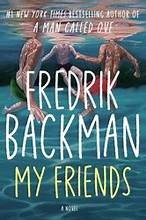
My Friends
2,219-word summary 10 min read 436 pages in the book
- First published
- 2025
- Publisher
- Atria Books
- Pages
- 436
- ISBN
- 9781982112820
- Original title
- Mina vänner
Reading options
What's inside (10 sections)
I picked this up with some suspicion, because "My Friends" is the kind of title that usually signals a small, safe book about people getting along. What I found was a novel that is far stranger and sadder than the title suggests, and also much funnier. It arrived in English first, published by Atria Books on 6 May 2025, a 436-page hardcover translated from the Swedish by Neil Smith. The Swedish original, Mina vänner, did not appear until 28 August 2025, from Norstedts. That reversal is worth noting because Backman is one of those writers whose books travel fast, and this one reached English readers months before it reached the ones who wrote it.
I want to say at the start what kind of book this is, because the marketing around it can make it sound softer than it is. It is a story about four teenagers and a painting, told across two timelines, and it is also a book about how hard it is to be a person who has been badly let down by the people supposed to care for you. Those two things are the same thing here. By the time I finished I could see why the reviews called it funny and moving in the same breath, though I also think some readers will find the ending a bridge too far.
A draft with far too much in it
Backman has said the first draft ran to roughly 82 parallel storylines and about 9,000 characters. That is not a typo, and it tells you something about the shape of the finished book. This is a writer who started with far too much and then had to find the small human thing at the center of it. He has said that two fellow writers read that enormous draft and responded to it warmly, and that their reaction is part of why he kept going. He rewrote the whole thing around four childhood friends, cutting away nearly everything else.
There is a context to all of this that I found hard to ignore once I knew it. Backman wrote the book during a stretch when his confidence was shaken, and he has said he seriously considered retiring. In interviews he has said this might be his last book. I do not think you need to know any of that to enjoy the novel, but knowing it colours the way the story lands, particularly the parts about a terminally ill artist deciding what to do with the one thing he has made that matters. Whether or not it really is his last book, there is a valedictory feel to the way he writes about leaving something behind.
Twenty-five years earlier, on the pier
The older timeline is set twenty-five years before the present, in a distant seaside town. Four teenagers are at the center of it. They come from bruising home lives, and the pier they keep returning to is abandoned. The details of that summer are deliberately small: long days, silly jokes, secrets traded, minor acts of rebellion. Nobody is saving the world. They are getting through an afternoon.
What Backman understands, and what makes this section work, is that for a certain kind of kid those afternoons are not minor at all. The four find in one another a reason to get up, to dream and to love. The prose here is not sentimental about it. The jokes are silly, and the book lets them be silly. It does not insist that these kids are profound. It just shows what happens when four people who have been given very little decide, without any grand plan, to give each other something.
I should be honest that the structure keeps this timeline at arm's length for a while. The book alternates between then and now, and it withholds the four friends for long stretches. There is a real cost to that choice. Just as you settle into the pier and start to care about who these kids are, the novel cuts back to the present and leaves you wanting more of the summer. For some readers that will be teasing in the good way. For others it will feel like the book is hiding its best material. I was somewhere in the middle, though I say more about that near the end.
The painting in the corner
That summer produces a painting. This is the hinge the whole novel turns on. Most people who look at the finished work read it as a picture of the sea, because that is what it appears to be. But in one corner, three tiny figures are seated at the end of a long pier. They are small enough to miss. Once you see them you cannot unsee them, and the painting changes.
This is a good trick, and Backman knows exactly what he is doing with it. The painting is a test of attention. Anyone can look at a picture of the sea and say, yes, that is the sea. The people who matter are the ones who notice the three figures in the corner, because noticing them is the whole point. The book asks the same question of the reader that it asks of its characters: are you looking at the surface, or can you see what someone put in the corner for you?
The painting has a name in the present day. It is known as The One of the Sea. That title is itself a small joke, because the sea is what everyone assumes the painting is about. The truth is tucked into the corner, and it is about four kids on a pier. I liked that the book never shouts this at you. It trusts you to find it.
Louisa walks into the auction house
The present timeline belongs to Louisa, and she is a different kind of person from the teenagers on the pier, though the book keeps drawing the two worlds together. She is eighteen and wants to be an artist. She has passed through several violent foster homes since her mother abandoned her, and she is reeling from the fatal overdose of a close friend. That is a great deal of loss for one person to carry at eighteen, and Backman does not soften it.
Louisa slips into an auction house to see the famous painting. She is not invited, she does not belong there, and she goes because the painting pulls at her in a way she cannot explain. There she meets its creator, C. Jat, who is thirty-nine and terminally ill. This meeting is the novel's big coincidence, and I will be blunt that it strained belief for me. An abandoned teenager wandering into an auction house and immediately encountering the dying artist whose work she has come to see is a lot to ask of a reader. The book knows it too, I think, and races past the awkwardness.
What carries the scene is not the coincidence but the two people in it. Louisa has been let down by nearly every adult in her life. C. Jat is a man who knows he is going to die and is trying to decide what his last act should be. Their conversation has the quality of two people recognizing something in each other quickly, because neither has much time to waste. Publishers Weekly singled out the Louisa and Ted interactions for praise, and while that review was not talking about this exact meeting, the instinct is right: the book is strongest when it lets these people talk to each other without explanation.
A last request, and a journey
C. Jat's final act is to ask Ted, one of the boys in the painting, to find Louisa and hand the artwork over to her. Ted is one of the four from that long-ago summer, which is how the two timelines finally lock together. A man who is dying gives a painting to a girl he has just met, through a boy he has known since he was a teenager. The chain is strange, and it works.
That request sends Louisa on a cross-country journey. She has to learn how the painting came to be and what she is supposed to do with it. This is the part of the book most like a road novel, and it is where the two timelines begin to speak to each other more freely. The closer Louisa gets to the painting's birthplace, the more nervous she becomes. Backman is canny about this. He lets the dread build without naming it, and the reader works out before Louisa does that reaching the place where the painting was made means reaching the people who made it, and that those people may not be who she expects.
I found the journey the most readable stretch of the novel. It gives the book a forward pull that the earlier back-and-forth structure sometimes lacks. It also gives Louisa something to do besides grieve, which is a kindness a lot of books about loss do not extend to their characters. She moves, she asks questions, she gets closer to a truth she is not sure she wants.
What the reviews were responding to
The book collected a serious pile of praise, and most of it makes sense once you have read it. USA Today called it unforgettably funny and deeply moving, which is an odd pairing until you see how the humor and the grief sit side by side here. Kirkus called it humorous, poignant and life-affirming. It won a Goodreads Choice Award, topped the Indie Next List for May 2025, was shortlisted for a British Book Award, and reached number one on the New York Times list on 17 August 2025.
The humor is worth a word of its own, because it is the thing I had not expected. This is a book about foster homes, overdose and terminal illness that is also very funny. The jokes the teenagers trade are genuinely silly, and Backman lets them land as jokes rather than loading every one with meaning. That lightness is what makes the sad parts bearable. When the book turns serious, and it does, the turn lands harder because you have just been laughing.
The life-affirming label is fairer than it sounds. The novel does not earn that description by giving everyone a happy ending. It earns it by insisting that the four friends and Louisa are worth knowing, and that the time they spend together matters even when it cannot be kept. That is a modest claim, but the book makes it with real conviction.
The parts that did not sit right
I should not pretend this is a flawless book. The two-timeline structure is the main problem. Withholding the four friends for long stretches means the present-day story has to carry a lot of weight on its own, and Louisa's sections, while strong, are not always strong enough to justify how long we wait to get back to the pier. There is a version of this novel that is tighter and more generous with its best characters, and I kept wishing I were reading it.
The coincidence of Louisa sneaking into the auction house and meeting the artist is the second problem. I know coincidences happen in real life, and I know fiction is allowed to use them. But so much of the plot rests on that one chance encounter that it needs more careful handling than it gets. The book hurries past it, and some readers will not buy it.
The ending is the third. It is deliberately unconventional, and I respect the choice to avoid a tidy resolution. But readers who want everything tied up will likely be frustrated, and I think the book knows that and does not much care. There is also, running under all of this, the question of whether a story about dying artists and abandoned teenagers risks being engineered to make you cry. I do not think Backman is manipulating the reader, but the material is arranged so neatly toward feeling that it is fair to ask.
Who I would hand it to
I would give this to a reader who likes a novel with a mystery at its center and does not mind being made to wait for the answer. The two timelines reward patience, and the painting is a genuinely good hook. I would be careful with a reader who wants a clean, conventional story, because the book withholds its friends, leans on a coincidence, and refuses to end neatly.
For all of that, I finished it glad I had read it. Backman writes about people who have been badly treated and who still find reasons to be funny and kind, and he does it without asking you to admire them for it. The four teenagers on the pier are not heroes. Louisa is not healed by the end. What they have is the time they spent together and a painting that preserves a few minutes of it in the corner of a picture of the sea. That is a small thing to build a novel around, and this one is bigger than it looks.
FAQ
Is My Friends really Fredrik Backman's last book?
Backman has said in interviews that it might be his last, and he wrote it during a period when his confidence was shaken and he considered retiring. That is his own uncertainty, not a confirmed retirement.
Why did the English edition come out before the Swedish original?
The novel appeared first in English, published by Atria Books on 6 May 2025 in a 436-page hardcover translated by Neil Smith. The Swedish original, Mina vänner, was published by Norstedts on 28 August 2025.
What is the painting called and why does it matter?
Known as The One of the Sea, it was made by the four friends one summer and shows three tiny figures at the end of a pier in its corner. It drives Louisa's cross-country journey and connects the book's two timelines.
Similar books
The Collected Regrets of Clover
A death doula who writes down the last words of strangers keeps her own heart locked away, until a new neighbor, a dying photojournalist and a road trip to…
3,055-word summary · 14 min read
The Interestings
Meg Wolitzer follows Jules Jacobson from 1974 arts camp into middle age, as friendship with Ethan and Ash turns into envy, money gaps, marriage strain, and…
2,990-word summary · 13 min read

The Wilderness
Four Black women move through twenty years of friendship in Angela Flournoy's discontinuous, widely praised second novel.
2,141-word summary · 10 min read
Our Souls at Night
A widow asks her widower neighbor to lie beside her at night, not for sex but for company, and two lonely people in a small Colorado town begin again.
2,582-word summary · 11 min read

One Boat
A woman returns to a Greek coastal town after her father's death, and the holiday she took nine years earlier after her mother's death keeps breaking through.
2,143-word summary · 10 min read
The Vacationers
A New York family's two-week stay in Mallorca turns into a comedy of exposed secrets when a magazine editor's affair and a son's debts come to light.
2,324-word summary · 10 min read
The Rachel Incident
A funny, sharp novel about two twenty-somethings in recession-era Cork whose bookshop friendship, tangled romance and a married professor's lie leave a secret…
2,346-word summary · 10 min read
The Emperor of Gladness
Ocean Vuong's second novel follows a young addict pulled back from a bridge in a dying Connecticut mill town and into the home of an elderly immigrant woman…
2,693-word summary · 12 min read
Tara Road
After her husband admits to an affair, a Dublin woman swaps houses for the summer with a grieving American, and each begins to heal inside the other's life.
2,020-word summary · 9 min read
Hollow Bones
On 11 September 2001, two-month-old Molly Fitzgerald loses her mother at the World Trade Center. She grows up planning for disasters, until a crisis in her new…
2,703-word summary · 12 min read
Heart the Lover
Lily King's seventh novel revisits a 1980s college love triangle thirty years on, as a woman who once gave up a baby decides what to tell the lover who never…
2,441-word summary · 11 min read
The Mermaid Chair
Jessie Sullivan returns to her childhood home on Egret Island to care for her agoraphobic mother, then finds her marriage, her faith, and a monk's vow thrown…
2,237-word summary · 10 min read
Last Night in Brooklyn
A copywriter in 2005 Fort Greene trades a scripted engagement for a bar crowd, a rising designer, and a neighborhood being remade around her.
2,540-word summary · 11 min read

We Are Okay
Marin fled San Francisco after her grandfather vanished and stopped answering anyone. When Mabel visits her college dorm, she has to say what happened.
2,253-word summary · 10 min read

Big Swiss
A transcriptionist for a sex coach falls for one of his clients, the tall Swiss gynecologist she calls Big Swiss, in a funny novel about work and secrets.
2,523-word summary · 11 min read

A Spool of Blue Thread
Four generations of the Whitshank family in Baltimore, and the silences, resentments and quiet love they hand down without ever saying so.
2,408-word summary · 11 min read
The No-Show
Three women are stood up on Valentine's Day by the same man, but the timeline is not what it seems. O'Leary's warmest book with a knife in it.
2,127-word summary · 9 min read
The One Hundred Years of Lenni and Margot
Dying teen Lenni and 83-year-old Margot paint one hundred years of stories.
2,281-word summary · 10 min read
Summer Sisters
Vix and Caitlin share Martha's Vineyard summers from age twelve into adulthood, through first love, grief, marriage, and a disappearance that still haunts Vix.
3,633-word summary · 16 min read
The Great Believers
Yale builds a Chicago art collection as AIDS takes his friends, and Fiona searches Paris for her daughter thirty years later.
2,742-word summary · 12 min read

The Bean Trees
Taylor Greer flees Kentucky, inherits Cherokee toddler Turtle, and roots with Tucson strays.
2,082-word summary · 9 min read
The Unlikely Pilgrimage of Harold Fry
A retired man in Devon walks to Berwick to visit a dying friend, hoping his steps keep her alive.
2,246-word summary · 10 min read
Beautiful World, Where Are You
Two friends Alice and Eileen trade letters while navigating love with Felix and Simon.
2,872-word summary · 13 min read
Remarkably Bright Creatures
A widowed night janitor, a lost young man, and a grumpy octopus circle the same old loss in a small seaside town.
2,012-word summary · 9 min read

And Every Morning the Way Home Gets Longer and Longer
An elderly grandfather, his son, and his grandson share memories and fears as the old man's mind begins to fade, in a short novel about grief and love.
2,078-word summary · 9 min read
Universality
Natasha Brown's short second novel turns a lockdown fracas over a gold bar into a sharp satire of money, identity and public argument.
2,302-word summary · 10 min read
The Rest of Our Lives
A law professor drives his daughter to college, then heads west instead of home, testing a private promise he made twelve years ago.
2,238-word summary · 10 min read
The Midnight Train
An eighty-one-year-old bookshop magnate dies and wakes young again aboard a train that carries him back through the moments that mattered most.
2,299-word summary · 10 min read
The Distance Between Us
Seventeen-year-old Caymen Meyers distrusts rich people, then a wealthy boy keeps proving her wrong while her mother's doll shop struggles to survive.
2,231-word summary · 10 min read
Thank You for Listening
A former child star turned audiobook narrator takes a final romance job to help her grandmother, only to fall for the secretive voice reading opposite her.
2,148-word summary · 10 min read