
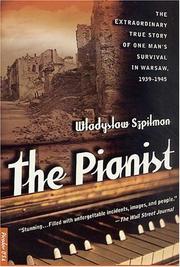
The Pianist
2,481-word summary 11 min read 224 pages in the book
- First published
- 1946
- Publisher
- Picador
- Pages
- 224
- ISBN
- 9780312263768
- Original title
- Śmierć Miasta. Pamiętniki Władysława Szpilmana 1939–1945
Reading options
What's inside (10 sections)
I came to this book after the Roman Polanski film, expecting a longer version of the same story. It is not that. The film is broad and physical; the book is short, dry, and at times almost eerily calm. It was first published in Polish in 1946 under a different title, written down by a music critic from what Szpilman told him, and the English edition did not appear until 1999. That gap matters. This is a memoir assembled from memory and from another man's notes, and its peculiar flatness is part of what makes it hard to forget.
The last broadcast
Władysław Szpilman was born in 1911 in Sosnowiec, Poland. He studied piano in the early 1930s at the Fryderyk Chopin University of Music in Warsaw and at the Berlin Academy of Arts, where he worked with Leonid Kreutzer and Artur Schnabel and studied composition with Franz Schreker. In 1933, after Hitler and the Nazi Party came to power in Germany, he returned to Warsaw and took a job as a pianist for Polish Radio. He was, by any measure, a young man with a fine career ahead of him.
The war arrives in the book through a power station. During the invasion of Poland in September 1939, German bombs destroyed the station that kept Polish Radio on the air. Szpilman played the station's last live recital before it went silent, a program of Chopin, on 23 September 1939. He did not know at the time that it was an ending. The detail stays with you because it is so exact: a pianist playing Chopin into a microphone while the lights are about to go out across the city.
The decrees came next, posted on walls and read aloud. From 1 December 1940, Jews over twelve had to wear a blue Star of David on a white armband. Property had to be handed over, and a Jewish family could keep only two thousand zlotys, with the rest placed in a blocked bank account. Very few people complied fully. Szpilman's household, which included his parents, his brother Henryk, and his sisters Regina and Halina, hid money in the window frame, an expensive gold watch under a cupboard, and the watch chain beneath the fingerboard of his father's violin. Those small domestic hiding places set the tone for the years that follow, in which survival often depends on where you put something small.
The ghetto and the Café Nowoczesna
By 1940 the roads into the area reserved for the Warsaw Ghetto were being walled off, and notices appeared claiming the district was infected with typhus. Szpilman's family already lived inside the designated zone. Others were given just over a month to move, and many paid inflated rents for cramped rooms. By May 1941, 445,000 Jews were packed into an area that covered 4.5 percent of the city. The gates closed on 15 November 1940. By then the family had sold everything, including their most precious possession, the piano.
Szpilman kept working. He played piano in the Café Nowoczesna on Nowolipki Street, then in a café on Sienna Street frequented by the Jewish intelligentsia, and later at the Sztuka on Leszno Street, the largest café in the ghetto. The Café Nowoczesna served smugglers and their guests, with food and drink arriving on wagons while guards looked the other way. Szpilman describes watching a child squeeze through a drain in the ghetto wall with a bag of goods, get stuck, and die after being pulled through with a shattered spine. He had run to help. The passage is only a few sentences long, and it is one of the hardest things in the book.
The ghetto eventually split into a small section, where the more comfortable families lived, and a large one, joined by a crossing on Chłodna Street. Szpilman's family was in the small ghetto. He had a friend there named Jehuda Zyskind, a smuggler and trader who brought news from outside by radio. In the winter of 1942, Zyskind and his family were shot after being caught producing underground publications. His brother Henryk traded books on the street and refused to join the Jewish Ghetto Police, calling its members bandits. When Henryk was picked up during a so-called human hunt, Szpilman went to the labour bureau and used his standing as a pianist to win a promise that his brother would be released. The other men swept up that day were sent to Treblinka.
The Umschlagplatz
The deportations began on 22 July 1942. Buildings were surrounded, residents were ordered out, and people were taken in wagons to the Umschlagplatz, the holding area beside the Gdansk railway station, and from there onto trains. Notices promised that Jews fit for work were going east to factories, with twenty kilograms of luggage and two days of provisions. In response, people scrambled for work certificates from German firms. Szpilman spent six days searching and deal making and managed to obtain six certificates, one for each member of his family. For a moment, it looked as though they might be spared.
On 16 August 1942, a selection at the collection centre broke that hope. Only Henryk and Halina were judged fit to work. The rest of the family was taken to the Umschlagplatz, and the two siblings volunteered to go with them. Szpilman was horrified, but his appeal to the guards failed. The family sat together in the open space, and a boy passed through the crowd selling sweets from a box on a string. They bought one cream caramel, and their father divided it into six parts with his penknife. It was their last meal together.
By six that evening the first wagons were full. There was a strong smell of chlorine, and the SS were pushing people with rifle butts. Szpilman had walked halfway down the train with his family when someone shouted his name and grabbed him by the collar, pulling him out of the cordon. He never saw any of them again. The train went to Treblinka, and none of his family survived the war. The abruptness of that separation, with no farewell and no explanation, is typical of the book. Szpilman records what happened and stops.
A ghost in the ruins
After the deportations, Szpilman was put to work demolishing the walls of the large ghetto. The job let him cross to the so-called Aryan side of Warsaw, where he and other workers bought potatoes and bread at Polish stalls, ate some, and traded the rest inside at a large profit. Later he was assigned as a storeroom manager at SS accommodation. A young man known as Majorek went into the city each day with a cart to collect food for the work detail, and he used the same trips to carry weapons and ammunition to the Jewish resistance. Majorek also carried word to Szpilman's friends on the outside, and arranged his escape.
On 13 February 1943, Szpilman slipped through the gate and met his friend Andrzej Bogucki on the other side. He spent the following months moving from one hiding place to another, carefully avoiding street lamps when Germans passed. Friends connected to the Polish resistance brought food when they could. He passed the time by teaching himself English, reading, and learning to cook elaborate meals silently out of almost nothing. He had made a decision that if he were discovered and could not escape, he would kill himself so that he could not betray the people helping him. He came close to that more than once. From his windows he watched the Warsaw Ghetto Uprising of 1943 burn through the district he had just left.
The Warsaw Uprising of August 1944 found him in a fourth-floor flat in a mostly German area of the city, with a good view and no way to join the fighting. On 12 August, the search for those behind the rebellion reached his building. Ukrainian fascists surrounded it, a tank fired into it, and it was set alight. Szpilman waited on the upper floor as smoke filled the rooms and carbon monoxide began to take hold. He took sleeping pills and a bottle of opium, intending to die, but fell asleep almost at once. When he woke, the fire had eased. He climbed out, sat against a wall until dark, then crossed the road on hands and knees, lying flat among the corpses whenever a German unit came into view. He reached an unfinished hospital and collapsed on the floor.
In the hospital he found crusts of bread and a fire bucket of stinking water covered with an iridescent film, and drank until he noticed he had swallowed dead insects. On 30 August he moved back into his old building, now burned out, and survived on bread and rainwater he found in larders and bathtubs. The Polish Home Army signed its capitulation on 2 October 1944, and an estimated 200,000 civilians died in the uprising. By 14 October, Szpilman and the German army were all but the only people left in Warsaw. He describes a city of chimneys and rubble under which the culture of his people and the bodies of hundreds of thousands of murdered victims lay rotting in the late autumn warmth.
Winter drove him down from the attic in search of a working stove, and a German soldier caught him. He escaped onto a steep roof, braced his feet against a gutter, and lay there while soldiers searched the building below. They never thought to look up. Days later, two Germans saw him on that roof and shot at him, and he fled again through the burnt-out buildings.
Wilm Hosenfeld
The encounter that gives the book its moral center happens almost by accident. In a kitchen of another ruined building, a German voice asked what he was doing. Szpilman said he was a pianist. The officer, Captain Wilm Hosenfeld, led him to a piano in the next room and told him to play. He played Chopin's Nocturne in C sharp minor, and the sound of the untuned strings moved through the empty flat and back across the ruins. Hosenfeld listened, then said he should not stay there and offered to take him to a village. When Szpilman refused, the officer asked if he was Jewish. Szpilman said yes. Hosenfeld sat down in the armchair by the piano and said that in that case he really could not leave.
Hosenfeld inspected the attic and found a loft above it that Szpilman had missed. He helped him up a ladder, then brought food, water, and news of the Soviet advance until his unit withdrew in the first half of December 1944. He left Szpilman with supplies and a German army greatcoat. Szpilman had nothing to give in return except a promise: if the officer ever needed help, he was to ask for the pianist Szpilman of Polish Radio. It took Szpilman five years even to learn Hosenfeld's name, and his efforts to secure his rescue came to nothing. Hosenfeld died in Soviet captivity in 1952. Israel recognized him as Righteous Among the Nations in 2008.
The Soviets arrived on 17 January 1945. Hoping to be friendly, Szpilman came out and greeted a woman carrying a bundle, who dropped it and ran away shouting that he was a German. He retreated, then came down the stairs calling out that he was Polish. A young Polish officer studied him closely before lowering his pistol.
How the book reached us
Part of the memoir appeared in the Polish weekly Przekrój in the summer of 1946 under the byline of Jerzy Waldorff, a music critic and friend of Szpilman. The full book followed that year from the publisher Wiedza as Śmierć Miasta. Pamiętniki Władysława Szpilmana 1939–1945, which translates as Death of a City: Memoirs of Władysław Szpilman 1939–1945. Waldorff was named as editor rather than author, and in his introduction explained that he had written the story down as Szpilman told it. The decision to present Szpilman as the author came from the publishing house. A German translation by Karin Wolff appeared in 1998 under the title Das wunderbare Überleben: Warschauer Erinnerungen. Anthea Bell's English translation was published in 1999 by Victor Gollancz as The Pianist: The Extraordinary Story of One Man's Survival in Warsaw, 1939-45, and won the Jewish Quarterly-Wingate Prize for non-fiction in 2000. The Picador paperback cited here appeared in 2000, runs 224 pages, and carries the subtitle The Extraordinary True Story of One Man's Survival in Warsaw, 1939-1945.
Szpilman returned to Polish Radio in 1945 and played the same Chopin nocturne in the rebuilt recording room. He led the music department until 1963, then composed and toured until retiring from performance in 1986. He died in Warsaw on 6 July 2000, aged eighty-eight. Two years later, Polanski's film won the Palme d'Or at Cannes and three Academy Awards, and a much wider public knew the story.
The silences in the telling
The prose is deliberately unadorned. Whole years pass in a few paragraphs, and scenes that would be expanded into chapters in another memoir are given a page. Some of that is the result of Waldorff's editing, some of it is the limit of what Szpilman chose to say. There is no commentary on the meaning of events, no argument with the reader about what they should feel. When his family is taken away, the account moves straight to what he did next. Readers looking for reflection may find the restraint cold, but I think the restraint is the method. The facts are allowed to do the work.
It is also a partial account by design. This is one man's route through occupied Warsaw, not a survey of the Holocaust, and it says little about the machinery that produced the ghetto beyond what Szpilman could see from the street. A few transitions jump awkwardly, and the voice shifts in ways that remind you the text was assembled. The famous piano scene is shorter than you might expect from the film, which is either a disappointment or a relief depending on what you came for.
Who should read it
For readers interested in the Holocaust, the Warsaw Uprising, or the history of classical music in wartime Poland, this is an essential and unusually compact account. It is not a novel and it does not read like one. The film is the more accessible entry point, but the book is stranger and more exact, and it keeps returning to the same small image: a musician at an instrument, playing for his life because someone in uniform happens to be listening. The last broadcast in 1939 and the nocturne in the ruins in 1944 close the loop. That symmetry is there in the record, and Szpilman was canny enough to leave it uncommented.
FAQ
When was The Pianist first published?
It appeared in Polish in 1946 as Śmierć Miasta, with Jerzy Waldorff credited as editor. Anthea Bell's English translation was published in 1999 by Victor Gollancz, and the Picador paperback cited here appeared in 2000.
Who was Wilm Hosenfeld?
A German army captain who found Szpilman hiding in a ruined Warsaw building, asked him to play piano, then brought him food and news until his unit withdrew. He died in Soviet captivity in 1952 and was recognized as Righteous Among the Nations in 2008.
Is The Pianist a novel?
No. It is a memoir based on what Szpilman told the music critic Jerzy Waldorff, who wrote it down and edited it for the 1946 Polish edition.
Similar books
The Happiest Man on Earth
Eddie Jaku's memoir follows a Leipzig childhood, Buchenwald, Auschwitz, a death march, and the slow rebuilding of a life in Australia.
2,597-word summary · 12 min read

The Forest of Vanishing Stars
A girl raised in the Polish wilderness uses her survival skills to hide Jewish refugees, until a secret from her own past catches up.
2,250-word summary · 10 min read
Survival in Auschwitz
A chemist deported from Turin records ten months in Auschwitz with a restraint that makes the horror impossible to look away from.
2,177-word summary · 10 min read

The Zookeeper's Wife: A War Story
The directors of the Warsaw Zoo hid roughly three hundred Jews in empty cages and outbuildings after the German invasion, while Jan worked for the resistance.
2,065-word summary · 9 min read
The Orphan's Tale
A Dutch teenager rescues a Jewish baby from a death train and joins a German circus, where a Jewish aerialist teaches her to fly.
2,943-word summary · 13 min read
Lone Survivor: The Eyewitness Account of Operation Redwing and the Lost Heroes of SEAL Team 10
Marcus Luttrell's account of the 2005 SEAL mission in Afghanistan that killed three of his team and left him alone.
2,144-word summary · 10 min read
Schindler's List
Womanizing profiteer Schindler spends a fortune typing over a thousand Jews onto factory lists.
2,048-word summary · 9 min read
We Were the Lucky Ones
Based on her own family, Hunter follows the Kurc family of Radom as war scatters five siblings from Siberia to Brazil and back toward reunion.
2,805-word summary · 12 min read
Cilka's Journey
After surviving Auschwitz, Cilka Klein is sentenced to a Siberian labor camp, where she trains as a nurse and fights to stay human.
2,365-word summary · 11 min read
A Long Way Gone: Memoirs of a Boy Soldier
A Sierra Leone boy flees rebels, becomes a child soldier at thirteen, and fights his way back through rehab.
2,434-word summary · 11 min read
Lilac Girls
Three women meet across World War II: a New York volunteer, a Polish courier turned prisoner, and a German camp doctor.
2,731-word summary · 12 min read
The Hiding Place: The Triumphant True Story of Corrie Ten Boom
The Ten Booms hide Jews in Haarlem, suffer Ravensbruck, lose Betsie, and learn forgiveness.
2,593-word summary · 12 min read
Night
Elie Wiesel's account of Sighet, the cattle cars, Auschwitz and Buchenwald, told in short flat sections by a boy about fifteen. Why the book carries the year…
2,594-word summary · 12 min read
The Teacher of Nomad Land
In 1941 Iran, an orphaned boy straps a chalkboard to his back and sets off to teach nomads, hoping to keep his little sister with him.
2,534-word summary · 11 min read

The Last Bookshop in London
A woman who has never cared for reading takes a job in a dusty London bookshop as the Blitz begins, and finds her place in it.
2,264-word summary · 10 min read
What Is the What: The Autobiography of Valentino Achak Deng
Dave Eggers retells the life of Valentino Achak Deng, a Lost Boy of Sudan, in the refugee's own voice, from a burned village to a robbery in Atlanta.
2,840-word summary · 13 min read
Sunrise on the Reaping
Twenty-four years before Katniss, sixteen-year-old Haymitch Abernathy is swept into the fiftieth Hunger Games, where District 12 must send four tributes and…
2,198-word summary · 10 min read
Hiroshima
In 1946 John Hersey followed six ordinary people through the atomic bombing of Hiroshima and its aftermath, using a plain style that made the reporting feel…
2,991-word summary · 13 min read

The Faith of Beasts
Book two of The Captive's War. Human captives of the Carryx fight for a future while their highest-ranked champion decides to manufacture one.
2,262-word summary · 10 min read
The Bronze Horseman
On the day Germany invades the Soviet Union, Tatiana Metanova meets a mysterious Red Army officer, and their love is tested by the Siege of Leningrad.
2,461-word summary · 11 min read
Monsters of Men
Todd Hewitt and Viola Eade are trapped between Prentiss's army, the Spackle and the Answer, in a war that keeps asking what a person becomes to win.
2,382-word summary · 11 min read

Corelli's Mandolin
A British doctor's daughter on a Greek island falls for the Italian captain billeted with her, until the German arrival turns a gentle occupation into a fight…
2,247-word summary · 10 min read

In Order to Live: A North Korean Girl's Journey to Freedom
A young North Korean girl crosses the Yalu, survives trafficking in China, and rebuilds her life in Seoul in this unsparing memoir.
2,027-word summary · 9 min read

Sophie's Choice
A young Southern writer in 1947 Brooklyn befriends a brilliant, unstable couple and slowly learns the story of the Polish Catholic woman at the center of their…
2,798-word summary · 12 min read
A Long Walk to Water
Two eleven-year-olds in southern Sudan, twenty-three years apart: a Dinka boy fleeing war and a Nuer girl walking hours for water, until their stories meet at…
2,217-word summary · 10 min read
The Girl with Seven Names: A North Korean Defector's Story
Hyeonseo Lee crossed the frozen Yalu River at seventeen, spent years hidden in China, escaped to South Korea, and later returned to rescue her family.
2,404-word summary · 11 min read

Scar Tissue
Kiedis's memoir follows the Red Hot Chili Peppers from Hollywood house parties to fame, heroin, and the long work of staying clean.
2,217-word summary · 10 min read
Life
The Rolling Stones guitarist tells his own story: a Dartford childhood, the band's first gigs, the drug raids, the tax years and Patti Hansen.
2,761-word summary · 12 min read
Exodus
Leon Uris's sweeping 1958 novel follows Jewish refugees, Haganah fighters, and Holocaust survivors from Cyprus to the founding of Israel and the 1948 war.
2,529-word summary · 11 min read
Those Who Save Us
A Minnesota professor hunts her mother's hidden wartime past in Weimar, where survival came wrapped in an SS officer's protection. A dual timeline about…
2,345-word summary · 10 min read