
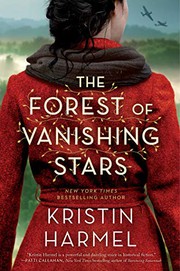
The Forest of Vanishing Stars
2,250-word summary 10 min read 416 pages in the book
- First published
- 2021
- Publisher
- Gallery Books
- Pages
- 416
- ISBN
- 9781982158934
Reading options
What's inside (8 sections)
I almost passed this one over because I thought I had read enough World War II novels about people hiding from the Nazis. That would have been a mistake. Kristin Harmel published this book in 2021 with Gallery Books, and it takes place mostly in a forest rather than a city or a camp. The central character is not a resistance fighter or a refugee at first. She is a young woman who has been raised in the wilderness and knows how to live there, and the story is about what happens when that knowledge becomes the only thing standing between a group of strangers and death.
The woman who took a child
The book opens with Jerusza, an eccentric and difficult woman with a backstory that the author reveals in pieces. Jerusza steals Yona from her wealthy German parents in Berlin, just before the girl's second birthday, and takes her into the Naliboki Forest in Poland. The kidnapping is not a misunderstanding. It is a deliberate act, and the novel keeps asking whether it was a cruel one.
Jerusza raises Yona in the forest and teaches her everything she needs to survive there. Yona learns to weave baskets, forage for food, build shelters, make fishnets, and tell the difference between a mushroom that will feed you and one that will kill you. She grows up without the ordinary company of other children, and the result is a person who is skilled and isolated in equal measure. She does not know what it means to connect with another human being until she is an adult.
The reading group guide published by the publisher asks whether Jerusza was fair to Yona, who never got to choose between her kidnapper and the parents she lost. That question stayed with me through the whole book. Jerusza believes she saved Yona from a world that was about to become poisonous, and the novel does not simply endorse that belief. It lets the ugliness of the act sit beside the usefulness of the skills. I found myself unable to settle on a verdict, which is a good sign for a character who could easily have been written as a wise mentor with no rough edges.
There is a quote in the book that captures Jerusza's view of her own life. She tells Yona that once fates intertwine, they are forever linked, and that lives are circles spinning across the world that meet again when they are meant to. It is a comforting idea if you believe it. For Yona, who has been cut off from everyone she might have loved, it is also a way of explaining a life that was decided for her before she could speak.
Learning to read the woods
Much of the first half of the novel is a practical education, and it is the part I enjoyed most. Harmel is interested in the specific work of staying alive outdoors. Yona notices tracks, weather, edible plants, and the small changes that tell her an animal is near. The forest is not scenery in these pages. It is the place that made her, and it behaves like a character with moods of its own.
That closeness has a cost. Yona knows how to be alone but not how to be with people. She also does not know who she is. Jerusza has told her the names of her family and something about her home, which leaves Yona torn between loyalty to the woman who raised her and a longing for the parents she never knew. The book returns to this tension again and again. Every time she considers reaching out to someone, the question of where she belongs rises up in front of her.
Her uncertainty is more than emotional. Yona grows up unsure of her family's heritage and religious beliefs. She identifies with the Jewish faith, but she does not learn the full truth of her Jewish heritage until late in the novel. She also carries German blood, and at one point she wonders whether she has inherited an evil side from her father. That fear is painful because it is not based on anything she has done. It is based on where she came from, which is exactly the kind of logic the Nazis around her are using.
Harmel takes her time with this stretch of the story, and the slow pace suits the material. A person who grows up alone measures time differently, by seasons and by the return of certain birds rather than by a calendar. The novel lets Yona notice those things, and the effect is that the forest feels lived in rather than studied. I found myself slowing down to match the prose, which is not something I say often about a thriller-adjacent historical novel. The quiet chapters are the ones that made the later danger matter.
Jerusza dies, and the book places this in 1941, leaving Yona alone in the forest. The death changes the shape of the story. Up to that point, the wilderness has been a place Yona was taught to survive. Afterward, it becomes a place she has to make sense of on her own. The shift is quiet but important, and it explains why she is ready to act when strangers appear in the trees.
Strangers in the trees
The strangers are Jews fleeing Nazi persecution. Yona is stunned to learn what has been happening in the world beyond the forest, and she decides to teach the group what she knows. This is where the premise finally clicks into place. The survival skills that made sense for one lonely girl become a way to keep dozens of people alive. She shows them how to move quietly, find food, build shelter, and avoid the mistakes that would give them away.
The group is not a single harmonious unit, and that is one of the book's better choices. Zus and Aleksander adjust to forest life relatively easily and trust Yona. Chana and her family struggle more, and they are slower to accept guidance from a young woman who speaks with the forest rather than with the town. Sister Maria Andrzeja, a nun, offers a different kind of comfort, telling Yona that people come to God in different ways. The disagreements among the refugees keep the story from becoming a simple parade of grateful people learning from a wise guide.
I liked watching Yona handle that mistrust. She is not a natural teacher and she does not have the authority of an official rescuer. She has knowledge, and knowledge has to earn its way with people who have already been betrayed. The scenes where she argues with Chana's family are more interesting to me than the scenes where everyone follows her plan, because they acknowledge that fear makes people difficult. People hiding in a forest in 1941 are not going to be reasonable all the time.
The teaching itself is handled in concrete terms, which keeps those scenes from turning into lectures. Yona shows rather than explains, and the reader learns alongside the refugees. That choice also gives the group a real arc. Zus and Aleksander take to the woods quickly because they can accept instruction from someone who has clearly done this before. Chana's family needs longer, and part of the tension comes from the fact that there may not be time to wait. Every disagreement carries the risk of being overheard, which makes even a small argument about food feel dangerous.
The novel also balances two kinds of danger. The refugees are hunted by the Nazis, and they are also exposed to cold, hunger, illness, and the sheer physical difficulty of living off the land. The publisher's guide points out that both conflicts are present throughout, man against man and man against nature. I think the second one is the more distinctive half here. Plenty of books cover the first. Few spend this much time on the actual business of keeping warm and fed while someone else is looking for you.
A name, a father, and a faith
The emotional center of the book is Yona's search for a self she never got to build. She identifies as Jewish, yet the knowledge of her heritage arrives late. She has German blood, and she has to sit with the fact that the people hunting her friends come from the same places her family did. The book does not let her off the hook by making her ancestry simple. Part of her belongs to the side that is doing the killing, and she has to decide what that means for the person she chooses to be.
Meeting her father is a defining moment. The encounter is difficult because he is a stranger and because everything she has been told about family is tangled up with the kidnapping that separated them. The novel uses the meeting to ask whether identity comes from birth or from how a person chooses to live. Yona has been making choices for years without knowing who her people were. Finding out does not hand her a ready answer. It gives her another fact to carry.
Faith works in a similar way. Jerusza describes herself as a seeker of truth and a seeker of God, believing in everything and nothing. Sister Maria Andrzeja suggests that different people reach God by different roads. Yona listens to both, and she never quite lands in one place. At one point she watches Aleksander and wants nothing more than to step out of the trees and be the answer to his prayer, the proof that a God exists after everything he has suffered. The thought is followed immediately by doubt about who she is to save anyone. That small movement, from longing to self-doubt, is the most honest religious moment in the book.
Betrayal and the occupied village
The second half of the novel tightens the screws. Yona is betrayed, and she escapes into a village under German occupation. This is where her past and present crash into each other. The skills that kept her hidden in the forest do not work the same way among neighbors, checkpoints, and soldiers. She has to read a different kind of danger, one made of glances and uniforms and questions asked in the wrong tone.
Jüttner is the Nazi character who personifies the regime in this story, and he is written as a genuinely hateful presence. The reading group guide raises the question of whether the author ever shows him as more than a villain, or as someone shaped by sorrow and suffering. I think the book keeps him mostly in the villain category, which is a defensible choice for a character whose job is to embody the threat. It does leave the Nazi side of the story flatter than the refugee side. Yona's moral confusion is rich. Jüttner's is barely there.
The village sequence is also where the book leans hardest on coincidence. People turn up when they are needed, and revelations arrive close together. Historical fiction often has to compress events, and Harmel is working with a real history that was itself full of improbable survival stories. Still, I noticed the machinery more here than in the forest chapters. The forest scenes earn their tension through detail. The village scenes sometimes get it through timing.
Where the story came from and where it ends
Harmel has said the book was inspired by real accounts of survival, and she researched groups including the society led by the Bielski brothers, which was depicted in the film Defiance. She spoke with Aron Bielski, who told her that sorrow teaches a person how to live and that hardship teaches a person life. You can feel that influence in the way the novel treats suffering. It does not romanticize the forest or pretend that loss is a gift. It does suggest that people learn things under pressure that they would never have learned in comfort.
The ending resists the tidy answer I expected. Almost everyone Yona helped in the forest moves back into society and tries to recover some version of ordinary life. Yona stays in the forest. On the surface, that seems like a strange choice after a book about the cost of isolation. By the end, it reads as consistent. The forest is the only home she has known on her own terms, and the people she helped do not need her in the same way anymore. Her decision is not a rejection of them. It is a return to the one place where she knows who she is.
That is what stayed with me after I closed the book. The forest is not a metaphor the author occasionally remembers. It is the setting that shapes every relationship in the story, and the reason Yona has both extraordinary skills and extraordinary difficulty trusting anyone. The historical material gives the book its urgency, but the survival detail is what makes it different. I would hand this to a reader who likes World War II fiction but wants something quieter and more physical than the usual camp or resistance story. I would warn them that the coincidence quotient rises near the end and that the villain never gets the complexity the heroine does. Those are real limits. They did not stop me from caring about what happened to Yona, or from thinking about Jerusza's terrible choice long after the last page.
FAQ
Is The Forest of Vanishing Stars based on a true story?
It is a work of fiction, but Kristin Harmel drew on real accounts of Jews who survived in forests during World War II. She researched the group led by the Bielski brothers and spoke with Aron Bielski.
Who is Yona and where does the story take place?
Yona is a young woman stolen from her German parents as a toddler and raised in the Naliboki Forest in Poland. The novel is set mainly in that forest during 1941 and the years that follow.
Do I need to read The Book of Lost Names first?
No, this is a standalone novel. Both books are World War II fiction by Kristin Harmel and touch on similar questions of identity and survival, but they share no characters.
Similar books
We Were the Lucky Ones
Based on her own family, Hunter follows the Kurc family of Radom as war scatters five siblings from Siberia to Brazil and back toward reunion.
2,805-word summary · 12 min read
Cilka's Journey
After surviving Auschwitz, Cilka Klein is sentenced to a Siberian labor camp, where she trains as a nurse and fights to stay human.
2,365-word summary · 11 min read
Lilac Girls
Three women meet across World War II: a New York volunteer, a Polish courier turned prisoner, and a German camp doctor.
2,731-word summary · 12 min read
The Pianist
A Polish pianist endures the Warsaw Ghetto, the Umschlagplatz, and life hidden in the ruins of the 1944 uprising, until a German officer asks him to play.
2,481-word summary · 11 min read
The Orphan's Tale
A Dutch teenager rescues a Jewish baby from a death train and joins a German circus, where a Jewish aerialist teaches her to fly.
2,943-word summary · 13 min read
The Power of One
A boy in apartheid South Africa decides to become welterweight champion of the world, and the novel follows every mentor, fight, and loss that gets him there.
2,145-word summary · 10 min read
The Valley of Horses
Exiled from the Clan, Ayla survives alone in a hidden valley, tames a horse and a cave lion, and nurses a wounded stranger back to life.
2,311-word summary · 10 min read
The Happiest Man on Earth
Eddie Jaku's memoir follows a Leipzig childhood, Buchenwald, Auschwitz, a death march, and the slow rebuilding of a life in Australia.
2,597-word summary · 12 min read
Those Who Save Us
A Minnesota professor hunts her mother's hidden wartime past in Weimar, where survival came wrapped in an SS officer's protection. A dual timeline about…
2,345-word summary · 10 min read
Fever 1793
Philadelphia, 1793: fourteen year old Mattie Cook nurses family, buries neighbors, and keeps a coffeehouse through yellow fever.
2,259-word summary · 10 min read
Schindler's List
Womanizing profiteer Schindler spends a fortune typing over a thousand Jews onto factory lists.
2,048-word summary · 9 min read
The Things We Cannot Say
A Florida mother travels to Poland to answer her silent grandmother's plea, uncovering a wartime love story and a decades-old identity swap.
2,365-word summary · 11 min read
Salt to the Sea
Four refugee teens cross frozen Prussia toward a doomed ship that history barely remembers.
2,094-word summary · 9 min read
The Clan of the Cave Bear
A Cro-Magnon girl orphaned by disaster grows up with a Neanderthal clan, learning their medicine and customs while testing their limits.
3,684-word summary · 16 min read
Hotel on the Corner of Bitter and Sweet
A Chinese American boy befriends a Japanese American girl in wartime Seattle, then loses her to the internment camps.
2,973-word summary · 13 min read
Hatchet
A plane crash leaves thirteen-year-old Brian alone in the Canadian wild with only a hatchet.
2,770-word summary · 12 min read
The Tattooist of Auschwitz
Heather Morris retells the years of Lale Sokolov as tattooist at Auschwitz Birkenau, his love for Gita Furman, and the food trades and quiet risks that kept…
2,442-word summary · 11 min read
All the Light We Cannot See
Doerr's All the Light We Cannot See retold: blind Marie-Laure, Werner the radio boy, and Saint-Malo.
1,962-word summary · 9 min read
The Book of Lost Names
A young forger in occupied France helps Jewish children flee with new names while keeping a secret book of the truth.
2,097-word summary · 9 min read
The Teacher of Nomad Land
In 1941 Iran, an orphaned boy straps a chalkboard to his back and sets off to teach nomads, hoping to keep his little sister with him.
2,534-word summary · 11 min read
The Last Bookshop in London
A woman who has never cared for reading takes a job in a dusty London bookshop as the Blitz begins, and finds her place in it.
2,264-word summary · 10 min read
Survival in Auschwitz
A chemist deported from Turin records ten months in Auschwitz with a restraint that makes the horror impossible to look away from.
2,177-word summary · 10 min read
Witchcraft for Wayward Girls
In 1970 Florida, a girl sent to a maternity home for unwed mothers finds a spellbook, and the real horror turns out to be what the adults do to her and her…
2,077-word summary · 9 min read
These Silent Woods
A father and his eight-year-old daughter live off-grid in the Appalachian woods, hiding from a past he cannot outrun. When their yearly supply run fails, their…
2,274-word summary · 10 min read
Theft
Gurnah traces three linked lives in Tanzania, where a servant's accusation of theft opens a family history of love, duty and quiet betrayal.
2,454-word summary · 11 min read
Stolen
A sixteen-year-old is drugged at a Bangkok airport and taken into the Australian Outback by a man who has watched her for years. Lucy Christopher tells it as a…
2,284-word summary · 10 min read
By the Shores of Silver Lake
Twelve-year-old Laura leaves Plum Creek for Dakota Territory, rides a pony, mourns old Jack, and learns to be eyes for her blind sister Mary.
2,540-word summary · 11 min read
At the Water's Edge
A Philadelphia socialite follows her husband and his friend to wartime Scotland to hunt the Loch Ness monster, and finds herself instead: a novel of friendship…
2,906-word summary · 13 min read
The True Confessions of Charlotte Doyle
A sheltered thirteen-year-old sails from Liverpool in 1832 and finds herself the only woman aboard a ship with a charming, dangerous captain.
2,330-word summary · 10 min read
The Dressmaker's Gift
In occupied Paris, three seamstresses hide dangerous secrets, and decades later one granddaughter returns to the same building to learn what really happened.
2,277-word summary · 10 min read