
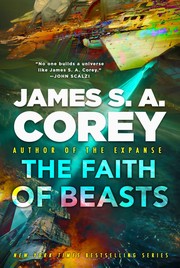
The Faith of Beasts
2,262-word summary 10 min read 448 pages in the book
- First published
- 2026
- Publisher
- Orbit
- Pages
- 448
- ISBN
- 9780316525671
- Series
- The Captive's War (#2)
Reading options
What's inside (8 sections)
A warning before I say anything else: The Faith of Beasts is the second main entry in The Captive's War trilogy, and it assumes you have read The Mercy of Gods. There is a novella in between, Livesuit, and this book picks up with the assumption that you know both. I read the first book some time ago and spent the opening chapters of this one trying to remember who every person was. That is partly my fault and partly the book's. Daniel Abraham and Ty Franck, writing together as James S. A. Corey, do not do much hand-holding here. If you are coming in cold, expect to be confused for a while.
That said, once the machinery of the story clicks, this is a smart and often brutal piece of space opera. It is published by Orbit in 2026, a 448-page hardcover, and it takes the human captives of the alien Carryx empire into a much larger war. The book's great subject is what a person becomes when survival requires serving something monstrous. It is not an uplifting read. It is a readable one, and it keeps finding new ways to make the word "human" feel unstable.
Five Hundred Humans Scattered Across an Empire
The premise carries over from the first novel. The Carryx empire rests on subjugation. Thousands of species are bound to the Sovran and tested endlessly, sorted into those who are useful in the Carryx's eternal war and those who are slaughtered. Humanity has been caught in that sieve. Since the end of the first book, five hundred humans have been dispersed across the empire for study, while the rest remain confined in the world-palace. The survivors are not a community in any comfortable sense. They are specimens, pets, and occasional tools, and the book never lets you forget it.
What makes the setup unusually tense is that the humans are not a unified bunch with one noble plan. They are a small group of people trying to work out what they are allowed to become. Some want to preserve what they were. Some want to survive at any cost. Some have decided that the only way to matter is to become indispensable to their captors. That last group is the most interesting, and the most uncomfortable.
The novel adds several new viewpoints. Jessyn Kaul comes into her own here. Surur is a keeper-librarian whose shelves hold knowledge the Carryx use and distrust. Campar becomes a military figure. And there is the Swarm, a biological spy belonging to the Carryx's enemies, now inhabiting a human called Jellit. The Swarm's chapters are among the strangest in the book, because its sense of self is not human at all. It observes, it consumes information, and it reports to something far away. Watching it move through human forms and human loyalties is one of the more unsettling pleasures on offer.
Dafyd and the Arithmetic of Survival
Dafyd Alkhor remains the highest-ranked human captive, and he is the novel's most difficult figure. The people he claims to champion fear him and despise him. He has carved out a niche in the Carryx war machine through ruthlessness, and he is willing to reshape human nature itself into a tool for his alien masters. When I say he is difficult, I mean that the book keeps forcing you to judge him and then denying you a stable place to stand. He is a collaborator and a protector, sometimes in the same scene.
The central decision he makes in this book is chilling in its logic. Meeting with the keeper-librarian Ekur-Tkalal, Dafyd learns that humanity must sustain its own population over the long term if it is to have any future at all. The population is too small, and the captors are not going to guarantee its growth. So Dafyd decides to create babies in artificial wombs. It is the kind of choice that reads as pragmatic and horrifying at once. He is treating human beings as a resource to be managed because the alternative is extinction, and the book does not let him off the hook for thinking that way.
I found this strand the most gripping part of the novel. The question is not whether the babies are a good idea in the abstract. It is what a community becomes when its future is engineered by one man who answers to an empire. Dafyd's authority comes from his usefulness to the Carryx, and every step he takes to protect his people deepens his dependence on them. Abraham and Franck understand that collaboration is not a single act but a habit, and that each compromise makes the next one easier.
Ekur-Tkalal is a good counterweight. The keeper-librarian is not a villain in the usual sense, and the conversations between keeper and captive have a dry, procedural quality that makes the stakes feel larger. These are conversations about the management of a species, conducted with the calm of people filing paperwork. That contrast, between the enormity of what is being decided and the flatness of how it is discussed, is one of the book's best habits.
The other humans around Dafyd give the argument teeth. They know what he is doing and they hate him for it, and yet they are also the ones who will inherit whatever he builds. That tension runs through every scene he is in. He walks through the world-palace as a man who has saved his people and betrayed them in equal measure, and nobody, including him, can separate those two things.
The Planet the Enemy Left Behind
Jessyn's storyline is where the novel opens outward. She is sent to a remote planet once inhabited by the Carryx's enemies, the Deathless Ones. A sinen called Third Gardener explains that this enemy destroys all evidence on the worlds it leaves, which makes the site a rare chance to learn something about them. The word "sinen" is one of those pieces of invented vocabulary the book drops without explanation, and I had to keep reading to work out what role it played. That is part of the experience here. You learn the world by being dropped into it.
On the planet Jessyn meets another human researcher, Garral, and the two of them are captured by a group of humans trying to evacuate the place. That group is its own small drama, a bunch of people who have decided that staying is worse than whatever comes next. And then comes the revelation that reframes the whole book. Together, Jessyn and the others realize that the Deathless Enemy is humanity itself. It is a great, cold joke at the center of the story. The empire has been fighting an enemy for millions of years, and the enemy turns out to be a species that has not even fully arrived yet, or perhaps one that is scattered through time in ways the Carryx barely understand.
This is the point where The Faith of Beasts becomes more than a prison drama. The scale flips. The humans are both the victims of the Carryx and the agents of something enormous and ancient. I liked the vertigo of it. The book asks what it means to be a small part of a very large lie, and it does so with a straight face. Garral's presence gives the planetary section a human anchor, since he is a researcher like Jessyn and someone whose curiosity gets him into trouble. His fate at the end of the book pays off the thread started here.
The Battle and the Ship
The military storyline follows Rickar, who was infected with the Swarm's signal in the first book. He joins an expedition fleet heading to an unknown battlefield with Campar and Ghati. Their warship emerges from Asymmetric Space into battle with the Deathless Enemy, and what follows is weeks of fighting. The Carryx win. The enemy fleet is destroyed or fleeing, with one exception: a damaged, apparently abandoned command ship. That ship is the bait that pulls the later chapters into motion.
The space battle is written with the patient, technical thoroughness that Abraham and Franck brought to The Expanse. There is a lot of maneuvering, a lot of waiting, and a lot of attention to what a fleet can and cannot do in the space they have. Some readers will find the middle section's strategic maneuvering slow. I did, in places. The battle goes on long enough that you start checking to see how many pages are left. But the length also does something useful. It makes the victory feel expensive, and it makes the abandoned ship feel like a real temptation rather than a convenient plot device.
Rickar's arc through this section is quietly sad. He is carrying the Swarm's signal, which means he is never entirely sure whose side he is on or what his own mind is doing. His body becomes a problem by the end of the book, and the outcome is violent. The Seam between the human characters and the alien intelligence that uses them is one of the novel's recurring worries. Who is the person making the decision, and who is the passenger along for the ride?
Secrets at the World-Palace
Back at the world-palace, things come apart. Tonner discovers that the Soft Lothark communicate through DNA exchange, a channel the Carryx cannot monitor. It is a genuine breakthrough, a way for the captives to speak without their masters listening. He announces it, and he is quickly killed by the Soft Lothark themselves. The discovery is true and useless, or it would be if Dafyd had not heard it. Dafyd hides the revelation from Ekur-Tkalal and quietly allies himself with the Soft Lothark, while the Swarm accesses the Carryx archives. This is the novel at its most intricate, with several parties each holding a piece of the truth and none of them able to say it out loud.
Meanwhile Jessyn and Garral put their evacuation plan into action. The shuttles initially fail to launch, and she believes Garral has escaped. The failure is one of those grim logistical defeats that this book is good at, the kind where nothing dramatic happens and everything is lost. Ghati, Campar, and an alien slug named Vaudai board the damaged enemy command ship for data, but the Deathless Enemy returns. Campar is badly injured, and the data is lost. At the same moment, the Swarm transmits what it has learned to the enemy fleet, and Rickar violently combusts. The convergence is sudden and brutal after so much slow maneuvering, and it works. Several plots that have been crawling finally snap together in a handful of pages.
What I appreciated is that nobody comes out of this cleanly. The humans have been trying to steal a march on an empire for the whole book, and the empire's own methods, spies, surveillance, and biological weapons, are the things that undo them. The Swarm is the clearest example. It is a tool that the captives think they can use, and it has been reporting to the enemy the entire time.
Babies, a New Queen, and Two Sovrans
The ending is a knot of payoffs. The first human babies are hatched, and the colony rejoices as Ghati, Campar, and Jessyn return. It is the closest the book comes to a hopeful image, a new generation arriving in a place that has spent the whole novel trying to delete it. But even this is complicated by the fact that those babies were made by Dafyd's decision, in wombs, as a strategy. The rejoicing is real and so is the unease behind it.
The Carryx Queen is killed by her daughter, who is declared Queen. The Sovran is replaced by one of its daughters, and the human moiety realizes that assassination will not topple the empire. The system eats its own leaders and continues. Dafyd and the Swarm, unlikely partners by now, conclude that humans are only one part of a Deathless Enemy whose war records span millions of years. Dafyd asks what would happen if there were two Sovrans. It is a question with a cold elegance to it, the sort of idea that only someone who has fully accepted the logic of the empire could think to ask. The book ends there, on a question rather than an answer.
One last scene goes somewhere unexpected. Garral, rescued by the Deathless Enemy, faces a human interrogator who shows him a photograph of the world-palace transmitted by the Swarm. Neither of them can explain how it was sent. The interrogator tells him to start with the planet Anjiin. It is an odd, compelling final beat that opens a door onto whatever the third book will be, and it left me wanting the next volume immediately.
The criticisms are real. The book assumes familiarity with The Mercy of Gods, and the number of viewpoints demands close attention. If you put it down for a few days, you will need to remember who Surur is and what Jellit has become. The middle section's strategic maneuvering can feel slow. And the large cast means some characters get less time than their storylines deserve. But for readers who stuck with the first book, this is a confident, often nasty continuation that knows exactly how strange its own premise is. It is a novel about captivity that keeps widening until captivity looks like the normal condition of everything alive.
FAQ
Do I need to read The Mercy of Gods first?
Yes. This is the second main entry in The Captive's War trilogy and assumes knowledge of the first book and the novella Livesuit.
Who are the Carryx and the Deathless Ones?
The Carryx are the alien empire holding humans captive. The Deathless Ones are the ancient enemy the Carryx have fought for millions of years, revealed to be humanity itself.
Is this the final book in the trilogy?
No. It is the second of three main entries, and the ending opens toward a further conflict rather than resolving the war.
Similar books
More from The Captive's War first, then related titles.
The Ghost Brigades
A traitor inside the CDF sparks an alien alliance, and a soldier grown from his DNA may be the only one who can stop him.
2,279-word summary · 10 min read
Old Man's War
At 75, John Perry joins the army for a new body and a brutal war over colonies.
2,636-word summary · 12 min read
Nemesis Games
The Rocinante crew scatters across the solar system just as Marco Inaros and the Free Navy bombard Earth. The Expanse reaches its turning point.
2,506-word summary · 11 min read
Sunrise on the Reaping
Twenty-four years before Katniss, sixteen-year-old Haymitch Abernathy is swept into the fiftieth Hunger Games, where District 12 must send four tributes and…
2,198-word summary · 10 min read

Opposition
In the Lux finale, Katy and Daemon face a fractured species, a government that hunts them, and a choice between their love and the future of mankind.
2,513-word summary · 11 min read
Monsters of Men
Todd Hewitt and Viola Eade are trapped between Prentiss's army, the Spackle and the Answer, in a war that keeps asking what a person becomes to win.
2,382-word summary · 11 min read
Consider Phlebas
The first Culture novel follows a spy for the opposing side, a man hired to hunt a fugitive through a war between an anarchist post-scarcity utopia and a…
2,350-word summary · 10 min read
Network Effect
Murderbot's contract job turns into a rescue mission when a hijacked research ship and a colony of corrupted colonists appear.
2,256-word summary · 10 min read
The Infinite Sea
Cassie and Squad 53 wait out winter in a hotel while Ringer is retaken and learns the truth behind the 5th Wave.
2,985-word summary · 13 min read
Xenocide
Lusitania faces a fleet with planet death while Ender, Jane, and families debate virus, souls, and law.
2,647-word summary · 12 min read

Ice Planet Barbarians
Crashed women meet blue hunters on ice and a parasite forces a mating choice.
1,983-word summary · 9 min read
The Forever War
Drafted in 1997, physics student William Mandella fights Taurans across collapsars while centuries slip past back on Earth.
3,136-word summary · 14 min read
Attack on Titan, Vol. 1
Humanity hides behind three walls until the Colossal Titan breaks Wall Maria and Eren Yeager vows to destroy every Titan.
2,357-word summary · 10 min read
Speaker for the Dead
Ender speaks whole truths for alien deaths on a fenced colony where biology confuses murder.
1,992-word summary · 9 min read
The 5th Wave
Cassie Sullivan crosses ruined Ohio to save Sammy after four alien waves, trusting Evan Walker while doubting him.
3,063-word summary · 14 min read

Babylon's Ashes
Three months after the Free Navy's strikes, the Rocinante crew returns as Earth, Mars, and the Belt unite to retake the Ring station of Medina.
2,245-word summary · 10 min read
Cibola Burn
Settlers and a company fight over a new world while Holden tries to stop a war.
2,011-word summary · 9 min read

Abaddon's Gate
A dead detective guides Holden, an assassin hunts him, and a pastor walks unarmed into a mutiny as the Ring opens new worlds.
2,672-word summary · 12 min read
Caliban's War
Ganymede burns, Bobbie survives it, Avasarala curses through politics, and Prax hunts daughter Mei.
2,080-word summary · 9 min read

Leviathan Wakes
A destroyed ice hauler, a missing heiress, and an alien growth pull a crew and a tired detective toward war across the solar system.
3,653-word summary · 16 min read
The Teacher of Nomad Land
In 1941 Iran, an orphaned boy straps a chalkboard to his back and sets off to teach nomads, hoping to keep his little sister with him.
2,534-word summary · 11 min read

The Pianist
A Polish pianist endures the Warsaw Ghetto, the Umschlagplatz, and life hidden in the ruins of the 1944 uprising, until a German officer asks him to play.
2,481-word summary · 11 min read

The 100
Three centuries after a nuclear war, a hundred teenage prisoners are sent from a failing space colony to test whether Earth is livable again.
2,152-word summary · 10 min read
Shadow of the Hegemon
Battle School graduates return to Earth in 2197, where Achilles kidnaps Ender's Jeesh and Bean works to free them while Peter Wiggin plays for the title of…
2,093-word summary · 9 min read

MaddAddam
Toby and Ren rebuild a camp after the plague while Zeb reveals the past and the Crakers invent a religion around Oryx and Crake.
2,201-word summary · 10 min read
The Last Contract of Isako
On a planet where your job is your worth, a legendary corporate samurai is offered one last contract that turns personal when her worst apprentice sits at its…
2,099-word summary · 9 min read
Saga, Volume 4
Book Two opens with Alana and Marko trying to raise Hazel in hiding on Gardenia, while a vengeful robot kidnaps Prince Robot IV's newborn son.
2,003-word summary · 9 min read
Barbarian Alien
Stranded on a frozen alien world, Liz accepts a symbiont to survive and finds it choosing Raahosh, the tribe's grumpiest hunter. A stubborn, steamy fight for…
2,778-word summary · 12 min read

Heretics of Dune
Fifteen centuries after Leto II, the Bene Gesserit raise a new Duncan Idaho while the Honored Matres return and Rakis burns.
2,673-word summary · 12 min read