
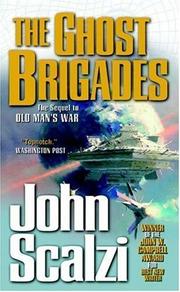
The Ghost Brigades
2,279-word summary 10 min read 384 pages in the book
- First published
- 2006
- Publisher
- Tor Books
- Pages
- 384
- ISBN
- 9780765354068
- Series
- Old Man's War (#2)
Reading options
What's inside (8 sections)
I read this one straight after finishing Old Man's War, mostly because the first book ended with Jane Sagan disappearing into classified channels and I wanted to know what she was doing. What I found was a book that barely resembles its predecessor. Where the first novel was one old man's wide-eyed tour of a brutal army, this is a colder, multi-viewpoint thriller about identity and treachery and what counts as a person when you can be grown in a tank from a dead woman's DNA. I liked it more than I expected, though not always for comfortable reasons.
The facts first. The Ghost Brigades by John Scalzi was published in 2006 by Tor Books, a 384 page hardcover with ISBN 9780765354068. It is book two of Old Man's War, following Old Man's War (2005) and ahead of The Last Colony (2007). Scalzi tells it in third person from several viewpoints, with a new soldier named Jared Dirac as the main lens. John Perry, the narrator of the first book, barely appears here. He is mentioned rather than seen. That choice tells you what this book is about. The old recruit is gone. The people he left behind are the story now.
A traitor inside the program
The book opens with the Colonial Defense Forces getting ugly news from a prisoner. They have captured a Rraey scientist and, through torture, learn that one of their own consciousness transfer scientists, Charles Boutin, has turned traitor. Boutin is not a disgruntled researcher filing a complaint. He has sparked an alliance between three alien species, the Rraey, the Enishan and the Obin, all pointed at wiping out humanity. This is a bigger threat than the border skirmishes Perry fought. It is an existential one, and it comes from inside the CDF's own science division.
That premise gave me a different feeling from book one. In Old Man's War the enemy was always outside the gate, however shady the Colonial Union was about explaining things. Here the danger is a gifted human who knows exactly how the CDF works because he helped build it. Scalzi spends real time on the investigation into Boutin's clumsy attempt to fake his own death. The team discovers that Boutin managed to store a copy of his consciousness in a computer before he vanished. So the threat is not just a man somewhere with an army. It is a man who can, in principle, come back inside any body the CDF grows from his cells.
I liked this switch. It turns the series' central technology, consciousness transfer, from a gift into a weapon pointed at its makers. The soldiers in this universe are already strange creatures: bodies grown for war, skills loaded through a BrainPal, memories that may not be their own. Adding a traitor who can hijack that setup makes the whole system feel fragile in a way the first book never quite did.
Growing a soldier named Jared
Boutin's cloned decoy corpse yields usable DNA, and the CDF's Special Forces, nicknamed the Ghost Brigades, decide on a bold experiment. They grow a fresh soldier body from that DNA and try to implant the stored copy of Boutin's consciousness into the new brain. The hope is that Boutin will wake up inside their own walls and lead them to his real location and his real intentions. The attempt appears to fail. The body comes online with no obvious trace of the traitor, so the CDF files the experiment under "worth a try" and gives the soldier a posting.
That soldier is Jared Dirac, named after the physicist Paul Dirac. He becomes a private in Special Forces and is assigned to a platoon commanded by Jane Sagan. Sagan, still the woman grown from John Perry's dead wife's DNA, is the one character who carries over with any real weight. She and her superiors keep a close eye on Jared on the off chance that Boutin's consciousness does surface. Perry himself is only a name and a memory in her past, which I found oddly appropriate. This is her war now.
Scalzi uses Jared to show us the Special Forces from the inside, and this is where the book gets its texture. These soldiers are not recruited at seventy five like Perry was. They are born into their bodies in tanks and know what to do only through their BrainPals. They have never been children, never had a life outside the CDF, never learned anything the slow human way. Jared's confusion about his own origins is not a quirky detail; it is the whole condition of his kind. Watching him try to locate himself among people who take their emptiness for granted was the most gripping part of the early chapters for me.
The universe gets more crowded too. Scalzi introduces the Eneshan, an insectoid species descended from termite-like creatures, hierarchical and matriarchal and constantly fighting among their own tribes. There are the Obin, who become central later, and the Gamerans, humans engineered to live in space who look something like large rock turtles hiding among asteroids and rings. I enjoyed the Gamerans as a quick idea, but I will admit the species catalog can feel like a list of concepts rather than living cultures. Book one had the same habit with its aliens. Scalzi is faster at inventing a striking look than at making you care about the society behind it.
One familiar face does turn up. Harry Wilson, the quick witted friend from Perry's lunch table in the first book, is now a scientist working for the CDF. Seeing him again gave me a small jolt of recognition, because he was the one character whose jokes I remembered most clearly. Scalzi uses him to bridge the two novels, and it helped me care about the new cast knowing that at least one old hand is still around asking awkward questions. The BrainPal, that computer wired into every soldier's head, is another thread back to the first book. It lets troops share targeting data and speak without opening their mouths, and in this sequel it becomes a weak point that can be switched off. What felt like a clever convenience in book one turns into a genuine liability here, and I liked that reversal.
The stranger in Jared's head
The turn comes through a memory. An experience that reminds Jared of Boutin's presumed dead daughter, Zoë, is enough to wake the stored consciousness. It starts small. Jared slowly becomes more like Boutin, picking up his patterns and his knowledge while shedding his own habits. The genuinely interesting choice Scalzi makes is that Jared does not simply disappear. He keeps his individuality and, crucially, keeps a strong moral opposition to Boutin's philosophy and actions. So for a stretch of the book you are inside one body occupied by two wills, one of them a traitor who genuinely believes humanity deserves what is coming to it.
I found this the most original part of the novel. It would have been easy to write a simple possession story where the villain takes over and the hero fights back from the shadows. Instead Jared and Boutin are entangled. Jared learns what Boutin knows, and Boutin has to deal with a host who finds him repulsive. Their internal arguments carry a moral weight that the physical battles do not. I kept thinking about the unfairness of it: Jared has to do the right thing with a mind that is partly built by the man trying to destroy his species.
This is also where the book earns its place as a sequel rather than a retread. In Old Man's War, the big questions were about age and bodies and grief. Here they are about selfhood. If you can copy a consciousness, print a body, and stuff one into the other, what makes the person in the chair the person who started the story? Scalzi does not lecture about it. He just keeps Jared stuck in the middle of the problem while bullets fly, and lets the reader do the worrying.
A fair complaint about this section: the body horror and the philosophy sometimes compete for space. Just as an argument between Jared and Boutin gets going, a fight interrupts, and just as a fight gets vivid, a technical explanation of BrainPal functions slows things down. I did not mind it much, but readers who want a clean philosophical thriller may find the tone split between thinking and shooting.
The moon mission falls apart
The plot's big set piece is a mission to the moon where Boutin is helping the Obin build their own consciousness transfer technology. Sagan leads it, and Jared goes along because the CDF needs him close in case Boutin surfaces again. The plan goes catastrophically wrong. Boutin has left a backdoor in the system and uses it to disable the soldiers' BrainPals, dropping many of them into a catatonic state. Picture highly trained supersoldiers who suddenly cannot access the computers wired into their own heads. Their bodies are still lethal; their coordination and shared awareness are gone. Scalzi writes this collapse with a cold efficiency that made me genuinely tense.
Boutin then interrogates Jared and settles on a plan of his own. He will transfer his consciousness into Jared's body, using it to infiltrate and destroy the Colonial Union from within, carried by a computer virus riding on the BrainPal. This is the moment when the "copy a person" premise turns into a proper nightmare. If Boutin succeeds, the CDF's own soldier becomes the delivery system for the thing that kills it.
Before that transfer can finish, Jared learns two things that matter more than any weapon. The Obin were given intelligence by the Consu, that ancient and ritual bound species from the first book, but they were not given individual self awareness. They crave it, and Boutin has promised to provide it. That is the real bait holding the alliance together. And Zoë, Boutin's daughter, is still alive. Jared manages to send both facts to Sagan before the transfer succeeds and his own consciousness ends.
I have to hand it to Scalzi for the pacing here. He could have dragged the moon sequence out for a hundred pages. Instead he lets the disaster happen fast, then spends his time on the information Jared manages to pass along. The stakes feel enormous precisely because they are delivered in a few urgent messages rather than a long speech.
A Trojan horse in the blood
Jared's last act happens after he is, in the strict sense, gone. Boutin is now in his body, but Jared has left a Trojan horse inside a BrainPal message. It oxidizes the smart blood coursing through that body, and Boutin dies. The man who spent the book trying to cheat death is killed by the very biology he thought he controlled. It is a neat ending to his arc, and it gave me a small shiver of satisfaction after all the dread.
The surviving mission members pull Zoë out, Sagan among them. The aftermath is handled with a dryness I appreciated. Sagan is offered retirement, less as a reward than as a way to keep her from repeating sensitive information she picked up from Boutin. She accepts. The book closes with her retiring to be with John Perry, the man from book one, and adopting Zoë. The Obin sign a treaty with the CDF that ends the hostilities. So the war that looked like it might finish humanity ends with a paperwork solution and a family arrangement, which feels like a very Scalzi way to resolve a galaxy sized crisis.
For context, the novel was a finalist for the 2007 Prometheus Award and for the 2009 Seiun Award in the translated long form category. Those nods make sense. It is a book about liberty and coercion dressed as a space opera, and its ideas traveled well enough to get nominated in Japanese translation.
What I took away from it
The thing I keep turning over is how differently this book treats its soldiers from the way the first one did. Perry enlisted because his life was finished and a new body sounded like a second chance. Jared never had a first life to compare anything to. He is a person assembled out of other people's plans, and his heroism consists mostly of refusing to let the strongest plan win. That is a bleaker idea than the first book's warm "age is a kind of skill" message, and I think it is a better fit for a story about identity theft at the level of the soul.
It is not flawless. The aliens remain thinly drawn, the technical detours can stall a good chapter, and the ending resolves a vast alliance rather quickly. There is also less of the warm humor that made Perry's narration so companionable. If you loved book one for its old folks trading jokes before a drop, this sequel trades that warmth for suspense and a harder questions. I missed the jokes, but I stayed for the questions.
I closed it thinking about Jared lying in that tank with two minds arguing over whether a species deserves to survive, and about Zoë being pulled out of a moon base by a woman who is not her mother but who is, in a way, made from the same family. The image of Sagan walking away from the CDF with a rescued girl in tow stuck with me longer than any of the battle scenes. It is the quietest thing the book does, and easily its best.
FAQ
When was The Ghost Brigades published and who published it?
Tor Books published it in 2006 as a 384 page hardcover with ISBN 9780765354068.
Do I need to read Old Man's War first?
It helps. John Perry is only mentioned here, while Jane Sagan and Harry Wilson carry over from the first book, so Old Man's War supplies the emotional backdrop.
Is this told from John Perry's point of view?
No. Scalzi uses several third person viewpoints with the new soldier Jared Dirac as the main lens, and Perry barely appears.
Similar books
More from Old Man's War first, then related titles.
Old Man's War
At 75, John Perry joins the army for a new body and a brutal war over colonies.
2,636-word summary · 12 min read
The Faith of Beasts
Book two of The Captive's War. Human captives of the Carryx fight for a future while their highest-ranked champion decides to manufacture one.
2,262-word summary · 10 min read
Consider Phlebas
The first Culture novel follows a spy for the opposing side, a man hired to hunt a fugitive through a war between an anarchist post-scarcity utopia and a…
2,350-word summary · 10 min read
Network Effect
Murderbot's contract job turns into a rescue mission when a hijacked research ship and a colony of corrupted colonists appear.
2,256-word summary · 10 min read
Heir to the Empire
Grand Admiral Thrawn returns from the Unknown Regions and outmaneuvers the New Republic while Luke, Leia, Han and smuggler Talon Karrde race him toward…
2,323-word summary · 10 min read
Xenocide
Lusitania faces a fleet with planet death while Ender, Jane, and families debate virus, souls, and law.
2,647-word summary · 12 min read
The Forever War
Drafted in 1997, physics student William Mandella fights Taurans across collapsars while centuries slip past back on Earth.
3,136-word summary · 14 min read
Speaker for the Dead
Ender speaks whole truths for alien deaths on a fenced colony where biology confuses murder.
1,992-word summary · 9 min read
The Guns of August
Tuchman narrates the first month of World War I, from a 1910 royal funeral to the Marne, and the decisions that trapped Europe.
2,405-word summary · 11 min read
Shadow of the Hegemon
Battle School graduates return to Earth in 2197, where Achilles kidnaps Ender's Jeesh and Bean works to free them while Peter Wiggin plays for the title of…
2,093-word summary · 9 min read
The Last Contract of Isako
On a planet where your job is your worth, a legendary corporate samurai is offered one last contract that turns personal when her worst apprentice sits at its…
2,099-word summary · 9 min read
Sunrise on the Reaping
Twenty-four years before Katniss, sixteen-year-old Haymitch Abernathy is swept into the fiftieth Hunger Games, where District 12 must send four tributes and…
2,198-word summary · 10 min read
Saga, Volume 4
Book Two opens with Alana and Marko trying to raise Hazel in hiding on Gardenia, while a vengeful robot kidnaps Prince Robot IV's newborn son.
2,003-word summary · 9 min read
Red Storm Rising
A fired Siberian oil field pushes the Politburo toward the Persian Gulf, and a conventional Third World War opens with stealth strikes and a fight for Iceland.
2,661-word summary · 12 min read
Barbarian Alien
Stranded on a frozen alien world, Liz accepts a symbiont to survive and finds it choosing Raahosh, the tribe's grumpiest hunter. A stubborn, steamy fight for…
2,778-word summary · 12 min read
The Killer Angels
A Pulitzer-winning novel of Gettysburg, told through Lee, Longstreet, Chamberlain, and Buford. Shaara turns a familiar battle into a chain of choices made by…
2,242-word summary · 10 min read

Opposition
In the Lux finale, Katy and Daemon face a fractured species, a government that hunts them, and a choice between their love and the future of mankind.
2,513-word summary · 11 min read
Monsters of Men
Todd Hewitt and Viola Eade are trapped between Prentiss's army, the Spackle and the Answer, in a war that keeps asking what a person becomes to win.
2,382-word summary · 11 min read
Babylon's Ashes
Three months after the Free Navy's strikes, the Rocinante crew returns as Earth, Mars, and the Belt unite to retake the Ring station of Medina.
2,245-word summary · 10 min read

Heretics of Dune
Fifteen centuries after Leto II, the Bene Gesserit raise a new Duncan Idaho while the Honored Matres return and Rakis burns.
2,673-word summary · 12 min read
Foundation's Edge
Exiled councilman Golan Trevize hunts for the Second Foundation and the lost world of Earth, and finds a planet with one mind waiting to change the galaxy.
2,335-word summary · 10 min read

Carve the Mark
On a planet divided between conquered and conqueror, the tyrant's sister and a kidnapped oracle's son discover that their gifts make them useful to everyone…
2,340-word summary · 10 min read
Leviathan
In an alternate 1914, a prince on the run and a girl disguised as a soldier meet aboard a living airship.
2,406-word summary · 11 min read
Starsight
Spensa Nightshade goes undercover aboard the Superiority space station Starsight to steal a hyperdrive, and finds a frightened bureaucracy where she expected…
2,568-word summary · 11 min read

Lone Survivor: The Eyewitness Account of Operation Redwing and the Lost Heroes of SEAL Team 10
Marcus Luttrell's account of the 2005 SEAL mission in Afghanistan that killed three of his team and left him alone.
2,144-word summary · 10 min read
The Ask and the Answer
Todd and Viola are separated in occupied Haven, where the Mayor's Ask tortures suspects and the Answer plants bombs in the name of freedom.
2,265-word summary · 10 min read
Saga, Volume 3
Marko, Alana, and Hazel hide on the planet Quietus with the reclusive author who inspired their romance, while assassins and a prince close in.
1,989-word summary · 9 min read
We Are Legion (We Are Bob)
A dead software engineer wakes up as a self-replicating space probe, clones himself into a squabbling fleet of Bobs, and tries to keep a ruined Earth alive.
2,357-word summary · 10 min read
Nemesis Games
The Rocinante crew scatters across the solar system just as Marco Inaros and the Free Navy bombard Earth. The Expanse reaches its turning point.
2,506-word summary · 11 min read