
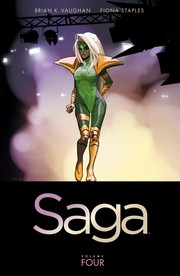
Saga, Volume 4
2,003-word summary 9 min read 144 pages in the book
- First published
- 2014
- Publisher
- Image Comics
- Pages
- 144
- ISBN
- 9781632150776
- Series
- Saga (#4)
Reading options
What's inside (8 sections)
A quiet life on Gardenia
This volume collects Chapters 19 through 24, the first stretch of what the creators call Book Two of the epic space opera. It opens in the aftermath of the family's flight from the burning lighthouse on Quietus. Alana, Marko, their daughter Hazel, Marko's mother Klara and the ghost girl Izabel have been living for several months on the neutral planet Gardenia, hiding in plain sight.
The premise of the series is a war between the Landfallians, who have wings, and the Wreathers, who have horns and practice magic. Alana and Marko are from opposite sides, their love is forbidden, and their child is the reason both sides want them dead. What makes the series unusual is that the domestic story is as important as the war. Volume 4 leans into that. The first chapters are about a family trying to have an ordinary life while the galaxy continues to hunt them.
Alana, through a favor from Heist's ex-wife Yuma, works as a masked actor in an underground theatre troupe called the Open Circuit, whose shows are projected across the galaxy. Marko, using the alias Barr, is a full-time stay-at-home father. Hazel is speaking in simple phrases. He meets Ginny, who runs a children's dance studio, while out with the baby. Those scenes are funny and tender, and they establish what the family has been trying to build.
The Open Circuit is one of the series' best inventions. It is an underground theatre troupe whose soap-opera and superhero performances are projected across the galaxy, which means Alana is famous to millions of people who have no idea who she really is. She wears a mask. Her work is to perform a version of a life for an audience that will never meet her. That premise fits a character who has been hiding in plain sight since the first volume, and Staples draws the theatre sequences with a theatricality that makes the rest of the book feel even more grounded.
Marko's situation is the mirror image. He gave up the life of a fighter to stay home with Hazel, and the book treats that as real work. There is a scene where he meets Ginny at the dance studio and is drawn to her easy competence with children. The attraction is believable because the series has spent three volumes showing how little ordinary adult companionship he has had. He is a formidable fighter and a stranger at a playground.
Hazel's language is growing, and the book uses her few phrases as punctuation. She is the reason everyone is trying to live quietly and the reason nobody can. The adult Hazel narrates the series from the future, which means every childish line carries a double meaning. We hear the words and we hear the woman remembering them.
That ordinary life is the volume's subject, and it is also what the volume threatens. Alana and Marko argue about the balance between keeping a low profile and giving Hazel a happy childhood. The argument is the kind that parents have everywhere, which is what makes it work. A space opera about a half-alien child can be about the tension between safety and freedom like any family story.
The other parents
Two other parents are introduced in parallel. Prince Robot IV's son is born while the prince is still missing in action. IV recuperates on the brothel planet Sextillion, haunted by guilt over the wounds he inflicted on Marko's family. When he learns what has happened to his wife and child, he goes to his father, King Robot, and asks for help. The king refuses. Special Agent Gale supplies a lead instead.
Dengo is the volume's new antagonist. He is a robot janitor and an anti-monarchist whose own son died at four because commoners do not have medical insurance. That grievance is absurdly specific and completely understandable, which is the best thing about him. He assassinates IV's wife and her staff, kidnaps the newborn and sets off for Gardenia with the baby as a hostage. He uses the infant to invade and kill the crew of a Landfallian starship.
The symmetry between Marko and IV is one of the volume's strongest ideas. Both are fathers who have made terrible choices, and both are now trying to get to a child who has been taken from them. The book puts them together near the end, and the scene works because their hatred is real and their purpose is temporarily the same. They resolve to find their stolen families together, which is a truce rather than a friendship.
The marriage comes apart
Alana takes a drug called Fadeaway after learning that half her colleagues use it. Marko grows closer to Ginny. Yuma warns Alana to maintain her cover, but her behavior may have alerted the tabloid journalist Upsher to her whereabouts. Marko discovers the drug use, and she confronts him about Ginny. The argument turns physical. He hurls groceries at her and she screams at him to leave the house. He becomes estranged from the family home.
That scene is the volume's most painful. Fiona Staples draws it with a clarity that makes it hard to look away from. There is no cosmic stakes in the moment. A man and a woman who love each other are destroying a domestic scene because they are frightened and exhausted. The series has always been willing to put ordinary dysfunction into its space opera, and this is the clearest example.
The aftermath of the fight is handled with care. Marko is not punished for leaving, and Alana is not simply forgiven for the drug use. Both of them have to live with what they said and did. Izabel's counsel about forgiveness is aimed at Alana, but it is really about the work of staying in a relationship when you have seen the worst of the other person. The ghost girl has died and returned, so she has a certain authority on the subject.
I should be direct about the book's content. The series is famous for explicit sex, sudden gore and strong language, and this volume is no exception. Those elements are not decoration. They are part of the book's insistence that its characters are physical beings with physical desires and vulnerabilities, even when they have horns or wings or tails. Readers who want a clean superhero comic will not find one here.
Dengo's demand for airtime at the Open Circuit is a strange and memorable scene. He wants the galaxy to hear the anti-monarchist case, and he kills two of Alana's colleagues to make the point. Yuma offers him something better than airtime, which is a negotiation the book does not explain until later. The scene matters because it shows how the personal and the political have collapsed into one another. A man who lost a son to a health system arrives at the theatre where Alana is hiding and makes her workplace into a crime scene.
Marko goes to Ginny's house but has a change of heart and turns back for the treehouse. That decision is the emotional turn of the volume. He chooses his family not because things are easy but because the alternative, however comforting, is not the life he wants. On the way back he finds that the house has been breached.
The invasion
Yuma reveals the family's location to Dengo, who shoots her. Izabel counsels Alana about the need for forgiveness. Dengo invades the tree-ship with the robot baby, takes Klara hostage and demands a course to his chosen coordinates. Alana launches the ship into space, which is one of the most astonishing images in the series: a living tree-house rising out of a quiet neighborhood while a robot holds an old woman hostage on board.
Marko arrives moments after the launch. He is met by the wounded Yuma and by Prince Robot IV, and the two enemies agree to work together. Elsewhere, Gwendolyn and Sophie, now Gwendolyn's formally sanctioned Page, meet The Brand, The Will's sister, who offers to help them obtain an elixir to heal the comatose mercenary. That thread continues the series' habit of following characters who have been out of the main story for a while.
Marko, IV and Yuma enlist Heist's neighbor Ghüs, using his psychic link to the robot Friendo, to track the missing families. The volume ends on a cliffhanger that leads to the frozen planet of Volume 5.
What the art does
Fiona Staples's work is the reason the book reads as powerfully as it does. She gives the characters bodies that are strange and legible at once. Alana's wings, Marko's horns, Izabel's transparent skin and the robot kingdom's angular designs are all distinctive, but the art never stops at spectacle. The emotional weight is carried by small things: Marko's face when he turns back from Ginny's house, Yuma's wound, Klara's stillness aboard the ship.
The color work is equally important. Gardenia is presented with a lightness that makes the later launch into space feel like a rupture. The series shifts between domestic comedy, body horror and space opera with a confidence that comes from the creators knowing exactly what kind of book they are making. Hazel narrates from the future, which gives the whole story a retrospective, slightly mournful tone even in the funny chapters.
The Gwendolyn thread deserves a paragraph because it is easy to overlook. She appears with Sophie, who has become her formally sanctioned Page, and the two meet The Brand, The Will's sister. The Brand offers an elixir that might heal the comatose mercenary. That plot barely touches the family on Gardenia, and yet it matters. The Will's relationship with Gwendolyn has been one of the series' strangest and most moving threads, and the book refuses to let it disappear just because the central family is in crisis. Vaughan is writing a universe in which secondary characters keep living when the main plot moves away from them.
The release date is worth noting for cataloguing. The trade paperback appeared in December 2014, collecting issues that had been published individually, and the edition runs to about 144 pages. A library binding and a Spanish edition exist, but the Image Comics paperback is the one to cite.
The volume also assumes familiarity with the comic's visual language. Staples draws the family's ship as a living tree with rooms inside, and the book relies on the reader recognizing it instantly from earlier volumes. New readers will spend a chapter or two working out the geography of a place the regulars know by heart.
Where it strains
The volume assumes you know the earlier books. The Will's coma, Gwendolyn's status and the history of the lighthouse on Quietus are all in the background, and a new reader will spend the first chapters guessing. That is reasonable for a fourth volume, and the site has the first three posted. The pacing also swings. The opening chapters are slow and domestic, then the last third accelerates into a series of crises. The change is deliberate, but it can feel abrupt.
Some of the supporting characters are introduced so quickly that they register as types: Ginny the dance teacher, Dengo the aggrieved janitor, Agent Gale the bureaucrat. Dengo in particular has a strong premise but gets less space than his grievance deserves. The book is more interested in what his action does to the central family than in who he is, which is a fair choice.
I finished the volume impressed by how much of it is about marriage. For all the aliens and robots, the central question is whether two people who love each other can survive a life of fear without becoming strangers. The launch of the tree-ship is a spectacular image, but the moment that stayed with me was Marko turning around outside Ginny's house. That is the book's real act of heroism.
FAQ
Which issues does Saga Volume 4 collect?
It collects Chapters 19 through 24 and opens Book Two of the series. The Image Comics trade paperback was published in December 2014 and runs about 144 pages.
Do I need the earlier volumes?
Yes. The Will's coma, Gwendolyn's role and the family's flight from Quietus are all background the book assumes you know. Volumes 1, 2 and 3 are already on the site.
How much of the series is romance and how much is war?
The central love story and the domestic life of Alana, Marko and Hazel are as important as the war between Landfall and Wreath. This volume is mostly about a marriage under strain.
Similar books
More from Saga first, then related titles.

Saga, Volume 1
Alana and Marko flee a galaxy-wide war with baby Hazel, hunted by both sides.
2,200-word summary · 10 min read
Saga, Volume 2
Alana and Marko flee with baby Hazel while exes, princes, and ghosts close the net.
2,028-word summary · 9 min read
Saga, Volume 3
Marko, Alana, and Hazel hide on the planet Quietus with the reclusive author who inspired their romance, while assassins and a prince close in.
1,989-word summary · 9 min read
The Stonekeeper
After their father's death, Emily and Navin chase a monster into a hidden world to save their mother, and Emily's great-grandfather's amulet offers power at a…
2,753-word summary · 12 min read

The Last Contract of Isako
On a planet where your job is your worth, a legendary corporate samurai is offered one last contract that turns personal when her worst apprentice sits at its…
2,099-word summary · 9 min read
The Gunslinger Born
A Marvel graphic novel adapting the flashback of Wizard and Glass: a fourteen-year-old Roland earns his guns, loves Susan Delgado and first sees the Dark Tower.
2,010-word summary · 9 min read

A Palace Near the Wind
In this 2025 science-fantasy novella, a Feng princess takes her sister's place as a human king's bride intending to assassinate him on her wedding day.
2,304-word summary · 10 min read

Babylon's Ashes
Three months after the Free Navy's strikes, the Rocinante crew returns as Earth, Mars, and the Belt unite to retake the Ring station of Medina.
2,245-word summary · 10 min read
Ship of Magic
A sentient ship wakes when her captain dies, and the family that owns her starts to come apart over who gets to sail her.
2,026-word summary · 9 min read

Bone, Vol. 1: Out from Boneville
Three cartoon cousins are run out of Boneville, separated by locusts, and dropped into a valley where rat creatures and an old grudge are waiting.
2,155-word summary · 10 min read

Archenemies
Nova steals for the Anarchists while Adrian hides his Sentinel identity, and a serum that erases prodigy powers puts them both at risk.
2,485-word summary · 11 min read

Carve the Mark
On a planet divided between conquered and conqueror, the tyrant's sister and a kidnapped oracle's son discover that their gifts make them useful to everyone…
2,340-word summary · 10 min read
Consider Phlebas
The first Culture novel follows a spy for the opposing side, a man hired to hunt a fugitive through a war between an anarchist post-scarcity utopia and a…
2,350-word summary · 10 min read
Network Effect
Murderbot's contract job turns into a rescue mission when a hijacked research ship and a colony of corrupted colonists appear.
2,256-word summary · 10 min read
Heir to the Empire
Grand Admiral Thrawn returns from the Unknown Regions and outmaneuvers the New Republic while Luke, Leia, Han and smuggler Talon Karrde race him toward…
2,323-word summary · 10 min read

The Borrowers
A family of tiny people live under the floorboards of an English house, borrowing what they need until a lonely boy and a suspicious housekeeper change…
2,164-word summary · 10 min read
We Are Legion (We Are Bob)
A dead software engineer wakes up as a self-replicating space probe, clones himself into a squabbling fleet of Bobs, and tries to keep a ruined Earth alive.
2,357-word summary · 10 min read
Nemesis Games
The Rocinante crew scatters across the solar system just as Marco Inaros and the Free Navy bombard Earth. The Expanse reaches its turning point.
2,506-word summary · 11 min read
Ancillary Justice
A ship mind trapped in one human body hunts the emperor who betrayed her across frozen worlds.
2,595-word summary · 12 min read

Y: The Last Man, Vol. 1: Unmanned
Yorick Brown and his monkey Ampersand survive a plague that kills every Y-chromosome mammal and cross a collapsed America.
2,525-word summary · 11 min read

Cibola Burn
Settlers and a company fight over a new world while Holden tries to stop a war.
2,011-word summary · 9 min read
The Fall of Hyperion
Keats persona Severn dreams pilgrims to the Time Tombs as Hegemony falls and TechnoCore war breaks the farcasters.
2,115-word summary · 9 min read
Rise of the Evening Star
Kendra and Seth return to Fablehaven as the Society of the Evening Star closes in, with a traitor inside the house and a demon prison key at stake.
2,874-word summary · 13 min read

A Wind in the Door
Meg must save Charles Wallace from a cosmic sickness by naming and loving what she fears, helped by a cherubim called Progo.
2,214-word summary · 10 min read
Dragonflight
A kitchen drudge with hidden mind talent Impresses a golden queen and must unite a starved dragon Weyr against Thread. First of Pern.
2,821-word summary · 13 min read

Abaddon's Gate
A dead detective guides Holden, an assassin hunts him, and a pastor walks unarmed into a mutiny as the Ring opens new worlds.
2,672-word summary · 12 min read
Fablehaven
Kendra and Seth spend the summer with their grandfather and learn his woods hide Fablehaven, a preserve for fairies, satyrs and darker things.
2,949-word summary · 13 min read
The Angel Experiment
Six winged kids escape the lab that made them and fly cross country to rescue their youngest from wolf hybrids.
2,037-word summary · 9 min read
Morning Star
Broken in a box by the Jackal, Darrow rises with Howlers to open Mars mines to sky.
2,009-word summary · 9 min read

Leviathan Wakes
A destroyed ice hauler, a missing heiress, and an alien growth pull a crew and a tired detective toward war across the solar system.
3,653-word summary · 16 min read