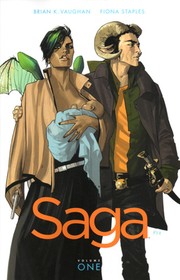
Saga, Volume 1
2,200-word summary 10 min read 160 pages in the book
- First published
- 2012
- Publisher
- Image Comics
- Pages
- 160
- ISBN
- 9781607066019
- Series
- Saga (#1)
Reading options
What's inside (9 sections)
I picked up Saga because a friend said it made him cry on a plane. Instead of space battles, the first pages give you a woman in labor on a workbench, a panicked husband, and soldiers at the door. That mix of tender and violent never lets up. Fiona Staples draws it in soft, warm colors that keep even bloody scenes close and human and painfully intimate.
This volume collects issues one through six, published by Image Comics in 2012. Brian K. Vaughan writes. Staples draws, colors, and letters. Hazel, the baby at the center, narrates from a later age. She tells us her parents did something brave and stupid, and that she lived to tell about it, though not without loss.
The setup is plain. Landfall, a planet of winged people with high tech, has fought Wreath, its moon of horned people who use magic, for generations. They spread the war to proxy worlds. Alana is a Landfall soldier. Marko is a Wreath soldier. She guarded him when he was a prisoner. They fell in love, deserted, and fled to Cleave. Now Alana is giving birth in a garage while Marko tries to help.
Birth and pursuit
The first issue barely leaves that garage, which I liked. Alana curses and pushes, wings damp and folded. Marko whispers encouragement that sounds useless because he is scared too. Hazel arrives loud and messy, with small wings like her mother and small horns like her father. In peacetime that mix might be sweet. Here it is proof of treason.
Hazel narrates with dry humor from the future. That voice keeps the scene from turning grim. You wince and laugh at once.
Then Landfall troops break in. Talk of arrest turns fast to execution, because a mixed child proves desertion. Marko tries words first. When that fails he fights. A spell flares. Blood hits tile. Alana grabs a dropped gun. They win, but Alana is still bleeding and Hazel is still screaming. They wrap the baby and run.
What struck me is how unglamorous parenthood looks here. Hazel is heavy, hungry, and loud. Marko tries a translation spell and it goes wrong in a funny way. Alana does not trust chants. They love each other, but they snap about sleep. They feel very young.
A fair criticism starts here. The dialogue often sounds like present day America. If you want hard science fiction with thick slang, this will feel thin. Vaughan is writing a war romance in space clothes.
Prince Robot IV in the woods
The family heads for the Rocketship Forest, where old living ships grow like trees and can be coaxed awake. To get there they must cross the wilds of Cleave, a planet seeded with mines and ghosts after years as a testing ground. The trees look dead. The light stays blue and cold.
After them comes Prince Robot IV, one of the best reasons to read this. He serves the Robot Kingdom, which sided with Landfall. His head is a television screen, his body is polished metal, his lower legs are narrow and hard. When he is calm his screen shows a polite face. When he is angry it breaks into static. Staples gives him posture and pauses that read clearly without a mouth.
He is not a simple villain. He has just become a father. The book cuts between the hunt and his wife and infant son back home. He tells himself he fights so his child can live in peace, the same excuse Alana and Marko use in reverse.
He moves through Cleave with local troops. There is a short, ugly interrogation where he tries to stay clean and fails. That shame does not stop him.
In between chase beats, the parents bicker about small things. How to wash cloth in a cold stream. Where to sleep when the ground might explode. Hazel remembers these details fondly in narration. The war is huge. The diapers are urgent.
The pacing dips a little here. The second issue is mostly running and hiding while Vaughan places all his pieces. I felt it drag on first read, less on second, but it is there.
Izabel the ghost
The strangest help comes from Izabel, a ghost girl about eleven or twelve. She died on Cleave when she stepped on a mine. Her upper half looks like a normal kid with messy hair. Her lower half trails into pale, floating strands. She cannot leave the planet because her spirit is tied to it. She is bored, lonely, and blunt.
Alana and Marko meet her in the ruins. She mocks them, then softens when she sees Hazel. She offers a deal. If they carry her spirit off world when they go, she will guide them through the minefields and help watch the baby. They agree, and she attaches herself to Hazel like a big sister.
Izabel steals every scene. Staples draws her as funny rather than gross. Vaughan writes her as a kid who has seen too much and jokes to cover fear. She teases Marko about his vow. She points out dead friends in the trees without self pity. One quiet page where she names kids she used to play with hit me harder than any battle.
Through her we learn Cleave's past without a lecture. Landfall tested weapons here. Wreath answered with curses. Locals paid. It gives the chase weight beyond catch the deserters.
A note on taste fits here. Izabel talks about bodies the way a kid who overheard adults might. The book keeps those lines brief and ties them to fear rather than teasing the reader. Still, this is not a kids comic. Preview if you share with teens.
The Will, the Stalk, Gwendolyn
Landfall and Wreath both hire freelancers to do the worst work. The Will and the Stalk are the pair sent after the family. They are lovers and partners, though neither word feels quite right for them. The Stalk is tall, spiderlike, cold, and fast. She kills without speeches. The Will is human looking, scarred, skilled with a lance, and followed everywhere by Lying Cat, a large hairless cat who says Lying aloud whenever someone near her lies.
Lying Cat sounds like a joke and becomes a conscience. The Will cannot fool himself long with her nearby. There is a panel where she curls around him while he sleeps, heavy as a big dog, and it tells you he is not fully hard yet.
We meet them on Sextillion, a pleasure planet built like an open air brothel. A teenage slave girl called Sophie cleans rooms and watches everything. The Will, who claims a rule about not hurting kids, loses his temper and kills her tormentor. He takes Sophie with him, which is better than leaving her, but he has no plan. The book knows rescue takes more than anger.
The Stalk mocks him for going soft. Their fight about the contract shows how this war works. The home planets claim honor, then pay outsiders to kill a newborn so their hands stay clean.
Then Gwendolyn arrives. She was promised to Marko on Wreath before he vanished. She still wears the ring and still knows his spells. When Wreath asks her to track him, she agrees from duty and hurt. Vaughan writes her as sharp rather than shrill. She is angry, but also competent.
She crosses paths with the freelancers and with a tracker named Upcatch. Her scenes with Sophie are uneasy. She sees a girl traded by adults and recognizes her own arranged future. She stays a hunter here, but you sense she could turn.
My criticism here is crowding. The Will, the Stalk, Lying Cat, Gwendolyn, Sophie, plus Marko's parents Barr and Klara, plus novelist D. Oswald Heist. That is a lot for 160 pages. The Stalk in particular moves very fast. First time I flipped back to remember who hired whom.
The explicit content peaks here, so plain talk helps. Sextillion pages show full nudity and frank haggling. A scene with Prince Robot IV and his wife is tender but graphic. None of it felt random. Vaughan argues that in a universe that treats bodies as weapons or products, touch is how people try to stay human. But the frequency can feel like dares. If you want war stories without sex, this will test you.
The forest and the vow
Near the end the family reaches the Rocketship Forest with Izabel's help, and the tone lifts. Huge seed ships hang from pale trees. Marko knows the old songs to wake them. For a few pages they are not prey. They are parents showing a baby something wonderful.
That pause lets the marriage breathe. Marko has sworn never to lift his sword again. He carries it wrapped. Alana thinks that is a luxury. She trusts what she can hold. They fight in short bursts between chores. It feels like real tired couples talk.
Barr and Klara, Marko's parents, catch up here. Barr is big, gentle, always knitting. Klara is thin, tart, practical. They disapprove of Alana, then help with Hazel anyway because grandparents cannot help it.
Heist lives nearby in a lighthouse, author of the romance Alana and Marko both loved during the war. There is a quiet scene where Alana reads his book aloud to Hazel while Marko listens from the doorway. She knows it is full of lies, but she loved it because it made her feel less alone as a soldier. Stories gave them a shared language before they met.
The trap is set while they rest. Prince Robot IV pushes on. The Stalk moves ahead alone. The Will lags with Sophie. Gwendolyn follows Marko's trace. You can feel the circle close.
What keeping her costs
The last issue drops the warmth fast. The Stalk finds them first, and the fight is the bloodiest in the book. Marko begs her to leave. She laughs. You always know where Hazel is in the frame, which makes every swing scarier. Marko breaks his vow to save his family and hates himself at once.
I will keep exact beats light, but the cost spreads. The Will arrives too late to stop it. Prince Robot IV arrives carrying fresh grief. Barr and Klara must pick between ideals and granddaughter. Izabel shows courage when Hazel is threatened. Hazel does what newborns do. She cries at the worst moment.
The final pages are deliberately cruel. Just as you think they bought time, Vaughan adds a new threat and stops. Hazel tells you this was only the start of losing people. Volume 1 is Act One, not a whole story. It ends on a gasp.
That is my biggest structural criticism. If you expect six issues to form a neat arc, you will be annoyed. Threads with Gwendolyn, The Will and Sophie, Prince Robot IV, Heist, all hang. Keep Volume 2 close.
Tone is the other fair knock. Vaughan mixes diaper jokes, gore, and graphic sex without warning. Staples holds it together with warm art that keeps faces human. But some pages feel glib, as if daring you to flinch. I got why some friends bounced off.
What kept me past those bumps was Hazel. She remembers smells better than speeches, milk and gun oil and wet leaves. She calls her parents idiots and heroes in the same sentence. Big armies decided she should not exist. Her parents decided otherwise. That small defiance gives every chase scene weight. You are not waiting to see who wins a battle. You are waiting to see if a tired couple can keep a baby fed one more night.
Staples deserves praise. You could follow much of the plot without words. Alana's tired eyes, Marko's soft look at Hazel, Prince Robot IV's flickering screen, Izabel's grin, Sophie's blank stare near Lying Cat, all read clearly. Colors stay pastel even in fights, which keeps gore from feeling celebratory. Blood looks sudden and ugly, then someone has to clean it while holding Hazel.
If you have never read comics, this is a friendly entry if you are an adult okay with explicit material. The plot is linear. The art is clear. You need no continuity. If you have read for years, you will catch the remix. Star crossed lovers, space chase, a little Romeo and Juliet, a little Lone Wolf and Cub with a baby girl.
I finished in one sitting. Two people from opposite sides of a stupid war, trying to change a diaper while the world burns. They fail a lot. They keep trying. That mix of love and judgment feels rare. It explains why Saga became a hit.
Reading it now
Rereading now, the war commentary has not dated much. Landfall outsources to proxies. Wreath answers with terror and tradition. Civilians pay for both. Alana and Marko are not cured by love. They unlearn slowly and badly, while Izabel heckles and Lying Cat calls out lies. I still wish Sophie had more voice here. She functions mostly to test The Will. Know what you are getting. Adult bodies, adult language, sudden violence, and a story that will not tie up neatly.
FAQ
Who are Alana, Marko, and Hazel in Saga, Volume 1?
Alana is a Landfall soldier and Marko is a Wreath soldier who desert after falling in love. Hazel is their newborn daughter, hunted because her birth proves treason, and she narrates from the future.
Is Saga, Volume 1 explicit or suitable for teens?
It is explicit. It includes full nudity, frank sex work on Sextillion, strong language, and bloody violence, so it fits adult readers rather than young teens.
Do I need to know the series before reading Volume 1?
No. This collection gathers issues 1 to 6 in order and introduces the war, the Rocketship Forest goal, and hunters like Prince Robot IV, Gwendolyn, and The Will.
Similar books
More like Saga, Volume 1 →More from Saga first, then related titles.

The Crown of Gilded Bones
Poppy, crowned queen, faces war with the Ascended after Casteel is taken captive.
2,562-word summary · 11 min read
House of Flame and Shadow
Bryce lands outside Midgard while Hunt sits in Asteri dungeons and the war for two worlds builds.
2,983-word summary · 13 min read

House of Sky and Breath
Bryce and Hunt want normal love but rebels and Asteri pull them to war and portals.
2,204-word summary · 10 min read

Divine Rivals
Iris Winnow trades secret letters with rival Roman Kitt as gods Enva and Dacre wake to war.
2,594-word summary · 12 min read

Tower of Dawn
Chaol and Nesryn sail to Antica for armies and healing, finding Yrene Towers and Valg darkness instead.
2,054-word summary · 9 min read

Empire of Storms
Aelin gathers armies and faces Maeve while Elide and Manon flee Morath.
4,466-word summary · 20 min read