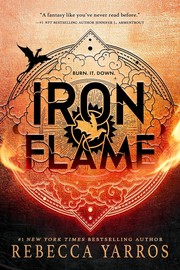
Iron Flame
2,687-word summary 12 min read 623 pages in the book
- First published
- 2023
- Publisher
- Red Tower Books
- Pages
- 623
- ISBN
- 9781649374172
- Series
- The Empyrean (#2)
Reading options
What's inside (9 sections)
I came into Iron Flame tired in the way you only get after a book like Fourth Wing. I had stayed up too late, I had strong opinions about dragons, and I did not want to wait to find out what happened after Violet learned her brother was alive and Navarre was lying. Rebecca Yarros published Iron Flame in 2023 with Red Tower Books as the second book in The Empyrean series, and it picks up almost right where the first one leaves off. It is longer, messier, and more interested in war than in school. I liked that shift, even when the middle tested my patience.
Violet Sorrengail survived her first year at Basgiath War College when almost no one expected her to. She is still small, still dealing with a body that bruises and breaks too easily, and still bonded to two dragons, which should be impossible. Tairn is old, large, black, and blunt. Andarna is young, gold, and growing into something no one fully understands. Violet also carries a lightning signet that can kill her as easily as it can save her. She opens the book trying to hold all of that together while hiding what she learned at the end of Fourth Wing. Her brother Brennan is alive. The rebellion was not finished. There are enemies past the wards that Navarre refuses to name. And Xaden Riorson, the man she loves, has been keeping his own list of secrets.
The return to Basgiath feels different from the first book. The parapet crossing and the early sparring matches gave Fourth Wing a clear school story shape. Iron Flame keeps the school, but war keeps intruding. A new vice commandant, Major Burton Varrish, runs second year with a focus on discipline that shades into cruelty. Classes turn into interrogations. Punishments turn into lessons for everyone watching. Violet is a target because of who her mother is, because of who she bonded, and because Varrish suspects she knows more than she says. Which she does.
Back to Basgiath
Violet does not get a soft landing. She walks back into a place that tried to kill her repeatedly and finds it colder. Her mother, General Lilith Sorrengail, is still in command. Her sister Mira is still serving. Her friends from first year, Rhiannon, Ridoc, Sawyer, and the others, are still there, but the easy trust of early training is gone. Everyone has seen combat now, or heard enough about it to act like they have.
Training in second year centers on new skills. There is more flying work, more signet control, more close combat, and a long stretch built around war games that divide the cadets into sides and ask them to take and hold ground. Yarros uses these sections to show how Violet thinks. She cannot outmuscle most riders. She wins by reading terrain, by remembering records, by asking what the instructors are not saying. One of my favorite small touches is how often Violet falls back on scribe habits. She notices supply lists. She notices which archives are locked. She notices when a lesson plan skips a region on the map. That habit drives the plot more than any single fight.
Varrish becomes the face of Basgiath in this book. He likes pain as a teaching tool. He uses Violet to make points to the whole wing. He watches her reactions, pushes her toward breaking, and writes it up as instruction. The book does not hide how much Violet hates him, and it does not ask you to find him interesting beyond his function. He is the wall she keeps hitting while the real threat waits outside Navarre.
Andarna pulls back early in the book, and that choice shapes a lot of Violet's loneliness. Without her youngest dragon speaking to her, Violet leans harder on Tairn, who is steady but not soft. Tairn scolds. He warns. He carries her through flight drills while telling her she is pushing too fast. Their bond remains the most stable relationship Violet has, which says something about how rough her human relationships get here.
Secrets between Violet and Xaden
Xaden and Violet end Fourth Wing together but not clear. Iron Flame lives in that lack of clarity. Xaden is now tied to the revolution in Aretia, working with other marked ones, the children of executed rebels who carry rebellion relics on their skin and suspicion everywhere they go. He goes quiet about meetings, about flights, about where his dragon Sgaeyl takes him. Violet asks. He deflects. She pushes. He tells her it is to protect her. She hears control.
I found this part both believable and exhausting. Believable because both of them have reasons to lie. Xaden was raised inside a plan Violet only just learned about. Violet reports to a mother and a college that would kill his friends if they knew the truth. Exhausting because the book repeats the loop many times. He hides something. She finds part of it. They fight. They make up in a physical way that solves nothing. Then it happens again.
The romance is explicit and frequent, more so than in the first book. If you liked that heat in Fourth Wing, you will get more here. If you wanted the plot to move faster, you may skim some of these scenes. I did skim once or twice, not because they were badly written, but because I wanted to get back to Aretia and the venin question.
Aretia itself matters more as the book goes on. It is the old rebel stronghold, hidden, rebuilding, full of people who do not trust Navarre and do not fully trust Violet either. When Violet finally spends real time there, the book breathes differently. The rules loosen. The dragons speak more freely. The archives are not censored in the same way. You see what Xaden has been protecting, and you also see why Violet feels shut out. She arrives as both guest and risk.
Brennan being alive lands hard in these chapters. Violet grew up mourning him. Now he is older, scarred, working as a healer for the revolution, and careful with her. Their scenes are awkward in a good way. He tries to act like an older brother. She tries to act like she does not need one. Their mother stands between them even when she is not in the room.
War games and Varrish
The middle of the book belongs to training, punishment, and the long war game exercise. Yarros stages squad movements, captures, negotiations, and betrayals that feel closer to real field problems than the duels of first year. Violet leads at times. She fails at times. She learns which friends follow orders and which friends follow her.
Varrish uses these games to isolate Violet. He assigns her impossible positions. He questions her after. He puts her in situations where using her signet will hurt her and not using it will fail the mission. One extended punishment sequence involves repeated physical pain under the excuse of interrogation resistance. It is grim to read. The book wants you to feel how Basgiath breaks people who ask questions, and it succeeds. I thought these chapters ran too long, but I understood why they were there. Violet has to learn that surviving school is not the same as winning a war.
Jack Barlowe returns, which surprised me and then annoyed me in the way I think Yarros intended. He should be dead after what happened in Fourth Wing. He is not, and his return gives Varrish a tool and Violet a constant source of dread. Jack knows something about what waits past the border. He hints at it. He smiles when others flinch. He is the kind of villain who enjoys being underestimated.
Rhiannon, Ridoc, Sawyer, Quinn, and the rest of Violet's squad get moments that keep the large cast human. Rhiannon in particular steps up as a leader when Violet is pulled toward Aretia. Ridoc provides humor without turning into a joke. Sawyer deals with injury and the fear that his riding days are ending. These threads do not get as much space as I wanted, because Violet and Xaden take up so much air, but they keep Basgiath from feeling empty.
Signet training is another thread. Violet's lightning is rare and strong. It responds to emotion, to storm, to need. That makes it powerful and unreliable. Instructors tell her to ground, to breathe, to channel through Tairn. She tries. Sometimes she overdoes it and blacks out or burns her own limits. Andarna's absence makes this harder, because Violet is missing part of her balance. When Andarna finally reenters the story in a fuller way, the shift in Violet's power makes sense. Growth has a cost here, paid in control.
What Navarre hides
The biggest idea in Iron Flame is the lie at the center of Navarre. The kingdom tells its riders and its citizens that the wards hold, that the war in the east is the real war, that the stories about venin, dark wielders who drain magic from the land, are old tales. Violet learns otherwise. She reads censored histories. She talks to riders who have seen gray-eyed enemies. She compares maps that do not match.
The venin are not subtle once you see them. They pull power straight from the ground, killing the land to feed themselves. Their eyes give them away. Their weapons feel wrong. The wards that should stop them are failing, and Navarre's leadership would rather punish cadets for asking than admit the wall is cracking. This is where the book is strongest. The school drama fades and a larger, bleaker picture forms. Violet realizes her mother may know. She realizes command may know. She realizes the war she trained for is not the war coming.
The book handles exposition about venin and wards through found texts, through Brennan, through Xaden's reluctant admissions, and through Violet's own trips past the border. Some of this is clunky. Characters explain things they would already know for the reader's benefit. Maps get described more than shown. But the core reveal lands. Navarre burned the rebellion to keep unity, and now it needs that unity to face something it still will not name in public.
Mira plays a key role in this section. She loves Violet, serves Navarre, and starts to see the cracks. Her loyalty is not simple. She defends their mother longer than Violet does, then bends when evidence piles up. I liked Mira more here than in Fourth Wing because she gets to be wrong and adjust, rather than just warn Violet and leave.
Lilith Sorrengail remains distant and hard to read. The book keeps her motives cloudy. Does she protect her daughters by keeping them inside the lie? Does she believe the lie herself? Does she know about Aretia and choose battle over truth? Yarros does not answer fully, which frustrated me at times but felt honest to Violet's view. Children rarely get clean answers from powerful parents during war.
Aretia, gryphons, and the wider fight
Once the story moves more fully to Aretia and the surrounding region, new allies and new limits appear. Gryphon riders from Poromiel enter the picture. Their beasts are smaller than dragons, faster in different ways, and tied to riders through a different kind of bond. Violet has to learn fast that dragon tactics do not always apply. The joint training scenes are some of the best action in the book because everyone is a little out of their depth.
The politics here are sharp. Poromiel wants help. Aretia wants independence. Navarre wants control. Violet wants truth. None of those wants line up neatly. Meetings end with partial deals. Promises get made that cannot be kept. Xaden tries to hold the center and pays for it. Violet tries to force honesty and learns that honesty can get people killed.
Dragons drive much of this. Tairn respects strength and speaks plainly about risk. Sgaeyl is fierce and loyal to Xaden in a way that mirrors and tests Violet's bond with Tairn. Andarna's growth changes what Violet thought she knew about dragon kinds and about her own signet. Without giving away the late reveals, the book ties Andarna's nature to the larger magic system in a way that reframes earlier scenes. I had guessed part of it, but not the full shape.
The late battles move quickly. There are sieges, rescues, flights through storm, and a costly stand where Violet has to use everything she has learned about lightning, grounding, and trust. Yarros writes flight well. You feel speed, height, cold, and the weight of a dragon turning under you. You also feel how tired Violet is by this point. She makes mistakes. People get hurt because of those mistakes. The book does not let her off easy.
The ending is brutal and abrupt. It resolves some questions about who can be trusted and opens larger ones about what the next fight will demand. A major loss near the close hit me harder than the romance beats, because it felt permanent in a series that sometimes saves its favorites. I closed the book angry at several characters, worried about Andarna, and ready for the next volume despite my complaints about length.
What worked and what dragged
What worked for me was scale. Fourth Wing promised a world beyond school. Iron Flame delivers it, with Aretia, Poromiel, gryphons, venin, and failing wards. The action scenes in the air are clear and exciting. The archive hunting scenes scratched the same itch as the scribe moments in book one. Violet's voice stays stubborn and funny under pressure, and her friendships still warm the book when the romance cools.
What dragged was repetition. Violet and Xaden have the same fight about secrets too many times. Varrish torments Violet in scenes that blur together. The middle could lose a hundred pages and gain pace. Some reveals arrive through long talks rather than through choices, which slows momentum right when the war should speed it up.
I also wanted more time with the wider squad and with Mira and Brennan. They flash brightly and then vanish for stretches. When they return, I had to remind myself where we left them. A shorter book might have served them better, or a book less focused on the central couple.
Still, I read fast once the wards plot took over. The questions about who gets to write history, who gets to name an enemy, and what loyalty costs when command lies, those carry the book past its bloat. Yarros is good at making institutional cruelty feel personal. Basgiath does not just teach riders. It teaches obedience, and Violet's refusal to obey quietly is the engine of the series.
If you loved Fourth Wing for the school trials and the slow burn, know that Iron Flame is heavier, sadder, and more about armies than classes. If you wanted more dragons, more politics, and a clearer look at the enemy, you will find plenty to hold onto. I finished it convinced that Violet's real test is not whether she can wield lightning without breaking. It is whether she can build trust across lines Navarre drew to keep people apart. That question, more than any battle, made me pick up the next book.
Reading order and context
Iron Flame is the second book in The Empyrean series after Fourth Wing and before Onyx Storm. You need the first book for any of this to make sense. Bonds, signets, rebellion marks, and the geography of Navarre, Aretia, and Poromiel all carry over without much recap.
Rebecca Yarros wrote the book quickly after the success of Fourth Wing, and you can feel both speed and pressure in the pages. The world expands fast. Some threads fray. But the core stays strong. A young woman who was supposed to copy records learns to read battlefields instead, and a kingdom that prized silence starts to lose control of its story. I may grumble about the length, but I stayed up late anyway. That counts for something.
FAQ
What is Iron Flame about?
Violet returns to Basgiath War College for her second year as a rider. She faces new instructors, war games, and orders that pull her toward the front lines.
Is Iron Flame a sequel to Fourth Wing?
Yes, it is the second book in The Empyrean series after Fourth Wing. It continues Violet and Xaden's story and sets up Onyx Storm.
Which dragons does Violet ride in Iron Flame?
Violet bonds Tairn and Andarna in Fourth Wing and keeps both bonds in Iron Flame. Her lightning signet grows stronger and harder to control.
Similar books
More like Iron Flame →More from The Empyrean first, then related titles.
Fourth Wing
Rebecca Yarros's Fourth Wing retold: Violet enters Basgiath, bonds Tairn, and learns what the wards hide.
2,580-word summary · 11 min read

The Crown of Gilded Bones
Poppy, crowned queen, faces war with the Ascended after Casteel is taken captive.
2,562-word summary · 11 min read
Saga, Volume 1
Alana and Marko flee a galaxy-wide war with baby Hazel, hunted by both sides.
2,200-word summary · 10 min read

Brisingr
Eragon rescues Katrina, backs a dwarf king, and earns a burning sword.
2,214-word summary · 10 min read

A Touch of Darkness
Persephone bargains with Hades in New Athens nightclub deal.
2,545-word summary · 11 min read
House of Flame and Shadow
Bryce lands outside Midgard while Hunt sits in Asteri dungeons and the war for two worlds builds.
2,983-word summary · 13 min read