
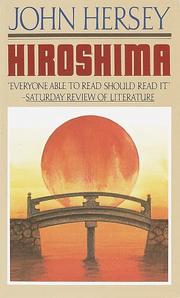
Hiroshima
2,991-word summary 13 min read 152 pages in the book
- First published
- 1946
- Publisher
- Alfred A. Knopf
- Pages
- 152
- ISBN
- 9780679721031
Reading options
What's inside (9 sections)
I had heard about this book for years before I finally opened it, and the story people always told me was about a magazine issue. On August 31, 1946, The New Yorker threw out its usual lineup and gave the entire issue to a single article. The editors printed a note on the first page saying the magazine was devoting all its editorial space to an article on the obliteration of a city by one atomic bomb, and that they did it because "few of us have yet comprehended the all but incredible destructive power of this weapon." It ran about thirty-one thousand words. Less than two months later the same piece was a book from Alfred A. Knopf, and it has never gone out of print. I picked it up wanting to know what kind of writing could make a magazine do something like that.
What I found was not a history in the usual sense. There are no chapters on the decision to drop the bomb, no maps of the city, no arguments about military necessity or the politics of surrender. Hersey chose six people and followed them through the blast and the months after it. That choice is his whole method, and it is the reason the book has outlasted most of the reporting done around it.
The morning everything stopped
The book opens at exactly 8:15 on the morning of August 6, 1945, Japanese time. The first sentence names Miss Toshiko Sasaki, a clerk in the personnel department of the East Asia Tin Works, who had just sat down at her desk and was turning her head to speak to the girl at the next desk. Hersey then walks through the other five, each still in the middle of an ordinary morning.
Dr. Masakazu Fujii is sitting cross-legged on the porch of his private hospital, reading the Osaka Asahi. Mrs. Hatsuyo Nakamura stands at her kitchen window, watching a neighbor tear down his house because it sits in the path of a fire lane. Father Wilhelm Kleinsorge, a German Jesuit, is lying in his underwear on a cot on the top floor of the mission house, reading a magazine called Stimmen der Zeit. Dr. Terufumi Sasaki is walking along a corridor of the Red Cross Hospital with a blood specimen for a Wassermann test in his hand. The Reverend Kiyoshi Tanimoto, pastor of the Hiroshima Methodist Church, has paused at the door of a rich man's house in the western suburb of Koi and is getting ready to unload a handcart of things he has evacuated from the city.
Then the light comes. Each person sees it differently. Toshiko Sasaki remembers a blinding flash, and a bookshelf falls onto her leg as the building comes down around her. Fujii sees a brilliant yellow flash and is thrown into the river running past his hospital, badly hurting his shoulder. Nakamura sees a whiter white than she has ever seen and is thrown into the next room while her children are buried under debris. Kleinsorge describes something like a large meteor colliding with the earth and comes to rest in the mission garden with only small cuts. Dr. Sasaki, in the hospital corridor, sees a gigantic photographic flash; the building is torn apart around him, but he is unhurt except for losing his glasses and shoes. Tanimoto sees a tremendous flash of light cut across the sky and feels his house push splinters into his back.
The number of dead was almost beyond comprehension. Hersey's opening says a hundred thousand people were killed; later estimates put the figure closer to a hundred and thirty-five thousand. The city had held roughly a quarter of a million. In a few seconds a huge share of that population was gone, and the six people Hersey chose were alive for reasons they could not explain. He writes that each of them counted "many small items of chance or volition," a step taken in time, a decision to go indoors, one streetcar instead of the next. The idea that survival is mostly a heap of accidents sits underneath everything that follows.
Six lives, chosen carefully
Hersey did not pick these people at random, and he tells us enough about each of them to make their choices feel like lives rather than symbols.
Toshiko Sasaki is twenty, engaged to a soldier, and new enough to her office job that the details of it matter to her. She is about sixteen hundred yards from the center of the blast. Her injury is bad and it is made worse by neglect. Her leg is fractured, the wound becomes infected, and for weeks she gets almost no real medical attention while she lies where she fell. Hersey lets the reader sit with that wait, which is one of the hardest stretches in the book. She later appears in the record under a different name, Sister Dominique Sasaki, a detail that only matters if you read the last chapter.
Mrs. Nakamura is a widow. Her husband, a tailor, was killed in Singapore in 1942, and she is raising three children alone: Toshio, ten, Yaeko, eight, and Myeko, five. She is the closest of the six to the center, at about thirteen hundred and fifty yards. She spends the days after the blast trying to keep her children alive and fed, and gradually learns that the rest of her family is dead. There is no big scene made of this. Hersey just keeps following her as she does what has to be done.
Dr. Fujii is the most prosperous of the group, a convivial man who owns a thirty-room private hospital with modern equipment and keeps his family in Osaka and Kyushu. He is about fifteen hundred and fifty yards out. The blast dumps him in the river and wrecks the hospital that is his livelihood. He spends the following days hurt, stranded, and increasingly aware that the practice he built is finished.
Father Kleinsorge is thirty-eight, a German Jesuit who has never quite felt accepted in Japan. Hersey describes him as thin, with a prominent Adam's apple, a hollow chest, dangling hands and big feet, worn down by the wartime diet. He is around fourteen hundred yards from the center, under his order's superior, Hugo Lassalle. His cuts are minor, but radiation sickness takes hold of him later and he grows worse through the weeks. In the later record he is listed under the Japanese name he eventually took, Makoto Takakura.
Dr. Terufumi Sasaki, no relation to Toshiko despite the shared surname, is a twenty-five-year-old surgeon at the Red Cross Hospital. He lives with his mother and is something of an idealist, annoyed by the poor state of health services and willing to practice without a permit in places that lack care. At about sixteen hundred and fifty yards he is the farthest out of the six and the only doctor in his hospital left standing. That fact defines his whole experience. Patients pour in, and he works on them with almost no rest.
Tanimoto is the furthest from the center of all, roughly thirty-five hundred yards away, and the most complicated figure. He studied theology at Emory University in Atlanta, speaks excellent English, is small in stature and quick to talk, laugh and cry, and chairs his neighborhood association. He is also worried constantly about being watched, which Hersey reports without much comment. His distance saves his life, and the guilt that comes with that shapes what he does next.
Walking through the chapters
The original book has four chapters, and the action moves in a straight line from the flash to the weeks after. The first, "A Noiseless Flash," is the one most readers remember, because it is the one where the ordinary morning gets destroyed.
The second, "The Fire," follows the immediate scramble. Tanimoto runs looking for his family and his parishioners, then stops to help strangers who are lost and burned, then goes back to looking for his family. Mrs. Nakamura digs her children out and makes for Asano Park, near the Jesuit mission, with a neighbor and the kids. Dr. Fujii is trapped in the wreckage of his hospital and cannot free himself. Toshiko is carried out unconscious by two injured people. Dr. Sasaki works through a flood of patients while the hospital around him is full of the wounded. Father Kleinsorge tends to people near him and then sets off for the park. Hersey moves from person to person without fanfare, and the effect of that steady switching is that no single hero takes over the story.
The third chapter, "Details Are Being Investigated," jumps ahead a few days. It is August 12. The survivors try to work out what happened to them, and what they hear is fragmentary and strange. Nakamura and her children are sick, and she learns the rest of her family has perished. Tokyo has not yet surrendered, so the war goes on in the background even though the city is ruined. Tanimoto ferries people across a river in a boat to stop the fires from taking more lives. Toshiko still lies where she was brought down, waiting for someone to notice her. Dr. Sasaki is close to collapse from exhaustion. On August 15 the war ends, and Hersey notes simply that the suffering does not end with it.
The fourth chapter, "Panic Grass and Feverfew," opens twelve days after the bomb. Four square miles of the city have been destroyed. The danger now is not the blast but what came with it: radiation sickness, infection, hunger, and the slow discovery that the ground itself has been poisoned. Kleinsorge keeps getting worse and is eventually taken to hospital. The chapter earns its odd title from the plants and the remedies that people turn to as the medical system struggles to cope. Hersey stays with his six, but by now their stories have spread out into the larger story of a city trying to function at all.
Why the prose is so plain
The style of this book is the thing people argue about, and Hersey was deliberate about it. Forty years on he said, "The flat style was deliberate, and I still think I was right to adopt it. A high literary manner, or a show of passion, would have brought me into the story as a mediator. I wanted to avoid such mediation, so the reader's experience would be as direct as possible." That is a strange thing for a writer to say about a book full of burned children, but it explains the effect. The sentences are short and clear. Hersey reports what people saw and did and barely tells you how to feel. The horror comes through without being announced, and a detail like the line about a human being being crushed by books in the first moment of the atomic age lands because it is not dressed up.
This is why the book is often described as an early example of New Journalism, reporting that borrows the pace and devices of a novel. Hersey had been a war correspondent, worked for Life, and followed John Kennedy through the Solomon Islands. William Shawn at The New Yorker commissioned him to write about the effects of a nuclear explosion from witness accounts, a subject almost nobody had touched. He interviewed many people and settled on six, and the result reads like a novel that happens to be true.
The reception was immediate and loud. The magazine sold out at newsstands within hours and was flooded with requests for reprints. ABC Radio preempted its schedule and had well-known actors read the whole text in four half-hour programs, which earned an honorable mention at the 1946 Peabody Awards. The Book of the Month Club rushed out a free edition for members. Time later called it the most celebrated piece of journalism to come out of the Second World War. A Manhattan Project scientist wrote that he wept while reading it, remembering how he had celebrated the bombing. The book was translated into Japanese in 1949 and has been in print there ever since.
Not everyone was convinced. Mary McCarthy remarked that to have done the atomic bomb justice, Hersey would have had to interview the dead. There is a fair point buried in the joke, and I will come back to it.
Going back forty years later
Modern editions carry a fifth chapter, "The Aftermath," which Hersey wrote in 1985 and first published in The New Yorker that July. He returned to Hiroshima to find out what had become of the six people he had written about, and the chapter is a report on survival stretched over four decades.
It is a quieter, sadder piece than the original. The survivors, known in Japanese as hibakusha, had lived with prejudice for years. Hersey notes how the attitude toward them shifted only after 1954, when the fishing boat Lucky Dragon No. 5 was exposed to fallout from a hydrogen bomb test and the danger of radiation became a live issue again. He finds that some of his six did well for themselves, some were worn down, and some carried their injuries for life. Toshiko Sasaki had become a nun. Kleinsorge had taken a Japanese name. Tanimoto remained busy with peace work and with the memory of the church and the city. Dr. Sasaki continued in medicine.
The chapter also records how Hiroshima has rebuilt itself, with a peace park and a museum and an annual declaration. Hersey, who had kept his feelings out of the first account, allows himself more reflection here. The bombing had made the city a byword, and the people who lived through it spent the rest of their lives being asked what it meant. He does not give them a tidy answer. He lets them be old and tired and still insistent that it must never happen again.
In the United States the book had been a kind of correction. Americans had been fed a version of the Japanese as an enemy people, and Hersey showed them neighbors, clerks, doctors and a priest. Some occupation officials tried to discourage a Japanese edition, and there were arguments about censorship, though General MacArthur said in 1948 that the book had not been banned in Japan. The point is that the account mattered enough to be contested.
What the book leaves out
I want to be honest about the limits, because they are real and they shape what kind of book this is. Hersey's focus on six people is what gives the book its power, and it is also what keeps it from being a full account of the bombing. You will not find a serious discussion of why the bomb was used, whether a demonstration was considered, or how the decision was made. Those questions are pushed to the margins. The editors' note says readers should consider the terrible implications of the weapon, but the reporting itself stays with the people on the ground.
That choice has bothered critics for decades, and the complaint is not only from people who think the bombing was justified. A book about one side of the horror can leave the reader feeling that the moral work is done once we have pitied the victims. Hersey's six are drawn with care, but they are also unusually decent and patient, and the book has little room for anger or for the messier politics of a country at war. The flat prose can feel bloodless in the chapters where people are dying in large numbers, and the switching between six lives sometimes keeps you at a distance just when you want to stay with one person.
There is also a limit to how much any reporter could have known in 1946. Hersey wrote while the occupation was beginning and while many records were closed. The book is a work of journalism with a strong moral purpose, not a neutral study, and it is better read as one witness account than as the final word. Mary McCarthy's remark about interviewing the dead is unfair as a review but useful as a warning about what any single account can claim.
Why I keep coming back to it
What stays with me is not an argument about the war but the stubborn attention to detail. A clerk turns her head to speak to the girl at the next desk. A widow watches a neighbor pull his house down. A priest reads a magazine in his underwear. Hersey gives us these small, unremarkable facts precisely so that when they are destroyed we understand the scale of what was lost. It is a technique so simple that it looks easy, and almost nobody has done it better.
The book is short, around a hundred and fifty pages in the common Vintage edition, and it asks for maybe two evenings. It has sold more than three million copies and is assigned in classrooms largely because it works as an introduction to the idea that a single person's morning can be the whole story. I would hand it to anyone who wants to understand how reporting can carry moral weight without preaching. I would tell them to read the 1985 chapter as well, because the first four chapters show what the bomb did and the last one shows what it meant to live with it.
Hersey never tells us what to think about the decision to drop the weapon. He spent his career disliking the idea of performing emotion on the page, and this book is the clearest proof of why he felt that way. The absence of commentary is not a gap. It is the space the reader has to fill, and after you have followed these six people through a destroyed city, you fill it yourself.
FAQ
Is Hiroshima a novel or nonfiction?
It is nonfiction reporting. Hersey interviewed witnesses and used novelistic techniques, which is why the book is often described as an early example of New Journalism.
Who are the six people the book follows?
They are Toshiko Sasaki, a young clerk; Hatsuyo Nakamura, a tailor's widow; Dr. Masakazu Fujii; Dr. Terufumi Sasaki, a Red Cross surgeon; Father Wilhelm Kleinsorge, a German Jesuit; and the Reverend Kiyoshi Tanimoto, a Methodist pastor.
Do modern editions include the chapter written forty years later?
Yes. Editions after 1985 add a fifth chapter called The Aftermath, in which Hersey returns to Hiroshima to report on what became of the six survivors.
Similar books
The Zookeeper's Wife: A War Story
The directors of the Warsaw Zoo hid roughly three hundred Jews in empty cages and outbuildings after the German invasion, while Jan worked for the resistance.
2,065-word summary · 9 min read
The Splendid and the Vile
Larson follows Churchill circle through Blitz year with diaries and bombing nights.
2,038-word summary · 9 min read
Band of Brothers
Easy Company, 506th Airborne, from Toccoa training through D-Day, Holland, Bastogne, and Hitler's Eagle's Nest.
2,685-word summary · 12 min read
The Guns of August
Tuchman narrates the first month of World War I, from a 1910 royal funeral to the Marne, and the decisions that trapped Europe.
2,405-word summary · 11 min read
Survival in Auschwitz
A chemist deported from Turin records ten months in Auschwitz with a restraint that makes the horror impossible to look away from.
2,177-word summary · 10 min read
One Day, Everyone Will Have Always Been Against This
From a viral 2023 post, Omar El Akkad builds a furious short argument about Western promises, silence and complicity during the Gaza war.
2,218-word summary · 10 min read
Nothing to Envy
Barbara Demick follows six defectors from Chongjin through the North Korean famine, showing how ordinary people lived, believed, and finally left.
2,068-word summary · 9 min read

Lone Survivor: The Eyewitness Account of Operation Redwing and the Lost Heroes of SEAL Team 10
Marcus Luttrell's account of the 2005 SEAL mission in Afghanistan that killed three of his team and left him alone.
2,144-word summary · 10 min read
Bury My Heart at Wounded Knee: An Indian History of the American West
Dee Brown's 1970 retelling of the American West from the point of view of the people it destroyed.
2,233-word summary · 10 min read
Killing Lincoln
Booth plots as Lincoln pushes war end and reunion in 1865.
2,486-word summary · 11 min read
Twelve Years a Slave
Free violinist Solomon Northup tells how Brown and Hamilton lured him south into twelve years of Louisiana bondage until Bass letters brought rescue in January…
2,931-word summary · 13 min read
Cleopatra: A Life
Pulitzer winner Schiff restores Cleopatra as a capable ruler, from Ptolemy debts and Caesar to Antony, Actium, and her death in 30 BC, built from coins and…
3,586-word summary · 16 min read
American Sniper: The Autobiography of the Most Lethal Sniper in U.S. Military History
Navy SEAL sniper Chris Kyle recounts Texas roots, SEAL training, four Iraq tours, and the strain combat placed on his marriage and health.
2,011-word summary · 9 min read
The Rise and Fall of the Third Reich: A History of Nazi Germany
A Berlin correspondent turned historian traces Nazi Germany from beer halls to bunker using eyewitness memory and captured German records.
3,559-word summary · 16 min read
Dead Wake
Larson tracks Lusitania, U-20, and Room 40 toward May 1915 sinking.
2,471-word summary · 11 min read
Days of Love and Rage
Six Syrians build a short democracy in Manbij, then watch inequality and ISIS undo it.
2,022-word summary · 9 min read
A Long Way Gone: Memoirs of a Boy Soldier
A Sierra Leone boy flees rebels, becomes a child soldier at thirteen, and fights his way back through rehab.
2,434-word summary · 11 min read
In the Garden of Beasts
Ambassador Dodd takes his family to 1933 Berlin and watches charm curdle into terror.
1,927-word summary · 9 min read
The Prince
Machiavelli advises Lorenzo on rule through fear and love, fortune, cruelty and mercy.
2,204-word summary · 10 min read
Fear and Loathing in Las Vegas
Raoul Duke and Gonzo binge Vegas covering Mint 400 and drug conference.
2,443-word summary · 11 min read
In Cold Blood
Capote reconstructs the Clutter murders and the killers' flight in the book that invented true crime.
1,965-word summary · 9 min read
Unbroken
Louis Zamperini survives a Pacific crash, sharks and POW camps after running in the Berlin Olympics.
3,263-word summary · 15 min read
Night
Elie Wiesel's account of Sighet, the cattle cars, Auschwitz and Buchenwald, told in short flat sections by a boy about fifteen. Why the book carries the year…
2,594-word summary · 12 min read
The Diary of a Young Girl
Anne Frank's diary explained: two years in the Secret Annex, the entries on fear and boredom, what Otto Frank cut, and why the book still reads like a…
1,913-word summary · 9 min read
Zeitoun
A Syrian-American contractor rides out Hurricane Katrina by canoe, rescuing neighbors and stray dogs, until a routine arrest turns into twenty-three days…
2,097-word summary · 9 min read
The Pianist
A Polish pianist endures the Warsaw Ghetto, the Umschlagplatz, and life hidden in the ruins of the 1944 uprising, until a German officer asks him to play.
2,481-word summary · 11 min read
The Lord of the Rings: Weapons and Warfare
An illustrated 2003 companion that breaks down the weapons, armies and battles of Middle-earth using film production art, maps and commissioned battle plans.
2,297-word summary · 10 min read
The Last Bookshop in London
A woman who has never cared for reading takes a job in a dusty London bookshop as the Blitz begins, and finds her place in it.
2,264-word summary · 10 min read
Motherland: A Feminist History of Modern Russia, from Revolution to Autocracy
A feminist history of modern Russia told through women's lives, from the revolutionaries of 1917 to Pussy Riot and the politics of today.
2,191-word summary · 10 min read
I Must Betray You
In 1989 Romania, a seventeen-year-old is forced to inform on an American diplomat's family and records the truth in a hidden notebook.
2,258-word summary · 10 min read