
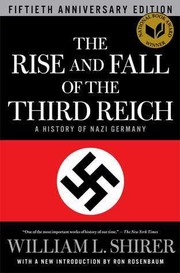
The Rise and Fall of the Third Reich: A History of Nazi Germany
3,559-word summary 16 min read 1245 pages in the book
- First published
- 1960
- Publisher
- Simon & Schuster
- Pages
- 1245
- ISBN
- 9781451642599
Reading options
What's inside (10 sections)
I picked up The Rise and Fall of the Third Reich because I kept running into arguments about how democracies fail and I wanted one long concrete case instead of slogans. William L. Shirer published it with Simon and Schuster in 1960, a 1245 page history with ISBN 9781451642599. He was not a professor writing from a library. He was an American radio correspondent who lived in Berlin from 1934 through late 1940, watched Hitler speak in person, reported from Vienna during the Anschluss and from Compiegne when France signed its armistice, then spent five and a half years after the war reading captured German papers, diaries, military orders, and Nuremberg testimony. That mix is the whole appeal. Part eyewitness diary, part document mountain.
My copy is heavy enough to hurt my wrist. I read it over three weeks, mostly late at night, with a pencil. Some nights I flew through a hundred pages. Some nights I stalled for days on Weimar party names. If you try it, give yourself permission to read slow. The payoff is that names like Papen and Schleicher and Fritsch stop being trivia and start feeling like people who made specific bad calls on specific days.
Shirer organizes the story in six large books, from Hitler youth to the bunker. I will follow that order here, because the sequence matters. How a fringe speaker becomes chancellor, how a chancellor becomes dictator, how a dictator talks himself into war, how early wins hide fatal errors, how defeat arrives.
A reporter with boxes of paper
Shirer starts with a frank note on sources, and I appreciated it. The Allies captured tons of German records before they could be burned. Orders with signatures. Meeting minutes. Navy war diaries. Goebbels diaries. Halder diaries. Ciano diaries. Nuremberg interrogations. Shirer says no fallen empire left this much paper behind, and he had the luck to be both present for part of it and free after to read the rest.
That shapes his voice. When he describes a Hitler speech in Berlin, he often remembers the room. The late start. The waiting crowd. The flat opening that warmed into shouting. Then he cuts to what the files add. Who ordered the police to stand down. Who paid the hall. Who wrote the press release after. The combination keeps the book from reading like a textbook. You get street sound plus office proof.
It also creates limits I kept tripping over. Shirer trusts German documents a lot, especially army generals writing after the fact. He can be sharp about Hitler and oddly soft about generals who later claimed they always opposed him. He had almost no Soviet archives in the 1950s, so the Eastern Front is told largely from German reports. And he writes with open moral judgment. He calls actions stupid or evil plainly. I mostly like that honesty, but it means you should read him as a smart witness with views, not a neutral judge.
One practical note. The first edition runs 1245 pages. Modern reprints like the Simon and Schuster hardcover with ISBN 9781451642599 run longer with introductions and notes, around 1280 pages. Either way, keep a bookmark for the cast. There are a lot of ministers and generals, and Shirer assumes you will remember them forty pages later.
Hitler becomes Hitler
Shirer spends serious time on Adolf Hitler before 1920 because he thinks the later empire cannot be explained by economics alone. Hitler was born in 1889 in Braunau am Inn, a border town between Austria and Germany. His father was a customs official, strict and status hungry. His mother doted on him. School reports show a bright boy who quit trying. He wanted to paint. He failed the Vienna Academy entrance. He drifted in Vienna and then Munich, selling postcards, living in doss houses, picking up pamphlets.
Vienna matters in Shirer telling. Hitler absorbed two poisons there. Pan German nationalism that despised the multiethnic Habsburg state, and a crude racial antisemitism sold in cheap papers. Shirer quotes from Mein Kampf here, not to admire it but to show how fixed these ideas were by 1913. I found those chapters grim and repetitive, which is the point. Hitler kept saying the same things for decades. People later acted surprised. Shirer shows the text was there.
World War I gave Hitler a home. He served as a corporal and dispatch runner, won an Iron Cross, and felt the army as family. Defeat in 1918 broke him. Like many soldiers, he refused the idea that Germany lost in the field. He reached for the stab in the back story, that socialists and Jews betrayed the army. Shirer treats that story as false and shows how useful it was. It turned shame into anger with a target.
Munich after the war is where the speaker emerges. Hitler joined a tiny workers party as an informer and discovered he could hold a beer hall. Shirer, who heard him later, tries to explain the effect without mystery. Simple sentences. Repetition. Enemies named again and again. Promises of work and pride. The early Nazi Party grew through brawls, marches, flags, and money from scared middle class donors. The failed Beer Hall Putsch of November 1923 should have ended it. Hitler fired a pistol in a hall, declared revolution, marched, got shot at, ran, hid, and went to prison. In Landsberg he dictated Mein Kampf to Rudolf Hess. Shirer reads that book closely and pulls out the program that never really changed. Destroy Versailles. Unite Germans. Win living space in the east. Remove Jews from German life.
What stayed with me was not the program alone but the patience. From 1925 to 1929 Hitler rebuilt a banned movement town by town, speaker school by speaker school. He learned to use courts for speeches. He learned to deny revolution while his SA beat people. Shirer calls him a master opportunist rather than a deep thinker, and that label fits the chapters. Hitler waited for a crisis big enough to carry him.
How a republic voted itself away
The middle of Book One and the start of Book Two were the hardest for me and the most useful. Shirer walks through Weimar Germany year by year, and the names blur until you make a chart. Here is the short version I wish someone had taped inside my cover.
Weimar had a constitution with strong emergency powers, proud generals who never accepted defeat, judges who punished leftists and excused rightists, and a depression that hit Germany brutally after American loans stopped. Elections kept splintering. Communists fought Social Democrats instead of joining them. Conservatives thought they could rent Hitler popularity and then control him.
Shirer is excellent on 1930 to 1933 because he shows doors closing one by one. Chancellor Bruning ruled by decree. Papen, a smooth aristocrat, thought charm could steer Nazis. Schleicher, a general who schemed in back rooms, thought the army could split the Nazis and use Gregor Strasser wing. President Hindenburg, old and tired, listened to his son and to landowners. Businessmen gave money. Newspapers owned by Alfred Hugenberg gave coverage.
Hitler lost fights and kept gaining. He ran for president in 1932 against Hindenburg and lost but looked like the future. His party became the largest in the Reichstag in July 1932 with 230 seats, slipped in November, and still ended up invited in. The backroom deal of January 1933 is told by Shirer like a crime story. Papen promised Hindenburg that Hitler in a cabinet full of conservatives would be boxed in. Hindenburg named Hitler chancellor on January 30, 1933. Franz von Papen smiled as vice chancellor. Within months Papen had nothing.
I put the book down after that chapter and sat for a while. No single vote created dictatorship. A lot of smart people chose short term advantage and assumed rules would hold. Shirer hammers that point with dates and quotes from diaries. It reads less like fate and more like a series of offices where someone could have said no and did not.
If you get lost here, do what I did. Write four names on a card. Hindenburg, Papen, Schleicher, Blomberg. Add one line each. Old president. Fixer. Schemer. Army boss who wanted rearmament. Watch those four hand Hitler the keys while thinking they kept a spare.
Making Germany Nazi
Once chancellor, Hitler moved fast, and Shirer pace picks up. The Reichstag fire on February 27, 1933 gave the excuse for emergency decrees. Communists were arrested by thousands. The March election, even with terror, did not give Nazis a majority, so Hitler pushed the Enabling Act through with Center Party votes and SA men in the halls. That vote ended parliamentary rule. Shirer prints the numbers and the threats together, so you see law and fear working as a pair.
Then came coordination of everything. States lost power. Unions were seized on May 2 after a fake day of honor. Parties dissolved or banned. The press was cleaned out. Professors signed loyalty oaths or left. Pastors who resisted formed a Confessing Church and paid for it. Jews were pushed from civil service in April 1933, boycotted, then trapped by the Nuremberg Laws of 1935 that stripped citizenship and banned mixed marriages. Shirer lists decrees in dull order on purpose. The dullness scares more than shouting. A clerk with a stamp can do what a mob cannot finish.
Two set pieces show how Hitler handled rivals. The Night of the Long Knives on June 30, 1934 purged SA chief Ernst Rohm and also murdered old enemies like Schleicher and Papen aides. Shirer uses Hitler own justification speech and army reactions to show the bargain. The army let murder happen in exchange for money, size, and an oath. When Hindenburg died in August, Hitler merged president and chancellor into Fuhrer and made soldiers swear personal loyalty to him, not to Germany. That oath returns later when officers claim their hands were tied.
Daily life chapters surprised me most. Shirer lived there, so he notices small controls. Block wardens. Youth groups on Thursday nights. Radio sets that played speeches. Teachers reporting parents. Courts with special Peoples Court for treason. At the same time he shows why many Germans accepted it. Jobs returned through rearmament and road building. Streets felt orderly after chaos. Strength felt good after shame. Shirer does not excuse that trade, but he explains its pull. Work plus pride covers a lot of silence.
My criticism here is that Shirer sometimes writes Germans as a single mind that snapped. Later research shows more grumbling, more local deals, more confusion. Shirer knew this in part, he cites jokes and church resistance, but his big thesis pushes toward a straight line from Luther to Hitler. I think that line is too straight. Prussia history, Versailles anger, depression pain, and Nazi skill explain a lot without fate. Read these chapters for the mechanics of decrees and police, which hold up, and stay skeptical when he talks about national character.
Step by step to war
Book Three is Shirer's best sustained writing, in my view. He follows foreign policy move by move and shows how each win taught Hitler that opponents would blink.
It starts with secret rearmament and leaving the League of Nations. Then the Saar vote, conscription back, a navy deal with Britain that Hitler framed as fairness. The Rhineland march in March 1936 is the hinge Shirer stresses. German troops had orders to retreat if France moved. France did not move. Hitler learned that risk paid. Shirer backs this with generals memoirs and French papers. I wish I had known this story in school. One brigade walking across a bridge changed Europe because no one stopped it.
Austria came next in March 1938. Pressure, threats to Chancellor Schuschnigg, a forced plebiscite after troops entered, cheering crowds that Shirer saw and never forgot. He is honest that many Austrians welcomed union, which complicates easy pictures. Then Czechoslovakia. Shirer hated the Munich conference of September 1938 and never hides it. He was in Prague and felt betrayal in the streets. Chamberlain and Daladier gave Hitler the Sudetenland to save peace. Hitler took the rest in March 1939 and made Slovakia a puppet. At that point promises meant nothing, but talks continued.
The Nazi Soviet pact of August 1939 still shocks when Shirer lays out the telegrams day by day. Two enemies who called each other monsters signed to split Poland and buy time. Ribbentrop flew to Moscow. Molotov smiled. Stalin stalled Britain and France while grabbing a buffer. Hitler got a free hand for Poland. Shirer prints the secret protocol summary and lets it sit. No speech can clean it.
Poland was invaded on September 1, 1939. Britain and France declared war on September 3. Shirer marks those dates plainly because Nazi leaders kept claiming they wanted peace. The papers show they planned war and chose the moment. That is the core of his road to war argument. Not accident. Not encirclement. Choice, repeated, rewarded until it could not be stopped.
I got tired in one stretch where Shirer reprints long diplomatic notes. You can skim those pages for the gist. The pattern matters more than each memo. Threat, last minute talk, broken promise, parade. After three rounds you can predict the next.
Winning everything, then losing it
War chapters run long, almost half the book, and they swing between thrilling and sickening. Early Blitzkrieg sections read fast. Poland crushed in weeks with help from the Soviet east. Denmark and Norway taken. France split open in May 1940 through the Ardennes while Allied armies waited in Belgium. Shirer was there for the French surrender in the same rail car used in 1918, and his memory of Hitler dancing a little jig is one of the few personal flashes he allows himself. Britain held because of the Channel, radar, the RAF, and Hitler divided aims. The Battle of Britain failed. The Blitz killed civilians without breaking will.
Shirer is strong on the Mediterranean and Russia as paired mistakes. Mussolini attacked Greece and Egypt without means, so Germany had to rescue Italy in Yugoslavia, Greece, and North Africa. That delayed the Russia invasion by crucial weeks, though historians now debate how much weather mattered versus Soviet resistance. Operation Barbarossa began June 22, 1941 with three army groups and early encirclements that took hundreds of thousands of prisoners. Shirer uses German war diaries to show confidence curdling by December. Mud. Snow. Long supply lines. A Soviet counterattack before Moscow. Then America entered after Pearl Harbor on December 7, and Hitler declared war on the United States on December 11, a decision Shirer treats as self destructive swagger.
The turning year 1942 gets careful treatment. Stalingrad and El Alamein appear as linked failures. Paulus Sixth Army bled out on the Volga while Goering promised air supply that never worked. Rommel lost in Egypt to Montgomery with American supplies building up. Shirer does not write these as genius Allied plans alone. He stresses German overreach, Hitler meddling with divisions from a map room, and an economy that never fully mobilized women and factories until Albert Speer arrived late.
The New Order chapters are the hardest to read. Shirer documents occupation rule country by country. Poland treated as labor pool. Czech factories seized. French farms drained. Dutch Jews rounded up with local police help. He gives numbers for executions, deportations, and starvation, drawn from orders and trial records. The Holocaust is described through decrees, Einsatzgruppen reports, Wannsee minutes, and camp records available by the late 1950s. Later books know more about gas chambers operations and about Jewish resistance, and Shirer underplays both, but his account of bureaucratic murder holds. Orders went down. Trains ran on time. Offices filed receipts.
I needed breaks here. I walked between chapters. If you read this book straight through, plan for that. The middle war success can numb you with maps and arrows, then a short paragraph on a massacre lands and you feel ashamed for admiring the arrows.
The fall and what Shirer gets wrong
The last stretch covers 1944 to 1945 with a clock ticking. Normandy on June 6, 1944 cracked the west. The July 20 plot by Claus von Stauffenberg and other officers nearly killed Hitler with a briefcase bomb and failed through bad luck and poor follow through. Shirer admires the courage but notes how late it came and how few joined. Most generals stayed loyal or quiet until defeat was certain. The Ardennes offensive in December spent the last reserves. The Soviets crossed the Oder. Americans and British crossed the Rhine. Hitler hid in the Berlin bunker, married Eva Braun, dictated blame, and killed himself on April 30, 1945. Germany surrendered in May. Nuremberg trials began in November.
Shirer closing argues that Hitler empire was inevitable once Germans accepted him, and that the fall proved dictatorship rots judgment. There is truth in that, but later historians have pushed back in ways worth knowing before you quote Shirer at dinner.
First, Shirer moral clarity sometimes flattens explanation. He treats Hitler will as the engine and German obedience as fuel. Modern work stresses polycracy, rival offices, party versus state fights, business deals, and improvisation. Orders from the top mattered hugely, but chaos below mattered too. The regime was both rigid and messy.
Second, his German history thesis feels dated. The idea of a special path from Martin Luther through Bismarck to Hitler ignores how contingent 1930 to 1933 was. If Hindenburg had refused Papen scheme, if Schleicher had moved sooner, if conservatives had funded differently, outcomes could have shifted. Shirer knows the what ifs, he reports them, yet his language often sounds fated. I prefer his reporting to his philosophy here.
Third, his sources tilt west and German. Soviet decisions get thin treatment. Resistance by Poles, Yugoslavs, French communists, and Jewish fighters gets less space than it deserves. Women appear mostly as victims or wives. Economics gets simplified into rearmament miracle talk without enough on loot, slave labor, and debt tricks that Hjalmar Schacht and later Walther Funk ran.
Even with those limits, I finished grateful. No other single book from that era puts you in the hall for the speech and in the archive for the order that followed. Shirer saw the flags and read the file. That double view is rare.
Who should read it now. If you want a one volume narrative of Nazi Germany with dates you can trust for the big moves, start here, then read a newer short history to correct the frame. Richard Evans trilogy or Ian Kershaw Hitler books pair well. If you teach, assign chunks, not the whole. The Weimar collapse chapters plus Munich plus Barbarossa plus the New Order section make a strong unit. Teens can handle the prose, though the length and the atrocity records suit older readers better. The book has no explicit sensationalism, but the facts are brutal.
Facts to cite are stable. First published in 1960 by Simon and Schuster. The original run is 1245 pages with ISBN 9781451642599 for the modern Simon and Schuster reissue cited here. Author William L. Shirer, 1904 to 1993, American journalist and historian. No series. Tags that fit are history, world war ii, nazi germany, nonfiction, military.
I closed my copy on a Sunday with pencil shavings on the table and a short list in my notebook. Say no earlier. Paper matters, keep records. Crowds lie, even friendly ones. Small steps to war look reasonable until you list them. Those notes sound plain. Plain is good. After 1245 pages of speeches and orders, plain feels like self defense.
Reading after Shirer
If Shirer leaves you angry or numb, one more conversation helps. Pick a book written from inside occupied Europe rather than Berlin offices. A diary from Warsaw or Amsterdam changes the temperature fast. Then pick a military history of the Eastern Front that uses Soviet records Shirer never saw. Read ten pages of each beside Shirer's Barbarossa chapters. You will see what he missed and why his core story still stands. Orders moved west to east with terrible ease. People in the east paid with lives Shirer could count but not always name.
I also kept a map open for the war half, which I recommend. The Ardennes looks like a wrinkle until you trace tanks through it. The Volga looks like a line until you picture a city block by block in winter. Trace Stalingrad supply by air on paper and the failure becomes physical. Planes, snow, weight, hunger. Numbers turn into bodies. That shift is the reason to read a book this long instead of a summary. Effort becomes real.
My nephew asked if the book is biased. I said yes, in the open, against Hitler and for democracy, and that bias is stated on page one. The bias to watch is quieter. Faith in documents over memory, in Berlin over provinces, in leaders over ordinary people. Notice it and keep reading. Shirer gives you enough paper to argue with him, which is more than many histories offer. Argue back in margins. He would have liked that. He was a reporter first, used to being yelled at, and he kept the receipts.
FAQ
When was The Rise and Fall of the Third Reich published?
Simon and Schuster published it in 1960. The first edition runs 1245 pages and the modern reissue cited here carries ISBN 9781451642599.
Is the book biased?
Yes, in the open. Shirer writes against Hitler and for democracy, and later historians fault his straight line from Luther to Hitler, thin Soviet sources, and soft treatment of generals.
Should I read Shirer or a newer history first?
Start here for the narrative, then read a newer short history to correct the frame. The Weimar, Munich, Barbarossa, and occupation chapters also work well as assigned chunks.
Similar books
Band of Brothers
Easy Company, 506th Airborne, from Toccoa training through D-Day, Holland, Bastogne, and Hitler's Eagle's Nest.
2,685-word summary · 12 min read

The Zookeeper's Wife: A War Story
The directors of the Warsaw Zoo hid roughly three hundred Jews in empty cages and outbuildings after the German invasion, while Jan worked for the resistance.
2,065-word summary · 9 min read
Lone Survivor: The Eyewitness Account of Operation Redwing and the Lost Heroes of SEAL Team 10
Marcus Luttrell's account of the 2005 SEAL mission in Afghanistan that killed three of his team and left him alone.
2,144-word summary · 10 min read
The Splendid and the Vile
Larson follows Churchill circle through Blitz year with diaries and bombing nights.
2,038-word summary · 9 min read

In the Garden of Beasts
Ambassador Dodd takes his family to 1933 Berlin and watches charm curdle into terror.
1,927-word summary · 9 min read
1776
Washington's amateur army from Boston siege to Trenton through mud and doubt.
2,139-word summary · 10 min read

Night
Elie Wiesel's account of Sighet, the cattle cars, Auschwitz and Buchenwald, told in short flat sections by a boy about fifteen. Why the book carries the year…
2,594-word summary · 12 min read

The Diary of a Young Girl
Anne Frank's diary explained: two years in the Secret Annex, the entries on fear and boredom, what Otto Frank cut, and why the book still reads like a…
1,913-word summary · 9 min read

Long Walk to Freedom
Mandela's account of a Thembu childhood, a law practice, a banned movement, twenty-seven years in prison, and the negotiation that ended apartheid.
2,454-word summary · 11 min read

1491: New Revelations of the Americas Before Columbus
Charles C. Mann gathers archaeology, ecology, and demography to argue that the Americas before Columbus were older, fuller, and more deliberately shaped than…
2,712-word summary · 12 min read
The DaVinci Code: A Quest for Answers
A short 2006 dialogue in which three friends test Dan Brown's claims about Jesus, Mary Magdalene, Nicaea, and the canon.
2,088-word summary · 9 min read

Nothing to Envy
Barbara Demick follows six defectors from Chongjin through the North Korean famine, showing how ordinary people lived, believed, and finally left.
2,068-word summary · 9 min read

Down and Out in Paris and London
Orwell's account of washing dishes in Paris hotels and tramping through London does not ask for pity, only for a clear look at how poverty actually works.
2,282-word summary · 10 min read
The Wright Brothers
David McCullough tells the story of two self-taught Ohio brothers, working largely alone and out of a bicycle shop, who solved the problem of flight before…
2,027-word summary · 9 min read

Bury My Heart at Wounded Knee: An Indian History of the American West
Dee Brown's 1970 retelling of the American West from the point of view of the people it destroyed.
2,233-word summary · 10 min read
At Home: A Short History of Private Life
Bill Bryson tours his own Norfolk rectory room by room to explain how private life and the modern home got built.
2,334-word summary · 10 min read

Prisoners of Geography: Ten Maps That Tell You Everything You Need to Know About Global Politics
Tim Marshall explains how mountains, rivers, coasts, and resources shape the choices of nations, from Russia's flat borders to the chokepoints of the South…
2,328-word summary · 10 min read

The Lost City of Z: A Tale of Deadly Obsession in the Amazon
David Grann retraces Percy Fawcett's 1925 disappearance in the Amazon and finds that the lost city he sought was not entirely a fantasy.
2,493-word summary · 11 min read

The Letters of Vincent van Gogh
Vincent van Gogh's letters to his brother Theo, in a Penguin Classics selection edited by Ronald de Leeuw, trace a decade of work, faith, and obsession.
2,611-word summary · 12 min read

The World Is Flat: A Brief History of the Twenty-first Century
Thomas L. Friedman's 2005 bestseller argues that technology, trade, and open borders leveled the global playing field, and it names the ten forces that did it.
2,369-word summary · 11 min read

Catherine the Great: Portrait of a Woman
A German princess survives a miserable marriage and a coup to rule Russia for thirty-four years, torn between Enlightenment ideas and absolute power.
2,065-word summary · 9 min read

The Warmth of Other Suns
Three migrants ride north out of Jim Crow toward Chicago and LA.
2,561-word summary · 11 min read

The New Jim Crow: Mass Incarceration in the Age of Colorblindness
How mass incarceration became a racial caste system after civil rights.
2,413-word summary · 11 min read

The History of the Hobbit, Part One: Mr. Baggins
Rateliff traces every draft of Bilbo from 1930 notes to print.
2,410-word summary · 11 min read

The Emperor of All Maladies
A biography of cancer from Galen to chemo through one doctor cases.
2,255-word summary · 10 min read
Killing Lincoln
Booth plots as Lincoln pushes war end and reunion in 1865.
2,486-word summary · 11 min read

In the Heart of the Sea: The Tragedy of the Whaleship Essex
The whaleship Essex sunk by a whale leaves men in boats for ninety days.
2,750-word summary · 12 min read
Hidden Figures
Black women computers at Langley launch rockets past Jim Crow.
2,385-word summary · 11 min read

Wild Swans
Three generations of women survive warlords, revolution, and the Cultural Revolution in Jung Chang's family memoir.
2,356-word summary · 10 min read

The Perfect Storm
Gloucester's Andrea Gail vanished in the October 1991 nor'easter; Junger joins the crew, storm science, and Tamaroa rescues into a plain and hardworking sea…
2,592-word summary · 12 min read