
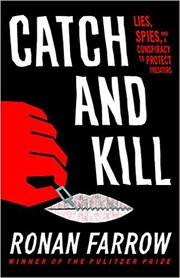
Catch and Kill: Lies, Spies, and a Conspiracy to Protect Predators
2,057-word summary 9 min read 464 pages in the book
- First published
- 2019
- Publisher
- Little, Brown and Company
- Pages
- 464
- ISBN
- 9780316486637
Reading options
What's inside (11 sections)
I read Catch and Kill on a train, which turned out to be the right setting. The book moves like a spy thriller: late-night meetings, burner phones, a private intelligence firm, a reporter who suspects he is being followed. The difference is that the stakes are not invented. The women Farrow interviewed were trying to tell the truth about Harvey Weinstein, and the institutions that were supposed to help them kept finding reasons not to.
Ronan Farrow published the book in 2019 through Little, Brown and Company. The hardcover runs 464 pages, and it is part memoir, part investigative report, and part anatomy of how power protects itself. The title comes from a tabloid practice. A media company buys the rights to a damaging story, then kills it. The person who sold the story thinks it will be published. It never is. Farrow argues that this practice, and the culture that supports it, helped keep Weinstein's behavior secret for decades.
The story starts at NBC
Farrow was a reporter at NBC News when he began looking into Weinstein. He had already written about the allegations against Bill Cosby and about the media's reluctance to investigate them. He had a personal connection to the subject of sexual abuse: his sister Dylan Farrow had accused their father, Woody Allen, of molesting her, and Farrow had watched the public relations machinery around that accusation for years.
The Weinstein reporting began with women who were willing to talk. Ashley Judd described an encounter in a hotel room. Rose McGowan had been silenced by a settlement. Ambra Battilana Gutierrez had gone to the Manhattan district attorney's office in 2015 with a recording of Weinstein pressuring her. The district attorney, Cyrus Vance Jr., decided not to prosecute. Farrow wanted to know why.
The book is careful about the difference between a rumor and a case. Farrow does not simply repeat what people had been whispering about Weinstein for years. He interviews women, checks documents, and looks for patterns. The pattern is the story. Weinstein would meet a young woman, offer her help with her career, and then use his power to isolate her. The women who resisted were sometimes threatened. The women who complied were sometimes hired. The system rewarded silence.
The machinery
The most disturbing sections of Catch and Kill are about the machinery that surrounded Weinstein. He employed private investigators. He hired Black Cube, a firm founded by former Israeli intelligence officers, to gather information on his accusers and on journalists. Operatives used false identities. One posed as a woman interested in publishing a memoir. Another posed as a journalist. They tried to get close to Farrow's sources and to Farrow himself.
Farrow also describes the role of American Media Inc., the publisher of the National Enquirer. AMI, under Dylan Howard, had a practice of buying stories and burying them. The book connects that practice to Weinstein and to other powerful men. The point is not that one tabloid was uniquely corrupt. The point is that the market for silence was bigger than one tabloid.
The legal machinery is another recurring theme. Weinstein's lawyers sent letters. His representatives threatened to sue. Nondisclosure agreements kept women from speaking. The book shows how the law can be used not only to punish wrongdoing but to prevent it from being reported. The women who spoke to Farrow often did so at great personal risk. Some of them had already been silenced once. Some of them were still afraid.
The book's title is not a metaphor. Farrow shows how a story can be caught, paid for, and killed while everyone involved maintains the fiction that they are protecting journalism. The people who sell their stories often do not know they are being used. The people who buy them are not interested in publishing them. The public never learns what happened.
NBC says no
The central drama of the book is Farrow's fight with NBC. He had the story. He had women on the record, documents, and a pattern. His producer, Rich McHugh, was with him. But NBC's executives, including Noah Oppenheim, Andy Lack, and Phil Griffin, kept delaying. They raised legal concerns. They questioned the sourcing. They said the story was not ready.
Farrow believes the delay was not about journalism. He points to Weinstein's connections to NBC, his history of hiring lawyers and investigators, and the network's fear of a lawsuit. He also points to the network's own problems. NBC had its own culture of sexual harassment, and the executives who were deciding whether to air Farrow's story had reasons to avoid a broader reckoning.
The book is not neutral on this question. Farrow is a participant, and he writes like one. He describes meetings where executives seemed more interested in protecting the network than in protecting the women. He describes the moment when he realized that the story might never air. He describes the decision to take it to The New Yorker.
NBC has disputed Farrow's account. The network has said that it did not kill the story and that Farrow's reporting was not ready. The book includes some of those disagreements, but it is clearly Farrow's version. Readers who want a neutral account of the NBC decision will not find it here. What they will find is a detailed, first-person record of what it felt like to be inside the process.
The New Yorker
Farrow took the story to The New Yorker, where David Remnick and his editors agreed to publish it. The magazine's fact-checking process was rigorous. Farrow describes the work of checking every detail, sometimes with lawyers involved. The story was published in October 2017, five days after The New York Times published its own investigation by Jodi Kantor and Megan Twohey.
The publication changed Farrow's life. It also changed the public conversation. The #MeToo movement, which had been building for years, became a mass phenomenon. Women across industries began telling their stories. Some of those stories led to firings. Some led to criminal investigations. Some led nowhere.
Farrow does not claim that his article caused all of this. He is careful to credit the women who spoke, the other journalists who worked the story, and the activists who had been fighting for years. But he does argue that the story would not have had the same impact if NBC had aired it first, with the network's resources behind it. The fact that it appeared in The New Yorker, after a fight, is part of the story.
The other men
Catch and Kill is not only about Weinstein. Farrow includes chapters on Eric Schneiderman, the New York attorney general who resigned after several women accused him of physical abuse, and Leslie Moonves, the CBS executive who was forced out after allegations of sexual misconduct. He also writes about Matt Lauer, the NBC anchor who was fired in 2017 after a colleague accused him of inappropriate behavior.
The Lauer chapter is the most contested part of the book. Farrow relies on Brooke Nevils, a former NBC employee who says Lauer raped her in a hotel room in Sochi during the 2014 Winter Olympics. Lauer has denied the allegation. NBC has disputed some of the details in Farrow's account. The chapter is powerful, but it is also the place where the book's method is most vulnerable. Farrow is close to the story, and his anger at NBC is visible on every page.
The Schneiderman and Moonves chapters are less personal and more straightforward. They show the same pattern: a powerful man, a group of women, a set of institutions that had reasons to look away. The book is building a case, not just telling a story. The case is that sexual misconduct is not an isolated problem. It is a system.
The method
Farrow writes in the first person, and he is not shy about his own role. He describes his fears, his mistakes, and his anger. He also describes the mundane parts of reporting: phone calls, hotel rooms, waiting for sources to decide whether to trust him. The book is more novelistic than most journalism. Some scenes are reconstructed from memory and interviews, and the dialogue is sometimes too polished to be literal.
That style has costs. Readers who prefer a straight investigative report may find the personal material distracting. Readers who are skeptical of Farrow may find the book self-serving. The NBC sections, in particular, read like a prosecution. Farrow is aware of this, and he occasionally acknowledges his own bias, but he does not let it slow him down.
The book is also not a complete history of #MeToo. It is Farrow's story, and it leaves out many of the activists, writers, and organizers who built the movement. It focuses on the rich and famous, on the men who ran studios and networks, and on the women who were brave enough to speak. That focus is a limitation, but it is also the reason the book is so readable. Farrow knows how to tell a story.
What the book gets right
The book is excellent at showing how power works in practice. It is not a conspiracy theory. It is a description of incentives. Weinstein had money, lawyers, and connections. NBC had a brand to protect. AMI had a business model based on buying silence. The district attorney had a career to think about. None of these people had to coordinate in a smoky room. They just had to make the choices that were easiest for them.
Farrow also gets the women right. He does not treat them as symbols. He gives them names, histories, and reasons for staying silent or speaking. Some of them are still afraid. Some of them are angry. Some of them are not sure they did the right thing. The book is at its best when it lets those contradictions stand.
Where it creaks
The book is long, and some of the middle chapters repeat information. The Lauer section is contested, and the book would be stronger if it acknowledged the disputes more fully. The personal material sometimes tips into score-settling. Farrow's prose can be overheated. He likes a dramatic scene, and he sometimes finds drama where a more patient reporter would find paperwork.
The biggest limitation is that the book is written by a participant. Farrow is not just reporting on the story. He is one of its characters. That makes the book compelling, but it also means that readers need to check his account against other sources. The NBC rebuttal is not included in full. The women who declined to speak are not given much space. The book is a version of events, not the final word.
The book's reception reflects that tension. It was widely praised as an important work of journalism, and it was also criticized by NBC and by some of the people it describes. The disputes are not resolved in these pages. They are part of the public record, and readers who want the full picture should seek out the responses as well as the book. That is not a reason to skip it. It is a reason to read it carefully.
Why it matters
Catch and Kill matters because it shows how a story can be stopped without anyone ever admitting they stopped it. The mechanisms are legal, financial, and social. A settlement here. A threat there. A friendly editor who decides the story is not ready. A network that does not want to make an enemy. The result is silence, and silence looks like nothing happened.
The book also matters because it is a reminder that journalism is not a neutral process. It depends on people who are willing to take risks, and on institutions that are willing to back them. When those institutions fail, the story does not disappear. It moves somewhere else, and the people who tried to kill it lose control of it.
I finished Catch and Kill angry, which I think is the point. The book is not subtle. It is a broadside against the systems that protected Weinstein and against the people who enabled them. It is also a tribute to the women who kept talking. That combination makes it a valuable book, even when it is an uneven one.
FAQ
What does catch and kill mean?
It is a tabloid practice of buying exclusive rights to a damaging story and then refusing to publish it, usually to protect a powerful person.
Did NBC really kill the story?
Farrow says executives delayed and ultimately declined to air it. NBC has disputed his account and says the reporting was not ready.
Is the book only about Harvey Weinstein?
No. It also covers Matt Lauer, Leslie Moonves, Eric Schneiderman, and the media companies that employed them.
Similar books
The Stranger Beside Me
Ann Rule's classic memoir of her friendship with Ted Bundy, written by the true-crime author who knew him long before the world learned what he had done.
2,481-word summary · 11 min read
Nothing to Envy
Barbara Demick follows six defectors from Chongjin through the North Korean famine, showing how ordinary people lived, believed, and finally left.
2,068-word summary · 9 min read
Columbine
Ten years of reporting on the 1999 school massacre, including a journalist's correction of the myths he helped create in the first hours.
2,232-word summary · 10 min read
Red Notice
An American financier in Moscow exposes a $230 million tax fraud, watches his lawyer die in prison, and turns the case into an international human rights law.
2,008-word summary · 9 min read
Empire of Pain: The Secret History of the Sackler Dynasty
How the Sackler family sold OxyContin and shaped an overdose crisis while giving to museums.
2,048-word summary · 9 min read
Say Nothing
Patrick Radden Keefe traces Jean McConville's 1972 disappearance through the Price sisters, Brendan Hughes, and Gerry Adams, using Boston College tapes to…
2,846-word summary · 13 min read
In Cold Blood
Capote reconstructs the Clutter murders and the killers' flight in the book that invented true crime.
1,965-word summary · 9 min read
Nudge: Improving Decisions About Health, Wealth, and Happiness
Thaler and Sunstein show how defaults, framing, and social cues steer choices, and argue for choice architecture with an opt-out.
3,146-word summary · 14 min read

Long Walk to Freedom
Mandela's account of a Thembu childhood, a law practice, a banned movement, twenty-seven years in prison, and the negotiation that ended apartheid.
2,454-word summary · 11 min read

In Order to Live: A North Korean Girl's Journey to Freedom
A young North Korean girl crosses the Yalu, survives trafficking in China, and rebuilds her life in Seoul in this unsparing memoir.
2,027-word summary · 9 min read

Too Much and Never Enough: How My Family Created the World's Most Dangerous Man
Mary L. Trump's 2020 memoir traces how a cold, zero-sum Queens household shaped her uncle, and uses family tax documents to challenge his self-made story.
2,059-word summary · 9 min read

Infidel
Ayaan Hirsi Ali's memoir of a Somali childhood, a forced marriage, a Dutch asylum claim, and the political fight that followed the murder of Theo van Gogh.
2,041-word summary · 9 min read

Down and Out in Paris and London
Orwell's account of washing dishes in Paris hotels and tramping through London does not ask for pity, only for a clear look at how poverty actually works.
2,282-word summary · 10 min read

The Girl with Seven Names: A North Korean Defector's Story
Hyeonseo Lee crossed the frozen Yalu River at seventeen, spent years hidden in China, escaped to South Korea, and later returned to rescue her family.
2,404-word summary · 11 min read
The Camel Club
Four Washington misfits witness a murder on Roosevelt Island and stumble into a conspiracy that reaches the Oval Office, with a hostage president and a nuclear…
2,354-word summary · 10 min read
America (The Book): A Citizen's Guide to Democracy Inaction
Jon Stewart and the Daily Show writers turn a high school civics textbook inside out, with a foreword from beyond the grave.
2,511-word summary · 11 min read

Why I'm No Longer Talking to White People About Race
Reni Eddo-Lodge traces black British history and shows how institutions, culture, and everyday assumptions keep producing racial inequality.
2,071-word summary · 9 min read
The Brethren
Three disgraced judges run a blackmail scam from a federal prison and accidentally trap a presidential candidate, pulling the CIA into their scheme.
1,967-word summary · 9 min read

Scrappy Little Nobody
Anna Kendrick's essays trace her path from a Portland childhood and Broadway to Hollywood, with jokes, anxiety, and a refusal to pretend fame fixed her.
2,092-word summary · 9 min read
Prisoners of Geography: Ten Maps That Tell You Everything You Need to Know About Global Politics
Tim Marshall explains how mountains, rivers, coasts, and resources shape the choices of nations, from Russia's flat borders to the chokepoints of the South…
2,328-word summary · 10 min read
The World Is Flat: A Brief History of the Twenty-first Century
Thomas L. Friedman's 2005 bestseller argues that technology, trade, and open borders leveled the global playing field, and it names the ten forces that did it.
2,369-word summary · 11 min read
What the Dog Saw and Other Adventures
Nineteen New Yorker essays on pitchmen, ketchup, Enron, profiling, late bloomers and the limits of prediction, arranged in three parts.
2,049-word summary · 9 min read
The Poet
A crime reporter investigates his twin brother's apparent suicide and uncovers a killer who leaves Edgar Allan Poe quotes behind, in the novel that took…
2,020-word summary · 9 min read
The New Jim Crow: Mass Incarceration in the Age of Colorblindness
How mass incarceration became a racial caste system after civil rights.
2,413-word summary · 11 min read
Behind the Beautiful Forevers: Life, Death, and Hope in a Mumbai Undercity
Life in a Mumbai slum near the airport, where families hustle for a better future.
2,406-word summary · 11 min read
Absolute Power
A thief watches the president kill, then runs with a lawyer who believes him.
2,401-word summary · 11 min read
The Hot Zone
Ebola and Marburg move from African outbreaks to a Virginia monkey house and an Army response in suits.
2,291-word summary · 10 min read
How to Be an Antiracist
Kendi blends memoir and history to argue that fair policy, not self fixing, creates an equal society.
2,513-word summary · 11 min read
The Library Book
Susan Orlean investigates the 1986 Los Angeles Central Library fire and suspect Harry Peak while tracing library history, her mother's influence, and the…
2,319-word summary · 10 min read
Cleopatra: A Life
Pulitzer winner Schiff restores Cleopatra as a capable ruler, from Ptolemy debts and Caesar to Antony, Actium, and her death in 30 BC, built from coins and…
3,586-word summary · 16 min read