
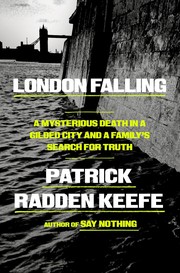
London Falling
2,371-word summary 11 min read 384 pages in the book
- First published
- 2026
- Publisher
- Picador
- Pages
- 384
- ISBN
- 9781035056293
Reading options
What's inside (8 sections)
I read a lot of true crime, and the cases that stay with me are rarely the tidy ones. They are the ones where a person dies and the official account arrives with obvious holes in it, and everyone with the power to investigate decides the holes can be lived with. London Falling is one of those. Patrick Radden Keefe, a staff writer at The New Yorker, published this narrative nonfiction with Picador on 7 April 2026, with Doubleday bringing it out in the United States at the same time. The full title is London Falling: A Mysterious Death in a Gilded City and a Family's Search for Truth. It runs 384 pages and grew out of a New Yorker article, drawing on police transcripts, emails, letters, surveillance footage and two years of conversations with the dead man's parents. That last detail matters, because the parents are the reason the book exists.
This is Keefe's particular strength as a reporter. He is interested in the machinery around a death as much as in the death itself, and he has the patience to reconstruct a life from the records it left behind. The book reads at times like an audit of a city, with the same attention paid to a broken jaw, a missing bank balance and a decades-old change in banking law. That approach can feel cold if you are looking for a page-turner, but it is also what keeps the story honest. Nobody in this book gets turned into a symbol for the sake of a good paragraph.
A silhouette on a fifth-floor balcony
The book opens in the early morning of November 2019. A surveillance camera mounted at MI6 headquarters, across the Thames from where this is happening, records the silhouette of a young man on the fifth-floor balcony of Riverwalk House, a luxury apartment block at Millbank. He seems to hesitate. Then he jumps.
Keefe reconstructs the fall with a reporter's patience for physical detail. The young man strikes the embankment wall with his hip on the way down. He may be unconscious when he hits the water. He drowns. His body is found five hours later, face down in the mud. The autopsy finds a series of injuries, including a broken jaw, and there is no way to tell whether those injuries happened before the fall or as a result of it. That uncertainty is the first of many that the book refuses to resolve.
The body is identified as Zac Brettler, nineteen years old, from a comfortable middle-class family in Maida Vale. Nineteen is an age at which a person can still be mistaken for a child and also insisted on as an adult, and Keefe is alert to how that ambiguity shaped the way people treated him. The camera at MI6 did not record a push. It recorded hesitation, a figure, a jump. Everything after that is argument.
Keefe returns to that camera more than once, and its position is almost a character in the book. MI6 is across the river, watching a different kind of building, when it catches the last moments of this young man's life. The footage establishes what the police can and cannot say happened. It shows no push, which is why one of the men in the flat could not be charged. But the image also leaves a small, unbearable gap: the hesitation. A person who is about to jump pauses, and that pause is the whole mystery in five seconds of grainy video.
The flat and the two men who were there
Zac spent his last night with Verinder Sharma, a fifty-five-year-old debt collector and drug trafficker known as Indian Dave. Sharma said he let Zac stay rent-free. Phone records and closed-circuit television put a third man in the flat as well: Akbar Shamji, a cryptocurrency and real estate trader working out of Mayfair.
Both men deny wrongdoing. Shamji in particular maintains his innocence and offers a portrait of Zac that is hard to ignore once you have heard it. He describes the teenager as a compulsive liar who invented the persona of Zac Ismailov, the son of a dead Russian oligarch, and who went so far as to affect a Russian accent. Shamji could not be charged because he was not in the flat at the time. The MI6 camera showed that Sharma did not push Zac. Those two facts leave the investigation with no obvious defendant, and the case does not move forward.
Keefe is careful to separate what can be established from what is claimed. He lets the denials sit on the page alongside the phone records and the footage, and he does not pretend that a liar's death is automatically less worth investigating. That tension, between a young man who apparently fabricated much of his life and a set of circumstances that still look deeply wrong, is the engine of the book.
Part of what makes the two men so hard to pin down is that they are both plausible in different registers. Sharma presents himself as a landlord doing a favour for a young man with nowhere to stay. Shamji presents himself as a businessman who was drawn into a strange evening and then blamed for it. Keefe does not cartoon either of them. He shows what the phone records place in the flat and what the footage shows, and then he shows what each man says about his own role. The result is a small study in how much truth can survive in a room where everyone is protecting themselves.
The boy who kept inventing himself
To understand how Zac ended up on that balcony, Keefe goes back to Mill Hill, where he was known for tall tales. He lied about his parents' jobs. He loved gangster films and wore temporary Russian gang tattoos that he bought online. He bragged about contacts in Kazakhstan and Nigeria, and he told his mother he was heading off to play blackjack at a casino in Berkeley Square. The Zac Ismailov story was the most elaborate version of a habit that had been building for years.
His parents were Rachelle Gryn Brettler, a journalist, and Matthew Brettler, a director in financial services. Keefe draws resonances between Zac's habit of fabrication and the family history on both sides. Matthew's father fled Germany on the last Kindertransport in 1939. Rachelle's father, Hugo Gryn, was an Auschwitz survivor and a rabbi who lied about attending Cambridge and fathered a secret child, a story exposed by the News of the World in 1988. This is not presented as a tidy explanation for Zac's lies. It is a suggestion that telling stories to survive, or to become someone else, has a history in this family.
That resonance is handled lightly, which is wise. Keefe could have built a whole theory out of Hugo Gryn's lie about Cambridge and the secret child exposed in 1988, but he leaves it as an echo. The point is not that Zac was destined to fabricate. It is that he grew up in a family where storytelling and survival had already been tangled together, and where the press had once turned a private lie into a public scandal. Against that background, the Russian accent and the bought tattoos look less like random eccentricity and more like a boy trying on a costume he thought would make him safe.
I found this section the most affecting part of the book. Keefe writes about Zac's parents with obvious respect, and the two years of conversations show. These are people trying to understand a son who made up a Russian oligarch father and then died in a city full of men who made up versions of themselves for a living. The parallel is not stated as a moral. You can feel it.
A fatted calf in Mayfair
The men around Zac in his final months were engaged in their own inventions. Shamji posed as a successful entrepreneur while carrying unpaid debts. His father Abdul had built a trading business on unsecured borrowing and had been jailed for perjury in 1989. They talked about cannabis skincare and a mine in Kazakhstan, and Shamji came to see the teenager as a fatted calf, a source of money and advantage whose usefulness had a shelf life.
Sharma, hoping for a cut of whatever was available, played a father figure. Zac, for his part, claimed that a Swiss mother living in Dubai had blocked his inheritance, and that he was worth six billion pounds. The lies met the ambitions and fed each other. When the two men grew suspicious, they confronted Zac in the flat. Hours later, he was dead.
There is a detail Keefe places near the end of this reconstruction that I keep returning to. Zac had four pounds in his bank account. Against the talk of billion-pound inheritances and Kazakh mines, that small, plain number is devastating. It tells you more about the actual situation than any of the personas did.
Keefe is careful about the order in which he gives us these facts. The talk of billions comes early, because that is what the adults around Zac believed or claimed to believe. The four pounds comes late, after the reader has learned to discount everything. By then the number works as a quiet correction to all the performance. It is also a detail that only a reporter with access to bank records could supply, and it is the sort of thing that makes the difference between a story that stays a rumour and one that becomes a book.
Police could not charge anyone. Sharma died of a suspected drug overdose in 2020. Zac's parents insist that their son was trying to escape an enraged Sharma in the moments before he jumped. The book does not settle whether they are right. It keeps their conviction alongside the evidence and lets the reader sit with the gap.
What the investigation missed
Keefe believes the police missed blood-like smears on the walls of the flat. He criticises what he calls the bizarre passivity of a budget-cut Scotland Yard operating after decades of deregulation. This is the part of the book that turns a single death into a broader argument about a city. London, in Keefe's phrase, is a twenty-four-hour laundromat for dirty money, full of professional facilitators who make it easy for people with questionable wealth to move, hide and present themselves as respectable.
That line is the book's central claim about place. The same city that attracts men with fictional biographies and convenient financial stories is a city whose police force has been hollowed out and asked to investigate their crimes with less capacity than before. Zac's death becomes legible as the intersection of those two facts. A young man skilled at performance meets adults skilled at performance, and the institutions meant to sort it out are too thin on the ground to do more than shrug.
The criticism of Scotland Yard is specific rather than general. Keefe points to what he sees as missed physical evidence and to a kind of institutional passivity that he connects to years of budget cuts. He is not arguing that the detectives were cruel or corrupt. He is arguing that they were asked to do a difficult job with resources that had been stripped away, and that the result was a case nobody pushed hard enough. That is a harder charge to dismiss than simple incompetence, because it points at a system rather than a person, and the system has no one to charge.
Keefe's reporting method supports the argument. He uses police transcripts to show what investigators did and did not pursue, emails and letters to show what people said to one another, surveillance footage to establish movement, and long conversations with Zac's parents to keep the human cost in view. The Guardian called the result grimly absorbing. Kirkus named it one of its best books of 2026 and described it as an exemplary account of naivety, wealth and menace. A television adaptation is in the works.
Kirkus calling it an exemplary account of naivety, wealth and menace seems exactly right. Naivety is the right word for Zac, who seems to have believed his own inventions at least some of the time. Wealth is the right word for the world around him, where six-billion-pound claims circulate alongside four-pound balances. Menace is the word for what is left when those two things meet in a flat at night. Keefe does not need to supply a villain to make that combination frightening. The book's achievement is to show how little villainy is required for a death like this to happen and go unanswered.
The value of an unresolved case
What I admire most about London Falling is its refusal to manufacture a culprit. Keefe could have built a case against Shamji or against Sharma, leaned on the broken jaw and the suspicious smears, and given readers the satisfaction of a solved puzzle. He does not. The book stays with what can be reported and what cannot, and it treats the parents' search for truth as the real subject rather than a sentimental frame around a whodunit.
That choice has a cost. Readers who want a verdict will finish this frustrated, because the last page offers no arrest and no confession. The book is also dense with financial and legal detail, and it asks you to keep track of several men whose names and stories blur together. Keefe is a patient guide, but he is writing for readers willing to be patient with him.
The book is at its best when the small details carry the argument: four pounds in a bank account, a broken jaw of uncertain timing, a camera across the river catching a figure who pauses before he jumps. Those images do more work than any summary of deregulation or dirty money could. They are the reason this case deserved a book, and they are why the parents were right to keep asking questions long after the police stopped.
FAQ
Does London Falling solve the death?
No one is charged, and the book holds to its reporting rather than supplying a verdict. It examines how the physical evidence and the police response fell short.
What is the full title of the book?
The full title is London Falling: A Mysterious Death in a Gilded City and a Family's Search for Truth, published by Picador in 2026.
Is the book based on real reporting?
Yes. It grew out of a New Yorker article and draws on police transcripts, emails, letters, surveillance footage and two years of conversations with Zac's parents.
Similar books
Catch and Kill: Lies, Spies, and a Conspiracy to Protect Predators
Ronan Farrow recounts how NBC killed his Harvey Weinstein reporting, then how The New Yorker published it and helped ignite #MeToo.
2,057-word summary · 9 min read
The Stranger Beside Me
Ann Rule's classic memoir of her friendship with Ted Bundy, written by the true-crime author who knew him long before the world learned what he had done.
2,481-word summary · 11 min read
The Innocent Man: Murder and Injustice in a Small Town
Grisham's first nonfiction book tells how Ron Williamson lost eleven years on death row for a murder he did not commit in Ada, Oklahoma.
2,245-word summary · 10 min read
Columbine
Ten years of reporting on the 1999 school massacre, including a journalist's correction of the myths he helped create in the first hours.
2,232-word summary · 10 min read
In Cold Blood
Capote reconstructs the Clutter murders and the killers' flight in the book that invented true crime.
1,965-word summary · 9 min read
Empire of Pain: The Secret History of the Sackler Dynasty
How the Sackler family sold OxyContin and shaped an overdose crisis while giving to museums.
2,048-word summary · 9 min read
Say Nothing
Patrick Radden Keefe traces Jean McConville's 1972 disappearance through the Price sisters, Brendan Hughes, and Gerry Adams, using Boston College tapes to…
2,846-word summary · 13 min read
One Day, Everyone Will Have Always Been Against This
From a viral 2023 post, Omar El Akkad builds a furious short argument about Western promises, silence and complicity during the Gaza war.
2,218-word summary · 10 min read
The Word Is Murder
A fictionalised Anthony Horowitz is talked into chronicling a prickly ex-detective's case: a woman murdered hours after planning her own funeral. A clever…
2,296-word summary · 10 min read
The Running Grave
In the seventh Cormoran Strike novel, Robin goes undercover inside a Norfolk cult while Strike digs into a child's death from decades earlier.
2,615-word summary · 12 min read
The Hallmarked Man
A body in a silver vault behind Freemasons' Hall sends Strike and Robin into a world of coded letters, secret societies and a girl whose whole identity may be…
3,084-word summary · 14 min read
The Girl Who Takes an Eye for an Eye
Lisbeth Salander investigates a secret childhood experiment from prison while Mikael Blomkvist uncovers a twin conspiracy behind a wealthy businessman.
2,059-word summary · 9 min read
Mountains Beyond Mountains: The Quest of Dr. Paul Farmer, a Man Who Would Cure the World
Tracy Kidder travels with Dr. Paul Farmer from Haiti to Peru, tracing how a Harvard doctor built a health system for the poor and what that work cost him.
3,095-word summary · 14 min read
Hiroshima
In 1946 John Hersey followed six ordinary people through the atomic bombing of Hiroshima and its aftermath, using a plain style that made the reporting feel…
2,991-word summary · 13 min read
Apple in China
A former Financial Times reporter argues that Apple poured about $275 billion into China, training a generation of engineers and leaving itself dependent on…
2,094-word summary · 9 min read
All or Nothing: How Trump Recaptured America
Wolff's fourth Trump book reconstructs the 2024 campaign and the return to the White House from Mar-a-Lago sources, phone monologues and unnamed confidants.
2,248-word summary · 10 min read

Nothing to Envy
Barbara Demick follows six defectors from Chongjin through the North Korean famine, showing how ordinary people lived, believed, and finally left.
2,068-word summary · 9 min read
Red Notice
An American financier in Moscow exposes a $230 million tax fraud, watches his lawyer die in prison, and turns the case into an international human rights law.
2,008-word summary · 9 min read
What the Dog Saw and Other Adventures
Nineteen New Yorker essays on pitchmen, ketchup, Enron, profiling, late bloomers and the limits of prediction, arranged in three parts.
2,049-word summary · 9 min read
The Poet
A crime reporter investigates his twin brother's apparent suicide and uncovers a killer who leaves Edgar Allan Poe quotes behind, in the novel that took…
2,020-word summary · 9 min read
Behind the Beautiful Forevers: Life, Death, and Hope in a Mumbai Undercity
Life in a Mumbai slum near the airport, where families hustle for a better future.
2,406-word summary · 11 min read
The Hot Zone
Ebola and Marburg move from African outbreaks to a Virginia monkey house and an Army response in suits.
2,291-word summary · 10 min read
The Library Book
Susan Orlean investigates the 1986 Los Angeles Central Library fire and suspect Harry Peak while tracing library history, her mother's influence, and the…
2,319-word summary · 10 min read
The Amityville Horror
The Lutz family flees 112 Ocean Avenue after 28 days of cold spots, voices, and flies, following DeFeo murders.
2,088-word summary · 9 min read
A Stolen Life
Kidnapped at eleven in 1991, Jaycee Dugard survived eighteen years in an Antioch backyard and tells her own story of endurance and motherhood.
2,807-word summary · 12 min read
The Wager: A Tale of Shipwreck, Mutiny and Murder
Thirty starved men reach Brazil as heroes in 1742, then three more land in Chile calling them mutineers, and Grann sorts the wreck.
2,995-word summary · 13 min read
Helter Skelter
Prosecutor Bugliosi builds Tate-LaBianca case against Manson Family.
2,838-word summary · 13 min read
The Psychopath Test
A journalist scores CEOs and Broadmoor men on the Hare checklist.
1,937-word summary · 9 min read
A Slow Fire Burning
A young man stabbed on a London houseboat leaves three simmering women and a stolen memoir behind.
2,074-word summary · 9 min read
Lethal White
When troubled Billy reports a buried child, Strike and Robin untangle blackmail around minister Chiswell in a long London case that strains their partnership.
3,063-word summary · 14 min read