
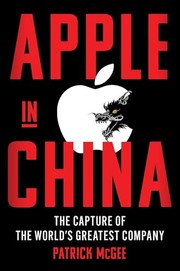
Apple in China
2,094-word summary 9 min read 448 pages in the book
- First published
- 2025
- Publisher
- Scribner
- Pages
- 448
- ISBN
- 9781668053379
Reading options
What's inside (9 sections)
I picked up this book because I wanted to understand something that had puzzled me for years. How does a company that sells the most wanted consumer device on earth become so tied to a government that decides what its citizens may see and say? Patrick McGee's answer, spread across 448 pages, is that Apple did not simply manufacture in China. It taught China how to build what Apple wanted built, and in doing so made itself dependent on the country it was schooling. That is an uneasy story, and McGee tells it with a reporter's patience rather than a polemicist's shout.
The full title is Apple in China: The Capture of the World's Greatest Company. Scribner published it on 13 May 2025, and it is a work of narrative nonfiction shaped into a chronology. By the end I had learned a great deal about how a supply chain turns into a kind of foreign policy. I also felt the discomfort the author plainly wants his reader to feel.
A reporter who kept his receipts
McGee covered Apple for the Financial Times from 2019 to 2023, and that stretch of access sits behind every page. He carried out more than 200 interviews. He also drew on unpublished meetings involving Steve Jobs, executive emails and internal memos. When a business journalist has that much privileged material, the risk is a book that becomes a scrapbook of leaked documents. McGee mostly resists it. He uses the material to build a chronological account, and the documents are there to support an argument rather than to dazzle the reader.
That argument is precise enough to dispute. Apple, under Tim Cook, invested about $275 billion in China between 2016 and 2021. McGee compares that sum to the Marshall Plan, and he is not being casual. The Marshall Plan rebuilt a continent after a war. McGee argues that Apple's spending rebuilt an industrial base inside China, paying for factories and training millions of workers. That is the engine of the whole book.
The scale is hard to hold in your head, so McGee gives it a consequence. He calls Apple the world's biggest corporate investor in China, a company earning about $70 billion a year there. Roughly 90 percent of its manufacturing sits in a country run by an authoritarian government. Put those numbers side by side and the interesting question changes. It stops being about whether Apple makes good phones and becomes about what happens when a company concentrates so much of itself in one place.
I appreciated that the reporting is strongest when it stays near individual people. The book is full of executives and policies, but the passages I remembered were the ones about a single life caught up in the machine. That is a matter of emphasis, and it is also where McGee's gift as a storyteller shows.
From factory floors to the biggest investor in China
The book moves in order, and that order is doing real work. McGee opens with Apple's reliance on Foxconn's Chinese factories and with the training of Chinese engineers. This is not background. It is the starting point of his claim. In his telling, the early decision to manufacture in China was about cost and speed, but it set in motion something much larger. Apple needed a workforce that could meet its standards, so it helped create one.
From there the chronology builds. Apple trains engineers, the engineers get better, the factories multiply, and the investment grows until the company is pouring in the $275 billion figure that anchors the argument. McGee describes this as an epic transfer of knowledge. The phrase matters because he is describing something that cannot be undone by moving a final assembly line to another country. Knowledge, once passed on, stays put.
He ties that transfer to Beijing's Made in China 2025 plan. The argument is that Apple's investment helped a native electronics industry take root, one that could eventually compete with the very company that trained it. This is where the book's title starts to make sense. The capture in the subtitle is not a hostile takeover in the legal sense. It is the slow process of a company becoming entangled with a place and a system it cannot easily leave.
At this point a reader might reasonably ask how much of this is Apple's fault. McGee is clear that the choices were Apple's, made by executives pursuing margin and scale in a market they could not ignore. The tone is not angry so much as sorrowful, as if he is describing a decision that was rational at every step and foolish in aggregate. I found that more convincing than outrage would have been.
The people inside the machine
Three figures stand out in McGee's account, and they give the book its human weight. The first is a Mormon missionary who established the Apple Store in China. That detail sounds almost quirky until you sit with what it means. Getting a retail presence right in China required someone willing to live there, to learn the rules and to stay. McGee uses the story to show how much of Apple's expansion depended on individuals who gave years of their lives to it.
The second is a group the book calls the Gang of Eight, executives tasked with placating Beijing. This is the side of the story that involves meetings, carefully worded statements and the quiet calculations of people whose job is to keep a government happy. McGee does not present them as villains. They are managers doing what their positions require, which is to protect the company by accommodating the state it operates inside.
The third figure is a veteran whose hopes of improving factory workers' lives were crushed, in McGee's telling, by both Cupertino and Xi Jinping's crackdown. This is the most painful thread in the book. A person who wanted to make life better for the people assembling the phones finds himself squeezed between a company guarding its production targets and a state guarding its control. When a story like that lands, the abstract numbers about investment and manufacturing stop being abstract.
I wanted more of this. McGee has an eye for the person who carries the cost of a large decision, and I finished the book wishing he had given that veteran more space. The executives and the policies are necessary, but the lives are what make the argument stick.
Fire, and the company that handed it over
McGee sums up his thesis with a myth. He casts Apple as Prometheus, the figure who stole fire from the gods and gave it to humanity. In this version Apple is the giver, China is the recipient, and the gift is the know-how to build a modern electronics industry. The comparison is dramatic, and it captures the book's central tension in a single image. Prometheus suffers for his gift. McGee suggests Apple is suffering a milder version of the same fate.
The metaphor also explains the subtitle's word capture. Apple gave away something it could not take back. The training of millions of workers, the building of factories, the creation of a supplier base: all of it outlives any single product cycle. McGee argues that this helped advance Beijing's goals while leaving Apple dependent on the government that now has the capacity to compete with it. The gift, in other words, empowered the recipient and exposed the giver.
I think this is the strongest part of the book and also the part most open to challenge. The Promethean frame is elegant, and it risks making a complicated set of business decisions feel like a tragic fable. Real companies make these trades for ordinary reasons, and the people who made them were not carving myths into stone. Still, the image is hard to shake once McGee has planted it.
Concessions that did not buy protection
The later chapters turn to what Apple did when the pressure came. McGee describes the company blocking virtual private networks and restricting AirDrop after citizens used the service to organise. These are not small details. For a company that built its brand on a language of privacy and individual freedom, the decision to limit tools that people use to communicate is a revealing one. McGee presents it as part of a pattern of accommodation.
He also argues that the concessions failed in their purpose. Apple gave ground to protect its position, and it did not protect it. Rivals such as Huawei rose, and the company found itself no safer for having tried to please its host. This is the book's sobering practical lesson. If you accept the premise that Apple was buying protection, the record does not show that the purchase worked.
There is an uncomfortable honesty in the way McGee lays this out. He is not arguing that Apple should have stayed away from China, or that a different set of executives would have produced a clean outcome. He is arguing that the trade had costs that were undercounted at the time, and that those costs are now visible. The crackdown on workers and organisers is part of the same picture. A company that helps build an industrial base cannot be surprised when that base answers to a government with its own priorities.
Reading these chapters, I kept thinking about how ordinary each concession sounds on its own. A VPN blocked here, a feature limited there, a statement softened. It is only when McGee stacks them up that the shape appears. That stacking is one of the book's real achievements.
The reception, and where I think it overreaches
The book was widely praised. Hannah Beech in The New York Times called it smart and wide-ranging. Kirkus described it as a well-argued, eye-opening look at the dark side of globalism. Foreign Affairs lauded its research. Those responses match what I felt about the reporting, which is careful and deep.
There was also sharp pushback, and it is worth taking seriously. Apple told Vanity Fair the book was full of inaccuracies. Chen Jing of The China Academy argued that the claims were greatly exaggerated and that the Marshall Plan comparison showed Western bias. I cannot adjudicate every disputed number from the outside. What I can say is that the Marshall Plan analogy does carry cultural assumptions, and a comparison that feels illuminating in an American context can look loaded from Beijing. McGee is writing for a Western audience, and the frame reflects that.
My own criticism is narrower. The book sometimes leans too hard on its central image. Once the Prometheus idea is in place, a lot of the material seems designed to illustrate it, and a story that complicated deserves to be allowed to stay complicated. At 448 pages there is room for the argument to breathe, but there are also passages where the thesis is restated when a scene would have done more work. I also thought the section on the Gang of Eight could have told us more about how those executives actually thought and argued, rather than what they represented.
None of that sinks the book. The reporting is strong enough that the doubts it raises are worth having. A friend of mine who follows tech stocks loved it. Another reader I can imagine, someone looking for a neutral corporate history, may find the moral framing heavy. This is not a neutral book, and it does not pretend to be.
What I took away
The thing I keep returning to is the phrase epic transfer of knowledge. It is the most useful idea here, and it explains why the story cannot end with a factory closing or a supply chain moving. Apple made a decision decades ago to build in China, and that decision trained a generation of engineers and workers who now belong to an industry China owns. The $275 billion and the 90 percent are the measure of how well that worked, for better and worse.
I would hand this book to anyone who wants to understand why the phones in their pockets are a political subject. I would warn them that it is an argument as much as a history, and that the argument is persuasive partly because McGee did the interviews and read the memos. You may finish it disagreeing with the Marshall Plan comparison or impatient with the mythmaking. You will not finish it thinking the supply chain is a boring topic. That is a real accomplishment for a book about factories.
FAQ
What is Apple in China about?
It is a 2025 work of narrative nonfiction tracing how Apple under Tim Cook built up manufacturing in China and became dependent on the government there. Scribner published it at 448 pages.
Where did McGee get his information?
He drew on more than 200 interviews, unpublished meetings involving Steve Jobs, executive emails and internal memos gathered while covering Apple for the Financial Times from 2019 to 2023.
Did everyone agree with the book's claims?
No. Some critics praised the reporting, but Apple told Vanity Fair it was full of inaccuracies, and Chen Jing of The China Academy argued the Marshall Plan comparison showed Western bias.
Similar books
Careless People
A former New Zealand diplomat recounts seven years at Facebook, from a Myanmar launch to a hospital bed where the job followed her between contractions.
2,413-word summary · 11 min read
Breakneck: China's Quest to Engineer the Future
Dan Wang argues that America is run by lawyers and China by engineers, from a bicycle ride through Guizhou to the human cost of the one-child policy.
2,281-word summary · 10 min read
The World Is Flat: A Brief History of the Twenty-first Century
Thomas L. Friedman's 2005 bestseller argues that technology, trade, and open borders leveled the global playing field, and it names the ten forces that did it.
2,369-word summary · 11 min read

One Day, Everyone Will Have Always Been Against This
From a viral 2023 post, Omar El Akkad builds a furious short argument about Western promises, silence and complicity during the Gaza war.
2,218-word summary · 10 min read

Mountains Beyond Mountains: The Quest of Dr. Paul Farmer, a Man Who Would Cure the World
Tracy Kidder travels with Dr. Paul Farmer from Haiti to Peru, tracing how a Harvard doctor built a health system for the poor and what that work cost him.
3,095-word summary · 14 min read
Flash Boys: A Wall Street Revolt
Michael Lewis follows a Canadian trader and his band of Wall Street outsiders as they discover how speed was used to rig the stock market, then build an…
3,009-word summary · 13 min read
All or Nothing: How Trump Recaptured America
Wolff's fourth Trump book reconstructs the 2024 campaign and the return to the White House from Mar-a-Lago sources, phone monologues and unnamed confidants.
2,248-word summary · 10 min read

Nothing to Envy
Barbara Demick follows six defectors from Chongjin through the North Korean famine, showing how ordinary people lived, believed, and finally left.
2,068-word summary · 9 min read
Catch and Kill: Lies, Spies, and a Conspiracy to Protect Predators
Ronan Farrow recounts how NBC killed his Harvey Weinstein reporting, then how The New Yorker published it and helped ignite #MeToo.
2,057-word summary · 9 min read
Empire of Pain: The Secret History of the Sackler Dynasty
How the Sackler family sold OxyContin and shaped an overdose crisis while giving to museums.
2,048-word summary · 9 min read
21 Lessons for the 21st Century
Twenty one essays on work, liberty, truth, and meaning when algorithms flood the world with noise.
2,101-word summary · 9 min read
Fast Food Nation
Fries, burgers, and meatpacking traced from stands to slaughterhouses show cheap food true price.
1,938-word summary · 9 min read
Bad Blood
How Theranos sold finger prick miracles, faked tests, and silenced staff who knew patients were at risk.
2,021-word summary · 9 min read
Zero to One: Notes on Startups, or How to Build the Future
Thiel argues monopolies create value through vertical progress, not by copying competition.
2,582-word summary · 11 min read
The Lean Startup
Ries lays out Build-Measure-Learn, MVPs, pivots and validated learning for building companies under extreme uncertainty.
2,581-word summary · 11 min read
Steve Jobs
Walter Isaacson's authorized Steve Jobs: forty interviews covering the garage, the 1985 ouster, Pixar, and the return that made the iPhone.
2,415-word summary · 11 min read
Universality
Natasha Brown's short second novel turns a lockdown fracas over a gold bar into a sharp satire of money, identity and public argument.
2,302-word summary · 10 min read
Motherland: A Feminist History of Modern Russia, from Revolution to Autocracy
A feminist history of modern Russia told through women's lives, from the revolutionaries of 1917 to Pussy Riot and the politics of today.
2,191-word summary · 10 min read
Built to Last: Successful Habits of Visionary Companies
Collins and Porras compare eighteen durable companies with their rivals and find habits like clock building, core ideology, and home grown management.
2,132-word summary · 9 min read

The Girl Who Takes an Eye for an Eye
Lisbeth Salander investigates a secret childhood experiment from prison while Mikael Blomkvist uncovers a twin conspiracy behind a wealthy businessman.
2,059-word summary · 9 min read
Source Code
Bill Gates's first memoir retells his Seattle childhood, from a grandmother's Ritz crackers to nights sneaking out to code. It stops just before the MS-DOS…
2,473-word summary · 11 min read
Men Explain Things to Me
A short collection of essays that begins with a man explaining Solnit's own book to her and expands into an argument about who gets believed, who gets heard…
2,019-word summary · 9 min read

I Am America (And So Can You!)
Stephen Colbert's 2007 debut extends his Colbert Report pundit into print, a mock-conservative tour of American life with margin notes, stickers and Fun Zones.
2,635-word summary · 12 min read

Hiroshima
In 1946 John Hersey followed six ordinary people through the atomic bombing of Hiroshima and its aftermath, using a plain style that made the reporting feel…
2,991-word summary · 13 min read
Getting to Yes: Negotiating Agreement Without Giving In
Fisher and Ury propose negotiating on interests rather than positions, using fair standards and a clear alternative if no deal is reached.
2,231-word summary · 10 min read
Emotional Intelligence 2.0
Bradberry and Greaves turn emotional intelligence into four learnable skills, a self-assessment and dozens of strategies, while their headline numbers rest on…
3,276-word summary · 15 min read
Digital Minimalism: Choosing a Focused Life in a Noisy World
Cal Newport argues that willpower cannot beat an attention economy designed against you, and offers a thirty day reset to rebuild your digital habits around…
2,701-word summary · 12 min read
Blue Ocean Strategy: How to Create Uncontested Market Space and Make the Competition Irrelevant
Two INSEAD professors argue that companies win by creating uncontested markets rather than fighting rivals, and give managers tools to do it.
2,333-word summary · 10 min read
Abundance
Two journalists argue that rules written to fix the abuses of the 1970s now block the housing, energy and clean construction the 2020s need, and propose a…
2,306-word summary · 10 min read
107 Days
Kamala Harris's memoir of the 107 days between Biden's withdrawal and Election Day, drawn from a journal kept during a campaign she believes she was best…
2,132-word summary · 9 min read