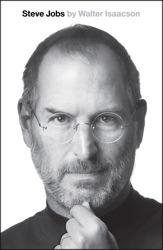
Steve Jobs
2,415-word summary 11 min read 656 pages in the book
- First published
- 2011
- Publisher
- Simon & Schuster
- Pages
- 656
- ISBN
- 9781451648539
Reading options
What's inside (10 sections)
I picked this one up because I wanted to know how the man behind the products actually treated people, and the short answer arrives fast. Walter Isaacson's Steve Jobs is an authorized life. He sat with Jobs for more than forty interviews across two years, then talked to more than one hundred family members, friends, rivals and colleagues who surrounded him. Jobs agreed to the book and asked for no control over the text, which is the most important fact about it. Simon and Schuster published it on 24 October 2011, nineteen days after Jobs died, so the final pages carry a weight nobody could have planned for. Isaacson had already written biographies of Benjamin Franklin and Albert Einstein. This one runs 656 pages in hardcover and moves in a straight line from a Silicon Valley garage to a Palo Alto bedroom.
The Bench in the Garage
Jobs was born in San Francisco in 1955 to a Syrian student, Abdulfattah Jandali, and his American girlfriend Joanne Schieble, who gave him up for adoption because her father objected. The couple who raised him, Paul and Clara Jobs, were modest people in the Bay Area. Paul worked as a machinist, cut and fixed things for a living, and never finished high school. He built a workbench in the garage and put Steve to work on it, taking apart radios, speakers, pinball machines, and whatever else came through the house.
Paul had a rule that stuck with his son: the side of a cabinet that nobody would ever see had to be finished as neatly as the side on display. He drove Steve to electronics shops and let him stand at the counter asking the staff questions until someone answered. It would be easy to make too much of garage mythology, but Isaacson keeps returning to this stretch because Jobs kept returning to it. Objects could be understood, he learned early, and once understood they could be taken apart and improved. Later that conviction turned into a management style, and the same conviction made him unbearable when a person, rather than a cabinet, was the thing being finished.
Reed, India, and Wozniak
Jobs enrolled at Reed College in Portland in 1972 and quit after a single semester, partly because he did not want to spend his parents' savings on a degree he did not want. He stayed on campus as an auditor, sleeping on other people's floors, returning bottles for deposit money, and eating at the Hare Krishna temple. In that free period he sat in on a calligraphy class taught by Robert Palladino, a monk who taught serif and sans-serif typefaces, the rhythm of letters, and the spacing between words. Ten years later that class paid off in the typography of the first Macintosh, which handled proportional type while rival machines produced uniform gray blocks of characters. It is the best example in the book of an apparently useless education working slowly.
In 1974 he flew to India with Daniel Kottke, a friend from Reed, looking for a guru, and came home with a shaved head and a lasting taste for Zen. He studied at the San Francisco Zen Center, considered monastic life, and carried a preference for stripped-down design and intense focus out of those years. He also carried the diets, the fasting, and a stubborn indifference to how he smelled, which show up repeatedly later in the book.
Steve Wozniak he had known since high school, an older kid who could build electronics from memory. Together they made blue boxes, devices that spoofed telephone switching tones and let people place calls without paying, and once they realized how illegal that was they stopped. The division of labor between them was set early: Wozniak built, Jobs sold. When Atari paid Jobs a bonus for the game Breakout and he told Wozniak the bonus was seven hundred dollars, splitting it three-fifty each, the truth was that the bonus was several thousand. Wozniak learned the real number years later. Isaacson reports it without dressing it up, and the episode is the template for a pattern that runs through the whole book: the engineering genius gets the credit he wrote, and the partner gets the rest.
Apple in the Garage and the 1984 Machine
Apple started in April 1976 in the Jobs family garage, with Wozniak's Apple I circuit board and a third partner, Ron Wayne, who drew up the first contract and then sold his share back within days for a small fraction of what it would have been worth. Mike Markkula, a retired Intel millionaire, put in two hundred and fifty thousand dollars, wrote the business plan, and brought the company its first real management. The Apple II followed in 1977 with color graphics and a friendly case, and it was the machine that actually made money, helped by the spreadsheet VisiCalc, which gave offices a reason to buy one. Apple went public in 1980 and made Jobs a millionaire before he was old enough to rent a car comfortably.
The Macintosh absorbed him from 1981 onward. He did not run Apple as a whole, he ran this one division, and he ran it the way he ran everything: daily battles over details, public grading of his staff as either brilliant or worthless, and an insistence that the machine's character mattered more than its component list. He got a look at the graphical interface and mouse being developed at Xerox PARC and understood immediately that the old command-line world was finished, then pushed his team to build a machine along those lines. The Mac arrived in January 1984 with a screen that drew windows and icons, a mouse you moved by hand, and type that looked like print. The advertising agency's commercial, showing a woman hurling a hammer at a screen full of drones, ran during the Super Bowl two days before launch and is still the most famous thing the company ever put on television. Jobs called the machine insanely great, which was exactly how he talked about everything he liked.
Then the sales disappointed. The Mac was expensive, its software library was thin at release, and the Apple II still paid the company's bills. Jobs wanted the older machine starved and the new one pushed harder. John Sculley, the president Jobs had recruited from Pepsi two years earlier by asking whether he wanted to sell sugar water for the rest of his life or come along and change the world, wanted the opposite.
Sculley and the Boardroom
The fight between Jobs and Sculley in 1985 is the center of the book's first half. Jobs tried to mount an internal reorganization that would strip Sculley of day-to-day authority. Sculley found out, went to the board, and the directors, most of them his allies, chose the chief executive over the founder. Jobs was removed from the Mac division in the spring of 1985, drifted for a few months without a real job at his own company, and resigned in September. He sold nearly all of his Apple shares, keeping a single share so that he could keep receiving the annual report.
He was thirty. By his own account in these chapters he felt the company had been taken from him, and for years afterward every negotiation with Apple carried that bruise. The account is worth reading closely because Isaacson prints what the board members and the executives said at the time as well as what Jobs said later, and the two do not always match.
NeXT, Pixar, and Toy Story
Jobs put together a new company, NeXT, hiring away a group of Apple engineers and hiring Hartmut Esslinger's design firm to shape the machine: a black magnesium cube that looked unlike anything on a desk. It shipped in late 1988, it was beautiful, and it cost far too much for the business and education markets it aimed at. Very few were sold. What survived was the software, NeXTSTEP, an operating system built on Unix with an object-oriented framework. When Apple bought NeXT in 1996, that system became the foundation of the Mac's software for the next two decades, which makes NeXT one of the strangest profitable failures in the industry.
Pixar came out of Lucasfilm's computer division in 1986, which Jobs bought for five million dollars and then kept funding through years of losses. The company sold an expensive imaging computer to hospitals and research labs and never found a big market. Jobs put in more money than he had planned, and the breakthrough arrived in 1995 when Toy Story, made with Disney, was released as the first fully computer-animated feature film. The public offering that followed made Jobs a billionaire, and it changed his standing: for the first time he had a hit he had not argued his way into by shouting.
The Second Apple
Apple bought NeXT at the end of 1996, brought Jobs back as an adviser, and within months he had pushed out the chief executive Gil Amelio and taken charge himself, first without a title and then as interim chief executive. The company was losing money and close to collapse. Jobs cut the product line to a handful of machines, cancelled licensed clones of the Mac, and took a fifteen million dollar investment from Microsoft while Bill Gates's face appeared on a giant screen at a Boston event and the audience booed.
The iMac arrived in 1998, designed with Jonathan Ive, translucent and blue, and it sold in large numbers to people who had never cared about computers. Then the sequence that made the company: the iTunes music software in 2001, the iPod in 2001, the iTunes Store in 2003, the iPhone in 2007, and the iPad in 2010. Each was announced by Jobs on a bare stage, working through slides with product names and a few numbers, and each is given a chapter or so here.
This is where the book starts to drag. The product-by-product stretch gets technical: chip speeds, storage capacities, screen dimensions, sales figures, and the internal arguments over whether a device should have a keyboard. Isaacson is better on conflict than on craft. Readers hoping to learn how these objects were designed will find more about who shouted at whom over the schedule than about the decisions that made the phone feel good in a hand. If you want an engineering history, this is the part to skim.
The Reality Distortion Field
Jobs's management has its own vocabulary in the book. The term reality distortion field came from the Apple team, borrowed from Star Trek, for his talent for making people believe a deadline that no one could meet was reasonable, until they met it. He applied it to engineers, to designers, to his own family. People who worked for him describe the thrill of being told they were doing the greatest work in the world, and the cost of being told the opposite five minutes later.
The secrecy was total. Projects carried code names, teams were told only what they needed, and entire buildings were off limits to anyone without the right badge. The design demands were just as absolute. He insisted that the inside of a product, the parts customers never see, be laid out as carefully as the outside, and he overruled engineers who argued that a hidden detail was good enough. He graded people in two categories, enlightened or fools, and said so out loud. Isaacson does not soften any of this. Nor does he soften the good part, which was that Jobs's attention to how a machine was finished produced objects that other companies spent a decade copying.
His friendship with Wozniak is the test case. Wozniak was the better engineer and knew it, gave away his shares of Apple after a plane crash nearly killed him, and has said he felt cheated by Jobs more than once. Isaacson lets both men talk, and the friendship survives on the page mostly because Wozniak decided it should.
Lisa, the Tumor, and the End
In 1978 Chrisann Brennan, who had been Jobs's girlfriend on and off since Reed, gave birth to a daughter, Lisa. Jobs denied he was the father for years, submitted to testing, and said things in print that no father should say about a child. He had by then named a computer the Lisa. The girl grew up poor with her mother while the man who refused her was getting rich, and the book does not look away from that. Later she lived with him as a teenager, the relationship stayed raw, and it softened only gradually in his final years.
The cancer diagnosis came in 2003, from a scan done for an unrelated complaint, and the tumor was a rarer, slower-growing kind of pancreatic cancer. His doctors urged surgery. Jobs spent roughly nine months on alternative treatment instead: a strict vegan diet, juices, herbs, acupuncture, and other approaches he researched and funded himself, while also meeting specialists who disagreed with him. He finally had surgery in 2004, and Isaacson reports that Jobs later regretted the delay. A liver transplant followed in 2009, along with two extended medical leaves, his resignation as chief executive in August 2011, and his death at home on 5 October 2011, with his family around him.
The criticism people make of the biography is mostly about repetition and tone. Isaacson acknowledges that the same story reaches him in different versions and prints the competing accounts side by side, which is honest but leaves some episodes running twice. Jobs comes across as genuinely cruel in places, most visibly toward Lisa and toward employees who had the bad luck to be wrong in a meeting, and readers who knew only the stage persona will find the warmth harder to find. The middle sections get bogged down in machines. What holds it together is the shape Isaacson gives the life: a man who could convince almost anyone of almost anything, who never learned to do that with his own daughter until it was nearly too late, and who was dying while the book was being finished. It is not a book for someone after a balanced verdict, since Jobs refused to steer it, and it is not for someone who wants the products explained. For anyone willing to sit with an uncomfortable portrait of a useful, difficult person, it earns its 656 pages.
FAQ
When was Steve Jobs published?
Simon & Schuster published it on 24 October 2011, 19 days after Jobs died on 5 October 2011. The hardcover runs 656 pages.
How much of the biography comes from Jobs himself?
Isaacson interviewed Jobs more than forty times over two years, then spoke with more than a hundred family members, friends, rivals and colleagues. Jobs agreed to the book and asked for no control over the text.
What was Jobs doing between Apple in 1985 and his return in 1997?
He founded NeXT in 1985 and bought Pixar from Lucasfilm in 1986. Toy Story made him a billionaire in 1995, and Apple's purchase of NeXT in 1996 brought him back to the company.
Similar books
More like Steve Jobs →
Elon Musk: Tesla, SpaceX, and the Quest for a Fantastic Future
Ashlee Vance traces Elon Musk from a rough Pretoria childhood through PayPal, Tesla and SpaceX.
2,286-word summary · 10 min read

Zero to One: Notes on Startups, or How to Build the Future
Thiel argues monopolies create value through vertical progress, not by copying competition.
2,582-word summary · 11 min read

The Lean Startup
Ries lays out Build-Measure-Learn, MVPs, pivots and validated learning for building companies under extreme uncertainty.
2,581-word summary · 11 min read
Think and Grow Rich
Hill teaches desire, faith and autosuggestion, distilling lessons from Carnegie interviews into thirteen principles for success.
2,458-word summary · 11 min read

Spare
Prince Harry recalls Diana's death in 1997, two tours in Afghanistan, and stepping back from royal life with Meghan in this frank 2023 memoir of grief, love…
2,586-word summary · 11 min read

John Adams
McCullough follows Adams from Braintree lawyer to second president.
2,515-word summary · 11 min read