
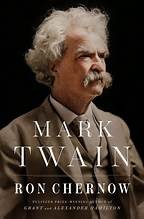
Mark Twain
2,501-word summary 11 min read 1200 pages in the book
- First published
- 2025
- Publisher
- Penguin Press
- Pages
- 1200
- ISBN
- 9780525561729
Reading options
What's inside (9 sections)
I have a complicated relationship with very long biographies. I love the ones that make a life feel inexhaustible, and I dread the ones that make you feel every single page. Ron Chernow's Mark Twain arrived with a reputation for being both, a book of 1,200 pages published by Penguin Press on 13 May 2025. I came to it expecting to be worn down. What I found instead was a study that is enormously readable and also genuinely enormous, a portrait of Samuel Clemens that keeps one argument in front of you from beginning to end. The writer the world calls Mark Twain (1835-1910) spent his life pulled in two directions, toward a genius for words and toward a talent for losing money that was almost just as remarkable.
That is a strong thesis, and Chernow does not let it go. Whether the book fully earns its length is a separate question, and I will get to that honestly. But the framing gave me a way through twelve hundred pages that might otherwise have swallowed me whole. I want to walk through what the biography actually says, because the story it tells is stranger and more human than the comfortable legend of the kindly humorist.
A life in two columns
The organizing idea here is simple enough to state in a sentence. On one side is the literary achievement, the body of work that led Faulkner to call Clemens the father of American literature. On the other side is a long record of financial judgment so poor that it becomes fascinating in its own right. Chernow presents the life as a sustained struggle between these two forces, and much of the drama comes from watching them collide again and again.
I should say at the outset that this is a biography rather than a work of criticism, and it is less interested in close reading of the books than in the man who wrote them. That will delight some readers and frustrate others. If you come looking for pages spent on the structure of Huckleberry Finn or the language of A Connecticut Yankee in King Arthur's Court, you will find comparatively little of that here. What you get instead is the story of how a man with an extraordinary gift for words kept finding fresh ways to part with his money, and what that cost him.
The dates tell their own story. Clemens was born in 1835 and died in 1910, and the span between those years covers the whole arc of the country's literary coming of age. Chernow is alert to that larger frame, but his focus stays firmly on the individual. The book is at its best when it keeps both scales in view at once, the private man wrestling with his own bad decisions and the public figure the world invented around him.
The long road to Huckleberry Finn
For me the most absorbing section concerns the making of the book everyone knows best. Chernow shows us a writer who did not produce Huckleberry Finn in one clean burst of inspiration. The New Yorker's account of the biography reports that Twain worked on it fitfully at a retreat in upstate New York, wrote a few hundred pages, and then stopped around 1880. The book that would come to define him sat unfinished, set aside by a man who had other things on his mind.
What brought him back was the river. In 1882 he returned to the Mississippi to gather material for Life on the Mississippi, and in doing so he reconnected with the voices of his youth. That detail matters more than it might appear to, because it explains why the finished book sounds the way it does. The speech patterns, the rhythms, the whole ear for how people actually talked were not invented at a desk. They came from going back to the place and listening again, from a man hearing the language he had grown up with after years away from it.
He wrote to his friend William Dean Howells about the pace of the work, saying he had produced eight or nine hundred manuscript pages in a remarkably short time. There is a boyish pride in that, the simple pleasure of a writer who has finally found his subject and cannot wait to get it onto paper. Chernow lets that moment breathe. It is one of the few places in the biography where you feel the pure excitement of composition rather than the low hum of anxiety about earning a living.
The American edition of Huckleberry Finn appeared in 1885. Chernow does not hurry past the difficulty that has followed the book ever since. The final section, in which Jim is recaptured, has troubled readers from the beginning, and it still troubles them now. I appreciated that the biography gives this its due instead of treating it as a small embarrassment to be explained away. The problem is not a footnote to the achievement. It sits at the center of what the book is and what it means, and a life this large deserves an honest account of the parts that do not sit comfortably. Chernow supplies one.
The machines that ate the money
If the writing forms the first column of Chernow's argument, the schemes form the second. This is where the biography turns almost farcical, although there is nothing funny about the consequences. Twain kept pouring money and attention into inventions that promised to make him rich. There were steam pulleys and marine telegraphs, but above all there was the Paige typesetting machine, which was going to transform the printing trade and instead delivered him into bankruptcy.
The Paige machine functions as the great villain of the book. It consumed years and astonishing sums, and it never came close to delivering what it promised. Chernow's account of it reads like a study in obsession. Here was a man who could see through the pretensions of almost anyone, who could deflate a fraud with a single well aimed sentence, and yet he could not bring himself to admit that the machine in front of him was a bottomless pit. The same habits of mind that made him a sharp observer of human folly in his fiction turned inward and did him real damage.
The detail I keep returning to is the one about the scrapbook. His most profitable book, Chernow notes, was a patented blank scrapbook of his own invention. Pause over that for a moment. The writer who gave American literature some of its defining pages made his most dependable profit from a book with nothing printed in it at all. I do not know whether Chernow means it as a joke, but it seems to me to capture the inverted logic of the man's whole financial life. The work he was uniquely gifted at doing did not reliably pay. The object anyone could have made did.
What struck me hardest in these chapters is how little the schemes resembled greed. Twain wanted the machines to work because he wanted the freedom and the standing he thought wealth would bring. Chernow is good on this, tracing the way each new venture pulled more of his time and capital away from the writing that actually mattered. The tragedy is not that he was a fool. It is that a considerable intelligence kept getting redirected toward things that could never repay the attention.
A working writer, and an exile
It would be a mistake to read this biography as the story of a man who never did anything right. Alongside the schemes there is an extraordinary run of work, and Chernow sets it out with real care. In 1885, the same year Huckleberry Finn appeared in America, Twain published Ulysses S. Grant's memoirs to great acclaim. Bringing a former president's life into print was a genuine coup, and it displayed a different set of talents from the ones that produced his novels: an instinct for what the public would read, the nerve to pursue it, and the editorial discipline to get it into shape.
In 1889 came A Connecticut Yankee in King Arthur's Court, that peculiar collision of medieval romance and American mechanical confidence. By 1891, however, the debts had grown large enough that he went into self-imposed exile in Europe. The phrase is a polite one, and the reality was a man leaving the country in part because he could not comfortably face the people he owed. Chernow traces this stretch without softening it. The exile is not a romantic chapter about an artist finding himself abroad. It is a retreat from the consequences of a long series of bad decisions, and the writing continues under that cloud.
This portion of the book gave me a clearer sense of Twain as a professional rather than a legend. He was a man who got up and worked, who understood the market for his own writing, and who kept producing even while his private world came apart. The biography is strongest when it holds those two facts together without trying to reconcile them into a lesson.
Climbing out, and the man who helped
The recovery, such as it was, came through work and through an unlikely patron. In 1896 Twain undertook a lecture tour of Australia, New Zealand, India and South Africa. These were not ceremonial appearances or a victory lap. They were a man earning his way back, travelling to the far side of the world to pay the creditors he had accumulated. There is something admirably stubborn about it, and Chernow gives the tour its proper weight. The lecture platform was the one piece of machinery in his life that reliably worked.
The other part of the rescue came from Henry Huttleson Rogers, a magnate in the Standard Oil empire who admired Twain's writing. Rogers reorganised his finances and secured his copyrights, and without that intervention the story might have ended much worse. This is precisely where the biography's governing idea gets its sharpest edge, because Chernow observes that Twain "raged against plutocrats even as he strove to become one." The man who could mock the rich so effectively in print needed a rich man to pull him out of the fire.
That is not a contradiction the book tries to resolve, and I do not think it should. It is simply the truth of the man, held up for inspection. I found this section the most interesting in the whole biography for just that reason. It refuses to be tidy. There is no moral here about how to live a better life. There is a gifted, impulsive man making an enormous mess, working extremely hard to clean it up, and depending on the very class of people he liked to attack in order to do it. The mess and the rescue are one continuous story, and separating them would falsify both.
The trouble with twelve hundred pages
So does the book work? Here I want to be fair in both directions. The New York Times called the biography "enormous, bland and remote" and an "endurance test," and argued that it skims the literary context and misses the man Faulkner called the father of American literature. That is a serious charge, and having spent the time with the book I understand exactly where it comes from.
The length is the most obvious target. Twelve hundred pages is a real commitment, and there are long stretches where detail accumulates without much change in pace or direction. Chernow is thorough in the way a careful accountant is thorough, and the virtues and the drawback are the same one: very little gets left out, which also means very little gets left out. The passages about the lecture tour and the financial reorganizing are genuinely illuminating. Other sections felt to me like they were filling in time. I caught myself skimming more than once, which is not something I want to find myself doing with a biography I otherwise admire.
The charge of remoteness is harder to pin down but ultimately more damaging. Chernow keeps the reader at a fixed distance from his subject. Even in the chapters about the books, the emphasis falls on what happened rather than on what it felt like to be the person it happened to. You finish knowing an extraordinary amount about Samuel Clemens and still wishing you had spent longer inside his head. The book possesses an immense amount of information about the man and somehow manages to keep him at arm's length, which is an odd achievement for a biography this intimate in its subject matter.
And yet I hesitate to set it down as a failure. The scale is partly the point. Chernow is attempting to hold an entire life in view at once, the books and the schemes and the debts and the rescue and the long public career, and a shorter biography would have been forced to choose among them. What we get instead is a life that refuses to be reduced to a single tidy line. If the result is sometimes bland, it is also unusually full, and the full picture has a value that a slicker book would not have had.
What I took away
I closed this book with a clearer sense of Mark Twain as a working writer rather than a statue. The legend tends to flatten him into a source of homespun wisdom, a man with a white suit and a good line. Chernow restores the mess. Here is a writer who stopped and restarted his most famous book, who found his voice by going back to the river, who lost a fortune to a typesetting machine, and who made his steadiest profit from a scrapbook with blank pages.
The central tension holds up because the evidence is there on every page. The genius and the bad judgment were not separate threads that occasionally crossed. They were bound together in the same person, and the life makes sense only if you keep both in sight. That is the real service of a biography this long: it has room for the whole contradiction without smoothing it into a slogan.
I would hand this to a reader who wants to understand the machinery of a literary life, the way money and work and reputation press on a writer over decades. I would be more cautious with a reader who wants a short, elegantly shaped account, or one mainly curious about how the novels are constructed. Those readers will find the length an endurance test, and the New York Times was not wrong to say so. For me, the trade was worth making. The book is slow in places and distant in others, but it leaves you with a Samuel Clemens who is far more complicated and far more interesting than the figure in the white suit. That is no small thing for a biography to accomplish.
FAQ
Is this a biography or a work of literary criticism?
It is a biography. Chernow concentrates on Samuel Clemens's life, money and career rather than close analysis of the novels, so readers wanting detailed readings of Huckleberry Finn will find comparatively little of that here.
What is the central argument of the book?
Chernow presents Twain's life as a struggle between his genius for writing and his disastrous judgment in business, holding that tension in view from beginning to end.
Why is the book so long, and is the length worth it?
At 1,200 pages it tries to hold an entire life in view, and while the New York Times called it an endurance test, that fullness lets it keep the contradictions of the man intact.
Similar books
Alexander Hamilton
Orphaned Caribbean immigrant becomes Washington's aide and America's first Treasury secretary, then falls in a duel.
2,004-word summary · 9 min read
Truman
McCullough's 1992 Pulitzer-winning biography follows Harry Truman from Missouri farm boy and senator to the president who ended a world war.
2,262-word summary · 10 min read
The Autobiography of Benjamin Franklin
Franklin writes his own life in four parts, from a Boston boyhood and a runaway apprenticeship to printing, science, and public service, while keeping careful…
2,259-word summary · 10 min read
The Wright Brothers
David McCullough tells the story of two self-taught Ohio brothers, working largely alone and out of a bicycle shop, who solved the problem of flight before…
2,027-word summary · 9 min read
America (The Book): A Citizen's Guide to Democracy Inaction
Jon Stewart and the Daily Show writers turn a high school civics textbook inside out, with a foreword from beyond the grave.
2,511-word summary · 11 min read
Eats, Shoots & Leaves
Truss defends commas with jokes about pandas and posters.
2,423-word summary · 11 min read
The Surgeon of Crowthorne
James Murray built the Oxford dictionary with Broadmoor inmate William Minor, whose thousands of slips shaped this 1998 HarperCollins story of murder, madness…
2,775-word summary · 12 min read
The Autobiography of Malcolm X
Malcolm X traces his life from Michigan childhood through Harlem, prison, and the Nation of Islam to Mecca in this 1965 memoir told to Alex Haley.
2,816-word summary · 13 min read
Becoming
Michelle Obama traces her path from South Side Chicago through Princeton, Harvard law and the White House years in this warm, candid memoir of family, work and…
2,143-word summary · 10 min read
Zeitoun
A Syrian-American contractor rides out Hurricane Katrina by canoe, rescuing neighbors and stray dogs, until a routine arrest turns into twenty-three days…
2,097-word summary · 9 min read

I Feel Bad About My Neck: and Other Thoughts on Being a Woman
In short, funny essays written just after her sixty-fifth birthday, Nora Ephron takes on aging, vanity, a White House summer, and the daily upkeep of looking…
2,099-word summary · 9 min read
The Princess Diarist
Built from diaries Fisher kept at nineteen while filming the first Star Wars movie, this 2016 memoir revisits her affair with Harrison Ford and the strange…
2,360-word summary · 10 min read
The Elements of Style
William Strunk Jr.'s tiny 1918 classroom primer, revised and expanded by E. B. White in 1959, became the handbook generations of writers turn to for clearer,…
2,501-word summary · 11 min read
Taste: My Life Through Food
Stanley Tucci's memoir traces his life through food, from a Calabrian family kitchen in Katonah to film sets, marriage and a cancer fight that cost him his…
2,503-word summary · 11 min read
Stories I Only Tell My Friends
Rob Lowe's 2011 memoir runs from an Ohio lumberyard to the Oval Office, through Brat Pack fame, a public scandal, sobriety and a television comeback, told with…
2,234-word summary · 10 min read
Mountains Beyond Mountains: The Quest of Dr. Paul Farmer, a Man Who Would Cure the World
Tracy Kidder travels with Dr. Paul Farmer from Haiti to Peru, tracing how a Harvard doctor built a health system for the poor and what that work cost him.
3,095-word summary · 14 min read

I Am America (And So Can You!)
Stephen Colbert's 2007 debut extends his Colbert Report pundit into print, a mock-conservative tour of American life with margin notes, stickers and Fun Zones.
2,635-word summary · 12 min read
All or Nothing: How Trump Recaptured America
Wolff's fourth Trump book reconstructs the 2024 campaign and the return to the White House from Mar-a-Lago sources, phone monologues and unnamed confidants.
2,248-word summary · 10 min read
1929
Sorkin's narrative history of the 1929 crash opens on 1 February of that year, seven months before the fall, and follows bankers and speculators through to…
2,953-word summary · 13 min read
107 Days
Kamala Harris's memoir of the 107 days between Biden's withdrawal and Election Day, drawn from a journal kept during a campaign she believes she was best…
2,132-word summary · 9 min read
The Ride of a Lifetime: Lessons Learned from 15 Years as CEO of the Walt Disney Company
Bob Iger's 2019 memoir on leading Disney through Pixar, Marvel, Lucasfilm and a global rebuild, told through the lessons he learned along the way.
2,475-word summary · 11 min read
The Body: A Guide for Occupants
Bill Bryson tours the human body from atoms to aches, mixing wonder at how we work with a sharp account of how our lives cut that short.
2,249-word summary · 10 min read
Sybil
A 1973 case study of a woman treated for multiple personalities, and the book that made dissociative identity disorder a household phrase.
2,054-word summary · 9 min read

Long Walk to Freedom
Mandela's account of a Thembu childhood, a law practice, a banned movement, twenty-seven years in prison, and the negotiation that ended apartheid.
2,454-word summary · 11 min read
1491: New Revelations of the Americas Before Columbus
Charles C. Mann gathers archaeology, ecology, and demography to argue that the Americas before Columbus were older, fuller, and more deliberately shaped than…
2,712-word summary · 12 min read
Too Much and Never Enough: How My Family Created the World's Most Dangerous Man
Mary L. Trump's 2020 memoir traces how a cold, zero-sum Queens household shaped her uncle, and uses family tax documents to challenge his self-made story.
2,059-word summary · 9 min read

Infidel
Ayaan Hirsi Ali's memoir of a Somali childhood, a forced marriage, a Dutch asylum claim, and the political fight that followed the murder of Theo van Gogh.
2,041-word summary · 9 min read

The Girl with Seven Names: A North Korean Defector's Story
Hyeonseo Lee crossed the frozen Yalu River at seventeen, spent years hidden in China, escaped to South Korea, and later returned to rescue her family.
2,404-word summary · 11 min read
Columbine
Ten years of reporting on the 1999 school massacre, including a journalist's correction of the myths he helped create in the first hours.
2,232-word summary · 10 min read
Life
The Rolling Stones guitarist tells his own story: a Dartford childhood, the band's first gigs, the drug raids, the tax years and Patti Hansen.
2,761-word summary · 12 min read