
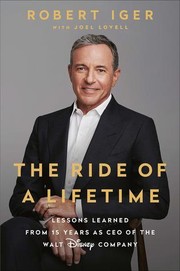
The Ride of a Lifetime: Lessons Learned from 15 Years as CEO of the Walt Disney Company
2,475-word summary 11 min read 272 pages in the book
- First published
- 2019
- Publisher
- Random House
- Pages
- 272
- ISBN
- 9780399592096
Reading options
What's inside (8 sections)
I picked this book up expecting a polished corporate victory lap and found something stranger: a chief executive who keeps insisting that the useful lessons came from mistakes, awkward meetings, and moments when he had no idea what he was doing. Robert Iger published The Ride of a Lifetime in September 2019, near the end of his first fifteen-year run as Disney's CEO. The full title, with its subtitle about lessons learned, is a fair warning about the shape of the thing. This is not a straight chronology. It is a memoir built out of decisions, with each chapter closing on a short list of principles Iger wants the reader to carry away.
He was born in 1951 and raised in Oceanside, New York, the son of an advertising executive and a schoolteacher. He went to Ithaca College intending to become a news anchor, spent a few months reading the weather on local television, and then took a job at ABC in 1974 doing the least glamorous work in a television studio for about $150 a week. I like that he keeps returning to this starting point. The kid who hauled equipment around a studio is the person who later negotiated with Steve Jobs and George Lucas, and the book keeps the two selves in the same frame.
The network years
Iger's big break came at the 1988 Calgary Winter Olympics. The weather went bad, events were delayed, and a live broadcast that was supposed to sell winter sports to America suddenly had holes in it. His team filled those holes with human interest stories: the Jamaican bobsled team, and a British ski jumper known as Eddie the Eagle. The coverage drew record ratings, and two ABC executives, Daniel Burke and Thomas Murphy, noticed the calm operator running the show. They backed him for years afterward. It is the first of many stories in the book about a problem becoming an opportunity if someone stays steady long enough.
By 1989 he was running ABC Entertainment, where he greenlit Twin Peaks and America's Funniest Home Videos. He also greenlit Cop Rock, a musical police drama that failed spectacularly, and he tells on himself about it. That willingness to include the flops is part of what makes the memoir readable. A lesser executive memoir would quietly drop the embarrassing projects. Iger keeps them in, then uses them to explain how he learned to trust instincts and to surround himself with people who would tell him the truth.
Disney bought Capital Cities/ABC in 1995, which moved Iger into the bigger company. He chaired the ABC Group, took charge of Walt Disney International in 1999, and became president and chief operating officer in 2000. Michael Eisner was still the man on top, and Iger writes about him with a careful, almost painful diplomacy. He credits Eisner's energy and taste, then describes a management style that could leave a subordinate feeling enormous one minute and small the next. The "Save Disney" campaign led by Roy E. Disney and Stanley Gold in 2003 made the succession question public, and in 2005 Iger got the job.
Three bets
The new CEO did something revealing almost immediately. He disbanded Disney's Strategic Planning division and reassigned its chief strategist, Peter Murphy. Iger's reasoning was that the division produced beautiful reports that nobody acted on, while the people who actually made films and ran parks were kept at a distance from decisions. He wanted judgment back in the hands of operators. Whether you agree with the move or not, it tells you what kind of manager he thought he was: impatient with process, impatient with paperwork, hungry for argument from people who did the work.
He arrived with three priorities. Recommit to quality. Embrace technology rather than fight it. Think globally, and make Disney a stronger brand outside the United States. Much of the memoir is an elaboration of those three sentences. Quality, for Iger, means that a guest's day at a park matters more than a quarterly margin, and he tells stories about cast members and small details to prove it. Technology means being willing to upset your own business before someone else does. Global means building for audiences who will never see Burbank or Orlando.
That technology bet eventually meant a subscription streaming service of Disney's own. The book was written before Disney+ launched, but the plan is all over it, and Iger resigned from Apple's board in September 2019 to avoid a conflict as the two companies prepared competing services. Reading it now, you can see the strategy forming in real time. What you do not get is much detail on the cost of that pivot, which is a gap the memoir shares with a lot of books written by people who won.
The Pixar purchase in 2006 was the first enormous test. Disney paid about $7.4 billion in stock, which made Steve Jobs its largest individual shareholder and brought John Lasseter and Brad Bird into the fold. Iger describes the negotiation as much as a friendship as a transaction, and he is candid about how much he learned from Jobs about focus and about saying no. One of the best passages describes sitting in on a Pixar "brain trust" session, where a film in progress was torn apart by colleagues with no ego in the result. He was struck that criticism could be blunt and still be kind. He tried to import that habit into Disney.
There is a smaller, lovely story in the same stretch about Oswald the Lucky Rabbit, Walt Disney's first star, whose rights sat with NBCUniversal. Iger traded the sportscaster Al Michaels to NBC Sports to get Oswald back. It is a small deal next to the billions, but it shows how seriously he took the archive and the legacy. The book is full of moments like this, where an executive's sentiment and his business sense point the same way.
The brand is the thing
Underneath the dealmaking is a fairly old idea: that a brand is a promise you make to people, and that breaking it costs more than keeping it. Iger keeps coming back to Walt Disney himself, not as a saint but as a standard. He asks, in effect, what Walt would do, and uses that question to justify everything from reacquiring Oswald the Lucky Rabbit to refusing to cheapen the parks. When a resort opening is too small or a film feels rushed, the problem is not just money. It is that Disney told the public to expect something better.
This shows up most clearly in the park stories. Iger writes about walking a park and watching how a cast member handles a family, because the people in the costumes are the company to a guest. Quality is not an abstract value in these pages. It is a clean window, a show that starts on time, a ride that works. He is willing to spend to protect those things, and he is impatient with executives who see them as line items. That is the part of the memoir that feels least like management theory and most like someone who actually cares what a visitor remembers.
It also explains the frustration he feels with the Strategic Planning group he dismantled. In his telling, the planners could describe the brand in a deck but could not tell you what a guest's afternoon felt like. He wants people arguing about the work, not about the model of the work. You can hear the same preference in the Pixar "brain trust" story, where the feedback was specific and merciless and aimed at the film rather than at the ego of the person who made it. Iger clearly wishes the whole company could run that way.
Building the empire
Marvel followed in 2009 for roughly $4 billion. Lucasfilm came in 2012 for about $4.06 billion, after Iger visited George Lucas and listened to a pitch for a universe far bigger than a few movies. The Force Awakens arrived in 2015, and the book treats the Star Wars material with something close to reverence. Iger says outright that he loves the mythology, and that affection is both a strength of the memoir and one of its soft spots. It is hard to tell where the fan ends and the dealmaker begins.
He also describes the slow repair of Walt Disney Animation Studios. Rather than replacing the studio, he gave Lasseter and Bird room to work with it, and the run that followed included Tangled, Wreck-It Ralph, Frozen, Big Hero 6, Zootopia and Moana. Frozen in particular became a case study in the quality argument, since the studio kept pushing on a story that had already been through many versions. The lesson Iger draws is that patience with artists can pay, but only if someone in charge protects the time they need.
One of his earlier gambles was the stage version of The Lion King. Plenty of executives thought a Broadway musical was a distraction from the film business, but Iger backed it, and Julie Taymor's production opened in 1997 and then ran for decades. He returns to it as proof that quality can outlast the meeting in which it was approved. It is a good story, and it is also the kind of story a memoir looks for: the moment the boss was right before anyone else was.
The global bet had its own stumble. Hong Kong Disneyland opened in 2005 and was built smaller than demand required, which meant crowds and a scramble to add capacity later. Iger owns that miscalculation and says it changed how Shanghai Disneyland was planned. When Shanghai opened in 2016 after years of negotiation and a $5.5 billion price tag, the park was designed with the lesson in mind. Whether you see this as honest accounting or as a neat story he tells about himself depends on your tolerance for CEOs narrating their own growth.
The last giant deal, the purchase of 21st Century Fox entertainment assets for about $71.3 billion, closed in March 2019, a few months before the book appeared. Iger describes months of negotiation with Rupert and James Murdoch. It is the moment the memoir is building toward, the proof that the man who started by carrying cables could now reshape an industry. It also arrived with the concern, barely addressed here, that Disney was accumulating more power than any one company should have.
What he says he learned
The book was a number one New York Times bestseller and made NPR's list of the year's best books, which tells you something about the appetite for this kind of account. It arrived at a moment when Disney seemed unstoppable, and readers wanted to hear how it was done. That context matters, because the memoir is partly a product of its moment. A book written two years later would have had to reckon with a pandemic and a leadership shuffle, and it would have been a different, more anxious thing.
The final chapters spell out the virtues: optimism, courage, decisiveness, fairness, curiosity, thoughtfulness, authenticity, and what he calls a quest for perfection. Optimism is not pretending the problem is small, he writes, it is choosing the useful response instead of blame. Courage means taking big bets when fear would freeze you. Decisiveness means making the call in time, because delay rots morale. Fairness means treating the person in the mailroom with the same respect as the star.
These are not original ideas, and Iger does not pretend they are. What gives them weight is the scale of the decisions he attaches them to. When he writes about decency over dollars, he can point to a friendship with Steve Jobs that lasted until Jobs's death, or to the way he tried to keep George Lucas comfortable after selling Lucasfilm. The advice lands best when it is tied to a room and a moment, and it thins out when it is offered as a rule.
His voice is part of the appeal. He writes in plain, unhurried sentences, and he is comfortable admitting confusion. The book is at its best in scenes of disagreement: a board member pushing back, a creative team resisting a note, a negotiator walking away from a table. He listens in those scenes, or says he does, and the memoir argues that listening is the core leadership skill. That is a nicer claim than the usual genius-at-the-top story, and even if it is partly image management, it is a better image.
What the book leaves out
For all its modesty, this is still a memoir written by a man who won nearly every argument he describes. The people who disagree with Iger tend to appear as reasonable obstacles who were eventually persuaded. You will not find much here about the unions who fought Disney over wages, the critics who worried about media consolidation, or the executives whose careers ended badly under his watch. The Lasseter and Weinstein questions, both live in the years the book covers, get almost no space. If you want an account of Disney's labor record or its treatment of women, look elsewhere.
The timing is another limitation. Published in the autumn of 2019, the book stops before the pandemic closed the parks, before the streaming wars fully arrived, before Iger's own return to the CEO chair in 2022. Read now, it feels like a victory lap taken just before the weather changed. Disney's value grew nearly five times under Iger, as the publisher's own copy points out, and the memoir is happy to let that number sit in the room. There is little curiosity about what those acquisitions cost beyond the purchase price.
Some readers will also find the lessons section repetitive. Each chapter ends with a short list, and after a while the lists begin to sound like a corporate offsite. If you are looking for a candid psychological portrait, this is not it. Iger keeps his family life mostly off the page and his tender moments brief. The book is a working executive's account of how he made decisions, not a novel of the inner life.
Still, the stories hold up. The Calgary broadcast, the Pixar brain trust, the Oswald trade, the too-small park in Hong Kong: these are concrete, memorable episodes, and they explain more about running a creative company than a stack of management books. I finished it convinced that Iger really does believe in quality and decency, and also convinced that he has spent years refining the story he tells about believing those things. Both can be true. That tension is what makes the memoir worth reading, even when it is selling you something.
FAQ
Is The Ride of a Lifetime a memoir or a business manual?
It is a memoir by Robert Iger, published by Random House in 2019. Each chapter ends with short leadership lessons, but most of the book retells his decisions at ABC and Disney, including the Calgary Olympics broadcast and the Pixar purchase.
Which companies did Disney buy under Iger?
The book covers the purchases of Pixar in 2006, Marvel in 2009, Lucasfilm in 2012 and the 21st Century Fox entertainment assets in 2019. It also describes the smaller deal that brought Oswald the Lucky Rabbit back to Disney.
Does the book cover Iger's return as Disney CEO in 2022?
No. It was published in September 2019 and stops before the pandemic, the full launch of Disney+ and Iger's 2022 return to the CEO role. The summary reflects that original 2019 text.
Similar books
107 Days
Kamala Harris's memoir of the 107 days between Biden's withdrawal and Election Day, drawn from a journal kept during a campaign she believes she was best…
2,132-word summary · 9 min read
Built to Last: Successful Habits of Visionary Companies
Collins and Porras compare eighteen durable companies with their rivals and find habits like clock building, core ideology, and home grown management.
2,132-word summary · 9 min read
Emotional Intelligence 2.0
Bradberry and Greaves turn emotional intelligence into four learnable skills, a self-assessment and dozens of strategies, while their headline numbers rest on…
3,276-word summary · 15 min read
Careless People
A former New Zealand diplomat recounts seven years at Facebook, from a Myanmar launch to a hospital bed where the job followed her between contractions.
2,413-word summary · 11 min read
Blue Ocean Strategy: How to Create Uncontested Market Space and Make the Competition Irrelevant
Two INSEAD professors argue that companies win by creating uncontested markets rather than fighting rivals, and give managers tools to do it.
2,333-word summary · 10 min read
Extreme Ownership: How U.S. Navy SEALs Lead and Win
Two retired Navy SEALs turn their Ramadi combat experience into a blunt leadership creed: the leader owns everything, and the team follows when the why is…
2,368-word summary · 11 min read

Long Walk to Freedom
Mandela's account of a Thembu childhood, a law practice, a banned movement, twenty-seven years in prison, and the negotiation that ended apartheid.
2,454-word summary · 11 min read

Infidel
Ayaan Hirsi Ali's memoir of a Somali childhood, a forced marriage, a Dutch asylum claim, and the political fight that followed the murder of Theo van Gogh.
2,041-word summary · 9 min read
The Girl with Seven Names: A North Korean Defector's Story
Hyeonseo Lee crossed the frozen Yalu River at seventeen, spent years hidden in China, escaped to South Korea, and later returned to rescue her family.
2,404-word summary · 11 min read
The Magic of Thinking Big
Schwartz's 1959 self-help classic argues that success follows from the size of your thinking, supported by sales anecdotes, vocabulary drills and goal setting.
2,579-word summary · 11 min read

The Magnolia Story
How Chip and Joanna Gaines met, closed their first shop, nearly lost everything in a housing development, and built Fixer Upper.
2,994-word summary · 13 min read

Life
The Rolling Stones guitarist tells his own story: a Dartford childhood, the band's first gigs, the drug raids, the tax years and Patti Hansen.
2,761-word summary · 12 min read
Creativity, Inc.: Overcoming the Unseen Forces That Stand in the Way of True Inspiration
Pixar's president on why the studio that made Toy Story nearly broke itself, and the daily habits that kept the creativity coming.
2,179-word summary · 10 min read
The Hard Thing About Hard Things
A founder and CEO writes about the parts of running a company that no framework can fix, from layoffs and demotions to the loneliness of the job.
2,161-word summary · 10 min read
The Letters of Vincent van Gogh
Vincent van Gogh's letters to his brother Theo, in a Penguin Classics selection edited by Ronald de Leeuw, trace a decade of work, faith, and obsession.
2,611-word summary · 12 min read
The Stranger Beside Me
Ann Rule's classic memoir of her friendship with Ted Bundy, written by the true-crime author who knew him long before the world learned what he had done.
2,481-word summary · 11 min read
Dare to Lead
Research on courage shows how leaders build trust through vulnerability and clear values.
2,442-word summary · 11 min read

Wild Swans
Three generations of women survive warlords, revolution, and the Cultural Revolution in Jung Chang's family memoir.
2,356-word summary · 10 min read
Think Again
Adam Grant argues for holding views loosely and testing them like a scientist, moving past preacher, prosecutor, and politician habits at work and in debate.
3,204-word summary · 14 min read
The Five Dysfunctions of a Team
New CEO Kathryn unites warring execs through trust, conflict, and care.
2,029-word summary · 9 min read
Open
Tennis star Andre Agassi recalls hating tennis, falling to No. 141, and rebuilding his life on his own terms.
2,352-word summary · 10 min read
American Sniper: The Autobiography of the Most Lethal Sniper in U.S. Military History
Navy SEAL sniper Chris Kyle recounts Texas roots, SEAL training, four Iraq tours, and the strain combat placed on his marriage and health.
2,011-word summary · 9 min read
Good to Great: Why Some Companies Make the Leap... and Others Don't
A five-year study of 11 companies that leapt ahead shows Level 5 leaders, right people, hedgehog focus and flywheel momentum explain lasting gains.
2,374-word summary · 11 min read
Lean In
Sit at the table, negotiate, share home load, and change offices while knowing advice skews elite.
2,005-word summary · 9 min read
The Autobiography of Malcolm X
Malcolm X traces his life from Michigan childhood through Harlem, prison, and the Nation of Islam to Mecca in this 1965 memoir told to Alex Haley.
2,816-word summary · 13 min read
Shoe Dog
Phil Knight tells how Blue Ribbon Sports grew from a trunk of Japanese running shoes into Nike.
2,824-word summary · 13 min read
Spare
Prince Harry recalls Diana's death in 1997, two tours in Afghanistan, and stepping back from royal life with Meghan in this frank 2023 memoir of grief, love…
2,586-word summary · 11 min read
I Am Malala: The Story of the Girl Who Stood Up for Education and Was Shot by the Taliban
Malala grows up in Swat, blogged for school under ban, and survives a bus shooting.
2,015-word summary · 9 min read
Becoming
Michelle Obama traces her path from South Side Chicago through Princeton, Harvard law and the White House years in this warm, candid memoir of family, work and…
2,143-word summary · 10 min read
Steve Jobs
Walter Isaacson's authorized Steve Jobs: forty interviews covering the garage, the 1985 ouster, Pixar, and the return that made the iPhone.
2,415-word summary · 11 min read