
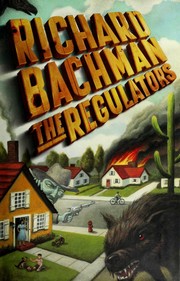
The Regulators
2,259-word summary 10 min read 480 pages in the book
- First published
- 1996
- Publisher
- Dutton
- Pages
- 480
- ISBN
- 9780525941903
Reading options
What's inside (9 sections)
I picked this one up because of a publishing prank. Here is a novel credited to Richard Bachman, a name Stephen King had publicly killed off more than a decade earlier, released on the very same day as another King book called Desperation that tells much the same story from another angle. The two first edition hardcovers were even designed so that their cover paintings joined into one picture when the books sat side by side. That is a great deal of machinery around a single story, and I wanted to know whether the novel could stand on its own once the gimmick fell away. Mostly it can. What remains is a mean, odd, sometimes very funny account of one afternoon in an Ohio suburb when a children's cartoon turns real and starts killing the neighbors.
The morning on Poplar Street
The book begins on an ordinary summer afternoon in Wentworth, Ohio, on a residential street called Poplar Street. A paperboy named Cary Ripton is making his rounds. The Carver kids are bickering at the corner store. A Frisbee sails across the Reeds' lawn. Gary Soderson is firing up the backyard grill. The only thing out of place is a red van idling up the hill. Soon it starts to roll, and the shooting starts with it. Cary goes down, and the quiet street turns into something much worse before the day is over.
King spreads the point of view across the whole block. We see the panic through people who barely know one another, which is part of the design. A novelist named Johnny Marinville tries to call the police and cannot get the call to go through. An unseen force is jamming the line. Other vans, colorful and driven by strangers who look like figures from a Saturday morning show, arrive and add to the body count. The neighbors run for shelter and discover that shelter is not reliable.
Two residents never join the panic. They stay inside a darkened house at 247 Poplar Street, lit only by a flickering television. They are Audrey Wyler and her eight year old nephew Seth Garin, whom she has cared for since his family died two years before. Seth is autistic. He sits watching television while the street outside comes apart, and the book slowly reveals that he is the still point around which everything turns. The red van and the others are not random. They come from him.
That opening is the best part of the novel. King writes the ordinary textures of a suburb with real affection, then lets violence break into them without warning. The contrast is the whole engine. A grill, a Frisbee, a paper route, and then a van rolling downhill. It is brisk and brutal, and it made me want to keep reading despite the many odd choices waiting ahead.
The name on the cover
The Richard Bachman credit is not a secret to the story itself, but it is worth explaining because it shapes how the book was sold. Bachman was a pen name King used in the late 1970s and early 1980s for novels he wanted judged on their own terms. After the pseudonym was exposed around the 1984 release of Thinner, King staged Bachman's death. When The Regulators appeared in 1996, the jacket and a tongue in cheek introduction by the editor claimed that this was an old Bachman manuscript found in a trunk by his widow. It was a joke, and a fairly elaborate one.
The book also began life as a screenplay called The Shotgunners. King has said that the writer director Sam Peckinpah read the script and offered suggestions, and that Peckinpah died while King was working on the second draft. You can feel that origin in the pacing. Scenes arrive in bursts, built around images of vehicles and gunfire rather than slow buildup, as if the whole thing were once intended to be watched rather than read.
Then there is the mirror novel. Desperation was published on the same day in September 1996, and the two books take place in parallel worlds. Many of the same people appear in both, in different circumstances and sometimes with different names or looks. In Desperation the action happens around a mine in Nevada. Here it happens on one street in Ohio. Read together, the books ask how much of a person is the setting and how much is the person. Read alone, The Regulators still makes sense, which is the fair test, and it passes.
The neighbors
King fills the street with people, and the sheer number is both a strength and a problem. Johnny Marinville is the most developed. He wrote a celebrated novel called Delight, he is a recovering alcoholic, and he plays guitar badly enough that others notice. He is the closest thing the book has to a POV anchor, a man trying to act sensibly while the world around him stops making sense.
Collie Entragian is a former police officer who takes charge once the shooting begins. He tries to marshal the survivors, first in the street and then inside the houses of David Carver and the retired town veterinarian Tom Billingsley. He is practical, armed, and increasingly desperate, and the book spends real time on the burden of being the only person with a plan.
The Carver family gives the story its domestic center. David and Kirsten have two children, six year old Ralph and eleven year old Ellen, whom Ralph teases by calling her Margrit the Maggot. Kirsten calls David Pie. Those small family habits matter because they make the later losses hurt. Nearby live Brad and Belinda Josephson, the Sodersons, with Gary drinking and Marielle Sharp tongued, and Kim Geller, a racist mother whose daughter Susie has a friend named Debbie Ross visiting. Steve Ames is a drifter with a truck. Cynthia Smith works the early shift at the EZ Stop. The Reed family has twins Jim and David, a German Shepherd named Hannibal, and a mother named Cammie. A deeply religious family named the Hobarts is part of the block too.
This is a large cast, and I will be honest that keeping everyone straight took effort. King gives most of them a distinguishing habit, but a few exist mainly to be killed. The book is short enough that the crowd never fully settles. That said, the ones who matter, Marinville, Collie, Audrey, Seth, the Carver children, and the Reeds, are drawn clearly, and the clutter has a purpose. A neighborhood is a crowd, and a crowd is what the vans are hunting.
Tak and the MotoKops
The force behind the attacks is an entity called Tak. It is introduced in Desperation, where it is released from a mine in that town and passes into a boy there. In this version of events Tak has come to Seth. The creature killed Seth's parents and siblings, then drove Audrey's husband Herb to suicide, and it has kept Audrey under psychological pressure ever since. To survive, Audrey retreated into a place she built in her own mind, modeled on a retreat she loved. It is a private meadow, and it becomes more than a coping device by the end.
Seth's autism is the reason Tak chose him. His mind is unusually strong in certain ways, which makes him a powerful host and also helps him stay intact while the creature rides him. This is the part of the book I found most convincing. King treats Seth as a person with his own habits and perceptions, not as a mystical prop. The television is central to the plot. Seth watches a cartoon called MotoKops 2200 obsessively, and Tak uses that material to build the vans and the attackers. Seth also watches a Western film called The Regulators, and as the afternoon wears on the creature starts reshaping the street into an Old West town, complete with the logic of a cowboy movie. There is no road out. The neighborhood has become a set.
That idea is absurd on its face, and King knows it. The book leans into the absurdity with a straight face, which is why it works for some readers and grates on others. A dog fighting a van, a barbecue turning into a shootout, neighbors hiding behind a fence while gunmen in bright uniforms close in, it is all very strange. But the strangeness follows a rule. Everything comes from what Seth has watched. The violence is a child's media filtered through a hostile intelligence, and that gives the chaos a shape even when the body count climbs.
The afternoon turns
As the vans multiply, the survivors gather in two houses, the Carvers' and Billingsley's. Collie tries to organize defenses and work out what the attackers want. Phones stay dead. The street itself seems to change, with exits leading back to the same places and the light taking on a hard western quality. People who try to run are cut down. Each death is reported in the flat, startled tone of someone who cannot quite believe what is happening, and King is good at the small physical details: a body left in a driveway, a wound described without glamour, the smell of a grill still burning.
One of the sharpest turns involves Jim Reed. Collie, moving fast in the confusion, is shot by Jim, who mistakes him for a threat. Jim is shattered by what he has done and takes his own life moments later. It is a senseless death in a book full of them, and it lands harder than the staged attacks because it comes from panic rather than the creature. Cammie, Jim's mother, is left grieving and armed, and her state of mind becomes important at the end.
The middle section is where the novel both earns and tests its length. King keeps adding threats, but he also keeps the focus on small human reactions: who comforts a child, who panics, who claims to know what is happening and is wrong. The best pages are the ones where ordinary decency shows up in a situation that offers no reward for it.
Audrey's way out
The ending belongs to Audrey. She has been watching from the dark house all day, and she understands Tak better than anyone because she has lived with its damage for years. While the creature is busy with the siege, Seth makes a opening for her. She slips across the street to the Carver house and tells the others what is really happening. The explanation recontextualizes the whole afternoon. The vans, the Western town, the gunmen are all projections from a boy in a house nobody thought to worry about.
Her practical move is grim and clever. She gives Seth a laxative in his milk. Tak cannot bear to stay inside a body in that condition, so it leaves temporarily. Audrey goes back with Johnny to try to get Seth out, but Cammie Reed follows them with a gun. Grief has made her unpredictable, and in the confrontation Cammie shoots Seth and badly wounds Audrey just as Tak tries to reenter the boy. With Seth dying, the creature turns to Cammie instead. Her body cannot hold it the way Seth's could, and it is destroyed from within. Tak leaves the wreck in the form of smoke and scatters in the wind. The vans vanish. The street becomes a street again.
There is a short epilogue in the form of a letter, written by a woman on her honeymoon to a friend. It mentions King's The Shining in passing, a nod that ties the book to his larger work. The letter reveals that Audrey and Seth have ended up together in the meadow from Audrey's mental refuge, living in what is implied to be a kind of parallel paradise. It is a soft landing after a very hard day, and I have mixed feelings about it. After so much brutal invention, the book reaches for comfort, and the comfort feels slightly unearned. Still, given what Audrey has endured, it is hard to resent her the peace.
What holds up and what sags
The strongest thing here is the setting. Poplar Street is drawn with a care that makes the later violence genuinely unpleasant, and the transformation of a suburb into a Western set is a bold, memorable image. Audrey and Seth are the emotional center, and King writes their bond without sentiment. The scenes of Audrey holding herself together inside her private meadow are quiet and effective, far better than the gunfire.
The weak points are tied to the conceit. A story built from a child's television watching can only surprise you so many times before the rule becomes predictable. Some neighbors are clearly there to fill the body count. The mirror novel arrangement, with its matching covers and shared characters, is a clever stunt that can make the book feel like half of an experiment rather than a complete work. And the epilogue softens a ending that had been admirably harsh.
For readers who want polished, restrained horror, this will probably feel too broad and too weird. For readers who like King at his most uninhibited, the strangeness is the draw. Richard Bachman, whether he is a real person or a joke kept alive past its punchline, gets a book that is more interesting than the stunt that surrounds it. I would read it again before I read Desperation a second time, and that is a small verdict in its favor.
FAQ
Why is this book credited to Richard Bachman?
Richard Bachman was a Stephen King pseudonym retired after the 1984 novel Thinner. King revived it for this 1996 book, with a jacket story claiming the manuscript was found years later in a trunk.
How does The Regulators relate to Desperation?
The two novels were published on the same day in September 1996 and tell parallel versions of events, with many of the same characters in different roles. This one moves the action from a Nevada mine to a street in Ohio.
Do I need to read Desperation first?
No. The Regulators stands on its own, and the mirror arrangement is a bonus for readers who know both. The cover paintings of the two first editions were even designed to join into one image.
Similar books
Nightmares and Dreamscapes
King's 1993 collection runs from a man buried alive in a Cadillac to a town of dead rock stars, mixing horror, science fiction and dark humor across 816 pages.
3,232-word summary · 14 min read

Rosemary's Baby
A young couple's dream apartment in the Bramford turns dark when helpful neighbors and a trusted doctor take over Rosemary's pregnancy.
2,665-word summary · 12 min read
Watchers
A lonely veteran and a shy woman shelter a genius dog while a lab-made killer hunts them.
2,823-word summary · 13 min read
The Institute
A kidnapped prodigy wakes in a Maine facility where gifted kids earn tokens in Front Half and vanish from Back Half.
3,814-word summary · 17 min read
Hidden Pictures
Nanny Mallory sees Teddy drawings predict a murder in New Jersey.
2,332-word summary · 10 min read
Thinner
A Connecticut lawyer escapes punishment after a fatal crash, then an old Romani father lays a wasting curse on him and the pounds start falling off.
2,502-word summary · 11 min read
Wayward
With Ethan Burke now sheriff, Wayward Pines runs on cameras, fear and a founder's private plan, until a murder forces him to choose between order and the truth.
2,252-word summary · 10 min read

The Atlantis Gene
A geneticist and an intelligence operative chase two kidnapped boys through a global conspiracy about human evolution and a weapon built to cull humanity.
2,369-word summary · 11 min read
Wake Up and Open Your Eyes
A Brooklyn father drives to Richmond to find his parents lost in a cable news trance, in Chapman's splatterpunk horror about possession spread through…
2,381-word summary · 11 min read
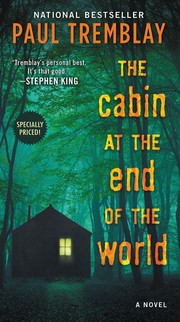
The Cabin at the End of the World
A family vacation in a New Hampshire cabin turns into an impossible choice when four strangers arrive demanding a sacrifice to stop the apocalypse.
2,571-word summary · 11 min read
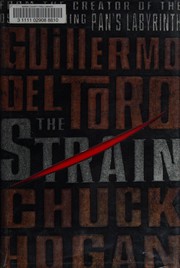
The Strain
A silent Boeing 777 lands at JFK with almost everyone aboard dead, and a CDC team finds an old vampire war following it into New York.
2,272-word summary · 10 min read
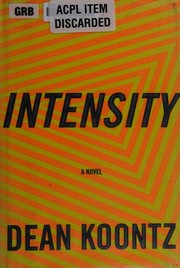
Intensity
A college student survives a brutal home invasion, then follows a killer's motor home in a bid to save the teenage girl he holds captive.
2,290-word summary · 10 min read
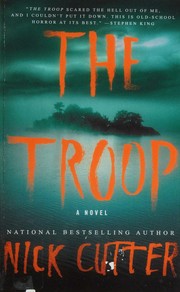
The Troop
A Boy Scout troop on a Canadian island takes in a stranger who cannot stop eating, and the worm inside him turns a camping trip into a war.
2,457-word summary · 11 min read
Lullaby
A reporter discovers that a poem in a children's book kills anyone who hears it, and his attempt to destroy every copy turns into a road trip through grief,…
2,147-word summary · 10 min read
Upgrade
A Gene Protection agent is infected with an upgrade virus that makes him stronger and faster than human, and only he can stop his sister from releasing it on…
2,166-word summary · 10 min read
Everything's Eventual: 14 Dark Tales
Fourteen Stephen King stories shuffled by the deal of a card deck, from the haunted room of 1408 to quiet tales of grief that sting as much as the monsters.
2,000-word summary · 9 min read
This Present Darkness
A pastor and reporter face demons over Ashton while angels answer prayer.
2,384-word summary · 11 min read
The Last House on Needless Street
A lonely man, a cat and a mysterious neighbor pull you into a house full of buried trauma.
2,627-word summary · 12 min read
The Chalk Man
Childhood chalk codes lead to a murder that follows friends thirty years later.
2,350-word summary · 10 min read
Relic
A museum beast kills during an exhibition while an agent investigates.
2,066-word summary · 9 min read

If It Bleeds
Holly Gibney faces an outsider plus three more tales of dread.
2,219-word summary · 10 min read

Full Dark, No Stars
Four novellas about revenge where ordinary people do terrible things and live with it.
2,646-word summary · 12 min read
Four Past Midnight
Four novellas about a plane lost in time, a writer haunted, and horrors small and large.
2,584-word summary · 11 min read
Rose Madder
After fourteen years of abuse, Rosie Daniels flees her cop husband and finds a painting that opens into a dangerous mythic world.
2,349-word summary · 10 min read
Horns
Accused of killing Merrin Williams, Ig Perrish wakes with horns that force strangers to confess their darkest sins.
2,264-word summary · 10 min read
Skeleton Crew
King's 1985 collection pairs The Mist with The Jaunt, The Raft, and Survivor Type: 22 stories of Maine dread.
3,209-word summary · 14 min read
Revival
Jamie Morton shadows preacher Jacobs from boyhood healings to electric cures that open a door best left shut.
2,037-word summary · 9 min read
NOS4A2
Vic McQueen's bike finds lost things through a bridge, pitting her against Manx's Rolls-Royce ride to Christmasland.
2,060-word summary · 9 min read
Later
Boy Jamie Conklin sees dead people who must answer truthfully, pulling him into NYPD cases and a drug crew's greed.
2,009-word summary · 9 min read
Duma Key
After losing his arm, Edgar Freemantle paints on a Florida island and learns his pictures can open doors for something hungry.
2,530-word summary · 11 min read