
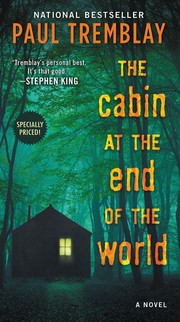
Reading options
What's inside (8 sections)
I read this one because a friend insisted the book was much stranger than the film, and I wanted to know what M. Night Shyamalan had changed. Paul Tremblay published it in 2018, and it won the Bram Stoker Award for Best Novel the following year. It is a short, tight horror novel, 272 pages in the first William Morrow edition, and it does something I did not expect. It spends its whole running time refusing to tell you whether the people in it are heroes or madmen. That refusal is the point, and it is also the thing that will either win you over or drive you up the wall.
The setup is almost insultingly simple. Andrew and Eric are a married couple in their forties who live in Cambridge, Massachusetts, with their adopted seven-year-old daughter, Wen. They take her to a rented cabin in the woods of New Hampshire for a quiet vacation. There is no argument, no hint of an unhappy family, no ominous note left on the windshield. Tremblay drops you into an ordinary family trip and then walks a large stranger up to the dock.
That stranger is Leonard. He meets Wen while she is outside catching grasshoppers, and he tells her, with obvious sadness, that he needs her help and her parents' help to save the world. He does not threaten her. He says he is sad about what he has to do. They spend a little time together catching insects, and the scene is genuinely gentle, which is what makes what follows so nasty. Wen becomes uneasy when three more people appear, carrying strange, homemade weapons. She runs back to the cabin to warn her fathers.
Four visitors with a demand
The three newcomers are Adriane, Redmond, and Sabrina. Together with Leonard they break in, tie up Andrew and Eric, and explain what has brought them there. They say they have never met before that day. Over the previous week, each of them has been overcome by visions and a compulsion to find the others and then to find this particular family in this particular cabin. They believe the world is about to end in four stages: the oceans will rise, a plague will come, the sky will fall, and an unending darkness will settle over everything. There is one way to stop it. The family must choose one of its own members to be killed as a sacrifice.
This is the engine of the book, and it is a cruel one. Andrew and Eric are told they can save billions of people by handing over their child, or one of themselves. The visitors insist they do not want to hurt anyone and take no pleasure in what they are doing. Leonard in particular seems genuinely miserable about it. That misery is more disturbing than any snarl would be. A kidnapper who hates what he is doing is harder to dismiss than one who enjoys it, because you cannot simply write him off as a monster.
Tremblay keeps the point of view close to the family, and most of the novel happens inside that cabin, with the four intruders standing over the two tied men and Wen moving in and out of the room. The confinement is deliberate. There is no police investigation or detective work, and no race against a clock outside. The whole moral argument plays out in one room, with a family forced to discuss which of them should die. It is a parent's worst nightmare in the most literal sense, and the book never lets you forget for a moment that a seven-year-old is listening to all of it.
The visitors have details that make them hard to dismiss. They know things about the family they should not know, and they describe their visions with a consistency that is unsettling. Andrew and Eric, meanwhile, grasp at any explanation that lets them refuse. They decide the four are deluded, or hateful, or acting out some shared fantasy. Eric, who works as a teacher, thinks about mental illness. Andrew thinks about his own past. Neither of them can prove the visitors wrong, and the visitors cannot prove them right. That gap is where the book lives.
The first sacrifice
When the family refuses to choose, the intruders do not debate for long. They put a cloth mask over Redmond's head and beat him to death with the weapons they brought. Eric, who has been hit on the head and is concussed, thinks he sees a figure of light as Redmond dies. On the television in the cabin, news reports come in about devastating tsunamis. Leonard says this is the first of the four disasters, and that Redmond's death has held it back for a while but not stopped it.
This is where the novel starts to play with what you believe. The disasters appear on the television, so they seem real. But the family has every reason to doubt what the television tells them, because the visitors could be manipulating the news or predicting events that were already in motion. Andrew, in particular, refuses to accept any of it. He notices that Redmond looks like someone he knows. He becomes convinced that Redmond is Jeff O'Bannon, a man who assaulted him in a bar thirteen years earlier and went to prison for it. In Andrew's mind, this is not an apocalypse at all. It is revenge, dressed up in religious language by four people who may be unstable.
Eric is less certain. He cannot fully accept that Redmond is O'Bannon, and he starts to notice small things that trouble his certainty. He has a vision of flies, which pushes him toward the television and toward a news report about an outbreak of bird flu. The second disaster arrives, and the book gives you another piece of evidence that something is happening beyond the cabin. But Tremblay is careful never to close the case. Every piece of evidence can be read two ways. The TV could be reporting real events, or the intruders could have planned for news that was already scheduled. Andrew keeps making the second argument, and he is not a fool for doing it.
The three surviving visitors also start to have doubts about Andrew's story. They question whether Redmond really was this man from Andrew's past, and they struggle with the guilt of what they have done. But they hold to their belief that the visions are real. This is one of the strongest parts of the book for me, because the intruders are not written as zombies. They are people who did something terrible because they felt compelled, and who now have to live with the fact that they might have murdered someone for a lie. Sabrina in particular becomes a person rather than a threat as the novel goes on.
A gun, a struggle, and Wen
The next day the visitors prepare to sacrifice Adriane. Andrew manages to escape the cabin and reach the car, where he finds a gun. He comes back and shoots Adriane, killing her. In the struggle over the gun with Leonard, Wen is shot and dies. This is the moment the book has been building toward, and Tremblay handles it without any of the usual horror movie slow motion. It is sudden, clumsy, and appalling. A child is dead because her father was trying to save her, and no amount of explanation from the intruders can make that okay.
Leonard, who seems shattered by what has happened, allows himself to be tied up. But he says the apocalypse has not been stopped. Wen's death does not count, he explains, because she was not a willing sacrifice. One of the two parents still has to die. This is a cold, almost bureaucratic distinction, and it is the most frightening idea in the book. The rules do not care about love or accident or grief. They demand a choice made freely by someone who understands it.
I found this section hard to read, and I mean that as a compliment. Tremblay does not ask you to admire anyone here. Andrew has killed one of the captors and caused the death of his daughter. Eric is concussed and beginning to slip into a belief system he has spent the whole book resisting. The intruders are horrified by what they have done and still convinced they are right. There is no clean hero, and there is no clean villain. The book has stripped away the comfort of knowing who the good guys are.
Sabrina's account and the walk to the car
Sabrina then tells the story of how the four of them came together. She describes being led by visions and compulsions to find the others online, to make their weapons, and to keep going when every part of them wanted to stop. Her account is detailed and ordinary in a way that is more convincing than any claim of divine instruction. These were people who felt a pull they could not explain, and they followed it. She says that after Wen's death she no longer wants to continue. She kills Leonard and offers to lead Andrew and Eric to the car that Redmond arrived in.
On the television, seven planes crash at roughly the same time around the world. This is meant to be the sky falling, the third disaster. Again, the book refuses to say whether the crashes are real or staged or coincidental. Andrew keeps arguing that the news is just news, that terrible things happen every day and that the visitors have been reading the same headlines he has. Eric keeps drifting toward belief. The argument between the two men is the real climax of the novel for me, and it is a quiet one, conducted while they carry Wen's body through the woods.
Sabrina leads them to the car, recovers the keys and a gun that Redmond had hidden, and tells Eric there is still time to prevent the end of the world. Then she kills herself, before the compulsion can take hold of her again. It is a strange, sad act of defiance, and it may be the most honest thing any of the four visitors does. She does not solve anything. She simply refuses to be used any further.
Eric considers taking his own life, which would satisfy the remaining condition. Andrew argues against it. Even if the apocalypse is real, he says, he will not obey a god that refuses to accept Wen's death as enough. That line of thinking is the closest the book comes to a statement of belief, and it is not comfortable. It is a refusal on principle, made by a man who has just lost his child and cannot bring himself to make sense of it. The two men decide that neither will leave the other alone. They take Wen's body and head for Redmond's car, and the novel ends with them walking into whatever comes next.
What the book will not tell you
This is an ambiguous ending, and I use that word carefully. Tremblay does not give you a final scene that explains the visions or confirms the disasters. You are left with a family carrying a dead child through the woods, two men who have decided to stay together, and a question you cannot put down. Did the four strangers really receive a message from God, or were they four people whose minds broke in the same week? The news reports suggest one answer, but Andrew's skepticism is never proven wrong. The book wants both possibilities to remain alive.
That ambiguity is the source of its power and also of its occasional coldness. I found myself frustrated, more than once, that Tremblay withholds an answer I desperately wanted. But I also think the frustration is intentional. If the book had confirmed that the apocalypse was real, the story would become a simple survival thriller. If it had confirmed that the visitors were deluded, it would become a story about mental illness dressed as horror. By keeping both readings open, Tremblay forces you to sit with the same uncertainty the family feels. That is an uncomfortable choice for a novelist, and I respect it even when it annoys me.
The quality I admire most is how little the book sensationalizes its own ideas. The intruders use homemade weapons that look ridiculous rather than frightening. There is no elaborate mythology or ancient prophecy, and no cinematic score in the background. There is a group of ordinary people, a rented cabin, a television, and an argument about whether a parent should kill a child to save the world. The horror comes from the question, not from the scenery. Readers looking for nonstop action will not find it here. Much of the novel is people talking in a room, and the tension comes from how badly they want to believe or disbelieve one another.
One small criticism: the book's middle stretch repeats the same argument between belief and doubt several times, and I felt the length of those exchanges. Andrew in particular keeps making the same point about coincidences, and Eric keeps drifting toward the television. The pacing is deliberate, but it dips. I also think some readers will find the ambiguity a bridge too far, especially given how much emotional weight the book asks you to carry. There is no tidy payoff, and there is no sentence that tells you what really happened. You have to decide for yourself, and not everyone wants that bargain from a horror novel.
The film and why the ending matters
M. Night Shyamalan adapted the book as Knock at the Cabin, released in 2023, with Dave Bautista as Leonard and Rupert Grint among the four visitors. If you have seen the film, the biggest change is the ending. In the movie, Wen lives and Eric sacrifices himself, and the apocalypse is clearly averted. The film gives you the answer the book refuses to give. It is a different experience, and I think the book is the more interesting of the two precisely because it declines to resolve the question.
That does not make the film bad. It makes it a different object. Shyamalan is interested in faith and in the act of belief, and his version pushes toward a clear emotional payoff. Tremblay is interested in doubt, and he is willing to leave you unsettled. Reading the book after seeing the film, I found myself relieved that the novel does not soften its ending. It trusts you to sit with the not knowing.
I would hand this book to a reader who likes horror that argues with itself, and to anyone interested in what happens to a family when it is asked to make an impossible choice. I would be careful with a reader who wants a clean explanation or a scary monster to defeat. There is no monster here except the idea itself, and no explanation at the end. What you get instead is a tightly written, genuinely upsetting novel about how hard it is to know what you believe when the person you love is in danger. That is a small thing to ask of a book, and a hard thing for a book to deliver. This one does it.
FAQ
Does the novel confirm that the apocalypse is real?
No. Tremblay leaves both possibilities open: the television reports seem to support the visitors, but Andrew's argument that the disasters are coincidental is never disproved. The book ends with the family walking into an uncertain future.
How does the book differ from the film Knock at the Cabin?
In the 2023 film Wen survives and Eric sacrifices himself, and the apocalypse is clearly averted. In the novel Wen is accidentally shot and dies, and the ending gives no confirmation that the world is saved.
Who are the four visitors and what do they want?
They are Leonard, Adriane, Redmond and Sabrina, strangers who claim visions compelled them to find the family. They demand that Andrew and Eric choose one of their number to kill as a sacrifice.
Similar books
A Head Full of Ghosts
A broke Massachusetts family lets a reality TV crew film their daughter's exorcism, and fifteen years later the only survivor tries to explain what really…
2,588-word summary · 12 min read
The Moonlight Child
On a cold January night, Sharon Lemke sees a child washing dishes in a neighbour's kitchen and decides she cannot ignore it.
2,169-word summary · 10 min read
These Silent Woods
A father and his eight-year-old daughter live off-grid in the Appalachian woods, hiding from a past he cannot outrun. When their yearly supply run fails, their…
2,274-word summary · 10 min read
The Regulators
A suburban Ohio street turns into a violent Western set in this Richard Bachman novel, a mirror to Desperation in which an autistic boy hosts a creature called…
2,259-word summary · 10 min read
Intensity
A college student survives a brutal home invasion, then follows a killer's motor home in a bid to save the teenage girl he holds captive.
2,290-word summary · 10 min read
The Troop
A Boy Scout troop on a Canadian island takes in a stranger who cannot stop eating, and the worm inside him turns a camping trip into a war.
2,457-word summary · 11 min read
Saving Noah
A seventeen-year-old swimmer confesses to molesting two girls he coached, and his mother must decide what unconditional love is worth.
2,976-word summary · 13 min read

The Best of Friends
Three lifelong friends discover their teenage sons were hiding more than anyone knew after a night that leaves one dead, one in a coma and one silent.
2,040-word summary · 9 min read
The Reappearance of Rachel Price
Bel films a doc when her missing mother walks back after years.
2,254-word summary · 10 min read
The Last House on Needless Street
A lonely man, a cat and a mysterious neighbor pull you into a house full of buried trauma.
2,627-word summary · 12 min read
The Chalk Man
Childhood chalk codes lead to a murder that follows friends thirty years later.
2,350-word summary · 10 min read
Relic
A museum beast kills during an exhibition while an agent investigates.
2,066-word summary · 9 min read
Hannibal
Lecter hides in Florence while Starling and Verger close in from both sides.
2,590-word summary · 12 min read
Full Dark, No Stars
Four novellas about revenge where ordinary people do terrible things and live with it.
2,646-word summary · 12 min read
Rose Madder
After fourteen years of abuse, Rosie Daniels flees her cop husband and finds a painting that opens into a dangerous mythic world.
2,349-word summary · 10 min read
Keep It in the Family
Mia and Finn renovate a long empty house and find seven children hidden in the attic.
2,270-word summary · 10 min read
What Lies Between Us
Nina keeps mother Maggie locked upstairs for years, trading lies about sisters and deaths that unravel fast.
2,062-word summary · 9 min read
The Chain
Rachel must kidnap another child to save kidnapped Kylie, entering a chain where parents pass crime forward.
2,021-word summary · 9 min read
Pieces of Her
After her mother kills a mall shooter with shocking skill, Andy Oliver uncovers a hidden 1980s past of radicals and wealth.
2,791-word summary · 12 min read
The Family Remains
Lucy returns to London as bones on the Thames reopen the Chelsea mansion deaths.
2,304-word summary · 10 min read
Rosemary's Baby
A young couple's dream apartment in the Bramford turns dark when helpful neighbors and a trusted doctor take over Rosemary's pregnancy.
2,665-word summary · 12 min read
I Found You
A man with no memory on a beach, a vanished husband, and a 1993 holiday collide in a seaside town.
2,990-word summary · 13 min read
Dear Debbie
Advice columnist Debbie Mullen loses her job, tracks her husband's secrets, and decides it is time for payback against those who wronged her.
2,432-word summary · 11 min read
Dead in the Water
After Damon survives drowning, one strange memory of a dead boy pulls him back toward death again and again to find the truth.
2,358-word summary · 10 min read
All the Little Houses
In 1980s Longview, Texas, social queen Charleigh and daughter Nellie guard mean-mom secrets when a new family threatens their empire.
2,206-word summary · 10 min read
The Sun Down Motel
In 1982 Viv vanishes from a Fell motel desk; in 2017 niece Carly takes the same shift to find her.
2,150-word summary · 10 min read
Leave the World Behind
Two families share a Long Island rental during a blackout no one can explain.
2,015-word summary · 9 min read
Invisible Girl
A missing teen, a strained marriage and a doxxed loner collide in London.
1,996-word summary · 9 min read
Dolores Claiborne
A Maine housekeeper confesses two deaths in one voice: Vera fall and husband lost in eclipse.
2,381-word summary · 11 min read
Watchers
A lonely veteran and a shy woman shelter a genius dog while a lab-made killer hunts them.
2,823-word summary · 13 min read