
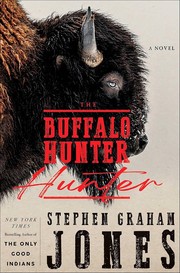
The Buffalo Hunter Hunter
2,731-word summary 12 min read 448 pages in the book
- First published
- 2025
- Publisher
- Saga Press (Simon & Schuster)
- Pages
- 448
- ISBN
- 9781668075081
Reading options
What's inside (11 sections)
- A diary found behind a wall in Miles City
- Arthur Beaucarne and the man who came to confess
- 1833, the Cat Man, and the blood in 1870
- The Marias Massacre, Napi, and the buffalo hunters
- The missing Flowers family and the detective's search
- Arthur's sins and the bodies in the pews
- What happened to the Cat Man
- Arthur walks out, and the ending in 2013
- Two voices and a deliberate slow burn
- Key takeaways
- FAQ
I picked this one up because I kept hearing it described as a vampire novel set on the Montana plains, and that pairing sounded odd enough to tempt me. It turned out odder than that, and sadder too. Stephen Graham Jones published it in 2025 through Saga Press, an imprint of Simon & Schuster, and the first edition runs about 448 pages. What I did not expect was a book assembled out of two distinct voices, a modern scholar and a Lutheran pastor a century in the ground, passing pages back and forth in a way that can feel jarring on one page and then quietly devastating on the next. I finished it with the sense that I had been handed a puzzle box that also happened to be a ghost story about the American West.
The title is easy to misread before you start. It sounds like a straightforward western, all hide and gunsmoke. The reality is a novel that keeps changing the rules of what a person, or a thing that used to be a person, can be. I want to walk through it the way it unfolded for me, because the order in which Jones hands over the pieces is a big part of the effect.
A diary found behind a wall in Miles City
The story opens in 2012, not in the past. A worker doing renovations on an old parsonage in Miles City, Montana, finds a manuscript tucked away in the wall. That is the spark. The parsonage, the hidden papers, the small town with its long memory, all of it arrives with the feeling of something that has waited a long time to be found.
The manuscript falls into the hands of Etsy Beaucarne, a junior professor at the University of Wyoming. She is a descendant of the man who wrote it, which gives the find a personal pull on top of the scholarly one. Etsy sets about transcribing the diary, and the hope driving her is professional as much as personal. She needs this to work. Tenure is on the line, and a fresh, strange archive from a Montana parsonage could be the thing that secures it. That bit of career anxiety is the modern thread that holds the frame together, and it keeps the book's present-day scenes grounded even as the material inside the diary grows more impossible.
I liked that the modern framing is so ordinary. Here is an academic with a deadline and a file of documents, doing the patient, unglamorous work of transcription. Against that plain setting, the contents of the diary hit harder. Jones does not spend too long on Etsy's campus politics, just enough to make us understand why she keeps pushing when the text starts to fight her.
Arthur Beaucarne and the man who came to confess
The diary itself was written in 1912 by Etsy's great-great-great-grandfather, Arthur Beaucarne. Arthur is the Lutheran pastor of the parsonage where the manuscript was found, and his entries describe a visitor who begins to change the shape of his life. The visitor is a Blackfeet man named Good Stab, who comes to Arthur's church to confess.
Confession is the right word for what follows. Good Stab does not come for absolution in any simple sense. He comes to tell, and Arthur, dutiful and eventually fascinated, listens. They meet in weekly visits, and over those sessions Good Stab lays out a life that runs from the middle of the nineteenth century into something far older and worse. Arthur writes it all down. The reader is thus one step removed twice over: Etsy transcribing Arthur, Arthur recording Good Stab. That layering is one of the book's quiet strengths, because it lets the most unbelievable claims arrive as testimony rather than as the narrator's guarantee.
What struck me is how the confession grows. Early on it feels like a pastoral call, a man of the cloth hearing a parishioner's troubles. Slowly it becomes something else, an accounting of violence and hunger that Arthur cannot quite file under any category his faith has prepared him for. Watching Arthur try to make sense of it is half the pleasure of the middle chapters.
1833, the Cat Man, and the blood in 1870
Good Stab's account begins with his birth in 1833. From there he describes a pale, fanged figure he calls the Cat Man, a creature that stalks the edges of his story and seems to carry a kind of hunger that never quite ends. Then comes the moment that bends his life into something unnatural. In 1870, white soldiers kill Good Stab. As he lies there, the blood of the Cat Man drips into his mouth, and he wakes up undead.
The rules of this condition are strange and specific, and Jones states them through Good Stab rather than through a lore dump. The revived Good Stab can drink only blood. He also takes the shape of whatever he feeds on, which means that to keep a human form he has to feed on humans. There is no clean way to survive here. To remain a man, he must do the one thing that most denies his humanity. That bind sits at the center of the novel, and it is what gives the book its moral weight. This is not a vampire who worries about the nice points of ethics after the fact. It is a creature whose every meal is a decision about what kind of being he gets to be.
I found this section the most gripping in the book. The transformation is told without much fuss, almost matter-of-factly, and that restraint makes it land. Jones trusts the image of blood dripping from a dying creature into a dying man's mouth to do the work, and he does not dress it up. It is a small, wet, intimate detail, and it opens into everything that follows.
The Marias Massacre, Napi, and the buffalo hunters
Good Stab's tale widens out into the history of the plains, and Jones is careful to keep the horror braided into that history rather than laid on top of it. The Marias Massacre sits in these pages, a real and brutal event in which a camp of Blackfeet people was attacked by the United States Army. Good Stab's undead life brushes up against this slaughter, and the book does not flinch from the fact that the violence done to Native people and the violence done by monsters are part of the same record here.
Alongside the historical material there is the supernatural. Good Stab speaks of Napi, a figure from Blackfeet tradition, and these encounters give the novel a second register beyond the Christian framework Arthur brings to the confession. The old gods and the new faith sit uneasily together in the diary, which is exactly where they belong in a story about a pastor hearing things he was not trained to hear. I appreciated that Jones lets these beliefs coexist without forcing a tidy explanation. The book is more interested in the friction than in a rulebook.
The buffalo hunters are the other great pressure in this stretch. They are the men who bring the great herds to an end, and their work is bound up with the hunger that drives Good Stab. There is a grim symmetry in watching a man who must eat to stay human move through a landscape where another kind of eating, the industrial slaughter of the buffalo, is remaking the world. Jones does not pause to underline the parallel. He sets the scenes side by side and lets the reader make the connection.
There is a Pinkerton detective in these chapters too, a man named Dove, and his presence pulls the story toward a mystery. Dove is hunting for a family that has gone missing, the Flowers family. His investigation runs through the same territory as Good Stab's account, and the two threads gradually converge. I won't pretend the pacing here is quick. It is not. Jones lets Dove's search unfold in its own time, and there are stretches where the reader is left waiting for the two lines to meet.
The missing Flowers family and the detective's search
The Flowers family matters more than the word "missing" suggests at first. Good Stab's story keeps circling back to them, and Dove's dogged pursuit gives that circle a human face. When a detective spends his career looking for people who have vanished, the people become a kind of absences that can be tracked, named, and eventually, in this book, found in a place no one expected to look.
Jones uses the investigation to do something clever with Arthur's diary. The closer Dove gets to the truth, the more the reader realizes that Arthur has been sitting on a piece of it all along. The confession in the parsonage is not a sideshow to the mystery. It is the key to it. That convergence is one of the more satisfying turns in the book, because it makes the modern frame and the historical account suddenly answer each other.
I did find myself wanting the Dove material to move faster than it does. There is a deliberateness to it that tests patience, especially since the reader can often see where it is heading before the characters do. But the slow approach also gives the final revelations their weight. When the missing people turn up, the long wait pays off in a way that a quicker reveal would not have.
Arthur's sins and the bodies in the pews
Here is where the book turns the knife toward Arthur. As the diary progresses, Arthur comes to understand that Good Stab did not choose him by accident. He chose him because of Arthur's own sins. The pastor who has been hearing confession is himself a man with something to confess, and the visitor knows it. That reversal reframe everything that came before. The weekly meetings were never a neutral record of another man's life. They were a judgment, delivered slowly, by someone who knew exactly which wound to press.
The detail that makes this concrete is the fate of the Flowers family. Good Stab reveals that Benjamin Flowers was Arthur's illegitimate son. The missing people Arthur's congregation has been praying for, and that Dove has been hunting, are tied to the pastor by blood and by shame. Then comes the scene I found the most shocking in the novel. Good Stab fills the pews of Arthur's church with the bodies of the missing. The literal bodies of the people everyone has been searching for, arranged in the seats of the sanctuary where Arthur has been preaching. It is a stunning image, and Jones places it at the point where Arthur's private guilt and the public horror finally meet.
That scene also explains Arthur's later choices. A man who has hidden such a thing, and who has seen what Good Stab can do, is not the same man who began the diary. The entries grow thinner, tighter, more focused on what is coming. I found this portion of the book the most cohesive, because here the two voices finally share the same fear.
What happened to the Cat Man
Good Stab's account takes one more strange turn before it ends. He describes how he trapped the Cat Man, the pale fanged creature whose blood first turned him undead. Rather than destroy it, he keeps it and force-feeds it fish, over and over, for four years. The point of this long, patient cruelty is transformation. Bit by bit, the creature becomes something else, and by the end of those four years it has become a sturgeon. A thing of the river, heavy and ancient and silent.
This episode is hard to summarize without making it sound absurd, and on a certain level it is absurd. That is part of its power. The image of a man systematically feeding a monster fish until it turns into a fish is bizarre, but it follows the book's own logic about shape and food. What you eat decides what you are. Good Stab applies that rule to the creature that made him, and the result is a kind of revenge carried out through diet and time rather than through a fight.
I read this as the strangest and most memorable passage in the novel, and also the one that best captures Jones's imagination. He is willing to sit with an image until it becomes ordinary, and then he lets its oddness sneak up on you. Four years of force-fed fish is a long time to spend on a revenge scene, and the book is better for it.
Arthur walks out, and the ending in 2013
The diary's last movements are quiet. Arthur hides the manuscript, the very papers that Etsy will find a century later. He sees a vision of the dead from the massacre, and then he walks out, apparently to be drained. The phrasing matters. He does not flee and he does not fight. He goes out to meet the hunger that has been circling him, and the diary ends with a man who has decided that he has no more use for the life he has been hiding inside.
Then the book snaps back to 2013. Good Stab brings Etsy to the site of the massacre, and he brings Arthur along, though Arthur has been reduced by then to something like a prairie dog, a small burrowing creature far removed from the pastor who wrote the first entries. There, at the place where the old violence happened, Etsy kills him. The descendant who came looking for a scholarly prize ends up the one who closes the circle, and the archive that was going to win her tenure turns out to be a record of a debt that had to be paid.
I won't say the ending resolves everything, because it does not. It does something better. It lets the central transaction, the need to consume in order to remain, play itself out one final time in a place already soaked with the history of consumption and loss. The return to the massacre site ties the personal story back to the national one, and it left me sitting with the book for a while after I finished.
Two voices and a deliberate slow burn
I should be honest about what did not work for me. The reviewers who praised this book singled out its two distinctive voices, Etsy's modern, slightly dry academic register and Arthur's formal, increasingly strained pastoral one, and I agree that they are the book's chief achievement. I also agree with the common complaint. The switches between narrators can be jarring, and the pace is deliberately slow. There are long stretches where the story seems to be circling the same ground, and Dove's investigation in particular takes its time getting to the point. A reader who wants a fast vampire hunt will likely find this book stubborn.
That said, I think the slowness is mostly intentional rather than accidental. The whole novel is about the cost of patience, about feeding something over years until it changes shape, about a diary written one weekly visit at a time. A quick book would have betrayed its own subject. The jarring switches, too, start to read as part of the design once you accept that this is a story about two people locked in a slow confrontation across a century. The friction between the voices is the friction of the book.
This is not a book I would hand to just anyone. It asks for a reader who likes history tangled up with horror, who can sit with an image like a sturgeon made out of a monster and see the logic in it, and who does not mind being made to wait. For that reader, The Buffalo Hunter Hunter is a strange, heavy, memorable piece of work. It takes the old story of the undead and puts it on the plains, where the thing that has to be fed is not only a monster but a country's history of violence. I closed it feeling that I had learned something about hunger, and I did not expect a vampire book to leave me with that.
FAQ
Is The Buffalo Hunter Hunter a western or a vampire novel?
It is both, and neither in a simple sense. Jones sets a vampire story on the Montana plains and braids it into the real violence of the Marias Massacre, so the horror is bound up with the history rather than laid over it.
Why is the book told through two different voices?
The novel layers a modern professor's transcription over a Lutheran pastor's 1912 diary, which itself records a Blackfeet man's confession. The two voices let the unbelievable claims arrive as testimony, and the friction between them is part of the design.
Do I need to like fast horror to enjoy this book?
Probably not, because the pacing is deliberately slow and the switches between narrators can be jarring. Readers who prefer a quick vampire hunt may find it stubborn, while those who like history tangled with horror will likely reward the patience.
Similar books
The Historian
A daughter traces her father's search for Dracula through letters and archives across Europe.
3,237-word summary · 14 min read
The Only Good Indians
Four Blackfeet men who killed a pregnant elk are hunted by her spirit a decade later, and the only person who can end the cycle is a teenage girl who was not…
2,010-word summary · 9 min read
The Distant Hours
A letter posted in 1941 reaches Edith Burchill in 1992 and draws her to Milderhurst Castle, where three elderly sisters still guard the secret of a stormy…
2,261-word summary · 10 min read
The Cask of Amontillado
A drunken nobleman follows a friend into his family catacombs to taste a cask of amontillado. Poe's 1846 tale turns a wine joke into one of literature's most…
2,916-word summary · 13 min read
Wolf Worm
An illustrator hired to draw parasites in 1899 North Carolina finds her employer's locked shed holds something far worse than insects.
2,404-word summary · 11 min read
Innamorata
A mute necromancer heiress engineers a royal marriage to reach a forbidden library, then falls for the prince she plans to use.
2,464-word summary · 11 min read
House of Hollow
Seventeen-year-old Iris Hollow is used to being stared at. When her sister Grey vanishes, a trail of flowers and hidden doors leads her toward the truth about…
2,514-word summary · 11 min read
The Tale of the Body Thief
Lestat trades bodies with a psychic thief for one day of mortality and ends up trapped, sick, and hunting his own vampire body.
2,069-word summary · 9 min read
The Lake House
Detective Sadie reopens 1933 Edevane baby vanishing tied to writer Alice.
2,055-word summary · 9 min read
Carmilla
Lonely Laura in Styria befriends beautiful Carmilla, whose night visits bring dreams, bites, and ancestral dread.
2,158-word summary · 10 min read
Abraham Lincoln: Vampire Hunter
Lincoln keeps a secret diary as a vampire hunter, tying his mother's death and the Civil War to a hidden war with the undead.
2,620-word summary · 12 min read
The Vampire Lestat
Lestat tells his own tale from French village to rock star, waking ancient ones who hate questions.
1,916-word summary · 9 min read
The Forgotten Garden
A Brisbane woman traces a century old abandonment from an English country house to a Cornish cove and a hidden author.
2,056-word summary · 9 min read

Flowers in the Attic
Four children locked in a grandmother attic learn their mother traded them for an inheritance.
2,052-word summary · 9 min read
Mexican Gothic
In 1950 Mexico, glamorous Noemi Taboada leaves Mexico City for High Place after a desperate letter, to rescue cousin Catalina from the chilling Doyles and…
2,523-word summary · 11 min read
'Salem's Lot
A writer returns to Jerusalem's Lot as an old house fills with vampires.
2,046-word summary · 9 min read

Interview with the Vampire
Louis tells a reporter how Lestat made him and how Claudia doomed them all in New Orleans and Paris.
2,195-word summary · 10 min read
Dracula
Count Dracula sails for England in letters and diaries, and Van Helsing leads the hunt to stop him.
2,860-word summary · 13 min read
Of Love and Other Demons
In colonial Cartagena, a twelve-year-old girl bitten by a rabid dog is locked in a convent, where the priest sent to exorcise her falls in love.
2,258-word summary · 10 min read
Witchcraft for Wayward Girls
In 1970 Florida, a girl sent to a maternity home for unwed mothers finds a spellbook, and the real horror turns out to be what the adults do to her and her…
2,077-word summary · 9 min read
Through the Woods
Five horror comics in which sisters vanish into the snow, a bride finds a secret in the walls, and a walk through the woods turns fatal.
2,513-word summary · 11 min read
The Winter People
A century-old ritual for calling back the dead connects a Vermont farmhouse, a girl who came back from the well and a modern investigation into a…
2,037-word summary · 9 min read
The Staircase in the Woods
Twenty-five years after a friend vanished at the top of a staircase in the woods, four estranged adults are summoned back to climb another one.
2,023-word summary · 9 min read
The Night Watchman
A Chippewa night watchman in 1953 North Dakota recognizes a bill as an attempt to end tribal recognition, while a young woman searches for her missing sister…
2,036-word summary · 9 min read
The Lunatic Cafe
Anita Blake takes a missing-shapeshifter case into St. Louis werewolf politics while Jean-Claude and Richard both press their claim on her.
2,327-word summary · 10 min read

The Kitchen God's Wife
Amy Tan's second novel pairs a San Jose speech therapist with her Chinese mother, whose account of war, an abusive husband, and a narrow escape comes out in a…
2,896-word summary · 13 min read
The Bewitching
A gothic horror novel that moves between 1908 Mexico and 1998 Massachusetts as an old family curse and a folkloric bewitchment repeat across three timelines.
2,332-word summary · 10 min read
The Art of Hearing Heartbeats
When a New York lawyer vanishes, his daughter follows an old love letter to Burma, where a stranger narrates the story of the father she never knew.
2,950-word summary · 13 min read
The Antidote
In a Dust Bowl town where a woman stores her neighbors' unwanted memories inside her own body, a storm blows the bank away and leaves a tangle of debts and…
2,707-word summary · 12 min read
Memnoch the Devil
In the fifth Vampire Chronicles novel, Lestat is taken by the Devil on a tour of Heaven and Hell and asked to serve as God's adversary.
2,619-word summary · 12 min read