
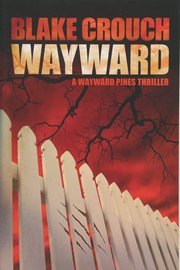
Wayward
2,252-word summary 10 min read 332 pages in the book
- First published
- 2013
- Publisher
- Thomas & Mercer
- Pages
- 332
- ISBN
- 9781477808702
- Series
- Wayward Pines (#2)
Reading options
What's inside (9 sections)
I picked up Wayward because Pines had left me sitting up late with the lights on, and I wanted to know what Blake Crouch would do with an ending that had already given away the biggest secret. The answer is that he does something quieter. This is not a book that spends its pages shocking you again. It is a book about what happens after the shock, when the person who knows the truth has to put on a badge and govern the people who do not.
Published by Thomas & Mercer in 2013 as the second Wayward Pines novel, it picks up a few weeks after Ethan Burke crashed his car into the town that would not let him leave. I say a few weeks, but the book wastes very little time on catching up. Crouch assumes you remember the fence, the cameras and the fact that the townspeople are not quite who they appear to be. If you have not read Pines, you will be lost in a way that no amount of clever writing can fix.
The town keeps its doors locked
Wayward Pines, Idaho, has a population of 461. It looks like a postcard from a nicer decade, with clean streets, good schools and people who wave from their porches. The first chapter ruins that picture in a single move. A sniper named Mustin sits in a guard tower above the valley, watching the town through a scope, and he has a fence strike to deal with before the chapter is over. The thing that comes out of the trees is not a bear or a stray dog. It is one of the abbies, a human shape gone wrong, and Mustin does not hesitate.
That opening tells you where the book's attention lies. The horror in Wayward is not a matter of one scary scene. It is built into the layout of the place. An electrified fence rings the town. Razor wire sits on top. Snipers watch from towers. Cameras track movements, and the residents wear devices that let the authorities know where they are at any hour. No one remembers arriving. People are told where to work, whom to marry and what to say when a stranger asks how they got here. The town's official motto is painted where everyone can see it:
YESTERDAY IS HISTORY. TOMORROW IS A MYSTERY. TODAY IS A GIFT. THAT'S WHY IT'S CALLED THE PRESENT. WORK HARD, BE HAPPY, AND ENJOY YOUR LIFE IN WAYWARD PINES!
I kept coming back to that slogan. It is the sort of thing a Chamber of Commerce might print on a banner, and in this town it functions as a warning. Everyone who repeats it knows that looking backward is dangerous. The sentence is cheerful on the surface and terrified underneath, and Crouch never has to explain the joke.
Ethan puts on the badge
Ethan Burke is a Secret Service agent who came to Wayward Pines looking for two missing colleagues, Kate Hewson and Bill Evans. By the end of Pines he had learned what the place really is, and in Wayward he has accepted the job of sheriff. That promotion is the central problem of the book. Ethan now enforces the rules of a system he knows to be a lie. He carries a star, carries a gun and carries the knowledge that the founder of the town, David Pilcher, is watching through a hundred eyes.
The personal mess matters as much as the job. Ethan had an affair with Kate before he ever saw Idaho, and Kate is in Wayward Pines now. His wife Theresa is here too, along with their son Ben, and the marriage is the kind that survives by not saying certain things out loud. Ethan is a man who is good at finding facts and terrible at sharing them. I found that frustrating in a way I think Crouch intended. Every time Ethan withheld something from Theresa, I wanted to shake him, and every time he did, the gap between them grew a little wider.
There is also the matter of Kate's new role. She is not sitting quietly in the background. She has gathered people who want the town opened up, and she wants Ethan to join them. The rebellion gives the book its political edge. Ethan is being pulled toward the one person he already betrayed, while Pilcher expects him to keep order. He has to decide whether a sheriff's loyalty belongs to the man who gave him the badge or to the neighbors he is supposed to protect. It is a neat trap, and the writing makes the pressure feel personal rather than abstract.
The badge also changes how people talk to him. Shop owners fall silent when he walks in. A deputy who might once have traded gossip now waits for instructions. Ethan notices all of it, and his discomfort is one of the better threads in the novel. Power is something he has studied professionally, and now he is holding a small, ugly version of it in his own hands.
Theresa, Ben and the cost at home
Theresa Burke has her own reasons to doubt the town. She remembers more than she is supposed to, and the fragments she has kept to herself make her increasingly certain that her husband is holding something back. Their scenes together have a careful, wounded quality. Neither wants a fight, and both are tired of the polite version of the truth they have been living. When Ethan dodges a direct question, you can see her decide to ask a different one later, in a softer way, because that is the only approach that has ever worked.
Ben is caught in the middle in the way children always are. He wants his father to be the person who fixes things, and he senses that the town does not allow anyone to fix anything. Crouch does not give the Burke family as much space as the mystery needs, but the pages he gives them matter. They are the reason Ethan's choice has weight. A sheriff without a family to protect would be a much simpler figure.
I wanted more of them, honestly. The book is at its best when the stakes are small and domestic, a dinner table where everyone is pretending, a bedroom conversation that stops before it gets honest. The large-scale revelations are spectacular, but it is the quiet ones that make the town feel like a real place people have to live in. By the end, the question of whether Ethan and Theresa can stay together is as gripping as the question of what Pilcher has been building.
A murder in a town with no secrets
The investigation that drives the middle of the novel begins with a body. Alyssa Pilcher is found dead, and the circumstances are ugly enough that Ethan cannot treat it as another tidy suicide or an accident. Wayward Pines is a place where inconvenient truths get buried quickly, so a murder is both a crime and a question about who is willing to break the town's rules.
What follows is a stretch of detection that will feel familiar if you liked the first book. Ethan follows a lead, finds a room that has been searched, questions someone who knows more than they are saying and gets warned off by Pam, the cool, controlled figure who handles Pilcher's instructions. Pam is good at her job. She never raises her voice, and she does not have to. Her presence in a scene is a reminder that someone else is listening.
Crouch uses the murder to widen the circle. The case touches Kate's rebellion, touches the history of the town and touches people who have lived here long enough to have learned the difference between the official story and what actually happened. Dr. Hassler and other residents get pulled into Ethan's questions, and each conversation adds a small piece to the picture. The pacing here is slower than in Pines. Crouch is willing to let a scene sit with a character's guilt or let a hallway conversation run long. Some readers will miss the breakneck pace of the first book. I noticed it too, though I did not mind it as much as I expected.
What keeps the section moving is the sense that every answer carries a cost. When Ethan learns something about the dead woman, he also learns who would prefer the question never be asked. The town's tidy surface depends on a long list of silences, and a murder investigation is a way of listing them one by one.
Pilcher's long game
The reason this sequel works as well as it does is that the reveal in Pines was never the end of the story. Knowing that the town is an experiment does not tell you who built it or why. Crouch fills in that history through flashbacks and documents, and the picture that emerges is of a man who decided he could save the human race by choosing who got to be part of it.
David Pilcher is not a cartoon villain. He is a scientist who made a bet with the future, and the book gives enough of his reasoning to make his choices legible even when they are monstrous. The town is a kind of ark. Its residents were preserved and brought forward to a time when the world above ground no longer belongs to them. Seen from that angle, the cameras and the fence are not merely cruelty. They are the price Pilcher decided everyone else should pay for his idea of survival.
That is where the book gets its teeth. A government that watches its citizens is easy to condemn in the abstract. A town built by a man who believes, sincerely, that he has saved the only people worth saving is harder to argue with in a single sentence. Ethan's job is to live inside that argument. He cannot arrest Pilcher, and he cannot join him. He can only keep the streets calm while he decides which side of the fence he is really standing on.
Crouch also understands that a utopia needs paperwork. There are schedules, assignments, medical procedures and a dozen small rules that add up to a complete system of control. None of it looks like tyranny from inside a well-lit kitchen. That is the point. The residents who benefit from the arrangement have a hard time naming what is wrong with it, and the people who do name it are treated as unstable.
The world beyond the fence
Tobias gives the novel its other point of view. He has been outside Wayward Pines, which means he has seen what the abbies have made of the world. His chapters take Ethan's questions and give them a physical answer. The valley is not a wilderness waiting to be explored. It is a place where the old rules of nature have been rewritten by evolution, and the creatures that roam it are patient.
I liked these sections, partly because they break the town's airless mood. Inside the fence, every conversation feels monitored and every hallway has a camera. Out beyond it, the danger is immediate and honest. Tobias's return also forces the issue that Ethan keeps dodging: if the town is a prison, then keeping its residents safe is not the same as doing the right thing. Crouch sets those two ideas against each other and lets them grind.
The abbies themselves get less attention here than in the first book, and that is probably for the best. They work better as a presence at the edge of the frame than as creatures to be catalogued. When one is finally close enough to study, the scene is over quickly, and the uncertainty is more effective than a description would have been.
What works and what drags
I finished Wayward convinced that it is a better novel than a thriller. The town is drawn with care, and the daily details, the diner, the school, the tidy lawns, make the control feel intimate. The book also understands that surveillance changes the way people think as surely as it changes the way they behave. A town where everyone watches everyone produces a particular kind of silence, and Crouch writes that silence well.
The weaknesses are real. The middle section circles some of the same confrontations, and Ethan spends a lot of the book looking grim while other characters explain things to him. Pam and Kate are both more interesting than the pages they get, and a few of the supporting residents exist mainly to deliver a piece of information and leave. The book also ends in the middle of a crisis, which is a hard habit to forgive when you have just spent 332 pages trying to settle scores. I closed it annoyed, then immediately reached for The Last Town, so the tactic worked on me.
If you came to the series for the first book's momentum, be ready for a different ride. Wayward trades some of that speed for a closer look at power, guilt and the cost of a secret kept too long. It asks more of the reader and gives back a story that is less flashy but more durable. Read it after Pines, keep the slogan in mind, and pay attention to the people who are quietly running the place. The town is still the best character in it.
FAQ
Do I need to read Pines before Wayward?
Yes. Wayward opens weeks after the first book's reveal and assumes you know the town's secret, so starting here removes the point of the story.
Who is David Pilcher?
He is the scientist who founded Wayward Pines as a preserved community brought forward into a ruined future. He runs the town's surveillance from a base in the mountains.
Does Wayward end on a cliffhanger?
Yes. It closes in the middle of a crisis, and the resolution comes in The Last Town, the third and final novel.
Similar books
More from Wayward Pines first, then related titles.
Pines
A Secret Service agent wakes hurt in Wayward Pines, Idaho, hunting two missing agents, and finds a town that will not let him leave.
2,452-word summary · 11 min read
The Atlantis Gene
A geneticist and an intelligence operative chase two kidnapped boys through a global conspiracy about human evolution and a weapon built to cull humanity.
2,369-word summary · 11 min read
Upgrade
A Gene Protection agent is infected with an upgrade virus that makes him stronger and faster than human, and only he can stop his sister from releasing it on…
2,166-word summary · 10 min read
Recursion
False pasts feel truer than true ones as a memory chair lets the grieving rewrite deaths.
1,995-word summary · 9 min read
Dark Matter
Abducted from his Chicago family, Jason Dessen wakes in a life he never chose and fights through worlds to return.
2,707-word summary · 12 min read
The Moonlight Child
On a cold January night, Sharon Lemke sees a child washing dishes in a neighbour's kitchen and decides she cannot ignore it.
2,169-word summary · 10 min read
The 5th Horseman
Two linked cases pull Lindsay Boxer and the Women's Murder Club into a hospital full of strange deaths and a luxury-car murder spree.
2,609-word summary · 12 min read
State of Terror
A new secretary of state and her team unpick a web of attacks across Pakistan, Afghanistan, and Iran in this 2021 political thriller.
2,307-word summary · 10 min read
Make Me
Reacher drifts into a quiet Midwestern town and finds a missing investigator, a trail of killers, and a deep web secret.
2,352-word summary · 10 min read
Zero Day
Army investigator John Puller is sent alone to a West Virginia coal town to solve a colonel's murder, and finds a much larger secret buried nearby.
3,434-word summary · 15 min read
You Are Not Alone
A lonely New Yorker witnesses a subway suicide and falls in with the dead woman's friends, where a makeover and a framed murder hide a hidden mastermind.
2,588-word summary · 12 min read
Vox
In a near-future America, women are fitted with counters that allow them a hundred spoken words a day. A linguist fights to reclaim her voice and save her…
2,434-word summary · 11 min read
The Running Grave
In the seventh Cormoran Strike novel, Robin goes undercover inside a Norfolk cult while Strike digs into a child's death from decades earlier.
2,615-word summary · 12 min read
The Midnight Line
A West Point class ring in a Wisconsin pawnshop sends Jack Reacher across the Midwest, from a biker's lie to a wounded veteran hiding from the opioid trade.
2,590-word summary · 12 min read
The Maid's Diary
A cleaner who snoops through her wealthy clients' lives finds a secret that could destroy them, while a detective investigates a bloody waterfront house with…
3,459-word summary · 15 min read
The Keeper of Lost Causes
Jussi Adler-Olsen introduces Carl Mørck and Department Q, a Copenhagen cold-case unit in a basement, and a missing politician whose file refuses to stay closed.
2,759-word summary · 12 min read
The Hard Way
A man Reacher sees drive a ransom-laden Mercedes pulls him into a retired colonel's hunt for his missing wife and stepdaughter.
2,637-word summary · 12 min read
The Cellar
Abducted in her small English town, sixteen-year-old Summer is locked in a cellar with three other girls. Their captor calls himself Clover and wants a perfect…
2,551-word summary · 11 min read
Not Quite Dead Yet
A drifting twenty-seven-year-old is told she will die within a week and decides to solve her own attempted murder instead of taking surgery with a ten percent…
2,010-word summary · 9 min read
Never Go Back
Reacher returns to his old military unit to find Major Susan Turner jailed and two invented cases hiding an opium smuggling ring.
2,245-word summary · 10 min read
Jack & Jill
A senator is killed with a nursery-rhyme calling card as a child is murdered near Alex Cross's home. The third Alex Cross novel pulls him toward two cases, one…
2,646-word summary · 12 min read
Gone Before Goodbye
Reese Witherspoon's first novel, written with Harlan Coben, follows a bereaved surgeon whose griefbot guides her into a medical conspiracy stretching from…
2,648-word summary · 12 min read
Fractured
In Karin Slaughter's second Will Trent novel, a mother kills the wrong man in an Atlanta mansion, and a GBI agent with a hidden reading difficulty finds a…
2,219-word summary · 10 min read
Falling
A pilot is told his family will be killed unless he crashes his Los Angeles to New York flight. Newman's debut turns one clean premise into a relentless…
2,507-word summary · 11 min read
The Witness
A Chicago murder witnessed at sixteen sends a woman into hiding in the Arkansas Ozarks, where a police chief starts asking questions about her past.
2,217-word summary · 10 min read
The Regulators
A suburban Ohio street turns into a violent Western set in this Richard Bachman novel, a mirror to Desperation in which an autistic boy hosts a creature called…
2,259-word summary · 10 min read
The Flight Attendant
A flight attendant wakes in a Dubai hotel beside a dead man she may have killed, and spends the rest of the novel lying to everyone who could help her.
2,496-word summary · 11 min read
The Anniversary
Alex Finlay's standalone revisits May 1 in a Nebraska town for ten years as two former classmates close in on the May Day Killer.
2,237-word summary · 10 min read

What She Knew
Rachel lets her eight-year-old son run ahead in a Bristol park, and the nine-day search turns her into a suspect in the public eye.
2,952-word summary · 13 min read

The Beach House
A young valet is beaten to death at a Hamptons party, and his law-student brother spends a year building a case against the family that covered it up.
2,049-word summary · 9 min read