
Reading options
What's inside (8 sections)
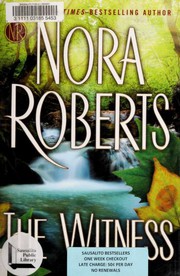
I came to The Witness expecting a familiar shape, and I got the familiar shape, but with a heroine who made me stay with it longer than I expected. Nora Roberts published this one in 2012 through G. P. Putnam's Sons. The first American hardcover runs 488 pages. It was her two hundredth book, and it is a standalone, with no series name attached and no earlier volume you need to have read. The story takes place in Bickford, an imaginary town in the Arkansas Ozarks that the Encyclopedia of Arkansas describes as resembling Eureka Springs. It is a romance and a suspense novel at once, and knowing which half is in charge at any moment is half the fun.
The night on Lake Shore Drive
The book opens with Elizabeth Fitch at sixteen. She is the daughter of a controlling, ambitious mother, and she was conceived through an anonymous donor, a fact that has been used against her her whole life. She is studious and obedient, the kind of girl people describe as sensible until they discover how badly she wants out. One night she slips loose of her mother's supervision, goes to a nightclub, drinks too much, and lets a man with a seductive Russian accent talk her into going with him to a house on Lake Shore Drive in Chicago. What she sees there is a murder connected to the Russian Mafia. She becomes a witness, then a person the government needs to keep alive long enough to testify.
Roberts does not linger on the trial. She gives us the part that matters to the character: two United States marshals assigned to protect Elizabeth are killed. The protection system fails, and the people who want her dead are still out there. Elizabeth disappears and comes back as someone else. That is the wound the whole novel is built around. She is not hiding because she is weak. She is hiding because she learned, at sixteen, that being identified and being safe are not the same thing. Twelve years pass, and the woman who used to be Elizabeth Fitch is now Abigail Lowery, living at the edge of a small Arkansas town under a name she chose herself.
A woman named Abigail
Abigail works as a freelance programmer and designs sophisticated security systems for other people. The joke is that she is very good at protecting everyone except herself, and the book takes that idea seriously. Her house sits outside Bickford, and it comes with a greenhouse, an assortment of firearms distributed around the rooms, cameras, locks, and a large dog named Bert who answers to commands in several languages. Brooks Gleason, the local chief of police, later notes that the animal responds in French, Farsi, German, and Italian, and observes that this is a sophisticated dog. Bert is more than a prop. He is Abigail's only companion, and the warmth she cannot show to people comes out in the way she trains and talks to him.
Roberts gives the mother a small but sharp presence in the backstory. Abigail's fear of being known was not innate; it was trained into her by a woman who treated her as a project and a disappointment. The money that follows her into adulthood works the same double way. It buys the house, the equipment, and the freedom to work for herself, and it also reminds her that the life she fled was built on the terms someone else set. Roberts is at her best with this sort of contradiction, where a gift and a wound are the same object viewed from different angles.
Abigail's routine is the novel's early rhythm. She works at home, keeps to herself, speaks little, and reveals less. When people in town try to draw her out, she deflects with a dry literalness that reads as rudeness until you understand it as armor. Roberts is good at the small mechanics of a life built around avoidance: the way Abigail positions herself in a room, the way she checks a door, the way she calculates how long it would take to reach the nearest weapon. She is brilliant and socially awkward, and the book never pretends that her skills came free. Her competence is a response to terror, which makes it both admirable and sad.
The Ozarks setting gives the novel a particular texture. Bickford is a tourist town with artisans, food-service workers, local politicians, and a historic hotel that matters to everybody. The supporting cast includes Brooks's siblings and a couple of recurring neighbors, including an unhappily married pair of alcoholics who were once the star football player and head cheerleader at Bickford High. Roberts clearly enjoys the small-town machinery. People talk in long, meandering conversations, they know one another's business, and a newcomer with money and no explanation becomes a project for the whole community. Abigail is rich, which is its own complication in a place where everyone assumes they know how everyone else lives.
The chief who would not leave it alone
Brooks Gleason has come home to Bickford after ten years on the Little Rock police force. His father teaches mathematics at the high school, his mother arrived in town as a hippie in the 1960s and stayed, and the Gleasons garden with an enthusiasm that Roberts clearly finds charming. Brooks is named, the Encyclopedia of Arkansas points out, for Brooks Robinson of the Baltimore Orioles, a detail that fits a writer who keeps sneaking baseball into her books. He is patient, decent, and stubborn in the specific way of a small-town cop who has seen enough of the world to know when something is off.
What draws him to Abigail is that her story does not add up. She has money without a visible source of income, a house full of hardware, a dog that behaves like a trained soldier, and a habit of vanishing when conversation gets personal. Professional curiosity and personal interest blur for him, and the book is honest that a police chief with a key to her front door has an advantage he should not press. He does press, a little. He feeds Bert rawhide bones, which is the smartest route to Abigail's good opinion, and he keeps coming back even when she makes it plain that she wants him gone.
There is a subplot about the historic hotel being vandalized by the ne'er-do-well son of the town banker, who tries to intimidate Brooks into letting him off. It is a small story about local power and the way a badge can be leaned on, and it gives Brooks something to do while the larger plot gathers. It also gives Roberts a way to show Bickford as a place with its own desires and compromises, a town with its own life rather than a picturesque backdrop for a romance. The hotel, the banker's son, the gardeners, the endless talk about who is dating whom, all of it creates a world that Abigail wants to join and fears joining at the same time.
When Chicago catches up
The suspense half of the book takes over when the men from Abigail's old life find her. The Russian Mafia connection that killed two marshals is not done with her, and the years of careful isolation start to pay off in a practical way. Her cameras and locks and alarms are not decoration. She has planned for this day in detail, and Roberts gets real pleasure out of showing a heroine whose preparations actually work. The house becomes a piece of equipment, and Abigail moves through it like someone who has rehearsed every corridor. There are guns in rooms where you would not expect them, and she knows where each one is without looking.
The two murdered marshals sit behind the whole story like an unpaid debt. Roberts uses them to explain why Abigail cannot trust any official protection, and why the men chasing her believe they can reach her anywhere. The failures were not accidents of plot but evidence of how thoroughly her old life was compromised, and the book keeps returning to the idea that a witness is only as safe as the people assigned to guard her. That is a grim bit of realism for a romance, and it gives Abigail's caution a weight that a generic stalker plot would not have carried.
Brooks learns the truth, and the relationship changes shape. He is no longer the curious neighbor; he is a man who understands that a murder in Chicago twelve years ago and a quiet woman in an Arkansas cabin are the same story. From there the two of them have to work out how to bring her out of hiding rather than keep her in it, and how to punish the people who have hunted her. That shift is the most satisfying part of the novel. Up to that point Abigail's whole strategy has been to shrink her life down to what she can control. The plot forces her to act on a larger stage, with Brooks as a partner rather than a threat.
Roberts writes action in short, clear beats. There is a directness to the confrontations that suits Abigail, who has no patience for dramatic speeches when a plan needs to be carried out. The violence is consequential without being lingering, and the book keeps the focus on competence under pressure. What I liked most is that the romance does not cancel the trauma. Abigail does not get better because a good man notices her. She gets better because she decides, slowly and with a great deal of argument, that hiding is no longer the same as living. Brooks matters because he gives her someone to practice being ordinary with, and because he treats her mind as the most interesting thing about her.
What the formula gets right, and what it does not
This is a Nora Roberts novel, so the pieces are familiar: a capable heroine with a secret, a steady man who sees through her, a small town full of talkers, and a threat from the past that has to be faced down. The formula works here mainly because Abigail is more than the usual mystery box. Her specific skills matter to the plot, her fear has a documented cause, and her awkwardness is written as intelligence under strain rather than as a cute quirk. The dog alone would justify the book for some readers, and the scenes of Brooks slowly winning Bert over are as persuasive as the scenes of him winning Abigail.
The cost of the formula is repetition. Brooks and Abigail circle the same argument about trust and exposure more times than the story needs, and the middle of the book spends a lot of words restating what each of them is afraid of. Roberts has a habit of explaining emotional positions twice, once in dialogue and once in narration, as if she worries the reader will miss it. Some of the supporting characters are drawn from a drawer of small-town types, and the alcoholic ex-cheerleader and ex-football player subplot never quite connects to the main story. A reader looking for lean suspense will find the first half slow going.
That said, the length gives the relationship room to develop at a believable speed, which is something this kind of book often rushes. Abigail's emergence is gradual, and the novel earns the point where she chooses a life with other people in it. Roberts also understands that safety is a practical question as much as an emotional one. Who has the keys, who knows the code, who can be trusted with a name: those details carry the tension, and they are more interesting than any amount of brooding. The book is at its best when it stays in that register, with two people working out a plan while one of them is still afraid to be seen.
The part that stayed with me
What I keep coming back to is Bert. A dog who knows commands in four languages is a strange emblem for a woman who has spent twelve years making herself illegible to everyone around her. Abigail trains him to answer to words that no one in Bickford would think to try, which is a small, practical way of keeping one advantage to herself. When Brooks starts feeding him and talking to him, he wins over the dog and shows her something at the same time. Not every act of attention, he demonstrates, is a prelude to being found.
The novel ends with the threat resolved and a life opened up, and Roberts lets the small-town world keep turning around the two of them. There is a warmth to that which I did not expect to respond to as much as I did. The book can be too long and too explanatory, and its villains are closer to functions than people. But the central idea, that a person can be brilliant, armed, and utterly alone, and that the hardest part is deciding to stop being alone, is handled with more care than the genre usually grants it. Abigail Lowery stays with you long after the mechanics of the chase have faded.
FAQ
Is The Witness part of a series?
No. It is a standalone novel, and it does not require any other Nora Roberts book.
When was The Witness published?
G. P. Putnam's Sons published it in 2012 as Roberts's two hundredth book. The first American hardcover runs 488 pages.
Who is Bert?
Bert is Abigail's large guard dog, trained to obey commands in several languages, and he becomes an unexpected bridge between Abigail and Brooks.
Similar books

Say You're Sorry
A widowed prosecutor defends the teenager accused of killing her babysitter, uncovering a small town's secrets and a killer hiding in plain sight.
2,116-word summary · 9 min read
Not Quite Dead Yet
A drifting twenty-seven-year-old is told she will die within a week and decides to solve her own attempted murder instead of taking surgery with a ten percent…
2,010-word summary · 9 min read

The Anniversary
Alex Finlay's standalone revisits May 1 in a Nebraska town for ten years as two former classmates close in on the May Day Killer.
2,237-word summary · 10 min read

Indigo Ridge
A new police chief in a Montana town meets the founding family's eldest son in a bar, and one night later a body turns up under their cliff.
2,763-word summary · 12 min read

Worth Dying For
Reacher stops for one night in rural Nebraska and finds a family that runs the county, a missing girl and a shipment worth killing for.
2,021-word summary · 9 min read
The Other Mrs.
A Chicago family inherits a house on a Maine island, then a neighbor is found murdered. Kubica's 2020 thriller builds to a final reframe.
2,267-word summary · 10 min read
Woman Down
A blocked author hides out at a lakeside cabin and falls for a detective who may be muse, lover, or trap in Hoover's twisty 2026 thriller.
2,445-word summary · 11 min read
The Guardian
Widowed at twenty-five, Julie Barenson leans on a Great Dane named Singer, then dates two men and learns one of them is a killer.
2,221-word summary · 10 min read
Listen for the Lie
Lucy Chase cannot remember the night her best friend Savvy died in Plumpton, Texas, until a true crime podcast pulls her back.
2,160-word summary · 10 min read

Verity
Colleen Hoover's Verity explained: Lowen, injured Verity Crawford, the hidden autobiography, and the letter that flips everything.
2,593-word summary · 12 min read

The Obsession
After a childhood in the shadow of her serial killer father, photographer Naomi Carson puts down roots in a coastal town, only to face a copycat killer…
2,230-word summary · 10 min read
Wayward
With Ethan Burke now sheriff, Wayward Pines runs on cameras, fear and a founder's private plan, until a murder forces him to choose between order and the truth.
2,252-word summary · 10 min read
The Moonlight Child
On a cold January night, Sharon Lemke sees a child washing dishes in a neighbour's kitchen and decides she cannot ignore it.
2,169-word summary · 10 min read

The Atlantis Gene
A geneticist and an intelligence operative chase two kidnapped boys through a global conspiracy about human evolution and a weapon built to cull humanity.
2,369-word summary · 11 min read
The 5th Horseman
Two linked cases pull Lindsay Boxer and the Women's Murder Club into a hospital full of strange deaths and a luxury-car murder spree.
2,609-word summary · 12 min read

State of Terror
A new secretary of state and her team unpick a web of attacks across Pakistan, Afghanistan, and Iran in this 2021 political thriller.
2,307-word summary · 10 min read
Make Me
Reacher drifts into a quiet Midwestern town and finds a missing investigator, a trail of killers, and a deep web secret.
2,352-word summary · 10 min read

Forever Odd
Six months after Stormy's death, Odd Thomas tracks a kidnapped friend to a decaying hotel and faces a cultist who wants his gift.
2,308-word summary · 10 min read
Zero Day
Army investigator John Puller is sent alone to a West Virginia coal town to solve a colonel's murder, and finds a much larger secret buried nearby.
3,434-word summary · 15 min read

You Are Not Alone
A lonely New Yorker witnesses a subway suicide and falls in with the dead woman's friends, where a makeover and a framed murder hide a hidden mastermind.
2,588-word summary · 12 min read
The Running Grave
In the seventh Cormoran Strike novel, Robin goes undercover inside a Norfolk cult while Strike digs into a child's death from decades earlier.
2,615-word summary · 12 min read
The Midnight Line
A West Point class ring in a Wisconsin pawnshop sends Jack Reacher across the Midwest, from a biker's lie to a wounded veteran hiding from the opioid trade.
2,590-word summary · 12 min read

The Maid's Diary
A cleaner who snoops through her wealthy clients' lives finds a secret that could destroy them, while a detective investigates a bloody waterfront house with…
3,459-word summary · 15 min read
The Keeper of Lost Causes
Jussi Adler-Olsen introduces Carl Mørck and Department Q, a Copenhagen cold-case unit in a basement, and a missing politician whose file refuses to stay closed.
2,759-word summary · 12 min read
The Hard Way
A man Reacher sees drive a ransom-laden Mercedes pulls him into a retired colonel's hunt for his missing wife and stepdaughter.
2,637-word summary · 12 min read

The Cellar
Abducted in her small English town, sixteen-year-old Summer is locked in a cellar with three other girls. Their captor calls himself Clover and wants a perfect…
2,551-word summary · 11 min read
Never Go Back
Reacher returns to his old military unit to find Major Susan Turner jailed and two invented cases hiding an opium smuggling ring.
2,245-word summary · 10 min read
Jack & Jill
A senator is killed with a nursery-rhyme calling card as a child is murdered near Alex Cross's home. The third Alex Cross novel pulls him toward two cases, one…
2,646-word summary · 12 min read
Gone Before Goodbye
Reese Witherspoon's first novel, written with Harlan Coben, follows a bereaved surgeon whose griefbot guides her into a medical conspiracy stretching from…
2,648-word summary · 12 min read
Fractured
In Karin Slaughter's second Will Trent novel, a mother kills the wrong man in an Atlanta mansion, and a GBI agent with a hidden reading difficulty finds a…
2,219-word summary · 10 min read