
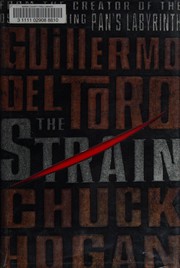
The Strain
2,272-word summary 10 min read 401 pages in the book
- First published
- 2009
- Publisher
- William Morrow
- Pages
- 401
- ISBN
- 9780061558238
- Series
- The Strain Trilogy (#1)
Reading options
What's inside (9 sections)
I came to this through the FX show, which I watched while del Toro's films were still the main reason I knew his name. The Strain came out in 2009 from William Morrow, and the 401 page first edition is the one I read. Guillermo del Toro wrote it with Chuck Hogan, a collaboration the first edition credits to both men even though del Toro is the name that usually gets printed first. It opens The Strain Trilogy and takes vampire fiction, shakes out the old folklore, and rebuilds it as a public health emergency. That is a good trick, and for a long while it works beautifully.
The book is at its best when it behaves like a procedural. There are teams, protocols, lab arguments, and a city that keeps generating more cases than anyone can count. It is at its weakest when the scale gets too big for the characters to carry, which happens toward the end. I will get to that. First, the opening, because it is the best thing in the book.
Night Zero at JFK
A Boeing 777 taxis across the tarmac at John F. Kennedy International Airport and stops for no reason. Every window shade is closed except one. The lights are out. No one answers the radio. The Centers for Disease Control and Prevention gets the call, and Dr. Ephraim Goodweather, who runs a rapid response unit called the Canary Project, goes out to meet the plane with Dr. Nora Martinez. They board and find almost everyone aboard dead. Four people are still alive, and none of them can explain what happened.
It is a terrific image: a giant aircraft sitting quiet on the runway, sealed like a container nobody wants to open. Del Toro, who directs films for a living, knows exactly how to frame it. The chapter works because it trusts the picture instead of explaining the science. Eph and Nora are competent professionals doing a job they have trained for, and their early attempts to make the deaths fit ordinary pathology are the kind of detail that gives the horror weight. Then the bodies start doing things bodies should not do.
The infection turns out to be biological. It arrives as a parasite that takes over the host and rewrites the rules of a human body, which lets the book treat vampirism like an outbreak rather than a curse. That choice is the novel's best idea. It gives the CDC something to measure, gives the scientists a reason to argue, and lets the horror grow by numbers instead of by whispered legends. It also means that the old rules are only partly useful. Silver still helps, sunlight still matters, and none of it makes the job any simpler.
Setrakian's long war
The character who gives the book its soul is Abraham Setrakian, a Holocaust survivor who runs a pawnshop in Spanish Harlem. He was a professor of East European literature and mythology at the University of Vienna once, and he lost that life when he refused to help a wealthy man named Eldritch Palmer find the creature he calls the Master. Setrakian saw the Master inside Treblinka, feeding on prisoners who were already too weak to resist. He tried to stop him and came away with hands broken so badly they never healed right. For more than sixty years he has hunted the thing, and he does it now with a silver sword in those ruined hands and a weak heart in his chest.
Setrakian is the reason the book is more than a creature feature. He carries the memory of the camps and the knowledge of what feeds on the desperate, and the two are not separate in his mind. When he explains vampire biology to Eph and Nora, he is not delivering exposition for its own sake. He is a man who has spent decades being disbelieved, and the impatience in his voice is earned. His name is a private joke, a blend of Abraham Van Helsing and an animatronics engineer del Toro has worked with, which tells you the authors were enjoying themselves.
I kept coming back to the pawnshop. It is a small, dusty place full of ordinary objects, and it sits in a city of millions, and from there one old man has been watching for a creature that has survived a thousand years. That is a wonderfully specific idea. It gives the global stakes a home address, and it makes the book's wild premise feel like it belongs on a real street.
The men who made a deal
The human villains are as important as the monsters, and in some ways more interesting. Eldritch Palmer is one of the richest men alive and wants the one thing money cannot buy, which is more time. He trades his fortune and his political reach to the Master in exchange for immortality. Jim Kent, a colleague of Eph and Nora at the CDC, sells his access to Palmer and spends the crisis steering information away from the people who need it. Dr. Everett Barnes, the CDC director, is more worried about public order and the agency's reputation than about the anomalies piling up in front of him.
Thomas Eichorst, the Master's chief facilitator, has the nastiest history. He was an SS officer at a concentration camp whom the Master changed into an immortal servant, and he killed Setrakian's wife. The connection makes their confrontations personal in a way the wider outbreak cannot be. I liked that the book keeps its human betrayals small and administrative: a memo, a suppressed report, a body quietly collected before anyone can examine it. Bureaucracy turns out to be a better cover for a vampire war than any castle.
Palmer is the most useful of these figures because his motive is so plain. He is dying, and he would rather trade the world than give up his place in it. Hogan and del Toro do not bother making him sympathetic, and the book is better for it. A villain who wants more life for himself is easy to understand, and that clarity lets the authors spend their time on the harder question of what the rest of the city should do once the truth is out.
The people who fight in the streets
Setrakian does not fight alone. Vasiliy Fet is an exterminator with the New York City Bureau of Pest Control who finds the truth while working in a derelict building and brings both his skills and his strength to the cause. He becomes something close to a surrogate son to the old professor, which gives the book one of its few warm relationships. Augustin Elizalde, called Gus, is a Mexican gang member fresh out of prison. A newly turned vampire attacks him in Times Square, he throws the thing under a truck, and the police arrest him for it. Setrakian, briefly locked up alongside him, tells him what is really happening. Gus turns out to be a natural day hunter and takes the fight into his own neighborhood.
Mr. Quinlan, known as the Born, is a rare hybrid, the son of the Master who serves the Ancients as a hunter. He recruits Gus for the work against his own father, which is a strange and appealing piece of casting in human terms. The ensemble gives the book its scale. The authors keep widening the circle: a pawnshop, a CDC lab, a pest control office, a gang neighborhood, a billionaire's tower. New York stops being a backdrop and starts behaving like another character, which is exactly what the television show later understood.
These are the pages I would hand to someone who says they do not like vampires. Fet with his tools and Gus with his street knowledge make the fight feel physical and local. The book is careful to give them jobs that matter rather than just bodies that can be put in danger. When a character here dies or changes, it changes the work of the others, and that is a decent measure of how well an ensemble is built.
Eph's divided attention
Eph Goodweather is newly divorced and in a custody fight over his son Zack with his estranged wife Kelly. Nora Martinez, his second in command, is trying to have an office romance with him while insisting she will not be pushed into the "woman's work" of the investigation. Both of them are good at their jobs and bad at arranging their lives around them, which is a familiar thriller setup done with enough care to feel real. When Kelly becomes infected and is used by the Master to track Eph down, the public health crisis collapses into the family crisis. That is when the book gets its hooks into you.
Kelly's live in boyfriend Matt is one of those details that stings more than it should. Eph resents the man's influence on Zack, and the resentment is mixed with the knowledge that he has no standing to complain. The custody battle is not a subplot parked in the background while the monsters do the real work. It runs alongside the outbreak the whole way, and it is the reason Eph keeps making choices that a purely rational epidemiologist would not make. He is not only trying to save a city. He is trying to save a boy who may already be lost.
The best example is Jim Kent. After he is infected, he begs Eph and Nora to kill him, and they cannot do it. That scene is brutal in a quiet way. There is no speech about the sanctity of life, just two doctors who have spent the book classifying the infected as cases suddenly looking at a colleague who used to be a friend. It is a small moment, and it does more for the moral weight of the story than the larger battles do.
What the book does with the old rules
The Master is one of seven Ancients, the original propagators of the vampire race. He scorns the truce the others accept and wants to wipe out their strains and subjugate humanity outright. By the time he reaches New York he has spent close to a thousand years moving through host bodies, and he currently occupies that of Jusef Sardu, a nineteenth century Polish nobleman with gigantism. The scale is deliberately absurd, and the book knows it. Del Toro's visual instincts show up in the gross inventiveness of the transformations, while Hogan's hand is visible in the clean, fast movement between scenes.
Critics argued about that split. The Times Literary Supplement praised the arresting start and called the book a rattling piece of escapism, while noting that the ending felt built for a blockbuster. Xan Brooks in the Guardian called it a pulpy, apocalyptic fable and described the vampires as mindless, undead leeches. Jeff Jensen in Entertainment Weekly wished for less Hogan and more del Toro, a complaint that always struck me as slightly unfair to a book that is, after all, a novel and not a film treatment. Deirdre Crimmins called it an imperfect vampire book with awkward phrases and clichéd characters. Some of that sticks. A few people speak in types rather than voices, and the prose is functional more often than it is beautiful.
The clichés are mostly in the authority figures and the thugs, not in the central group. Barnes the CDC director could have stepped out of any bureaucracy novel, and the gang members around Gus are drawn with a broad brush. But Setrakian, Fet, and Eph's family scenes have a different texture, and the book is at its best when it stays with them. This is a useful warning for readers who bounce off the first hundred pages. The quality is uneven, and it is worth sticking around for the characters who were given real interiors.
Where the first book leaves us
The Strain does not finish the war. By the last pages the infection has spread through New York, the Master's plot is still in motion, and Eph's family is in as much danger as the city. That is what a trilogy opener is supposed to do, and it was followed by The Fall in 2010 and The Night Eternal in 2011. A comic adaptation from Dark Horse ran from 2011 into 2013, and Carlton Cuse developed the FX television series that aired from 2014 to 2017. If you know the show, bear in mind that it changed plenty of details, including the fate of several characters.
This is also where the book's weaknesses become clearest. Because the ending is designed to open the next volume, several threads stop rather than resolve, and the pace tips into a sequence of escalations. The TLS review called the ending predictable, and I understand the complaint. A book that has been careful about small evidence for three hundred pages suddenly starts announcing bigger and bigger threats. It is still fun, but it feels written for what comes next rather than for the story in hand.
I would hand this to a reader who likes horror with a procedural spine, someone who enjoys watching a team assemble and a city get overrun. I would not hand it to someone looking for elegant prose or subtle character work, because the book is too interested in scale and momentum to spend much time on interiority. The opening chapter is the thing to test yourself with. If a plane sitting silent on a runway gives you the same chill, the rest of the book is worth your time.
FAQ
Who wrote The Strain?
Guillermo del Toro wrote it with Chuck Hogan. It came out in 2009 from William Morrow and opens The Strain Trilogy.
Is The Strain based on Dracula?
It reworks vampire lore rather than retelling Stoker. Its infection is biological, its vampire hierarchy has seven Ancients, and its setting is modern New York.
Is The Strain a standalone novel?
No, it is book one of The Strain Trilogy, followed by The Fall in 2010 and The Night Eternal in 2011.
Similar books
More from The Strain Trilogy first, then related titles.
NOS4A2
Vic McQueen's bike finds lost things through a bridge, pitting her against Manx's Rolls-Royce ride to Christmasland.
2,060-word summary · 9 min read
Wake Up and Open Your Eyes
A Brooklyn father drives to Richmond to find his parents lost in a cable news trance, in Chapman's splatterpunk horror about possession spread through…
2,381-word summary · 11 min read
Nightmares and Dreamscapes
King's 1993 collection runs from a man buried alive in a Cadillac to a town of dead rock stars, mixing horror, science fiction and dark humor across 816 pages.
3,232-word summary · 14 min read
The Regulators
A suburban Ohio street turns into a violent Western set in this Richard Bachman novel, a mirror to Desperation in which an autistic boy hosts a creature called…
2,259-word summary · 10 min read
The Tale of the Body Thief
Lestat trades bodies with a psychic thief for one day of mortality and ends up trapped, sick, and hunting his own vampire body.
2,069-word summary · 9 min read
Night Film
A disgraced journalist investigates the death of a reclusive horror director's daughter, following a red coat through hospitals, secret clubs, and a family…
2,690-word summary · 12 min read
Angels' Blood
Nalini Singh's 2009 Guild Hunter opener sends vampire hunter Elena Deveraux after a murderous archangel in New York, while its most powerful ruler watches.
2,367-word summary · 11 min read
Lullaby
A reporter discovers that a poem in a children's book kills anyone who hears it, and his attempt to destroy every copy turns into a road trip through grief,…
2,147-word summary · 10 min read
Everything's Eventual: 14 Dark Tales
Fourteen Stephen King stories shuffled by the deal of a card deck, from the haunted room of 1408 to quiet tales of grief that sting as much as the monsters.
2,000-word summary · 9 min read
This Present Darkness
A pastor and reporter face demons over Ashton while angels answer prayer.
2,384-word summary · 11 min read

If It Bleeds
Holly Gibney faces an outsider plus three more tales of dread.
2,219-word summary · 10 min read
Four Past Midnight
Four novellas about a plane lost in time, a writer haunted, and horrors small and large.
2,584-word summary · 11 min read
Let the Right One In
A bullied boy in 1981 Blackeberg befriends the strange child next door, where love and hunger grow side by side.
2,546-word summary · 11 min read
Horns
Accused of killing Merrin Williams, Ig Perrish wakes with horns that force strangers to confess their darkest sins.
2,264-word summary · 10 min read
Revival
Jamie Morton shadows preacher Jacobs from boyhood healings to electric cures that open a door best left shut.
2,037-word summary · 9 min read
Later
Boy Jamie Conklin sees dead people who must answer truthfully, pulling him into NYPD cases and a drug crew's greed.
2,009-word summary · 9 min read
The Dark Half
A Maine novelist buries his violent pen name George Stark, then faces murders that carry his own fingerprints.
2,956-word summary · 13 min read
Rosemary's Baby
A young couple's dream apartment in the Bramford turns dark when helpful neighbors and a trusted doctor take over Rosemary's pregnancy.
2,665-word summary · 12 min read
Thinner
A Connecticut lawyer escapes punishment after a fatal crash, then an old Romani father lays a wasting curse on him and the pounds start falling off.
2,502-word summary · 11 min read
Lock Every Door
Broke Jules apartment sits at the Bartholomew where another sitter vanished.
2,224-word summary · 10 min read
Doctor Sleep
Grown Dan Torrance gets sober in New Hampshire and helps gifted Abra Stone face the True Knot.
2,841-word summary · 13 min read
The Outsider
Coach Terry Maitland's DNA and witnesses point to an impossible murder, until Ralph Anderson and Holly Gibney trace it to El Cuco.
2,586-word summary · 11 min read
Hidden Pictures
Nanny Mallory sees Teddy drawings predict a murder in New Jersey.
2,332-word summary · 10 min read
The Shining
The Shining retold: Jack winters at Overlook with Wendy and Danny, REDRUM, hedge maze chase.
2,011-word summary · 9 min read
John Dies at the End
Two slacker friends, a drug called soy sauce, and a portal to something that wants every universe.
2,382-word summary · 11 min read

Forever Odd
Six months after Stormy's death, Odd Thomas tracks a kidnapped friend to a decaying hotel and faces a cultist who wants his gift.
2,308-word summary · 10 min read
Battle Royale
A Japanese dystopian thriller about a class of students forced to kill one another on an island, and the three who refuse to play the game.
2,266-word summary · 10 min read
Witchcraft for Wayward Girls
In 1970 Florida, a girl sent to a maternity home for unwed mothers finds a spellbook, and the real horror turns out to be what the adults do to her and her…
2,077-word summary · 9 min read
We Live Here Now
After a near-fatal fall, a woman moves with her husband to a remote Dartmoor house where strange events happen only when she is alone, and a raven watches from…
2,016-word summary · 9 min read
The Staircase in the Woods
Twenty-five years after a friend vanished at the top of a staircase in the woods, four estranged adults are summoned back to climb another one.
2,023-word summary · 9 min read