
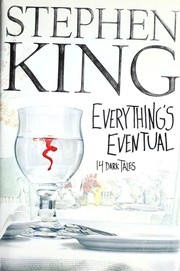
Everything's Eventual: 14 Dark Tales
2,000-word summary 9 min read 464 pages in the book
- First published
- 2002
- Publisher
- Scribner
- Pages
- 464
- ISBN
- 9780743235150
Reading options
What's inside (8 sections)
Everything's Eventual came out in 2002, at a point when Stephen King had already published eight story collections and did not need to prove anything about short fiction. That freedom shows. This is a book where the master of the doorstop novel gets to stretch, and the result is one of his strongest and most varied collections, even if it is not the most famous.
The title is a little misleading in the best way. There are fourteen stories here, and only some of them are what the cover promises. There are haunted rooms, infernal hitchhikers, and monsters, but there are also quiet character pieces about grief, divorce, and men at the end of their ropes that would not raise a scream if you read them aloud at a dinner party. King has always been a better writer of ordinary sorrow than his reputation allows, and a reader who comes to this book for the horror will leave remembering the sadness instead.
How the collection was assembled
The introduction explains the gimmick, and it is a good one. King pulled the spades out of a deck of cards plus a joker, assigned the fourteen stories to the cards, shuffled, and dealt. The order of the deal became the order of the book. He says the result created a nice balance between the literary stories and the all-out screamers.
It sounds like a stunt, and it is, but the pacing genuinely works. The collection alternates between dread and melancholy in a rhythm no editor would have planned, and the effect is that the scary stories land harder because the sad ones have softened you up. If you want to understand King's range in one volume, this is the one to read, because the accidental curation captures every gear he has.
The two famous ones
The collection's biggest story is 1408, and deservedly so. Mike Enslin is a writer who makes a living debunking haunted places, visiting inns and hotels and writing books about how the ghosts are drafts and the ghosts are plumbing. Then he tries to check into room 1408 of the Dolphin Hotel in New York, and the manager, Olin, does everything short of physically blocking him. The room has a history, he explains, and in that history no one has lasted more than an hour.
What follows is one of the best sustained pieces of horror in King's short fiction. The room does not simply scare Enslin. It studies him, weaponizes his memories, and wears him down, and the story cycles through increasingly wrong realities with a logic that keeps escalating the wrongness. The 2007 film adaptation stretched the story to feature length and changed the ending, so readers who know the movie should expect a leaner, meaner original.
Riding the Bullet is the other headline. It was first published as an e-book in 2000, an early experiment in digital publishing that was read by hundreds of thousands of people and briefly made King the self-proclaimed test case for the format. The story itself is a classic ghostly hitchhiker tale with a twist of real feeling. Alan Parker is a young man trying to get across Maine to see his mother, who has suffered a stroke. He accepts a ride from a man named George Staub, and the conversation turns out to be a negotiation with a person who is very clearly not alive.
The horror in Riding the Bullet is gentler than the room in 1408. It is about guilt and the terrible arithmetic of who you would sacrifice for the people you love, and the ending has a staying power that surprised me more than the frights did.
One historical footnote is worth pausing on. When Riding the Bullet appeared in 2000, it circulated as a digital-only release, and the fact that it was downloaded hundreds of thousands of times in its first days, years before e-readers existed, is a genuine piece of publishing history. King has always been early to new formats, and where some of his experiments in that era came off as stunts, this one proved something real about how people wanted to read. It also says something about the story itself that it survived the format that made it famous and still gets anthologized on its own merits.
The Dark Tower visit
The Little Sisters of Eluria is the collection's deep cut and my personal favorite. It is a Dark Tower story, which means it belongs to the epic that had been running through King's work for two decades, but it stands alone with no homework required. Roland Deschain, the last gunslinger, is found half dead outside the town of Eluria and carried to a way station run by an order of nuns who are not what they seem. They are feeding on the patients, Roland included, and his slow salvage of the situation is one part detective work, one part sheer stubbornness.
King's Roland is a joy to watch when he is being clever rather than noble, and this story gives him a small, self-contained adventure with an unsettling mystery at its center and a touch of real warmth. If the Dark Tower has ever intimidated you, this is a painless and atmospheric way in.
Devils and dark rooms
The title story, Everything's Eventual, is a novella about Dinky Earnshaw, a young man with a strange talent. He can send out a piece of art, a message, and everyone who receives it dies. He is recruited by a man named Sharpton into an organization that wants his gift, and the story becomes a spy thriller with a moral crisis at the center, as Dinky works out what his employers are actually using him for. It is one of the strangest things in the collection and one of the most memorable.
The Man in the Black Suit is a compact masterpiece that won the World Fantasy Award for best short fiction. Gary is nine years old and fishing in a Maine stream when he meets a man in a black suit who knows everything about him, including how his mother really died. The story is a duel of manners and a nightmare at once, and its ending is one of the sharpest little stings in King's whole catalog.
Lunch at the Gotham Café takes the mundane horror of a divorce meeting and turns it into a knife fight. Steve Davis has been separated from his wife for months and is meeting her and her lawyer at a restaurant to sign the paperwork, and the maitre d', a man in a red jacket, is having some kind of breakdown. The story escalates from awkward to deranged in about six pages, and the image of the man in red has stuck with me far longer than I expected.
In the Deathroom is a taut story about an American in the hands of men in a South American interrogation room. The reversal comes fast and the story never stops to explain itself, which is exactly the right choice. Autopsy Room Four is a black comedy about Howard Cotterman, a man who is not dead but cannot say so, stuck on an autopsy table while the doctor prepares to begin. I will not spoil how he is saved. The solution is famous and awful and perfect.
The Road Virus Heads North follows Richard Kinnell, a horror novelist who buys a picture at a yard sale and then watches it change as he drives home. The painting is of a man in a car, and each version is closer. It is a haunted-object story of the purest kind, and its ending is bleak in a way King rarely commits to with this much relish.
The quiet weight at the back of the book
The stories that stay with me longest are the ones that barely count as horror at all. All That You Love Will Be Carried Away is about a traveling salesman named Alfie Zimmer who checks into a motel with a gun and spends the night deciding whether to use it, while going through his collection of strange things he has copied off bathroom walls across decades of lonely roads. It is a story about whether a person who is invisible to everyone else can still count as mattering, and it is one of the finest things King has written at any length.
The Death of Jack Hamilton comes at the same territory from the Depression era. It is a fictionalized account of the death of one member of John Dillinger's gang, narrated by another, and most of it takes place in a hot car and a hiding place where the wounded man is taking a long time to die. There is no supernatural element at all, just pain and loyalty and bad teeth and heat, and it is as brutal as anything in the collection.
That Feeling, You Can Only Say What It Is in French is a sliver of a story about a woman who keeps reliving the same stretch of a trip to Florida and slowly understands what the repetition means. Its structure and its ending are the point, so I will say only that it earns its oddness.
L.T.'s Theory of Pets is the funniest and most painful story in the book, a long, rambling barroom anecdote about a marriage told through the couple's mismatched pets, which hated the wrong people with total honesty. The punchline is a horror moment, and the horror is entirely domestic, which is exactly the trick King pulls over and over in this collection.
King's treatment of despair in these stories never feels like an author working out his own material, which is one reason they endure. All That You Love Will Be Carried Away is the clearest case, a story about a man deciding whether his life counts, told through the graffiti he has collected off rest stop walls, and it neither sentimentalizes him nor judges him. That restraint is exactly what the horror stories could not afford, and the quiet pieces are the ones that come back to mind months later. King is often praised for making ordinary places terrifying. These stories make ordinary despair legible, which is a harder and more useful trick.
And Luckey Quarter is a small, kind story to close on, about a waitress who keeps finding quarters with messages on them and what that little bit of mystery does for her week. After the deaths and the devils and the dying, it is a strange grace note, and the shuffled deck providentially left it for last.
What works and what does not
The collection's strength is its range and its generosity. King writes children, old men, waitresses, mobsters, and gunslingers with the same ear, and the introduction and story notes, which he includes throughout, turn the book into a conversation between writer and reader. The famous stories hold up, and the deep cuts deserve the fame more than some of the hits do.
The weaknesses are the ones that follow King everywhere. He overwrites endings, and a couple of these stories run a page or two past their natural stopping point. The horror-comedy tone in Lunch at the Gotham Café will strike some readers as more silly than scary, and the Dillinger story is slow in a way that is deliberate but still slow. The book also suffers slightly from being fourteen stories of uneven weight, and reading it straight through can feel like a long drive with changing weather.
Still, Everything's Eventual belongs near the top of King's short fiction. It is the volume I recommend to people who think they know what a Stephen King story is, because it contains almost all of them, and the shuffling means they arrive in the wrong order, which is the right order. Fourteen dark tales, and more than a few that are simply true.
FAQ
Does Everything's Eventual include the story 1408?
Yes. 1408 is one of the fourteen stories in the collection and the basis for the 2007 film starring John Cusack, which changes the ending substantially.
Is The Little Sisters of Eluria a Dark Tower story?
Yes. It features Roland Deschain and belongs to the Dark Tower series, but it is written to stand alone and needs no prior reading.
When was Everything's Eventual published?
Scribner published it on March 19, 2002. The hardcover runs 464 pages with ISBN 9780743235150 and collects eleven short stories and three novellas.
Similar books

If It Bleeds
Holly Gibney faces an outsider plus three more tales of dread.
2,219-word summary · 10 min read
Four Past Midnight
Four novellas about a plane lost in time, a writer haunted, and horrors small and large.
2,584-word summary · 11 min read

Hearts in Atlantis
Five linked stories follow Bobby Garfield, Carol Gerber, and their friends from a haunted childhood in 1960 to the long aftermath of Vietnam.
2,402-word summary · 11 min read

Full Dark, No Stars
Four novellas about revenge where ordinary people do terrible things and live with it.
2,646-word summary · 12 min read

Skeleton Crew
King's 1985 collection pairs The Mist with The Jaunt, The Raft, and Survivor Type: 22 stories of Maine dread.
3,209-word summary · 14 min read
Revival
Jamie Morton shadows preacher Jacobs from boyhood healings to electric cures that open a door best left shut.
2,037-word summary · 9 min read
Later
Boy Jamie Conklin sees dead people who must answer truthfully, pulling him into NYPD cases and a drug crew's greed.
2,009-word summary · 9 min read
The Dark Half
A Maine novelist buries his violent pen name George Stark, then faces murders that carry his own fingerprints.
2,956-word summary · 13 min read
Night Shift
King's first story collection moves from haunted mills to killer cornfields, twenty early tales where ordinary places turn evil.
2,488-word summary · 11 min read
Doctor Sleep
Grown Dan Torrance gets sober in New Hampshire and helps gifted Abra Stone face the True Knot.
2,841-word summary · 13 min read
The Outsider
Coach Terry Maitland's DNA and witnesses point to an impossible murder, until Ralph Anderson and Holly Gibney trace it to El Cuco.
2,586-word summary · 11 min read
The Shining
The Shining retold: Jack winters at Overlook with Wendy and Danny, REDRUM, hedge maze chase.
2,011-word summary · 9 min read

Lullaby
A reporter discovers that a poem in a children's book kills anyone who hears it, and his attempt to destroy every copy turns into a road trip through grief,…
2,147-word summary · 10 min read
This Present Darkness
A pastor and reporter face demons over Ashton while angels answer prayer.
2,384-word summary · 11 min read

Haunted
Writers lock in for three months and trade worse stories as food runs out.
2,576-word summary · 11 min read

The Call of Cthulhu and Other Weird Stories
Seventeen tales from Dagon to Innsmouth, led by Cthulhu, the Colour, and the Whisperer, in S. T. Joshi careful Penguin edition with notes and corrected texts.
2,593-word summary · 12 min read
The Call of Cthulhu
A professor's papers link a sculptor's dreams, a Louisiana cult raid, and a sailor's voyage to a sleeping god under the sea.
2,530-word summary · 11 min read
Horns
Accused of killing Merrin Williams, Ig Perrish wakes with horns that force strangers to confess their darkest sins.
2,264-word summary · 10 min read
NOS4A2
Vic McQueen's bike finds lost things through a bridge, pitting her against Manx's Rolls-Royce ride to Christmasland.
2,060-word summary · 9 min read
Rosemary's Baby
A young couple's dream apartment in the Bramford turns dark when helpful neighbors and a trusted doctor take over Rosemary's pregnancy.
2,665-word summary · 12 min read
Thinner
A Connecticut lawyer escapes punishment after a fatal crash, then an old Romani father lays a wasting curse on him and the pounds start falling off.
2,502-word summary · 11 min read

Hidden Pictures
Nanny Mallory sees Teddy drawings predict a murder in New Jersey.
2,332-word summary · 10 min read
Lisey's Story
Two years after her novelist husband dies, Lisey Landon follows a trail of clues into his childhood and the other world that made him a writer.
1,998-word summary · 9 min read
Rose Madder
After fourteen years of abuse, Rosie Daniels flees her cop husband and finds a painting that opens into a dangerous mythic world.
2,349-word summary · 10 min read
Duma Key
After losing his arm, Edgar Freemantle paints on a Florida island and learns his pictures can open doors for something hungry.
2,530-word summary · 11 min read
Desperation
Travelers on Highway 50 are hauled into empty Desperation, Nevada, where a possessed deputy serves an old thing in the mine.
2,993-word summary · 13 min read
Insomnia
Widowed Ralph stops sleeping in Derry and sees small doctors with scissors deciding who lives and dies.
3,605-word summary · 16 min read
Dolores Claiborne
A Maine housekeeper confesses two deaths in one voice: Vera fall and husband lost in eclipse.
2,381-word summary · 11 min read

Different Seasons
Four novellas: prison hope, a boy and an old Nazi, kids chasing a body, and a club that grants wishes with teeth.
1,974-word summary · 9 min read
The Dead Zone
Coma waker Johnny sees futures in touch and faces demagogue Stillson.
2,132-word summary · 9 min read