
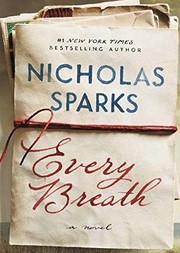
Every Breath
2,357-word summary 10 min read 320 pages in the book
- First published
- 2018
- Publisher
- Grand Central Publishing
- Pages
- 320
- ISBN
- 9781538728529
Reading options
What's inside (9 sections)
I picked this one up because of the mailbox. Long before I knew what the book was about, I had heard about the Kindred Spirit mailbox on Bird Island, the driftwood post at the far end of Sunset Beach in North Carolina where visitors have been leaving letters and journals since 1983. Nicholas Sparks has said that mailbox, stuffed with handwritten notes, was one of two starting points for this novel, the other being a safari trip that gave him the character of a Zimbabwean guide. You can feel both in the finished book. Every Breath is a love story that runs on paper: letters, drawings, handwriting that outlasts the people who made it. Grand Central Publishing released it in October 2018, the hardcover runs 320 pages, and it stands alone, with no connection to The Notebook or its sequel, which matters if you are the kind of reader who keeps track.
A story inside a story
The novel opens with a move that is unusual for Sparks: he writes himself in. In a prologue, a fictionalized version of the author is at Kindred Spirit when he finds a thick manila envelope among the letters. Inside are pages of a story and drawings of a couple. The envelope vanishes before he can come back for it, and he spends weeks trying to find the person behind it, eventually tracking down an older man in his late sixties who admits the story is his. The man agrees to let it become a novel on one condition: the names get changed.
Then the author steps back, and the real book begins, with a date: September 1990. Sparks bookends everything with the same device in the epilogue, and his author's note is clear that the discovery is fiction, a frame rather than a confession. I have mixed feelings about it, and I will come back to that. As a doorway, though, it does its job, because it promises a love that ends up written down and left in a mailbox for strangers to find.
Two people arriving with too much on their minds
Tru Walls is forty-two, a safari guide in Hwange National Park in Zimbabwe, and he has never set foot in America. He comes because of a letter: a man he has never met claims to be his biological father and asks him to visit. Tru grew up on a wealthy farming estate ruled by a patriarch everyone called the Colonel, the kind of man whose word reshaped other people's lives. Tru's mother, Evelyn, died in a fire at the family compound when he was eleven, a fire that was never fully explained. His stepfather, Rodney, withdrew after the funeral, and the workers on the farm raised Tru more than anyone else did. He started drawing as a boy, mostly because it was the only way he had to hold on to things.
He reaches Sunset Beach several days before his father will, which leaves him in a rented house with nothing to do but think. Next door is Hope Anderson.
Hope is thirty-six, a trauma nurse from Raleigh, and she is using a week at her family's cottage for three errands at once. She is there to fix the place up for sale. She is there because her father has just been diagnosed with ALS, and the family is quietly replanning around a horizon that keeps moving closer. And she is there for her friend Ellen's wedding, which falls at the end of the week. Her boyfriend, Josh, an orthopedic surgeon she has been with on and off for six years, broke things off after an argument and went to Las Vegas instead of coming with her. Hope wants marriage and children, and she can feel her own arithmetic working against her.
They meet on a Wednesday morning. Hope's Scottish terrier, Scottie, gets grazed by a car, and Tru finds the dog and carries him home. It is a small rescue, but it gives them an excuse to talk, and the talking comes easily. That evening they end up at the same restaurant, share dinner, and walk the beach afterward. Tru tells her about his mother. Hope tells him about her father. By the time they turn back toward the cottages, the week has rearranged itself.
Four days, one mailbox
On Thursday they walk out to Kindred Spirit at low tide and read the letters strangers have left behind. This is where the novel is at its best, because the mailbox gives two guarded people permission to say things they would never say out loud. Hope admits how badly she wants to be a mother. On the walk back, a storm catches them, and Tru leans in to kiss her. She stops him with a hand on his chest, and they hold hands the rest of the way home. That night, Josh calls from Las Vegas, and Hope hangs up on him. Then she and Tru kiss, and the hesitation is over.
Friday is for declarations. Tru sketches Hope's portrait and begins a drawing of the two of them in profile, which will matter later. It is all very fast, and I want to flag that now. Three days is not much runway for the kind of love this book needs you to believe in. The dialogue carries a lot of it, and the beach setting does its work, but readers who need a relationship built slowly on the page will feel the novel asking for a loan of faith.
The other story lands on Saturday. Tru's father, Harry, finally arrives: mid-seventies, frail, terminally ill, carrying the past in a suitcase and not much time to unpack it. What he tells Tru is the strongest material in the book. Harry was an American working in Rhodesia, and he fell in love with Evelyn. The Colonel found out. His men kidnapped Harry, beat him, and drove him out of the country, and Harry never saw Evelyn again. He did not know she was pregnant when he left. Now he hands Tru photographs and a stack of Evelyn's drawings, the pieces of his mother's life that Tru has been missing since childhood.
What makes these chapters work is that they refuse to be noble. Harry is not asking for absolution exactly. He is an old man trying to hand his son the truth while he still can, and the book lets the cowardice and the love sit in the same room. A powerful man made a decision decades earlier, and two lives got rerouted. That is the whole tragedy, and Sparks does not dress it up.
The choice, and the letter in the glove compartment
That same Saturday, Hope goes to Ellen's wedding, and Josh turns up with an apology and a proposal. On Sunday morning, she tells Tru the truth. She loves him. She also cannot leave her father while he is dying, and there is a second thing, harder to say: Tru cannot give her biological children. A bout of measles left him sterile. Becoming a mother is not a footnote in the future Hope has imagined; it is load-bearing. She has not answered Josh yet, but she is going to choose the life she can actually picture, and both of them know it.
Tru begs her to come to Zimbabwe. She refuses through tears and drives away. Before she goes, he slips his drawings and a letter into her glove compartment. The letter says she is forgiven, and that if she ever needs him, he will come.
Eight weeks later, back in Raleigh, Hope accepts Josh's proposal. She marries quickly, already suspecting she is pregnant with their first child, Jacob. This is the hinge of the whole book, and I think Sparks earns it. It would have been easy to make Josh a monster or Hope a coward. Instead she makes the choice plenty of people make, for reasons that sound decent on their face, and the novel spends the rest of its length living with the consequences.
Twenty-four years, mostly offstage
The second half jumps to October 2014. Hope is sixty, retired, and divorced for eight years after Josh's affairs. She has two grown children, Jacob and Rachel. Her father died of ALS, having lasted a little less than seven years from diagnosis, and her mother died four years after him, never really recovering. Through the marriage and the divorce, Hope kept Tru's drawings, his letter, and Ellen's wedding invitation in a carved wooden box. She spent years searching for him across southern Africa and found nothing. In one of her father's last lucid moments, she told him about Tru, and her dying father, who had not moved his hand in weeks, moved it to ask a single question: was she sure it was too late?
Tru's decades arrive as a long catch-up conversation, which is both efficient and a little disappointing. The facts, though, add up to a hard life. He went back to Zimbabwe, married a woman named Kim because she was pregnant, and they had a son, Andrew, before the marriage quietly fell apart. He moved to Botswana after Andrew left for university. The government seized the family farm. His stepfather, Rodney, took his own life a year later. In 2004, a car accident left Tru clinically dead before he was revived, and he spent nearly three years learning to speak and walk again. In 2007, he got as far as an airport, meaning to fly to Hope, and turned around.
The coincidence that reconnects them is where readers divide. In a coffee shop in South Africa, Tru overhears an American couple with a house at Sunset Beach talking about a letter they found at Kindred Spirit, signed by a woman named Hope. That is what sends him to North Carolina. He flies over and goes out to the mailbox day after day for weeks, waiting.
The letter, the fire, and the last page
The year before the reunion, Hope had written to Kindred Spirit, asking to see Tru one last time, and named a date: October 16, 2014. On that day she makes the long walk out to Bird Island, and among the letters she finds one on yellow legal paper, addressed to her in Tru's handwriting. He explains that he came and waited. She looks up, and he is standing there.
They catch up on twenty-four years: his accident, her search, the airport he walked away from. Then, by the fire at the cottage, Hope tells him the real reason she wrote. She has ALS, diagnosed in July of the year before, and she has not told her children. Tru, of all people, knows something about coming back from the edge. He tells her she is living, not dying, and that he will move to North Carolina, marry her, and love her for however much time either of them gets. She says she would like to marry him. It is a quieter ending than the premise suggests, and better for it. Nobody is cured. Nobody gets the years back. Two people simply refuse to waste what is left.
The epilogue returns to the frame. The fictional author visits Tru's friend Romy in Zimbabwe, who remembers Tru saying that telling Hope goodbye was the hardest thing he ever did. Romy once asked Tru, after the accident, whether he saw God when he died. Tru's answer was that he saw Hope. Then the author goes back to Sunset Beach, sees Hope in a wheelchair with Tru beside her, his hand on her shoulder, and understands what he is looking at. A note in the epilogue mentions an extra chapter about the week the two of them spent at Carolina Beach, Hope telling her children, a small wedding the following February, and a honeymoon safari.
What holds up and what does not
The strongest parts of this book are not the romance beats. They are Sunset Beach, the mailbox, and the illness. Sparks writes the ALS material with a specificity that feels lived-in, from the way a family starts quietly reworking a house to the way conversations get postponed because nobody can say the word out loud. Harry's account of losing Evelyn is the other peak, and it does more in about twenty pages than the central couple manages in a hundred.
The central couple is where the pushback belongs. Because Hope and Tru fall in love in roughly three days, the book has to keep insisting on the depth of what they feel, and the insistence gets loud in places. Publishers Weekly, in an otherwise positive review, called the leads cookie-cutter, and that is close to my reaction. The frame is a second risk: some readers will find the author writing himself into the story charming, and others will find it a trick that keeps the story at arm's length just when it wants to be intimate. The coincidences pile up as well, especially the coffee shop encounter that sends Tru to the mailbox. If you trip over contrivance, this one will trip you more than once.
Still, I keep thinking about the ending. A book about a week that happens in 1990 and a reunion that happens in 2014 has to earn its second chance, and this one mostly does, because it never pretends the intervening years were wasted or reversible. The novel asks, in its publisher's copy and again in its final chapters, how long a dream can survive. Its answer is not forever, and not never. It is: as long as two people are willing to keep showing up, one day at a time, with whatever time they have. That is a smaller promise than the usual vows, and in this story a braver one. If you know what you want from Sparks (a fast romance, coastal weather, a few good cries), this is a solid version of it. If you need the love story to earn every step on the page, the chapters with Harry and Evelyn may be the ones you remember.
FAQ
Is the Kindred Spirit mailbox real?
The mailbox is a real landmark on Bird Island near Sunset Beach, North Carolina, where visitors have left letters since 1983. The couple and the story are fiction.
Is Every Breath based on a true story?
Sparks frames the novel as a story he found in an envelope at the mailbox and was allowed to retell with names changed. That opening is a literary device, not a true account.
Is it part of a series?
No. It is a standalone romance. Sparks's other North Carolina books share the region but not the characters.
Similar books
Message in a Bottle
A divorced mother finds a grieving widower's letter and seeks him in North Carolina.
2,113-word summary · 9 min read
Never Too Far
Blaire flees Rosemary Beach after Rush's lies, then must decide if his pursuit and Nan's exposed schemes earn trust again.
2,626-word summary · 12 min read
The Longest Ride
A stranded widower relives his marriage while a Wake Forest student and a bull rider test new love in North Carolina.
2,488-word summary · 11 min read
A Bend in the Road
Widowed sheriff Miles loves teacher Sarah while her family's secret touches his wife's death.
2,182-word summary · 10 min read
The Best of Me
Teen lovers torn apart in small town Oriental reunite twenty years after a friend's death to settle his estate and face the choices that split them.
2,871-word summary · 13 min read
Nights in Rodanthe
Divorced Adrienne and guilt worn surgeon Paul share one stormy weekend at a Rodanthe inn, fall hard, then hold close by letter until loss in South America ends…
3,338-word summary · 15 min read

Sam's Letters to Jennifer
A grieving journalist reads her grandmother's letters and finds a decades-long love affair that changes how she sees her family.
2,310-word summary · 10 min read
Wedding Night
Lottie marries an old flame days after a breakup, then flies to a Greek island while her sister quietly works to sabotage the honeymoon. A farce about memory,…
2,213-word summary · 10 min read
Something Wilder
Lily Wilder runs staged treasure hunts in Utah until her first love Leo returns and the old legend turns dangerous.
2,556-word summary · 11 min read
The Switch
A burned-out consultant and her 79-year-old grandmother swap London and Yorkshire homes for two months, facing grief, dating apps, and village politics.
2,782-word summary · 12 min read
Fix Her Up
Party clown Georgie fakes a romance with ex ballplayer Travis to earn respect, and their act turns real in Port Jefferson.
2,368-word summary · 11 min read
The Dead Romantics
A ghostwriter who stopped believing in love goes home to bury her father and finds her editor's ghost waiting at the funeral parlor.
2,634-word summary · 12 min read
Things We Left Behind
Lucian Rollins returns to Knockemout to bury his father's past and collides with librarian Sloane Walton.
2,777-word summary · 12 min read

Part of Your World
ER doctor Alexis Montgomery falls for carpenter Daniel Grant in Wakan while her surgeon family presses duty.
3,078-word summary · 14 min read
Just for the Summer
Emma and Justin date to break a matching curse, then face sudden guardianship and illness on Lake Minnetonka.
3,090-word summary · 14 min read

One True Loves
Emma Blair loses husband Jesse presumed dead, rebuilds life in Acton with fiance Sam, then Jesse returns alive after years missing, forcing a painful choice…
2,418-word summary · 11 min read
Archer's Voice
Bree flees to Pelion, Maine and falls for Archer Hale, a mute recluse hiding a violent family past.
2,787-word summary · 12 min read
It Happened One Summer
LA It girl Piper is cut off and sent to Westport where gruff captain Brendan challenges her glitter.
2,089-word summary · 9 min read
Things We Never Got Over
Naomi runs from her wedding to help her twin in Knockemout and clashes with Knox Morgan.
3,358-word summary · 15 min read

Happy Place
A split couple fakes being together for one last week with friends at a Maine cottage. Emily Henry mixes witty banter, grief, and second chances in this 2023…
2,497-word summary · 11 min read

Book Lovers
Sharp literary agent Nora Stephens gets dragged to small-town Sunshine Falls with her sister and keeps colliding with brooding editor Charlie Lastra.
1,952-word summary · 9 min read
It Starts with Us
It Starts with Us retold: Lily and Atlas after Ryle, co-parenting, second chances in Boston.
2,216-word summary · 10 min read

At First Sight
Jeremy and Lexie are married and expecting a baby when anonymous emails tell him the child may not be his.
2,317-word summary · 10 min read
True Believer
Jeremy Marsh, a science journalist who debunks paranormal claims, comes to a small North Carolina town and falls for a librarian who believes in things he…
2,125-word summary · 9 min read
See Me
A law student with a violent past falls for a prosecutor whose old case returns as a stalker, in a romance with a thriller at its center.
2,007-word summary · 9 min read
The Wish
A dying photographer recalls 1996 Ocracoke first love and an adoption choice.
2,176-word summary · 10 min read
The Wedding
Wilson Lewis courts his own wife again with Noah's help as daughter Anna plans her wedding.
2,076-word summary · 9 min read
The Guardian
Widowed at twenty-five, Julie Barenson leans on a Great Dane named Singer, then dates two men and learns one of them is a killer.
2,221-word summary · 10 min read
The Choice
A settled Beaufort veterinarian falls for his taken neighbor, then faces an impossible hospital decision eleven years later.
2,150-word summary · 10 min read
The Rescue
Volunteer fireman Taylor finds a crashed mother and son in a storm, then falls for them both.
1,939-word summary · 9 min read