
Reading options
What's inside (10 sections)
- The sales meeting that starts everything
- Believing, and the disease Schwartz calls excusitis
- Big thinker's vocabulary and the room you sit in
- Case histories: the engine and the weak point
- Action, crusades, and the next mile
- Defeat as material, goals as steering
- Leadership, and the frame that limits it
- What is worth carrying out of it
- Key takeaways
- FAQ
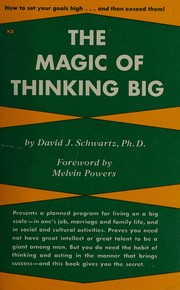
I expected slogans and got something stranger: a 1959 sales manual that treats vocabulary as a tool you can service. The copy I read was a later Fireside printing with a cracked spine and somebody's pencil underlining roughly half of it, which is close to how most readers meet this book.
The first edition appeared in 1959 from Wilshire Book Co of Chatsworth, California, and ran 228 pages. That edition carries ISBN 9780879800925. Simon and Schuster put out an abridged Fireside version in 1987 and reissued the whole thing in 2015, which is why catalogues, and most people who mention the book, put the date in the present. The 2015 printing is 320 pages under ISBN 9781501118210.
David J. Schwartz was a marketing professor at Georgia State University in Atlanta, chaired that department, and later ran a consulting firm called Creative Educational Services. He died in 1987 at sixty. The publisher claims more than six million copies in print.
One thing to clear up before anything else. This is not the author's own list of ten ideas, whatever you have heard. It is thirteen chapters, each broken into short numbered sections, and Schwartz explains the method in his second page: every technique in the book is illustrated with a real-life case history.
He is not writing research. He is writing a manual, and the cases are the illustrations.
The sales meeting that starts everything
The preface opens with a story Schwartz watched as a young man. A vice president of marketing brought his top salesman onto a stage in front of the sales force and made him explain why that man earned close to sixty thousand dollars while the average representative earned twelve. The vice president had checked everything: the man was not smarter on the personnel tests, he did not work longer, he took more time off than most, his territory was average, his education was average, his health was average.
The difference, the executive said, was that Harry thought five times bigger.
Schwartz then reaches for the sentence that the rest of the book spends hundreds of pages unpacking: success is determined not so much by the size of one's brain as it is by the size of one's thinking. He calls this magic, which is his word and a bit of a tease, since magic usually means you do not get to choose.
He builds the frame with geography. Most people live on what he calls Second Class Street, the crowded road where the jobs are plentiful and the ceilings are low. First Class Avenue is short and uncrowded, and there are vacancies there, which is his way of saying that the scarcity of opportunity is mostly an attitude in disguise. He quotes Disraeli to open the instruction, that life is too short to be little, and he lines up Emerson, Milton and Shakespeare as evidence that the big thinkers had company.
There is also a number in the preface about personnel selection executives receiving fifty to two hundred fifty times as many applicants for ten-thousand-dollar jobs as for fifty-thousand-dollar jobs.
It is offered as proof that the ladder is real and the waiting room is fictional.
Believing, and the disease Schwartz calls excusitis
Chapter one makes the case that belief is a skill rather than a feeling. The story he tells is of a tool-and-die salesman in Detroit who felt, in his own words, like a middle-class failure while waiting on a job interview. He took a sheet of hotel stationery, wrote down the names of five men he knew who had gone well past him in earning power, and wrote to them. The replies led to a job, then a sales position, and eventually a reorganization in which the man was handed stock and a raise. Schwartz's commentary is blunt: the belief was the cause.
Then comes the chapter that gave the book its cult status among salespeople. Excusitis, he writes, is the failure disease, and it has four flavours. Health excusitis, which he illustrates with Roosevelt's legs and Harry Truman's lack of a college degree. Age. Intelligence. Luck. A man who came to him after a talk in Cleveland explained that his ideas could not help much because he had a bad heart and four doctors had failed to find the problem. Schwartz answers that he has never met a successful executive, officer, salesman or leader who could not have found an excuse perfectly adequate to the size of the ambition.
Chapter three takes on confidence and says the flat, unfashionable thing that no one is born with it, that every confident person you admire acquired theirs, in pieces, usually by doing the thing they feared. He uses the wartime Navy swimming classes as his illustration: recruits who were terrified of a few feet of water were put in the water until the terror wore off.
The criticism starts here, and it should. None of this is evidence. It is a professor of marketing telling sales audiences what he has noticed, and the stories are short enough that a reader can half a dozen of them in a sitting. The claims they support would need study to mean anything, and there is no study in the book.
Big thinker's vocabulary and the room you sit in
Chapter four is the book in miniature, and its title is a command: How to Think Big. Schwartz lays out five practices. Concentrate on your assets instead of your liabilities. Use the vocabulary of big thinkers, meaning bright, hopeful words rather than the vocabulary of failure. Stretch your vision to see what can be rather than only what is. Take the big view of your job instead of the small view of your tasks. And think above trivial things by asking whether the thing you are about to get upset about actually matters.
He backs these with a side-by-side table, one column for the petty thinker and one for the big thinker, twelve entries each. The petty thinker believes in retrenchment, looks for ways to avoid work, competes with the average, saves money by cutting necessary items, sees only the short run, and worries about security. The big thinker believes in expansion, finds more ways to do things, keeps the long run in view, and invests. It reads like a personality test written by a salesman, which is worth saying plainly, and it is also the most quoted spread in the book.
Then chapter seven makes the environmental argument, and it is the strongest thing Schwartz wrote. The mind, he says, is fed by what surrounds it, and most people sit in an environment arranged to keep them small. He points to the refrain that there are too many chiefs and not enough Indians, and observes that the people doing the hiring say the opposite, that there are too many Indians and not nearly enough chiefs. He recommends getting plenty of psychological sunlight and choosing the company you keep carefully, since you become like the five people you spend the most time with.
Case histories: the engine and the weak point
Chapter five is where the manual reveals its method, because almost every claim arrives wrapped in somebody's life. Schwartz offers three sources of what he calls mind food: reading, meeting people who think about different things than you do, and listening harder than you talk. The second one comes with a case that is hard to forget. A young accountant for a paint manufacturer went to a real estate luncheon as a guest, heard a speaker predict the city would keep growing into farmland, bought fifty acres, had it surveyed into ten five-acre plots, sold all ten by direct mail in six weeks, and cleared nineteen thousand six hundred dollars on ten thousand four hundred of costs while working only evenings and weekends.
The third source is listening, and he says so plainly, since listeners in his experience are usually waiting for their turn to talk.
Chapter eight adds a method for manufacturing enthusiasm, and it is the most charmingly odd thing in the book. To get enthusiastic about something you are indifferent to, study it until you are not indifferent. His example is bumblebees. If you learn what they do for plants, how the colony is organized, where they go in winter, you will end up genuinely interested in bumblebees. He uses the same drill on a room of executives who have never thought about greenhouses and cannot be made to care about them by any other route.
This is where fair criticism has to be honest. The case histories are thin. They arrive pre-digested, they are almost always secondhand, and the causal claim they carry is enormous: one accountant, one luncheon, one farm, and now your own failure is a matter of your thinking. Schwartz does not know what the accountant would have done without the luncheon, or what the man in Cleveland would have done with a cardiologist. A reader who wants a demonstration rather than an anecdote will not get one here.
Action, crusades, and the next mile
Chapter nine, on treating people well, is oddly practical. Schwartz borrows two sentences from Benjamin Fairless: ask yourself what you can do to make yourself more deserving of the next opportunity, and do not waste time and energy being discouraged, do not berate yourself, plan to win next time. Then he adds the mechanics of liking: be likable, introduce yourself, get names right in both directions, send a personal note afterward.
Chapter ten is the loudest chapter, and it is the one that gives the book its reputation for pure forward motion. Schwartz divides the world into activationists, who do things, and passivationists, who wait. His practice list includes being an activationist, refusing to wait for conditions to be perfect, using action to cure fear, thinking in terms of now, and seizing the initiative as a crusader. He tells of a man who moved into a new subdivision and organized the residents until a swimming pool was built, at which point the families who had not cared became the loudest supporters and the neighborhood took on new life.
Two cases sit in the middle. One man wanted to start his own business and never did, because conditions were never perfect. Another wanted a house and got one. Schwartz's judgment is that waiting for perfect conditions is the expensive mistake, since conditions never are.
He also makes the point that failure and mediocrity come from the same shelf. The people on skid row and the people who are merely average give the same reasons: the wife ran off, the money went, the door closed. Same reasons, different outcomes, which is the sharpest evidence in the book that thinking is not everything.
Defeat as material, goals as steering
Chapter eleven treats failure as something to be investigated. Schwartz uses commercial aviation, where the fatality rate per miles flown is so low that any crash becomes an event, and investigators spend weeks reconstructing what went wrong from the wreckage and the witnesses. His advice is to study your own setbacks the same way, which is better than any of the affirmations around it.
Chapter twelve turns to goals, and it contains the book's most practical material. Schwartz describes five weapons that murder desire, among them self-depreciation and what he calls security-itis, the belief that the current position is good enough. He quotes John Wanamaker: a man is not doing much until the cause he works for possesses all there is of him. He asks the reader to write a ten-year plan and then build thirty-day goals on top of it, one day at a time, and he puts a good image on setbacks, the detour where the airport you planned to land in is closed and the pilot has other fields and reserve fuel.
He also treats a chosen goal as a form of automatic pilot, a set of decisions you make without re-arguing every time.
That is the closest the book comes to explaining how motivation actually works.
Leadership, and the frame that limits it
Chapter thirteen is about leadership, and its best story is a school. The first teacher inherited a class of healthy, restless rural children with too much energy and no outlet, and the year ended badly. The teacher who came the next September did something different. She gave each child a specific job, washing blackboards, cleaning erasers, grading papers for the younger grades, and she built the program around character and personal pride. The performance changed. Schwartz draws the lesson for managers in one line: change the thinking at the top and you change the thinking at the bottom. The closing pages push the same idea into solitude, the subconscious mind and the deliberate use of quiet time.
The frame has a limit, and it is worth naming. If success is a function of thinking, then failure is too, and that is a hard thing to hand a reader who is poor, ill, new to the country, or working a job with no ladder in it. Schwartz was a professor of marketing writing at the height of postwar American business confidence, and the world he describes has mail lists and land deals and no internet. Some of his advice is period-specific. The claim that the size of your thinking sets your ceiling is also not something the book can support, and readers who have been told for years that their thinking is the problem may find this material less than encouraging.
The influence was real anyway. Thomas J. Stanley, who wrote The Millionaire Next Door, credited Schwartz with the idea that pushed him to study how people actually became wealthy. The publisher claims more than six million copies. That is a measure of reach, not of proof.
What is worth carrying out of it
Read as a 1959 coaching manual, the book has three durable pieces. The first is the environment argument, that the people and rooms around you set the size of what you consider normal, and that choosing them is a decision rather than a fate. The second is the naming of excuses, which is a small piece of therapy: write down the reason you cannot do the thing, look at it, notice that every ambitious person alive has a version of it, and then do it anyway. The third is the crash-investigation approach to your own setbacks, which is more useful than the affirmations it sits next to.
Skip the vocabulary drills and the sales-meeting lore if you dislike motivational business writing, because Schwartz's voice assumes an audience that has come to be persuaded and it does not stop to argue. And read the case histories as illustrations rather than evidence. Schwartz is not claiming that effort is sufficient. He is claiming that a ceiling set in your own head is not a law of nature, and that particular claim is much easier to test than the one he is actually selling.
That is the honest use of the book. It is not a research finding and it was never presented as one.
It is a persuader who was good at his job, telling you, for 228 pages in 1959, to stop talking yourself out of the thing you want.
FAQ
When was The Magic of Thinking Big first published, and who published it?
The first edition appeared in 1959 from Wilshire Book Co in Chatsworth, California, and ran 228 pages. Simon & Schuster published an abridged Fireside edition in 1987 and a 320-page reissue in 2015, which is why the book is often dated 2015.
Is the book really a list of ten ideas?
It runs thirteen chapters broken into short sections rather than a numbered list of ideas. Schwartz says in his opening pages that every technique is illustrated with a real-life case history.
Is The Magic of Thinking Big still worth reading?
The material on naming your excuses, choosing your environment and studying your setbacks is usable today. The larger claim, that the size of your thinking decides success, is asserted rather than demonstrated, and the sales language dates the book.
Similar books
Dare to Lead
Research on courage shows how leaders build trust through vulnerability and clear values.
2,442-word summary · 11 min read
Make Your Bed: Little Things That Can Change Your Life...And Maybe the World
SEAL lessons from bed making to never ringing the bell, from McRaven's 2014 Texas speech and 144 page book.
2,974-word summary · 13 min read
Think and Grow Rich
Hill teaches desire, faith and autosuggestion, distilling lessons from Carnegie interviews into thirteen principles for success.
2,458-word summary · 11 min read
The Total Money Makeover: A Proven Plan for Financial Fitness
Dave Ramsey lays out seven Baby Steps, from a $1,000 starter fund to a paid-off house, with the debt snowball at the center.
2,663-word summary · 12 min read
Year of Yes: How to Dance It Out, Stand in the Sun and Be Your Own Person
Shonda Rhimes takes her sister’s accusation seriously and spends a year saying yes to the things that frighten her, from live television to her own reflection.
2,585-word summary · 11 min read
Don't Sweat the Small Stuff ... and It's All Small Stuff: Simple Ways to Keep the Little Things from Taking Over Your Life
Richard Carlson’s 1997 bestseller offers one hundred short chapters on lowering the volume on daily irritations, and it is more pragmatic than its title…
2,502-word summary · 11 min read
Made to Stick: Why Some Ideas Survive and Others Die
The Heath brothers break down why some ideas vanish on contact while others lodge in memory, tracing six traits that make a message stick.
2,527-word summary · 11 min read
Creativity, Inc.: Overcoming the Unseen Forces That Stand in the Way of True Inspiration
Pixar's president on why the studio that made Toy Story nearly broke itself, and the daily habits that kept the creativity coming.
2,179-word summary · 10 min read
The Hard Thing About Hard Things
A founder and CEO writes about the parts of running a company that no framework can fix, from layoffs and demotions to the loneliness of the job.
2,161-word summary · 10 min read

The 5 AM Club
A struggling entrepreneur and artist are mentored by a billionaire who teaches them to reclaim the first hour of the day.
2,205-word summary · 10 min read

The War of Art
Pressfield names Resistance and urges daily professional work.
2,565-word summary · 11 min read

The Little Book of Hygge
Denmark happiness researcher tours candles, cake and cozy winter light.
2,582-word summary · 11 min read
How to Stop Worrying and Start Living
Carnegie offers day-tight routines for worry built from interviews and worker stories.
2,505-word summary · 11 min read

Think Again
Adam Grant argues for holding views loosely and testing them like a scientist, moving past preacher, prosecutor, and politician habits at work and in debate.
3,204-word summary · 14 min read
Essentialism
McKeown argues for less but better: discern the vital few, refuse the trivial many, and use buffers, small wins, and steady routines so key work gets done well…
2,421-word summary · 11 min read
Braving the Wilderness: The quest for true belonging and the courage to stand alone
Belonging to yourself first lets you stand alone and still stay close to others.
2,004-word summary · 9 min read
The Power of Positive Thinking
Peale's 1952 guide to faith, affirmations, picturing success, prayer, and worry control, retold chapter by chapter with stories, limits, and small daily habits…
2,742-word summary · 12 min read
The Millionaire Next Door
Stanley and Danko survey wealthy Americans and find frugal savers living next door, not big spenders, in this 1996 money study.
2,466-word summary · 11 min read
Drive: The Surprising Truth About What Motivates Us
Pink argues fair pay plus autonomy, mastery, and purpose at work beat carrots and sticks, using FedEx days, ROWE, flow, and clear Goldilocks tasks to explain…
2,339-word summary · 10 min read
The Five Dysfunctions of a Team
New CEO Kathryn unites warring execs through trust, conflict, and care.
2,029-word summary · 9 min read
Grit
A psychologist argues sustained passion plus perseverance beats raw talent, and shows how grit can be grown.
2,432-word summary · 11 min read
Emotional Intelligence
Goleman argues self awareness and empathy shape success more than IQ alone.
2,026-word summary · 9 min read
The One Minute Manager
A young seeker learns three one minute habits from a plainspoken boss: clear goals, quick praise, and fast fair correction.
2,997-word summary · 13 min read
Influence: The Psychology of Persuasion
Six levers plus unity explain why people say yes, learned undercover in salesrooms and labs.
2,030-word summary · 9 min read

Getting Things Done: The Art of Stress-Free Productivity
Capture all, clarify next moves, sort by context, review weekly, and engage calmly like water.
2,030-word summary · 9 min read

David and Goliath: Underdogs, Misfits, and the Art of Battling Giants
Gladwell argues disadvantages can become advantages, from biblical sling to dyslexia and class size.
3,197-word summary · 14 min read

Big Magic
Gilbert on creative living past fear: ideas that visit, permission without credentials, daily work, finished over perfect, and trust in curiosity.
2,984-word summary · 13 min read
Start with Why
Great leaders start with Why before How and What, from Apple to King.
2,206-word summary · 10 min read
Good to Great: Why Some Companies Make the Leap... and Others Don't
A five-year study of 11 companies that leapt ahead shows Level 5 leaders, right people, hedgehog focus and flywheel momentum explain lasting gains.
2,374-word summary · 11 min read

12 Rules for Life
Twelve essays on responsibility from posture to truth to petting cats.
2,045-word summary · 9 min read