
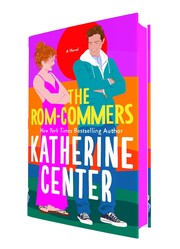
The Rom-Commers
2,356-word summary 10 min read 336 pages in the book
- First published
- 2024
- Publisher
- St. Martin's Press
- Pages
- 336
- ISBN
- 9781250283801
Reading options
What's inside (8 sections)
I came to The Rom-Commers right after reading Katherine Center's The Bodyguard, so I knew roughly what to expect: a heroine who has absorbed too much responsibility, a love interest with a hidden wound, and a tone that mixes kitchen comedy with real grief. This one is a 2024 St. Martin's Press novel, 336 pages in hardcover, and it is the most directly about writing that Center has written. I expected a light Hollywood romp. I got a book about a woman who believes she caused her mother's death and has spent years punishing herself by never wanting anything for herself.
Emma Wheeler lives in Texas and has not left her hometown in years because her father needs her. The cause was a family camping trip. A rockfall struck her father in the head, he lost control of the rope holding Emma's mother, and their mother fell to her death. Emma was the one who had wanted that trip. She was a child, but she has carried the blame as if she were an adult making a deliberate choice. Her father survived but was left partially paralyzed. Emma became his caretaker, took charge of the household, and slowly pushed her own life to the margins. Her younger sister Sylvie has just finished college, and Emma assumes that now, finally, she will have some room to breathe.
Emma's real love is screenwriting, specifically romantic comedy. She writes the scripts, enters contests, and earns praise without ever getting the kind of break that turns into a career. The book is frank about the gap between talent and opportunity. Emma's problem is that she has stopped letting herself imagine a future in which she gets to have both duty and desire.
A call from the wrong ex boyfriend
The inciting phone call comes from Logan Scott, a former boyfriend from high school who is now a successful manager in Hollywood. Logan has an odd assignment. Charlie Yates, one of the most respected screenwriters in the business, has written a romantic comedy so bad that Logan thinks the only person who can fix it is Emma. The job means six weeks in Los Angeles and a shot at working with her idol. It also means leaving her father, which feels to Emma like a betrayal.
She reads the script and knows Logan is right. The thing is a disaster, and the chance is too big to refuse. Sylvie agrees to take over caretaking duties, giving up an internship to do it, and their father insists Emma go. That push from him matters. He does not want his daughter to shrink her life down to his needs. Emma arrives in Los Angeles guilty and exhausted, and Logan immediately makes things worse. He has arranged for her to stay at Charlie's house, and before she has time to adjust, she overhears Logan and Charlie arguing. Charlie had no idea she was coming.
Logan has also handed around an old family video that includes her late mother and her father before the accident. For Emma, that tape is not a quaint piece of nostalgia. It opens a wound she keeps under tight control. Hurt and angry, she tries to leave. Charlie brings her back to his house for the night, and their first real conversation goes badly. He is blunt, arrogant, and dismissive of the compromises she has made. He says, in effect, that anyone serious about writing puts work first. Emma, who has spent years putting family first, does not know what to do with a man who says a thing like that.
Then she faints. It is exhaustion and not eating, and Charlie's response surprises her. He takes care of her with quiet competence, gets her food, and does not make a speech about it. When she recovers, he hires her for a short stint to give honest notes on the screenplay. Emma does not hold back. She tells him exactly why the script fails, and instead of shutting her down, Charlie listens. He takes notes. He asks questions. By the next morning he wants her to stay and work with him properly, and admits he has read her own writing and likes it, even while claiming to despise the genre.
A hero who does not want to be rescued
Charlie is not the man Emma imagined when she dreamed of working with him. He is famous, yes, and very good at what he does, but he has not really written in years. Cancer treatment left him blocked and afraid of failing in public. He has money and status and a house in Los Angeles, and he is profoundly stuck. His reputation has become a cage. Because he was once great, the possibility of falling short feels humiliating, so he wraps himself in cynicism about romance and acts as though nothing matters.
Center layers in his history slowly. There was a near drowning when he was a child. His mother left the family. His wife, Margaux, left him on the day he was diagnosed with cancer. Each loss reinforced the same lesson: people leave when things get hard, so it is safer to act as though you do not need anyone. Charlie's indifference is a defense, not confidence, and Emma is the first person in a long time to see it. She recognizes the pattern because she has her own. She handles fear by becoming indispensable. He handles it by becoming untouchable.
The work gives them a daily rhythm. They swim in the mornings. They write for hours. They cook dinner. There is a guinea pig named Cuthbert, shared with Margaux through a custody arrangement that keeps Charlie's old life close, and the animal's care becomes one of the small domestic details that make the house feel real. Charlie's assistant and various industry people drift through, including a rude writer named T.J. whose contempt for Emma gives Charlie a chance to defend her, and a director Emma has long admired named Donna Cole, whose attention later changes everything.
Emma never quite loses the sense of being an outsider in this world. The project is tangled up in Hollywood politics, and a lot of people around it treat the screenplay as disposable work that exists only to satisfy a contract. That makes Charlie's willingness to take her notes seriously feel like a small act of loyalty. She has spent years being the person who makes other people's plans work, and here is a famous writer actually changing his mind because of something she said. Center writes that shift quietly, through the way Charlie starts leaving his drafts open on the kitchen table for her to see, rather than through any grand declaration of faith in her talent.
Arguing about the kiss
The heart of the book is not the Hollywood machinery but the argument these two have about what makes a romance believable. They are trying to fix an unconvincing kiss scene in the script. Charlie thinks the mechanics can be solved on the page. Emma says that if he wants to write love well, he has to understand it. In the charged moment that follows, she offers to kiss him. He refuses at first because he does not want the kiss to mean nothing. Then he gives in, and it changes the temperature of everything between them.
That scene is the book in miniature. Emma believes in emotional payoff, in tenderness, in the idea that love stories tell the truth even when life is messy. Charlie believes those things are sentimental traps. Their collaboration forces both of them to test their positions. The script improves because they put real feeling into it rather than cliches, and it becomes less about a generic couple and more about two people who are afraid of being known. You can feel Center enjoying the argument. The writing scenes have a sharpness that the more mechanical plot twists do not.
Donna Cole sees what is happening before either of them will name it. She points out that Charlie looks at Emma the way a man in love looks at someone, an observation that lands because it comes from a woman with no stake in their denial. Emma has spent so long reading the needs of the people around her that she is bad at reading her own good fortune. Charlie, who has made a career out of noticing everything, seems determined to miss the one thing in the room that matters. Those interruptions from the outside world keep the writing plot from closing in on itself.
The romance arrives in fits and starts. Charlie defends Emma in public and supports her when her confidence cracks. He watches her with an intensity that other people notice before she does. Emma sees past the reputation to the fragile, generous man underneath. But mixed signals keep tripping them up. She overhears remarks that sound cruel, though they are often his way of hiding what he feels. Margaux's reappearance unsettles her, and Charlie handles it badly. After one especially warm night, Emma tells him she has feelings for him. Charlie shuts her down and says he does not want a romantic relationship. She is crushed. Because they are still under contract, they keep working together in painful silence.
The fall that reopens everything
Then the call comes from Texas. Emma's father has fallen, suffered a brain bleed, and is in emergency surgery. She flies home without saying much to Charlie. Old resentments erupt between Emma and Sylvie during the panic. Emma blames Sylvie for not protecting their father, and Sylvie throws back the buried accusation that Emma's desire for that camping trip is what killed their mother. It is a cruel thing to say, and it is believable because it comes from fear and years of unspoken blame.
The surgery goes well and their father recovers. In the quiet afterward, he tells Emma the thing she has needed to hear for more than a decade: her mother's death was not her fault. He tells her that life cannot be managed by endless vigilance, and that she has spent too long trying to outguess tragedy. This is the emotional center of the novel, and Center gives it room. It is not a tidy speech that fixes everything. Emma has lived inside that guilt so long that hearing it named out loud takes time to absorb.
Charlie comes to Texas to support her, but she is still too hurt and confused to let him in, and she sends him away. Back home, ordinary life feels false. Then Logan calls with news that does not seem possible. Donna Cole, the director Emma admires, wants to produce a screenplay called The Rom-Commers. Emma cannot imagine why until she learns what Charlie did after she left Los Angeles. He rewrote their script, turning it into a story about two screenwriters who fall in love, and he made sure Emma got proper credit and top billing. For the first time, her talent is being recognized in public.
Why Charlie let her go
The explanation for his rejection arrives in pieces. Before Emma left, Charlie had learned that his cancer had returned and spread to his lungs. Convinced he was dying, he decided to push her away rather than let her become his caretaker, because he knew what that role had done to her with her father. In a private video he never meant her to see, he says he loves her and that staying near him would only hurt her. His rejection was fear, not absence of feeling. That choice, making the decision for both of them, is the book's most arguable moment. It is meant to be noble, and it also costs Emma months of needless pain.
Emma finds him at an awards event, where he gives a speech about discovering that love is real after all. His phone rings with the medical update he has been waiting for. The earlier diagnosis was wrong. There is no metastatic cancer. He sees Emma in the audience, leaves the stage, and comes straight to her. She is angry that he lied and took the choice away from her, but relief swamps everything else. They finally stop resisting what they feel.
The ending widens the circle. Emma's father finds love again with Mrs. Otsuka and marries her. Sylvie and Salvador marry too. Emma moves to Los Angeles, keeps writing, and builds a creative and personal partnership with Charlie. Their film succeeds, and they keep choosing each other on the page and off. The last idea is that pain is unavoidable but the story you make from it is still yours to shape. It sounds tidy in summary, but after the camping guilt and the months of caretaking, it felt earned rather than pasted on.
What I would trim
The machinery is where the book strains. Logan's surprises are funny the first two times and exhausting after that, and the whole premise depends on a manager handing a stranger to a famous writer who did not agree to it. The returning cancer scare and the video confession are engineered to produce maximum ache, and the mistaken diagnosis arrives with convenient speed. Readers who want their romance plots to obey a stricter logic may find themselves checking the mechanics instead of the feelings.
I set that aside because the emotional argument is sound. Center writes a heroine whose competence is also a cage, and a hero whose detachment is a coat he puts on every morning. The scenes that matter are small: a reused family video, a guinea pig needing care, an argument about a kiss, a father telling his daughter she was never to blame. The book's best joke is that a man who claims to despise romantic comedy ends up writing one of the great ones, and its best point is that wanting a life of your own is not the same as abandoning the people you love. I closed it wanting to call my own father, which is probably the highest compliment I can give a book like this.
FAQ
Is The Rom-Commers part of a series?
No. It is a standalone contemporary romance by Katherine Center, published in 2024 by St. Martin's Press.
Who are Emma and Charlie?
Emma is a Texas screenwriter who stopped pursuing her career to care for her injured father. Charlie is a celebrated but blocked Hollywood writer who has not truly written since cancer treatment.
Does the book have a happy ending?
Yes. Emma's father recovers and later marries Mrs. Otsuka, and Emma moves to Los Angeles to write and build a life with Charlie.
Similar books
Hello Stranger
Portrait artist Sadie loses face recognition after brain surgery and must finish a contest piece while falling for two men.
2,210-word summary · 10 min read
Thank You for Listening
A former child star turned audiobook narrator takes a final romance job to help her grandmother, only to fall for the secretive voice reading opposite her.
2,148-word summary · 10 min read

Kiss the Sky
Rose Calloway signs her family up for a reality show to save her fashion line, and her old rival Connor Cobalt keeps pace.
2,178-word summary · 10 min read
Roomies
A Broadway archivist with a crush on a subway busker marries him to solve his visa problem, and finds the roommates arrangement harder to keep practical than…
2,030-word summary · 9 min read
Release Me
A guarded engineering graduate newly arrived in Los Angeles is used as bait at an art gala, then offered a million dollars to pose for a powerful man's private…
2,070-word summary · 9 min read

On the Island
A Chicago teacher and her teenage student survive a seaplane crash in the Maldives and build a life on an uninhabited island, in a romance that gets harder…
2,171-word summary · 10 min read

Beautiful Oblivion
Cami tends bar and keeps her long distance boyfriend a secret, until a night at the Red Door puts Trenton Maddox in her way.
2,322-word summary · 10 min read
The Next Always
A widowed architect restores an old hotel in Boonsboro and falls again for the bookseller across the street, in a warm small-town romance.
2,242-word summary · 10 min read
Say You'll Remember Me
A vet who writes off a sick kitten falls for the woman who saves it, then follows her into the hard, funny work of caring for a mother with dementia.
2,293-word summary · 10 min read

Great Big Beautiful Life
Two rival journalists chase the biography of a reclusive media heiress on a Georgia island, only to find her family history holds a secret bigger than either…
2,394-word summary · 11 min read
Alone With You in the Ether
Two people in Chicago agree to six conversations, and the experiment becomes a love affair that is also a study of bipolar disorder, obsession, and the shape…
2,713-word summary · 12 min read
One to Watch
A plus-size fashion blogger takes the lead role on a reality dating show to prove she belongs on television, and finds she might want what the cameras offer.
2,478-word summary · 11 min read
Marriage for One
Rose marries a cold lawyer to save her coffee shop, then discovers the arrangement was never only business.
2,032-word summary · 9 min read
The Exception to the Rule
A typoed Valentine's email turns into yearly notes between two strangers who wonder if they should meet.
2,226-word summary · 10 min read
The Coincidence of Callie & Kayden
Callie saved Kayden in an alley and meets him again in college, where both must face assault and abuse to learn trust.
2,578-word summary · 11 min read
Love Redesigned
Rival designers Dahlia and Julian restore a Lake Wisteria Victorian while facing grief, family pressure, and old sparks.
2,248-word summary · 10 min read
The Marriage Plot
At Brown in 1982, Madeleine loves Austen while torn between brilliant Leonard and steady Mitchell.
2,804-word summary · 12 min read
Where Rainbows End
Told in letters and emails, Rosie Dunne and Alex Stewart grow from Dublin childhood to midlife, missing chances at love while raising Katie.
1,943-word summary · 9 min read
Before We Were Strangers
Matt waits fifteen years to ask Grace why she left after one college night that shaped them both.
2,386-word summary · 11 min read
November 9
Fallon and Ben meet every November 9 for five years with no contact between, until his novel reveals the fire that scarred her.
2,547-word summary · 11 min read
Ugly Love
Colleen Hoover's Ugly Love retold: Tate and Miles, the rules, the past with Rachel, and the lake letter.
2,339-word summary · 10 min read
Beach Read
Two rival writers share a summer next door, trading genres to beat block and grief.
2,301-word summary · 10 min read
It Ends with Us
It Ends with Us from Lily's flower shop to her marriage: alternating past and present, Ryle's cycles of violence, and why the ending refuses a clean romantic…
2,381-word summary · 11 min read
How to Walk Away
Margaret Jacobsen has the job, the fiance, and the future mapped out, until a small-plane crash on Valentine's Day takes almost all of it in one afternoon.
2,012-word summary · 9 min read
Things You Save in a Fire
A Texas firefighter takes a job at an old Boston-area firehouse and moves in with her estranged mother while facing hazing, old trauma, and love.
2,967-word summary · 13 min read
The Bodyguard
Hannah Brooks, an executive protection agent grieving her mother, poses as movie star Jack Stapleton's girlfriend on his Texas family ranch.
3,962-word summary · 18 min read
The Distance Between Us
Seventeen-year-old Caymen Meyers distrusts rich people, then a wealthy boy keeps proving her wrong while her mother's doll shop struggles to survive.
2,231-word summary · 10 min read
Reckless
Kiera and Kellan marry in secret as the D-Bags explode onto the charts, then fight to keep their private life from becoming the band's best publicity.
2,231-word summary · 10 min read
Our Souls at Night
A widow asks her widower neighbor to lie beside her at night, not for sex but for company, and two lonely people in a small Colorado town begin again.
2,582-word summary · 11 min read