
Reading options
What's inside (9 sections)
- A prologue about John Kennedy Jr.
- A lumberyard in Dayton, and an audience in Ohio
- Malibu, the Penn brothers, and the Lost Boys
- Coppola, The Outsiders, and the Brat Pack label
- The tape, the fall, and a mirror in the bathroom
- Sheryl, sobriety, and a second career
- What remains after the Oval Office
- Key takeaways
- FAQ
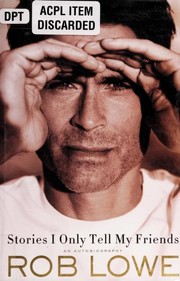
I picked up this memoir because of a photograph. The cover shows Rob Lowe looking exactly as you expect him to look, and the title promises secrets shared only with friends. I expected a glossy Hollywood confession, the kind that spends two hundred pages arranging its own scandals into a tidy arc. What I found was funnier and stranger than that, a book that keeps returning to one awkward question: what does it mean to be treated as an object from the age of fifteen, and how does a person come back from it?
The full title is Stories I Only Tell My Friends: An Autobiography, and Henry Holt published it in April 2011. It runs to about 320 pages in the first hardcover edition. That subtitle matters, because Lowe is not writing a novel or a tell-all in the usual sense. He is writing a life, and he has chosen to make the telling itself part of the story.
A prologue about John Kennedy Jr.
The book does not begin with childhood. It opens with John Kennedy Jr., which threw me at first. Lowe recalls meeting him at a political event when he was twenty-four, and the two of them bonding over something they had in common: both were young men living under a scrutiny they had not chosen. Years later, at a holiday party in Sun Valley, Idaho, Kennedy asked Lowe how he had managed to settle down with his wife, Sheryl. Lowe told him to marry Carolyn, the woman he was seeing.
In June 1999, Kennedy watched a pilot of The West Wing and decided he wanted Lowe on the cover of his magazine, George. Weeks later Kennedy died in a plane crash with Carolyn and her sister Lauren. The editors went ahead with the cover shoot anyway, on the show's Oval Office set, honoring his last editorial decision. Lowe uses that moment as a threshold. One life had ended, and his own second act was about to start.
It is a bold way to open a memoir, and it took me a while to see why it works. Everything that follows is shaped by the idea of public attention as a force that lands on a person and rearranges the furniture. Kennedy understood it. Lowe would spend the next thirty pages showing what it felt like from the inside.
A lumberyard in Dayton, and an audience in Ohio
Lowe's earliest memories are of Dayton, Ohio. His father, Chuck, was a combative, pragmatic man from Indiana who had studied law at the University of Virginia. His mother was a bookish English major from a small Ohio town. The marriage came apart through infidelity and long stretches of conflict, and when Lowe was five he asked his mother in a lumberyard whether his father was ever coming home. She told him they were getting a divorce.
He writes about that scene without much ornament, and the plainness makes it land. He describes a child learning to shut down, to avoid conflict, to stop expecting the adults in his life to stay. Acting arrived as an escape. After seeing a local production of Oliver!, he was gripped by the connection between the people on stage and the people watching them, and he started performing in community theater.
His mother remarried a politically minded man named Bill, and the family moved to a rough part of North Dayton. That marriage failed too. In 1976 she moved the family to Malibu, California, accompanied by Dr. Steve Wilson, a boyfriend from a Chicago allergy hospital where she had been treated for problems no one could quite name. If this sounds like the setup for a darker book, that is because it is. Lowe keeps the tone light even when the underlying material is not.
Malibu, the Penn brothers, and the Lost Boys
Malibu in the late seventies was a place with its own rigid social order, enforced by surfers and athletes who decided who belonged. Lowe did not belong at first. He found his people in the neighborhood kids who made amateur 8mm movies, among them Chris and Sean Penn, Charlie Sheen and Emilio Estevez. The Penn brothers, in particular, become recurring figures in the book, and their friendship gives the early chapters a warmth that the acting story alone would not have.
There is a grim thread running through these pages. A popular surfer named Peter disappeared after a night of drugs and swimming, and was never found. Lowe describes him as the first of what he calls the Lost Boys of Malibu, a string of young deaths that hung over that stretch of coast. I appreciated that he did not turn this into a lesson. It sits in the book as a fact, uneasy and unresolved, which is more honest than a tidy moral would have been.
He got an agent, took long bus rides to Hollywood auditions, and landed a Coca-Cola Super Bowl commercial and a blender spot. At fifteen he won a role on the ABC series A New Kind of Family, acting opposite Eileen Brennan. The show lasted thirteen episodes, but it gave him his first taste of screaming fans and the strange sensation of being handled as a thing rather than a person. That idea comes back again and again, and it is the book's real subject.
Coppola, The Outsiders, and the Brat Pack label
By the time he was back at Santa Monica High School, Lowe had been rejected for a run of major film roles. He applied to UCLA and USC and prepared to give up acting for film school. Then, just after Christmas in 1982, his agents called with one last reading, for Francis Ford Coppola's adaptation of S. E. Hinton's The Outsiders.
The audition is one of the best scenes in the book. Roughly twenty-five young actors, among them Dennis Quaid, Scott Baio, Tom Cruise and Tommy Howell, auditioned at the same time on a soundstage while Coppola played Italian opera. Lowe panicked, dropped his script and performed from memory, pulling on his own experience of family loss. More screen tests followed in New York against Matt Dillon and Ralph Macchio, and he was cast as Sodapop Curtis.
The shoot in Tulsa was a strange boot camp. Coppola put the cast through two weeks of tai chi, gymnastics, nights with former local greasers and a game of tackle football on concrete. Patrick Swayze turned up as the eldest Curtis brother, a decade older than the rest and physically imposing. Days ran fourteen hours, with a minimum of twelve takes per scene. For Sodapop's breakdown, Coppola filmed all the wide shots first to drain Lowe's emotions before announcing he needed close-ups. Tommy Howell stepped in with an improvised monologue about the two brothers and their shared history, and Lowe says it replenished him just in time. Then he saw the finished film and found that nearly all of his scenes had been cut. The picture still launched the whole cast.
Work came quickly after that. Tony Richardson cast him opposite Jodie Foster and Nastassja Kinski in The Hotel New Hampshire. Class put him with Andrew McCarthy. He played the saxophone player Billy Hicks in St. Elmo's Fire, whose poster ended up on dorm room walls everywhere, and then took About Last Night, adapted from a David Mamet play, which he calls his best work of that decade. A New York magazine reporter invited to dinner by Emilio Estevez coined the term Brat Pack in a cover story that branded a whole generation of actors as spoiled and empty. The label stuck anyway, and fans mostly embraced it.
The tape, the fall, and a mirror in the bathroom
This is the part readers come for, and Lowe does not dodge it, though he does frame it carefully. By his midtwenties he was at the top of 1980s stardom and unhappy. A brief romance with Princess Stephanie of Monaco ended badly after his security advisor, Glenn Souham, was assassinated outside his Paris home. A film with Peter Bogdanovich, Illegally Yours, was judged unreleasable. At the 1988 Democratic National Convention in Atlanta, where he was campaigning for Michael Dukakis, a videotape involving two women, one of them sixteen, became a national story. A widely mocked turn singing with Snow White at the 1989 Academy Awards did not help.
Lowe's account of the tape is candid about the facts and guarded about the meaning. He places it in the context of a decade of excess and of a young man who had been handed fame before he had any idea what to do with it. He even calls it a first world problem. Some readers will find that convincing. I found it partly convincing and partly a convenient piece of packaging, the kind of explanation that arrives after all the damage is done and smooths the edges. Other people in that story might tell it differently, and a memoir gives us only one version.
The turn comes in May 1990. After a night of drinking, his mother called to say his grandfather had suffered a heart attack. Lowe stood beside the answering machine and chose not to pick up, deciding he would finish the tequila, sleep it off and call in the morning. In the bathroom he caught his reflection and decided it was over. He called a drug and alcohol counselor the next day, went to an old-school rehab in Arizona rather than a Malibu spa, and discovered that he had been using alcohol to quiet a discomfort he had carried for years.
Sheryl, sobriety, and a second career
Sheryl Berkoff, a makeup artist he had known and reconnected with on the film Bad Influence, visited him in rehab every week despite a long commute from a Seattle set. He proposed to her on Mulholland Drive in June 1991, and she named a wedding date only a month away. They married in a secret ceremony with about thirty guests who thought they were attending a charity lunch. Their sons, Matthew and Johnowen, arrived later, and the family moved to Santa Barbara in search of a quieter life.
The work got stranger and better. Wayne's World, produced by Lorne Michaels and starring Mike Myers, was a huge hit. Tommy Boy paired him with Chris Farley, and the two bonded over the odd business of being turned into a public character. Farley died of a drug overdose at thirty-three, one more name on the list Lowe had been collecting since Malibu.
Then his agent Tiffany Kuzon sent him the pilot for The West Wing, written by Aaron Sorkin. Lowe felt an immediate connection to Sam Seaborn, the White House deputy communications director, whom he saw as a better version of himself shaped by years of political interest. He read for Sorkin directly, delivered Sam's signature speech from memory and took a pay cut of fifty percent to get the part. The show became a phenomenon, winning more Emmys in its first year than any series before it.
It also became a source of friction. Costars negotiated raises that left him out, and his request for a comparable increase was refused. Drawing on the clarity he says sobriety gave him, he left after four seasons and roughly eighty episodes. It is hard not to read that decision as the payoff the whole book has been building toward: the boy who learned to shut down in a lumberyard finally says no.
What remains after the Oval Office
The closing chapters move quickly, and this is where the memoir starts to feel like a highlight reel. Lowe reveals that he was booked on American Airlines Flight 77 out of Dulles on August 31, 2001, eleven days before that same flight was flown into the Pentagon. He starred in three television series at once, and with his friend Tom Barrack he describes buying Miramax from Disney. His mother died of breast cancer at sixty-four, and his manager Bernie Brillstein died in 2007. On a flight home to Los Angeles he thinks about his marriage, his sons and the strange good luck of a life built out of dreams.
That sprint of famous names and near misses is the book's main weakness. The early chapters take their time and let scenes breathe, but the later ones often reduce complicated years to a paragraph and a punchline. The scandals get the same brisk treatment as the triumphs, which keeps the tone even but flattens the stakes. A memoir told only by its author will always have this problem. Lowe is funny and self-aware enough to get away with more than most, but the tidiness is sometimes doing work that a harder look would have done better.
Still, I closed it glad I had read it. The book is at its best when Lowe stays with the small, physical details: a nurse asking for an autograph at his grandmother's deathbed, a grandmother chasing off drunk teenagers who wanted to know whether Handsome was home, a soundstage in Tulsa with opera playing and a script on the floor. Those moments are specific and unguarded in a way the summary passages are not. The title promises stories told only to friends, and on the strength of those scenes, the promise feels earned.
FAQ
Is Stories I Only Tell My Friends a novel?
No. It is Rob Lowe's autobiography, first published by Henry Holt and Company in 2011. He tells it in his own voice with a self-deprecating, often comic tone.
Does the book discuss the 1988 sex tape scandal?
Yes. Lowe writes about the incident at the Democratic National Convention in Atlanta and the damage it did to his career. He frames it as a product of 1980s excess and of being young and famous, which some readers may find too forgiving.
What does the memoir say about The West Wing?
Lowe describes taking a fifty percent pay cut to play Sam Seaborn, the show's Emmy success, and leaving after four seasons when costars won raises and his own request was refused.
Similar books
The Princess Diarist
Built from diaries Fisher kept at nineteen while filming the first Star Wars movie, this 2016 memoir revisits her affair with Harrison Ford and the strange…
2,360-word summary · 10 min read
Scrappy Little Nobody
Anna Kendrick's essays trace her path from a Portland childhood and Broadway to Hollywood, with jokes, anxiety, and a refusal to pretend fame fixed her.
2,092-word summary · 9 min read
Born Standing Up: A Comic's Life
Steve Martin's memoir of how a shy Disneyland magician's assistant built a strange avant-garde act, and why he walked away from stand-up at his peak.
2,034-word summary · 9 min read
Beyond the Wand: The Magic and Mayhem of Growing Up a Wizard
Tom Felton looks back on ten years as Draco Malfoy, from schoolboy auditions to fame, music, and getting sober.
2,267-word summary · 10 min read
Friends, Lovers, and the Big Terrible Thing
Matthew Perry revisits Friends fame and a long struggle with addiction, from junior tennis to Chandler Bing to a 2018 health crisis, with blunt humor.
2,258-word summary · 10 min read
Wishful Drinking
Carrie Fisher's 2008 memoir, drawn from her one-woman show, tells her story with sardonic jokes about Hollywood parents, Princess Leia, bipolar disorder, and…
2,341-word summary · 10 min read
84, Charing Cross Road
Over twenty years, letters between a cash-strapped New York writer and a London bookseller grow into a warm, funny friendship built on rare books and food…
2,343-word summary · 10 min read
Scar Tissue
Kiedis's memoir follows the Red Hot Chili Peppers from Hollywood house parties to fame, heroin, and the long work of staying clean.
2,217-word summary · 10 min read
Dry
A memoir of drinking, rehab and relapse, and the strange business of getting sober one morning at a time.
2,643-word summary · 12 min read
Seriously...I'm Kidding
DeGeneres strings show stories and home jokes into light life advice.
2,292-word summary · 10 min read
Open Book
Simpson replays pop fame, love and drink through recovery work.
2,552-word summary · 11 min read
My Horizontal Life: A Collection of One-Night Stands
Handler turns dating disasters and family chaos into brash comic essays about single life in Los Angeles.
2,304-word summary · 10 min read
Open
Tennis star Andre Agassi recalls hating tennis, falling to No. 141, and rebuilding his life on his own terms.
2,352-word summary · 10 min read
Talking as Fast as I Can: From Gilmore Girls to Gilmore Girls
Lauren Graham looks back on broke actress years, Parenthood, and playing Lorelai Gilmore twice in this funny 2016 memoir.
2,701-word summary · 12 min read
Finding Me
Viola Davis traces her path from poverty in Rhode Island to Oscar night with blunt honesty about race and family.
2,823-word summary · 13 min read
Are You There, Vodka? It's Me, Chelsea
Handler mines family, jail, dating, and travel for brash essays where oversharing is both joke and shield.
2,186-word summary · 10 min read
Why Not Me?
Essays on work, dating, and body image from the Office writer learning to ask for bigger rooms.
2,000-word summary · 9 min read
This Is Going to Hurt
Adam Kay retells his junior doctor diaries with humour and strain, from labour ward nights to leaving medicine.
2,869-word summary · 13 min read
Everything I Know About Love
Dolly Alderton recalls bad dates flatshares and female friendship in her twenties memoir.
2,194-word summary · 10 min read
The Long Haul
Greg Heffley's summer road trip goes sideways with a towed boat, a live pig, and a family in a purple van.
2,311-word summary · 10 min read
I Feel Bad About My Neck: and Other Thoughts on Being a Woman
In short, funny essays written just after her sixty-fifth birthday, Nora Ephron takes on aging, vanity, a White House summer, and the daily upkeep of looking…
2,099-word summary · 9 min read
Dad Is Fat
A comic essay collection about raising five kids in a two-bedroom New York apartment, delivered in Gaffigan's dry, deadpan voice.
2,196-word summary · 10 min read
A Year in Provence
Peter Mayle's first year in a Luberon farmhouse, told through mistral winds, difficult builders, long lunches and local rules nobody warned him about.
2,209-word summary · 10 min read
When Life Gives You Lululemons
Emily Charlton leaves Runway for Hollywood and ends up in Greenwich, where a supermodel's DUI and a senator husband's ambitions draw three women into a…
2,028-word summary · 9 min read
What Is the What: The Autobiography of Valentino Achak Deng
Dave Eggers retells the life of Valentino Achak Deng, a Lost Boy of Sudan, in the refugee's own voice, from a burned village to a robbery in Atlanta.
2,840-word summary · 13 min read
The Vacationers
A New York family's two-week stay in Mallorca turns into a comedy of exposed secrets when a magazine editor's affair and a son's debts come to light.
2,324-word summary · 10 min read
The Rachel Incident
A funny, sharp novel about two twenty-somethings in recession-era Cork whose bookshop friendship, tangled romance and a married professor's lie leave a secret…
2,346-word summary · 10 min read
The Impossible Fortune
Osman gathers the Coopers Chase pensioners for a fifth mystery that opens on a quiet year, a wedding, a vanishing guest and a code worth a fortune in Bitcoin.
2,685-word summary · 12 min read
The Emperor of Gladness
Ocean Vuong's second novel follows a young addict pulled back from a bridge in a dying Connecticut mill town and into the home of an elderly immigrant woman…
2,693-word summary · 12 min read
Taste: My Life Through Food
Stanley Tucci's memoir traces his life through food, from a Calabrian family kitchen in Katonah to film sets, marriage and a cancer fight that cost him his…
2,503-word summary · 11 min read