
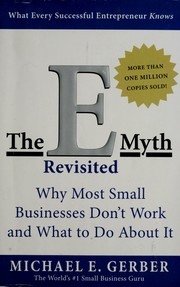
The E-Myth Revisited
2,169-word summary 10 min read 268 pages in the book
- First published
- 1995
- Publisher
- HarperBusiness
- Pages
- 268
- ISBN
- 9780887307287
Reading options
What's inside (9 sections)
A friend of mine opened a bakery three years ago. She is a genuinely excellent baker, the kind of person whose croissants make people stop mid sentence. Last winter I asked her how business was going and she said, "I haven't had a Saturday off since we opened." She said it cheerfully, the way people do when they are too tired to be honest. That sentence is basically the subject of this book. Michael Gerber would hear it and know exactly what happened to her, and he would say the problem is not that she works too hard. The problem is that she built a job and called it a company, and she is now the least replaceable employee in it.
The E-Myth Revisited came out in 1995, a reworking of Gerber's 1986 book, and it has been sitting on small business shelves ever since. It is not a complicated argument. It is more like a diagnosis delivered repeatedly, with a story attached, until it lands.
The seizure
Gerber's starting observation is that most small businesses are not started by people who know how to build a business. They are started by people who are good at a craft. A baker opens a bakery. A programmer starts a software shop. A mechanic opens a garage. The technical skill is real, and it is usually the reason the person believes they will succeed.
He calls the moment of leaving employment to open your own place the "entrepreneurial seizure." The word is deliberately medical. It is not a considered decision so much as a fit, a sudden conviction that you could do this better on your own, that your boss is an idiot, that the market is waiting. Gerber does not sneer at the feeling. He thinks it is necessary fuel. He thinks it is also blind, and that the blindness has a predictable cost.
The cost has a name, and it is the E-Myth itself: the fatal assumption that understanding the technical work of a business means understanding a business that does the technical work. These are different pieces of knowledge and they do not transfer. A great baker knows flour, fermentation, and ovens. Running a bakery means knowing hiring, cash flow, pricing, scheduling, supplier terms, and what to do when the oven dies on a Friday. The craft tells you nothing about any of that. If anything, the craft is a distraction, because it is the part that feels good.
This is the hinge of the entire book. Everything after it is consequence.
Three people in one head
Gerber then puts three personalities inside the owner, and the book is worth reading for this alone if you have ever wondered why your own week keeps going sideways.
The Entrepreneur lives in the future. This is the part that dreams, sees possibilities, wants change, and gets bored fast. The Manager lives in the present and wants order, systems, predictability, and a clean schedule. The Technician lives in the work itself, hates interruption, wants to be left alone with the craft, and judges every day by how much actual production got done.
In a healthy business all three get airtime. In most small businesses the Technician wins, because the Technician is the one with the skill that got the business started, and because doing the work is more immediately satisfying than designing the system that would let someone else do the work. So the owner drifts back to the bench. The owner answers the phone, bakes the bread, writes the code, takes the appointment. The Manager never gets a turn. The Entrepreneur gets a few minutes at midnight and then goes quiet.
The result is a business that cannot run without its owner, staffed by people who were never really given a way to do things, and an owner who is bewildered that working fourteen hours a day does not produce freedom. Gerber's line is that the owner ends up with a job instead of a business. It is a job with worse hours and more risk, and you cannot quit it, because you are the boss.
There is a second cost he draws out, and it is the part most owners do not expect. Staff get hired into a business with no defined way of doing anything, so they either invent their own method or wait to be told, and the owner reads both as incompetence. The owner concludes that nobody cares like they do, which is true, because nobody was given a reason to care and no standard to meet. Then the owner stops delegating, takes the work back, and the loop tightens. Gerber's claim is that this is not a people problem. It is a design problem wearing a people costume.
Sarah and the pie shop
To make this concrete he gives us Sarah, who runs a small pie shop called All About Pies. Sarah is a superb baker. She opened the shop because she loved baking and because she was tired of working for other people. She now works fourteen hour days, does the baking herself, does the books at night, cannot take a day off, and has gradually stopped enjoying pies. The business owns her.
Gerber is upfront that Sarah is a composite and that the conversations in the book are invented to carry the argument. That honesty helps, because the dialogue is the weakest writing in the book. Sarah keeps saying things like "I don't understand" so that Gerber can explain, and the exchanges have the quality of a training video. But the shape of her situation is recognizable, and the specifics are the useful part: she cannot leave, she cannot grow, and every improvement she imagines requires her to personally do more.
The turn comes when he asks her to stop thinking about the shop as a place where she bakes pies and start thinking about it as a product she is building. Not a job. A prototype. Something whose whole purpose is to be reproduced, taught, and eventually run by other people following a defined way of doing things. Once Sarah sees the shop as a machine she is designing rather than a task she is performing, the questions change. What are the steps? Who could do them? What would a new employee need to know on day one? What does a bad Tuesday look like, and what is the procedure for it?
McDonald's, and what Gerber takes from it
The model for that machine is franchising, and the exemplar is McDonald's. Gerber's point is not that you should franchise. His point is that Ray Kroc did not invent the hamburger. Somebody else had already done that. What Kroc built was a system that could be taught, measured, and repeated by ordinary people in thousands of locations, so that a teenager in Ohio could produce the same product as a teenager in Florida.
That is the ambition. Gerber's phrase is that the system runs the business and people run the system. It sounds cold until you notice what it buys you: consistency for the customer, predictability for the owner, and a real job with real training for the staff rather than a series of improvisations. A business that depends on the owner's talent is a business that disappears when the owner gets sick.
The business development process he lays out has three stages, and they repeat forever. Innovation is finding a better way to do something. Quantification is measuring whether the better way actually works, in numbers rather than vibes. Orchestration is making it the standard, writing it down, training it, and then going back to innovate again. The goal is a turn-key operation, one that can be handed to someone else and run.
The planning work
Only after all that does Gerber get to the business plan, and he builds it from the top down.
First is the primary aim, which is about your life rather than the business. What do you actually want your days to look like, how much money do you need, what do you want to be doing in ten years? This is the step most owners skip, and skipping it is why they end up with a business shaped by accident. Then comes the strategic objective, a specific statement of what the business is for: what it does, for whom, at what size, by when.
From there the plan narrows into organizational strategy, then management, then people, then marketing. Gerber treats the plan as a living document that gets revised as the prototype is tested. It is not a binder you build once to satisfy a lender and then shelve. The plan is the current best guess about the machine, and the machine keeps changing.
He is also insistent that your personal life belongs inside the design. If you want to coach your kid's team on Wednesdays, that is a design constraint, not a hobby. The business exists to serve the life you want. An owner who cannot leave the shop has built a prison with a sign on the door, and no revenue figure makes that a success.
The people strategy gets the least space and deserves more. Gerber's position is that you hire for fit with the system, not for the brilliance you hope will rescue it, and that a clear role with clear standards is kinder to an employee than vague freedom. The marketing strategy rests on the same logic: know exactly who you serve, what they want, and how you will be found, and then do that consistently rather than chasing whatever worked last month. None of this is exotic. What makes it unusual is that most owners never write any of it down.
Where the book is weak
The honest problems start with the writing. This is a long book making a short argument, and it makes it several times. Sarah's story is stretched across the middle third, the dialogue is stiff, and by the fourth restatement of the three personalities you can feel the page count being met. A good editor could have cut it to eighty pages without losing a single idea.
The McDonald's example is also doing more work than it can bear. Gerber uses it as proof that systems beat talent, but McDonald's is also a real estate company with enormous brand power and decades of accumulated capital, and much of what made franchising work for them does not transfer to a person running a two person cleaning service. The example is selective.
More seriously, the model assumes things many small businesses do not have: enough margin to pay for systemization, enough demand to justify scaling, and enough time to build the prototype while also keeping the lights on. For a solo consultant or a single chair hair salon, the advice can be aspirational in a way that quietly becomes another form of overwork. Gerber also has almost nothing to say about failure, competition, capital, or plain bad luck, and those are not small omissions in a book about small business.
The case study method has a limitation too. Because Sarah is invented and her turnaround is narrated rather than observed, we never see the version where the changes do not work. We never meet an owner who systemized carefully and still lost the lease, or one whose market shifted while the prototype was being tested. Gerber's argument is protected by the fact that his only detailed example is designed to prove it. That does not make him wrong, but it means the book is a persuasive essay in story form, not evidence.
There is a subtler trap too. "Turn-key" can become its own fantasy, a reason to keep grinding now because someday the machine will run itself. Some owners spend years building systems for a business that never gets big enough to need them, and the promise functions as permission to keep working.
What stays with you
The parts that hold up are the parts you can use on a Monday morning. The distinction between working in the business and working on it is genuinely clarifying, and it survives the book's padding. The three personalities are a decent diagnostic: when you feel scattered, ask which one is driving, and whether the other two have been starved. And the central reframing, that a business is a product you design rather than a burden you carry, changes what you notice when you walk into your own shop.
My baker friend would probably resist the franchise framing. She might be right to. Not every good bakery needs to become a chain, and the pleasure of a small place is partly that it is small. But she would recognize the trap immediately, and the question the book leaves her with is the right one, which is not how to work harder but what she would have to build so that someone else could open the shop on a Saturday.
FAQ
What does Gerber mean by the E-Myth?
It is the mistaken belief that understanding the technical work of a business means understanding the business itself. A great baker, in his example, does not automatically know how to run a bakery.
Does The E-Myth Revisited tell you to franchise your business?
No. Gerber uses franchising and McDonald's as a model for thinking, not as a recommendation. The point is to build a system that can be taught and repeated, whether or not you ever sell franchises.
Is the Sarah story a real case study?
No. Gerber presents Sarah as a composite, and the dialogue is invented to illustrate his argument. It reads as a teaching device rather than documented evidence.
Similar books
The Hard Thing About Hard Things
A founder and CEO writes about the parts of running a company that no framework can fix, from layoffs and demotions to the loneliness of the job.
2,161-word summary · 10 min read
Rework
Two Basecamp founders argue for smaller, faster business: skip big plans, cut meetings, ship half a product.
2,948-word summary · 13 min read
The Lean Startup
Ries lays out Build-Measure-Learn, MVPs, pivots and validated learning for building companies under extreme uncertainty.
2,581-word summary · 11 min read
Creativity, Inc.: Overcoming the Unseen Forces That Stand in the Way of True Inspiration
Pixar's president on why the studio that made Toy Story nearly broke itself, and the daily habits that kept the creativity coming.
2,179-word summary · 10 min read
Essentialism
McKeown argues for less but better: discern the vital few, refuse the trivial many, and use buffers, small wins, and steady routines so key work gets done well…
2,421-word summary · 11 min read
The Five Dysfunctions of a Team
New CEO Kathryn unites warring execs through trust, conflict, and care.
2,029-word summary · 9 min read
The One Minute Manager
A young seeker learns three one minute habits from a plainspoken boss: clear goals, quick praise, and fast fair correction.
2,997-word summary · 13 min read

Getting Things Done: The Art of Stress-Free Productivity
Capture all, clarify next moves, sort by context, review weekly, and engage calmly like water.
2,030-word summary · 9 min read
Good to Great: Why Some Companies Make the Leap... and Others Don't
A five-year study of 11 companies that leapt ahead shows Level 5 leaders, right people, hedgehog focus and flywheel momentum explain lasting gains.
2,374-word summary · 11 min read
The 4-Hour Workweek
Ferriss's 2007 manual for escaping the nine to five: define the dream, cut fake work, automate a small income, and travel now.
2,986-word summary · 13 min read
Zero to One: Notes on Startups, or How to Build the Future
Thiel argues monopolies create value through vertical progress, not by copying competition.
2,582-word summary · 11 min read
Deep Work: Rules for Focused Success in a Distracted World
Cal Newport's Deep Work in full: what focused work actually is, why shallow busyness wins by default, and the four philosophies he recommends for protecting…
2,138-word summary · 10 min read

The Total Money Makeover: A Proven Plan for Financial Fitness
Dave Ramsey lays out seven Baby Steps, from a $1,000 starter fund to a paid-off house, with the debt snowball at the center.
2,663-word summary · 12 min read

Made to Stick: Why Some Ideas Survive and Others Die
The Heath brothers break down why some ideas vanish on contact while others lodge in memory, tracing six traits that make a message stick.
2,527-word summary · 11 min read
The Magic of Thinking Big
Schwartz's 1959 self-help classic argues that success follows from the size of your thinking, supported by sales anecdotes, vocabulary drills and goal setting.
2,579-word summary · 11 min read

The Magnolia Story
How Chip and Joanna Gaines met, closed their first shop, nearly lost everything in a housing development, and built Fixer Upper.
2,994-word summary · 13 min read

The World Is Flat: A Brief History of the Twenty-first Century
Thomas L. Friedman's 2005 bestseller argues that technology, trade, and open borders leveled the global playing field, and it names the ten forces that did it.
2,369-word summary · 11 min read
How to Stop Worrying and Start Living
Carnegie offers day-tight routines for worry built from interviews and worker stories.
2,505-word summary · 11 min read
Dare to Lead
Research on courage shows how leaders build trust through vulnerability and clear values.
2,442-word summary · 11 min read
Think Again
Adam Grant argues for holding views loosely and testing them like a scientist, moving past preacher, prosecutor, and politician habits at work and in debate.
3,204-word summary · 14 min read
The Black Swan
Taleb argues rare shocks shape history more than models admit, and urges safer exposure over prediction.
2,588-word summary · 12 min read
Empire of Pain: The Secret History of the Sackler Dynasty
How the Sackler family sold OxyContin and shaped an overdose crisis while giving to museums.
2,048-word summary · 9 min read
The Millionaire Next Door
Stanley and Danko survey wealthy Americans and find frugal savers living next door, not big spenders, in this 1996 money study.
2,466-word summary · 11 min read
Drive: The Surprising Truth About What Motivates Us
Pink argues fair pay plus autonomy, mastery, and purpose at work beat carrots and sticks, using FedEx days, ROWE, flow, and clear Goldilocks tasks to explain…
2,339-word summary · 10 min read
SuperFreakonomics: Global Cooling, Patriotic Prostitutes And Why Suicide Bombers Should Buy Life Insurance
Levitt and Dubner apply incentives to prostitutes, suicide bombers, doctors, and climate fixes with cheeky data.
2,007-word summary · 9 min read

Predictably Irrational
Behavioral economist Dan Ariely shows why we overpay, procrastinate, and misjudge through simple experiments.
2,183-word summary · 10 min read
Emotional Intelligence
Goleman argues self awareness and empathy shape success more than IQ alone.
2,026-word summary · 9 min read

Moneyball
Oakland buys walks and patience to win 103 games on a small payroll in Lewis's 2003 baseball story.
2,955-word summary · 13 min read
The Big Short: Inside the Doomsday Machine
Outsiders who read the bonds shorted subprime and watched the machine eat itself in 2008.
2,194-word summary · 10 min read
Influence: The Psychology of Persuasion
Six levers plus unity explain why people say yes, learned undercover in salesrooms and labs.
2,030-word summary · 9 min read