
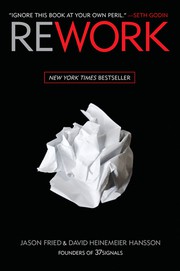
Rework
2,948-word summary 13 min read 288 pages in the book
- First published
- 2010
- Publisher
- Crown Business
- Pages
- 288
- ISBN
- 9780307463746
Reading options
What's inside (8 sections)
I grabbed Rework on a Saturday because a friend left it on my kitchen table and said, you will finish this before dinner. He was right. The edition I read is the Crown Business hardcover from 2010, listed at 288 pages, ISBN 9780307463746. It is built like a brick, short and wide, with drawings by Mike Rohde in the margins. Most spreads hold one idea and then stop. I read it in two sittings with coffee going cold, and I kept arguing out loud.
The authors run Basecamp, which at the time was still called 37signals, a small Chicago software company. Jason Fried is the cofounder and president. David Heinemeier Hansson is his partner and the programmer who created Ruby on Rails. They had already passed around a free PDF called Getting Real about building web apps with tiny teams. Rework grew out of their blog, Signal vs. Noise, where they had spent years poking at Silicon Valley habits. Later they would write Remote about working from anywhere. But this book is the loud one, the one that made the New York Times bestseller list by telling almost everyone in business they were doing it backwards.
That attitude is the whole appeal and also the thing that wears on you. Fried and Hansson write like two guys at the next table who overheard your startup pitch and could not stay quiet. Sometimes they are exactly right. Sometimes they sound like winners explaining how winning is simple.
A pamphlet that punches above its weight
Forget the usual business book shape. There is no three part framework here, no hero story stretched over three hundred pages. Rework is a stack of very short essays grouped under loose headings. Takedowns. Go. Progress. Productivity. Competitors. Damage Control. Culture. You can open anywhere.
The design matters. Big type. Lots of white space. A cartoon of a meeting room with everyone asleep. That brevity is a sales pitch in itself. The authors keep saying that good ideas should fit on a page, and then they prove it fifty times in a row.
Their starting point is personal. They built Basecamp, Highrise, Backpack and Campfire with a handful of people, no outside investors, no San Francisco office, no twelve hour days as a badge. Basecamp itself began as an internal tool because they needed a simpler way to manage client projects. Customers started asking to use it. So they started charging. That origin story shows up everywhere in the book. Scratch your own itch, they say. Build what you need, then sell the extra.
I found that refreshing after a run of books that treat founding a company like applying to college. You know the script. Write the plan. Find mentors. Raise a round. Hire fast. Here the advice flips. Do not write the plan. Do not raise the round. Do not hire. Start making something this afternoon.
My friend who lent me the book runs a bakery. She loved that part. She said most business advice assumes you want forty locations. She wants two good ones where the staff stays. Rework is one of the few books that treats her goal as sane rather than small minded.
Still, the size cuts both ways. At 288 pages with illustrations and wide margins, the actual reading time is closer to a long magazine issue. Some essays are three paragraphs. You get spark after spark, but you do not get much follow through. If you want cash flow statements or hiring contracts, look elsewhere. This is a book of opinions, and it admits that.
Plans are guesses, growth hurts, meetings poison
The first section, Takedowns, is where they pick fights. Planning is guessing, they say. Long term business plans pretend you can predict customers, competitors and your own energy a year out. You cannot. So draw a line in the sand about what you stand for, guess at the next step, and adjust when reality answers back. I laughed because I have a drawer full of neat plans from Januarys past. They also warn against the phrase ASAP and the culture around it. Everything marked urgent means nothing is.
Workaholism gets a whole essay, and it is one of the better ones. They argue that long hours do not mean dedication. They mean confusion, or fear, or a broken process. When people brag about eighty hour weeks, the authors hear a confession. More hours just spreads the same work thinner and steals the sleep that makes morning work sharp. There is a memorable comparison to doping in sports. Extra hours buy a short burst and then bill you later in mistakes and burnout.
Growth takes a similar hit. Why grow, they ask. What is the actual point of hiring twenty people if ten happy customers pay the bills. Growth adds rent, meetings, policies, egos. Sometimes it makes sense. Often it is vanity. They prefer staying small on purpose, charging real money from day one, and letting competitors chase headcount while they keep profit.
Outside money is Plan Z in their ranking. First bootstrap, then borrow patience from customers, then, only if desperate, take investors. The logic is blunt. Investors want an exit. An exit pushes you toward either a sale or a fling with scale. Both choices can wreck a calm, profitable shop. Building to flip, they write, is building to flop, because you start making choices for a future buyer instead of a present user.
Meetings get the sharpest language in the book. They call them toxic. A one hour meeting with eight people is not one hour. It burns a whole morning once you count context switching and the quiet half hour before when nobody starts anything hard. Their fix is simple. Skip them. If you must meet, invite as few people as possible, keep it under thirty minutes, pick a sharp problem, and end with someone owning the next step. I tried this rule for a month at an old job. Declining two recurring meetings gave me back Friday. Nobody missed me in either one.
There is a limit to this contrarian streak, and I felt it here. Telling a funded biotech lab or a restaurant chain to skip planning sounds brave until payroll hits. The authors built software with almost no marginal cost per user. That shape lets you improvise in ways a bakery or a clinic cannot. They never quite admit how much their advice depends on that shape. For a solo freelancer or a ten person software team, this section sings. For anyone with regulators, inventory or night shifts, you have to translate.
Less is a feature, half a product, saying no
The middle of the book is about building. Start making something, they say. Stop researching chairs and logos. Take the idea out of your head and put a rough version in front of strangers within weeks. No time is no excuse is aimed straight at people with day jobs. An hour at night is enough to start. If you need six free months to begin, the idea owns you rather than the reverse.
Underdo your competition is my favorite phrase in here. Instead of matching every feature of Microsoft Project or whatever giant owns your category, do less and do it calmly. Cut until the product feels almost too plain, then ship. Customers overwhelmed by bloated tools will pay for clarity. Basecamp won early fans exactly this way. It did fewer things than the enterprise suites, and teams liked it because anyone could learn it in an afternoon.
That leads to one of their most quoted rules. Build half a product, not a half assed product. Pick a few core jobs, polish those, leave the rest out. They tell the story of saying no to feature requests for years. Say no by default. Every yes adds weight that you carry in support tickets, documentation and future compromises. Let some customers outgrow you. Losing the power user who needs custom reports is fine if keeping them would ruin the tool for a thousand small teams.
Emulate drug dealers gets laughs in talks, and yes, that is a real essay title. The point is less wild than it sounds. Give away a small free taste so people feel the effect, then charge for continued use. Basecamp offered a free basic tier with limits. Chefs give samples on toothpicks. Software can do the same with a trial that asks for no credit card. The ethics of the metaphor are shaky, and the authors know it. They keep it because it sticks in memory.
I tested this section against my own bad habits. I tend to add. Another chapter, another footnote, another meeting to cover the last meeting. Reading Rework felt like someone taking items out of my cart. Do I need that plugin. Do I need that survey. Probably not. One paragraph about long lists hit home. They say long to do lists never get done because everything important drowns. Break the work into tiny wins you can finish today. Momentum beats ambition.
The fair pushback is that less is easy to praise and hard to price. Saying no to customers takes nerve when rent is due. The book makes it sound like discipline alone. In practice it helps a lot to already have income, which 37signals did from consulting and early products. A first time founder with no cushion hears say no and thinks, easy for you. The principle still holds, but the book skips the scary middle where saying no means losing the only big client you have.
Work like a small team that wants to stay small
Productivity in Rework means protecting attention, not squeezing more hours. Interruption is the enemy of good work, they write, and the modern office is an interruption factory. Managers tap shoulders. Chat pings. Calendars chop the day into confetti. Their answer at 37signals was to favor solitude. Give people long quiet stretches. Treat a canceled afternoon as a gift, not laziness.
A few tactics stuck with me because they are concrete. Sleep matters more than another late push. They compare a tired brain to a drunk one, slower and sloppier, confident while impaired. Estimates always run long, so stop pretending a guess is a promise. Shrink the decision instead. Choices about a headline or a button color should take minutes, not a committee. Quick wins keep morale up because finished work teaches you what unfinished plans cannot.
They also hate paperwork theater. Mission statement impossible mocks those framed sentences about excellence and synergy. If you need a paragraph on the wall to know what you do, you have a deeper problem. Draw a line in the sand about one or two beliefs, like software should be simple or support answers should come from humans, and let behavior show the rest.
Going to sleep got a wry smile from me. They describe the 2 a.m. hero who patches a bug and breaks two other things, then spends the next day fixing the fix. I have been that hero. Nobody thanked me. The calmer move is to write down the worry, close the laptop, and solve it at 9 a.m. in twenty minutes. That advice alone is worth the price for chronic night owls.
What is missing here is any serious talk about money systems. They say charge from the start and charge enough, which is true and useful. But there is almost nothing on taxes, cash reserves, pricing tests that failed, or what happened when a launch flopped. The tone implies that if you keep costs low and work sensibly, profit follows. Sometimes it does not. A reader new to freelancing could finish this chapter energized and still have no idea how to set a rate that covers health insurance.
Hire late, handle damage, get noticed without begging
Rework treats hiring as a last resort. Hire when it hurts, they say. Wait until the pain is steady, until work is being refused or quality is slipping for weeks. Then hire one person, not three. Even then, pass on great people if you do not have a real gap. A talented extra with no clear job creates work about work.
Resumes get roasted. They compare hiring from a resume to picking a band from a written description. Everyone sounds good on paper. Test drive instead. Pay a candidate for a small real project. Watch how they write, how they ask questions, how they handle feedback. For programmers they suggest looking at actual code or writing samples. For designers, a trial page. It costs a little money up front and saves months of regret.
Culture gets a grounded treatment. They distrust perks as bribes. Free laundry and game rooms do not fix a fearful office. What matters is how you act when something breaks. Own bad news fast. When servers went down or a feature misfired, they posted plain explanations on their blog, said what happened, said sorry without hedging, and said what changed. Customers forgive outages faster than evasions. I remember a hosting failure at a company I used where the status page stayed green for hours. I left. A short honest post would have kept me.
Marketing advice is similarly blunt. Pick a fight with a stale industry habit. Out teach the competition instead of outspending them. Write posts that show how you think, share behind the scenes numbers, publish the proposal that lost. Press releases are spam, they say, because nobody believes a PDF that calls its own news exciting. A useful blog post that solves a real problem travels further than an ad. Their own Signal vs. Noise following proved it. People found 37signals through articles about design and speed long before they needed project software.
Nobody likes plastic flowers is another plant metaphor about authenticity, and it mostly works. Customers can tell when copy is polished but empty. Write like you talk. Show the rough edges. That voice runs through the whole book, slang and all, which is why teenagers and retirees both finish it.
The gap I kept noticing is people. Hiring late is wise, but the book says little about who gets hired in those rare slots, how to widen the pool, or how to keep a tiny team from burning out when someone gets sick. Test drives favor people with free evenings, which favors the young and child free. Remote work helps parents, and to their credit the authors later pushed remote hard, but in these pages that tension goes unaddressed. A small team can feel like family in the best way and also in the worst way, where disagreement feels like disloyalty. Rework celebrates the first and skips the second.
What bugged me and who should still read it
Let me be direct about where I bristle, because the book invites argument.
First, survivorship flavor hangs over it. 37signals was already profitable with hit products when they wrote this in 2010. Advice like ignore investors and stay tiny sounds different when you have revenue. They do admit their path is one path, but the essays rarely show a time they were broke or wrong for months. Without those stories, confidence can read as smugness. A reader failing at year two might feel judged rather than helped.
Second, the anti planning stance overcorrects. Yes, fifty page plans gather dust. But some planning is care. A bakery ordering flour for December, a clinic scheduling nurses, a builder sequencing inspections, all of that is planning. The book would be stronger if it separated rigid prediction from light preparation. Make the plan smaller, sure. Do not pretend guessing loudly is a strategy.
Third, repetition sets in. Essays are so short that the same point returns in new clothes. Say no appears in product, hiring, marketing and culture. After a while I started skimming headings. That is probably intentional for a book meant to be dipped into, but read straight through it feels like a playlist with three favorite songs on repeat.
Even with those gripes, I keep recommending it, with a caveat about fit. If you run a small service business, freelance, make apps, publish, teach online, or lead a team under fifteen people, this book will save you money and weekends. It gives you permission to charge, to cut meetings, to ship the plain version, to go home at five. My bakery friend taped hire when it hurts above her desk and canceled a loyalty app she did not need. My cousin, who codes, killed status meetings and moved updates to a short written note twice a week. Both felt lighter within a month.
Who should skip it or at least read against the grain. Anyone in a heavily regulated or capital heavy field should treat it as spice, not dinner. Hospital administrators, airline operators, hardware founders, grant funded researchers, you cannot underdo safety checks or scratch your own itch with a bridge. Take the spirit, which is respect for attention and customers, and leave the letter.
I closed the book thinking less about business than about time. Rework wants your work to fit inside your life rather than the reverse. It prefers a calm company that pays its people and delights a specific crowd over a frantic one chasing a chart. That preference will not make everyone rich. It might make more people content, which is a stranger goal for a business bestseller and the reason this one lasted. Ten plus years later, in a world of layoff memos and hustle videos, a small brick of a book that says work less but better still feels like a dare worth taking.
FAQ
Who wrote Rework and when was it published?
Jason Fried and David Heinemeier Hansson, the founders of 37signals (now Basecamp). The Crown Business hardcover came out March 9, 2010 with 288 pages.
Is Rework part of a series?
No. It is a standalone collection of short essays. They later wrote Remote about working from anywhere, which pairs well with it.
What is the main practical advice in Rework?
Start something small this week, charge real money early, cut meetings to the bone, and say no to most feature requests.
Similar books
The E-Myth Revisited
Gerber argues that most small businesses are run by technicians who own a job rather than a business, and that the fix is a system that runs without them.
2,169-word summary · 10 min read
The Hard Thing About Hard Things
A founder and CEO writes about the parts of running a company that no framework can fix, from layoffs and demotions to the loneliness of the job.
2,161-word summary · 10 min read
The One Minute Manager
A young seeker learns three one minute habits from a plainspoken boss: clear goals, quick praise, and fast fair correction.
2,997-word summary · 13 min read
The 4-Hour Workweek
Ferriss's 2007 manual for escaping the nine to five: define the dream, cut fake work, automate a small income, and travel now.
2,986-word summary · 13 min read
The Lean Startup
Ries lays out Build-Measure-Learn, MVPs, pivots and validated learning for building companies under extreme uncertainty.
2,581-word summary · 11 min read
Creativity, Inc.: Overcoming the Unseen Forces That Stand in the Way of True Inspiration
Pixar's president on why the studio that made Toy Story nearly broke itself, and the daily habits that kept the creativity coming.
2,179-word summary · 10 min read
Essentialism
McKeown argues for less but better: discern the vital few, refuse the trivial many, and use buffers, small wins, and steady routines so key work gets done well…
2,421-word summary · 11 min read
The Five Dysfunctions of a Team
New CEO Kathryn unites warring execs through trust, conflict, and care.
2,029-word summary · 9 min read

Getting Things Done: The Art of Stress-Free Productivity
Capture all, clarify next moves, sort by context, review weekly, and engage calmly like water.
2,030-word summary · 9 min read
Good to Great: Why Some Companies Make the Leap... and Others Don't
A five-year study of 11 companies that leapt ahead shows Level 5 leaders, right people, hedgehog focus and flywheel momentum explain lasting gains.
2,374-word summary · 11 min read
Shoe Dog
Phil Knight tells how Blue Ribbon Sports grew from a trunk of Japanese running shoes into Nike.
2,824-word summary · 13 min read
Zero to One: Notes on Startups, or How to Build the Future
Thiel argues monopolies create value through vertical progress, not by copying competition.
2,582-word summary · 11 min read

The 7 Habits of Highly Effective People
Covey's famous framework for living by principle: seven habits that move from private victory to working well with others.
2,259-word summary · 10 min read
Deep Work: Rules for Focused Success in a Distracted World
Cal Newport's Deep Work in full: what focused work actually is, why shallow busyness wins by default, and the four philosophies he recommends for protecting…
2,138-word summary · 10 min read

The Total Money Makeover: A Proven Plan for Financial Fitness
Dave Ramsey lays out seven Baby Steps, from a $1,000 starter fund to a paid-off house, with the debt snowball at the center.
2,663-word summary · 12 min read

Made to Stick: Why Some Ideas Survive and Others Die
The Heath brothers break down why some ideas vanish on contact while others lodge in memory, tracing six traits that make a message stick.
2,527-word summary · 11 min read
The Magic of Thinking Big
Schwartz's 1959 self-help classic argues that success follows from the size of your thinking, supported by sales anecdotes, vocabulary drills and goal setting.
2,579-word summary · 11 min read

The Magnolia Story
How Chip and Joanna Gaines met, closed their first shop, nearly lost everything in a housing development, and built Fixer Upper.
2,994-word summary · 13 min read
The 5 AM Club
A struggling entrepreneur and artist are mentored by a billionaire who teaches them to reclaim the first hour of the day.
2,205-word summary · 10 min read

The World Is Flat: A Brief History of the Twenty-first Century
Thomas L. Friedman's 2005 bestseller argues that technology, trade, and open borders leveled the global playing field, and it names the ten forces that did it.
2,369-word summary · 11 min read
Liar's Poker
Michael Lewis recalls his years as a Salomon Brothers bond salesman in the 1980s, when bluffing paid better than analysis and the mortgage machine was just…
2,405-word summary · 11 min read
How to Stop Worrying and Start Living
Carnegie offers day-tight routines for worry built from interviews and worker stories.
2,505-word summary · 11 min read
Dare to Lead
Research on courage shows how leaders build trust through vulnerability and clear values.
2,442-word summary · 11 min read
Think Again
Adam Grant argues for holding views loosely and testing them like a scientist, moving past preacher, prosecutor, and politician habits at work and in debate.
3,204-word summary · 14 min read
The Black Swan
Taleb argues rare shocks shape history more than models admit, and urges safer exposure over prediction.
2,588-word summary · 12 min read
Empire of Pain: The Secret History of the Sackler Dynasty
How the Sackler family sold OxyContin and shaped an overdose crisis while giving to museums.
2,048-word summary · 9 min read
The Millionaire Next Door
Stanley and Danko survey wealthy Americans and find frugal savers living next door, not big spenders, in this 1996 money study.
2,466-word summary · 11 min read
Drive: The Surprising Truth About What Motivates Us
Pink argues fair pay plus autonomy, mastery, and purpose at work beat carrots and sticks, using FedEx days, ROWE, flow, and clear Goldilocks tasks to explain…
2,339-word summary · 10 min read
SuperFreakonomics: Global Cooling, Patriotic Prostitutes And Why Suicide Bombers Should Buy Life Insurance
Levitt and Dubner apply incentives to prostitutes, suicide bombers, doctors, and climate fixes with cheeky data.
2,007-word summary · 9 min read
Predictably Irrational
Behavioral economist Dan Ariely shows why we overpay, procrastinate, and misjudge through simple experiments.
2,183-word summary · 10 min read