
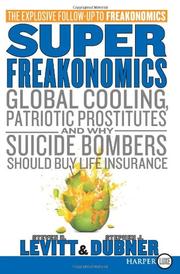
SuperFreakonomics: Global Cooling, Patriotic Prostitutes And Why Suicide Bombers Should Buy Life Insurance
2,007-word summary 9 min read 416 pages in the book
- First published
- 2009
- Publisher
- HarperLuxe
- Pages
- 416
- ISBN
- 9780061927577
Reading options
What's inside (7 sections)
I read Freakonomics years ago and argued about baby names for weeks, so I came to SuperFreakonomics ready to argue again. Steven Levitt and Stephen Dubner's 2009 follow up, 416 pages in large print edition cited here, applies incentives to prostitutes, suicide bombers, doctors, and the climate with cheeky confidence. Some chapters delight. Others infuriate in useful ways that reveal how economists think and where they blind.
Prostitutes and bombers
The opening on street prostitution uses data from a Chicago madam's books to show economics beats morals in explaining prices. Weekends pay more, holidays pay less, police stings lower supply briefly then displace. A patriotic call to reduce demand, like military wives shaming johns, works better than arrests because shame shifts incentives without jail costs. Levitt, known for provocative frames, delights in showing pimps as middle managers optimizing territory. Readers may flinch at treating sex work as market like any other. That flinch is the point to economists, though feminists rightly ask who bears cost when markets clear through bodies. The book notes violence but moves fast past it to pricing curves. Speed is both virtue and vice here. Insight comes with blinders.
Suicide bomber economics follows similar logic with darker stakes. Why do bombers not buy life insurance if they believe in paradise rewards for families. Because insurers would investigate and expose networks. Rational choice predicts behavior that ideology claims to transcend. Data on Palestinian bombers and Tamil Tigers shows education and income higher than stereotype, undermining poverty causes terror claims. The policy nudge, get insurers to require checks that disrupt funding, is clever and cold. It treats holy war as job with benefits to audit. Critics argue this misses meaning that motivates beyond pay. Levitt would answer meaning still responds to price. Raise cost of bombing through insurance scrutiny and fewer will afford martyrdom. Cynical, testable, uncomfortable. Classic Freakonomics in a sentence.
What I liked is the willingness to be wrong in public with numbers attached. Freakonomics made claims about abortion and crime that scholars still debate. Super doubles down with climate sulfur hoses and handwashing miracles. You can check math, argue samples, and learn even while disagreeing. Few pop nonfiction books invite that level of audit. Most hide methods in endnotes no one reads. Here methods are the show, with regressions explained through stories about real people making odd choices for clear reasons. That transparency teaches economic reasoning even when conclusions fail.
A fair warning is tone. Smug about cleverness, quick to mock doctors who do not wash hands and environmentalists who hate geoengineering. Dubner's journalistic voice smooths, but Levitt's Chicago price theory edge cuts. Readers who want humility should look elsewhere. Readers who want tools to question pieties will forgive smug for substance, at least sometimes.
Doctors, altruism, and climate
Doctor chapters argue simple checklists save more lives than miracle tech because doctors wash hands less than a third of the time observed. Semmelweis redux with sensors that beep when dispensers unused. Hospitals that publish infection rates cut deaths fast. Apologies that admit error reduce lawsuits more than denials, a finding that should reshape malpractice but threatens egos. Kidney exchange chains, where altruistic donors start swaps that save dozens, show markets in kindness work when designed. Levitt loves design that uses self interest for good without requiring saints. Nudges over sermons is the creed.
Altruism gets a chapter that surprised me with warmth. Why do people donate kidneys to strangers, return wallets, tip in cities they will never revisit. Experiments show most cheat a little but not maximally, suggesting internal honesty taxes. Appeals that make cheating visible cut fraud more than fines. The book praises costly apologies and punishments that signal care. It is less cynical than reputation suggests. People are mostly decent when watched by mirrors they respect. Design systems with that mirror in mind and virtue scales without preaching.
Climate is the most controversial section and has aged worst and best in parts. The authors argue solar and wind cannot scale fast enough, then tout Nathan Myhrvold's sulfur hose to cool planet cheaply for millions versus trillions for cuts. Scientists cried foul over side effects, governance, and moral hazard. Who controls thermostat. What if hose stops. Levitt, undeterred, frames it as insurance to research, not deploy tomorrow. Rereading after a decade of stalled cuts and worsening fires, the call to research geoengineering looks less crazy though governance questions remain unanswered. The book's sin was breezy confidence that engineering beats politics when politics is the hard part. Take the numbers seriously and the politics more seriously than authors do.
Read it as sequel that assumes you liked the first's trick. If you did not, start elsewhere. At 416 large print pages it reads fast with sidebars and charts that help. Pair with Factfulness for better global data manners, or with Thinking Fast and Slow for psychology Levitt brackets as noise. For book clubs, assign one chapter each to argue. Prostitution, terrorism, medicine, climate, altruism. Everyone will have a chapter that offends and one that converts. That spread is the franchise gift. Economics as lens, not answer. Use it to ask better questions about incentives hiding inside morals, then bring morals back to judge answers. Levitt gives lens. You supply conscience.
Reception, critics, and how to argue
Reception split in ways that teach how to read pop economics critically. Fans praised counterintuitive delights and clear prose that makes regressions fun. Critics from climate scientists to criminologists flagged cherry picking, causal leaps, and tone deafness about race and gender in prostitution and terrorism chapters. The climate hose chapter drew particular fire for downplaying governance and side effects while touting cheap fix. Levitt responded with data dumps and blog posts that sometimes helped and sometimes doubled down. Follow up blogs and errata are worth reading alongside for a full picture of how social science argues in public. Do not skip endnotes here. They contain caveats the main text breezes past for pace.
How to argue with the book productively is itself a skill it can teach despite itself. Ask what was measured and what was missed. Who was in sample and who was excluded. What alternative explains the same pattern with less cleverness. Prostitute prices respond to policing, yes, but also to migration and drug supply the book touches lightly. Bombers with degrees reflect selection into groups that recruit educated, not proof poverty never matters. Handwashing sensors work in trials cited, but Hawthorne effects fade when novelty wears off. Each objection does not kill insight. It bounds it to conditions where incentives dominate. Use the book to practice bounding rather than debunking wholesale. Keep the lens, add context the authors skim. That practice will serve beyond economics in news full of single study stories that claim too much.
For teachers, the book remains useful with framing. Assign the kidney exchange chapter to show market design saving lives without cash for organs. Assign handwashing to show measurement beating moralizing in hospitals. Pair each with a critical response from specialists to model charitable disagreement. Students learn to love cleverness while checking it, a balance schools rarely teach. The authors would likely approve of that use. They want readers who think like economists for an afternoon, not converts who quote them at parties. Think in incentives for a chapter, then return to thicker motives the rest of the day. Both/and beats either/or when problems involve people, not just prices.
Kidney chains and apology economics
Kidney exchange chains deserve a closer look because they show economics saving lives without paying for organs, a line the authors refuse to cross for ethical and practical reasons. An altruistic donor gives to a stranger, whose partner gives to another stranger, chaining through dozens made compatible by algorithm. Hospitals once did pairwise swaps that failed when pairs mismatched. Chains started by nondirected donors unlock cascades. Levitt delights in the math. One good kidney can save thirty through dominoes if logistics hold. He profiles surgeons who stay late to keep chains unbroken and pilots who fly organs free. Markets in kindness, designed like markets in widgets but without prices, work when rules reward compatibility over wealth. It is the book's most hopeful case because incentives align with decency without bribing it.
Apology economics follows similar logic with smaller stakes but wider use. Hospitals that disclose errors and apologize face fewer lawsuits than those that deny, though lawyers advise silence. Doctors fear saying sorry admits liability. Data show juries punish cover ups more than mistakes owned quickly with fixes. The book cites programs at Michigan and Stanford that cut claims by apologizing fast and fairly. Readers can use this at work tomorrow. Own the missed email with plan to fix rather than excuse. Customers, like patients, punish evasion more than error. That insight travels from operating rooms to classrooms without needing regressions to feel true, though regressions back it here with numbers that persuade administrators who ignore anecdotes. Say sorry with check attached and watch anger drop faster than with flowers.
Both cases reveal the authors at their best when incentives serve morals rather than mock them. Critics who call Freakonomics cynical miss these chapters where markets complete compassion. Chains need altruists to start. Apologies need remorse to work. Design cannot manufacture goodness, only channel it efficiently once present. Levitt and Dubner, often accused of reducing all to price, here show price as plumbing for values that already flow. Build good pipes and kindness reaches more sinks. That metaphor, uncharacteristically earnest, is worth keeping when other chapters irritate. Economics as infrastructure for decency, not substitute. Use it to move kidneys and sorrys where they need to go.
Doctors washing and climate hose
Handwashing detail deserves a closer look because it shows measurement beating moralizing in hospitals that resist both. Sensors on dispensers record who passes without pumping, with rates under a third on busy wards. Feedback screens that flash red shame more effectively than lectures. Programs that publish unit rates cut infections fast as staff compete to avoid bottom. Levitt loves the cheap fix over miracle tech. A $2 dispenser plus $200 sensor saves more lives than a million dollar robot that still needs clean hands to operate. Hospitals that invested in culture plus counters won. Those that bought gadgets without changing routines wasted. The lesson travels to schools and offices. Measure the boring behavior you want, show scores, and watch norms shift without bonuses.
Climate hose proposal needs careful handling because it tempts dismissal as Bond villain scheme. Myhrvold's idea, lofting sulfur dioxide through a hose to the stratosphere to mimic volcano cooling, costs millions versus trillions for emissions cuts. Models suggest it could offset warming fast. Side effects include shifting monsoons, ozone loss, and governance nightmare of who sets thermostat. Who decides temperature for Sahel versus Siberia. What if hose stops and warming rebounds fast. Levitt presents as research option, not deployment plan, but breezy tone understates politics that make research itself fraught. Who funds, who patents, who vetoes field trials. Reading now after a decade of stalled cuts, the call to study feels less crazy though still fraught. Take it as prompt to learn geoengineering basics rather than endorsement. Know the hose exists as idea before billionaires propose it without oversight. Debate with numbers, not just dread.
Pair these chapters to see the authors' method at both best and most blind. Hands: small behavior, clear measure, quick win with little downside. Climate: planetary behavior, uncertain measure, huge downside if wrong. Economics handles the first brilliantly and the second clumsily because incentives of researchers themselves go unexamined. Who gains from cheap fix talk that delays cuts. Fossil interests cited the book to argue wait for tech. That misuse is not authors' fault entirely, but tone invited it by mocking greens as priests. Read with that history in mind and extract useful tools while rejecting breezy dismissal of politics. Wash hands and cut emissions. Research hoses while cutting. Both/and again beats clever either/or when stakes include bodies and planets.
FAQ
When was SuperFreakonomics published?
William Morrow published the hardcover in October 2009. The HarperLuxe large print runs 416 pages with ISBN 9780061927577.
Is it a sequel?
Yes. It follows Freakonomics with new cases on altruism, medicine, and geoengineering.
What are examples?
Patriotic calls cut street prostitution demand, life insurance deters bombers, handwashing saves more than miracle cures.
Similar books
The Total Money Makeover: A Proven Plan for Financial Fitness
Dave Ramsey lays out seven Baby Steps, from a $1,000 starter fund to a paid-off house, with the debt snowball at the center.
2,663-word summary · 12 min read
The Black Swan
Taleb argues rare shocks shape history more than models admit, and urges safer exposure over prediction.
2,588-word summary · 12 min read
Predictably Irrational
Behavioral economist Dan Ariely shows why we overpay, procrastinate, and misjudge through simple experiments.
2,183-word summary · 10 min read
Freakonomics
Levitt asks why cheating teachers, sumo wrestlers and crime drops share incentives.
4,055-word summary · 18 min read
Nudge: Improving Decisions About Health, Wealth, and Happiness
Thaler and Sunstein show how defaults, framing, and social cues steer choices, and argue for choice architecture with an opt-out.
3,146-word summary · 14 min read
Made to Stick: Why Some Ideas Survive and Others Die
The Heath brothers break down why some ideas vanish on contact while others lodge in memory, tracing six traits that make a message stick.
2,527-word summary · 11 min read
The World Is Flat: A Brief History of the Twenty-first Century
Thomas L. Friedman's 2005 bestseller argues that technology, trade, and open borders leveled the global playing field, and it names the ten forces that did it.
2,369-word summary · 11 min read
Liar's Poker
Michael Lewis recalls his years as a Salomon Brothers bond salesman in the 1980s, when bluffing paid better than analysis and the mortgage machine was just…
2,405-word summary · 11 min read
Dare to Lead
Research on courage shows how leaders build trust through vulnerability and clear values.
2,442-word summary · 11 min read
Think Again
Adam Grant argues for holding views loosely and testing them like a scientist, moving past preacher, prosecutor, and politician habits at work and in debate.
3,204-word summary · 14 min read
Essentialism
McKeown argues for less but better: discern the vital few, refuse the trivial many, and use buffers, small wins, and steady routines so key work gets done well…
2,421-word summary · 11 min read
The Millionaire Next Door
Stanley and Danko survey wealthy Americans and find frugal savers living next door, not big spenders, in this 1996 money study.
2,466-word summary · 11 min read
Drive: The Surprising Truth About What Motivates Us
Pink argues fair pay plus autonomy, mastery, and purpose at work beat carrots and sticks, using FedEx days, ROWE, flow, and clear Goldilocks tasks to explain…
2,339-word summary · 10 min read
Emotional Intelligence
Goleman argues self awareness and empathy shape success more than IQ alone.
2,026-word summary · 9 min read

Moneyball
Oakland buys walks and patience to win 103 games on a small payroll in Lewis's 2003 baseball story.
2,955-word summary · 13 min read
The Big Short: Inside the Doomsday Machine
Outsiders who read the bonds shorted subprime and watched the machine eat itself in 2008.
2,194-word summary · 10 min read
Influence: The Psychology of Persuasion
Six levers plus unity explain why people say yes, learned undercover in salesrooms and labs.
2,030-word summary · 9 min read
The 48 Laws of Power
Robert Greene turns court history into 48 blunt power laws, each taught through stories like Fouquet and Louis XIV, plus reversals that show when each law…
2,846-word summary · 13 min read
Never Split the Difference
Ex-FBI hostage negotiator Chris Voss shares tools for high stakes talks, from mirroring to calibrated questions. His 2016 book is direct, story driven, and…
2,965-word summary · 13 min read
David and Goliath: Underdogs, Misfits, and the Art of Battling Giants
Gladwell argues disadvantages can become advantages, from biblical sling to dyslexia and class size.
3,197-word summary · 14 min read
Zero to One: Notes on Startups, or How to Build the Future
Thiel argues monopolies create value through vertical progress, not by copying competition.
2,582-word summary · 11 min read
Think and Grow Rich
Hill teaches desire, faith and autosuggestion, distilling lessons from Carnegie interviews into thirteen principles for success.
2,458-word summary · 11 min read
Who Moved My Cheese?
A tiny parable about two mice and two little people hunting cheese in a maze, and why adapting to change beats waiting for old days to return.
2,533-word summary · 11 min read
Thinking, Fast and Slow
Kahneman's tour of two minds: fast gut System 1 and slow careful System 2, and how biases, overconfidence, and framing shape every choice.
2,306-word summary · 10 min read
The Power of Habit
Why we do what we do: the cue routine reward loop, keystone habits, and how companies and movements use the same science, from toothpaste to the bus boycott.
2,207-word summary · 10 min read
The Tipping Point: How Little Things Can Make a Big Difference
How tiny shifts push ideas and products past a tipping point into epidemics.
2,014-word summary · 9 min read
Outliers: The Story of Success
Success comes from practice, timing, and hidden chances more than talent alone.
1,934-word summary · 9 min read
Deep Work: Rules for Focused Success in a Distracted World
Cal Newport's Deep Work in full: what focused work actually is, why shallow busyness wins by default, and the four philosophies he recommends for protecting…
2,138-word summary · 10 min read
The E-Myth Revisited
Gerber argues that most small businesses are run by technicians who own a job rather than a business, and that the fix is a system that runs without them.
2,169-word summary · 10 min read

Sybil
A 1973 case study of a woman treated for multiple personalities, and the book that made dissociative identity disorder a household phrase.
2,054-word summary · 9 min read