
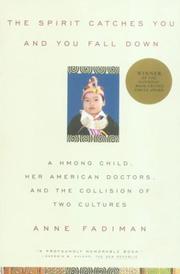
The Spirit Catches You and You Fall Down: A Hmong Child, Her American Doctors, and the Collision of Two Cultures
2,972-word summary 13 min read 339 pages in the book
- First published
- 1997
- Publisher
- Farrar, Straus and Giroux
- Pages
- 339
- ISBN
- 9780374267810
Reading options
What's inside (9 sections)
I opened this book because of the photograph on the cover. It shows a round, healthy looking little girl with a broad face and a watchful expression, and it is easy to miss that the child in that picture would spend most of her life unable to speak or move. Anne Fadiman keeps a carton of cassette tapes under her desk, and she says in the preface that she sometimes listens to them just to hear the voices of the people the photograph came from. That small admission told me what kind of book I was in for. This is reported nonfiction built out of years of sitting and listening, and the listening is very nearly the whole point.
The title is a translation of the Hmong phrase qaug dab peg, pronounced roughly "kow da pay." It means "the spirit catches you and you fall down," and it is the Hmong name for epilepsy. Fadiman's book, published in 1997 by Farrar, Straus and Giroux, takes that phrase as more than a linguistic curiosity. It becomes the key to a long argument about what happens when two ways of explaining illness meet in a small California hospital and neither one has a reliable way to translate the other.
What I did not expect was how even handed the book is. Fadiman clearly loves the Lee family, and she clearly respects the doctors who tried to save their daughter. She refuses to make either side the villain. That refusal is the source of the book's strength, and it is also, at times, the source of a certain flatness. More on that later.
How the story found its writer
Fadiman did not set out to write this book. She first went to Merced, California, in the spring of 1988, after hearing that there were "strange misunderstandings" between Hmong patients and the doctors at the county hospital. She was curious about how the culture of American medicine and the culture of the Hmong might illuminate each other, and she has said that at the start the project was "all theory." She thought she was looking at a general problem, not at one family's private disaster.
The piece she originally imagined for The New Yorker grew to about 35,000 words, too long for a magazine and too short for a book. The magazine did not run it. The project took roughly eight years, and Fadiman has described writing it as a kind of accident, a book that chose her. She eventually settled on a distinctive shape. The chapters that carry Lia's story alternate with chapters that step back and explain the wider world around it. There is a preface, nineteen numbered chapters, and, in the 2012 edition, a new afterword.
Her own life kept intruding on the work. While she was writing, her husband, her father, and her daughter all had medical problems of their own. Those experiences pushed her toward two questions that sit under the whole book: what makes a good doctor, and what makes a good parent? She has said that over time she stopped parsing the situation in straight lines and found herself thinking "a little less like an American and a little more like a Hmong." You can feel that shift happening across the pages. The early chapters have the brisk confidence of an outside observer. The later ones are quieter and more uncertain, which suits the material.
The book won the National Book Critics Circle Award for General Nonfiction, along with the Los Angeles Times Book Prize for Current Interest and the Salon Book Award. It has been cited in medical journals and is often assigned to students in medicine, pharmacy, and anthropology. It is, in short, a book that was useful to the very profession it was criticizing, and that is a tricky thing to be.
A door slam in Merced
Lia Lee was born on July 19, 1982, in Merced. She was one of fourteen children born to Foua Yang and Nao Kao Lee, Hmong refugees who had come to the United States from the highlands of Laos in 1980. Of all those children, she was the only one delivered in a hospital. The others had been born at home in Laos, often with Foua squatting over the dirt floor of their house, and several had died in childhood. Lia, born in an American delivery room, was the family's second youngest child and the one they favored.
When Lia was three months old, her older sister Yer slammed a door. Lia had a seizure. Her parents decided that the noise had frightened her soul out of her body, and they named the condition qaug dab peg. A dab is an evil spirit in Hmong belief, one of many that wait to steal a person's soul. Falling down and losing consciousness, in this reading, is what happens when a spirit catches you.
This is where the book gets interesting, because the Hmong understanding of Lia's condition was not simple fear. Seizures could also be a sign of a special soul. A person who has them may be chosen to become a txiv neeb, a shaman or spiritual healer, and txiv neebs are held in high esteem. They go into a trance to bargain with the spirits and call a wandering soul back into the body. So the Lees mourned the loss of Lia's soul and took some pride in the possibility that she might one day heal others. Fadiman is careful with this paradox. She does not present it as a quaint mistake or as a holier-than-thou alternative to science.
I should say something about the wider history here, because the book insists on it. The Hmong had been allies of the United States during the war in Laos, a conflict that hardly registered in American public memory. When the war ended, many faced persecution and fled to refugee camps in Thailand before resettling in places like Merced, in California's Central Valley. Fadiman spends real time on this background. Without it, the Lees' distrust of hospitals can look like stubbornness. With it, you can see how a family that had been moved across the world by forces it never controlled might view a white coated doctor with a needle as one more authority to be wary of.
What the doctors saw
Merced Community Medical Center, or MCMC, was the county hospital, a busy place that served low income patients and had no Hmong interpreter on staff. The Lees spoke no English. On Lia's first visits the staff could not work out what was wrong because she had stopped seizing by the time they arrived, and there was no one to explain the story of the slammed door. On a third visit she was still convulsing, and a doctor named Dan Murphy, who was curious about Hmong ways, used a nephew as an interpreter. He told the parents he needed to put an IV in Lia's scalp to deliver Valium and stop the seizure. The Lees resisted, and he talked them through it. He then diagnosed epilepsy and kept Lia in the hospital for several days.
The doctors who would become central to the case were Neil Ernst and Peggy Philp, pediatricians at MCMC who were married to each other. Fadiman writes about them with real affection. They were sharp, inquisitive, willing to admit mistakes, and they drove to the hospital in the middle of the night when Lia was brought in. Around the time of her fourth birthday, they settled on a diagnosis of Lennox Gastaut syndrome, a severe form of epilepsy that brings frequent seizures and developmental problems. They tried one drug regimen after another, hoping to find a combination that would quiet her brain without wrecking her alertness.
The numbers are hard to read. Between roughly eight months and four and a half years of age, Lia was admitted to MCMC seventeen times and made more than a hundred visits to the emergency room. Each visit generated a fresh set of instructions about pills and doses, each set slightly different from the last. The Lees were expected to carry all of it home in their heads, in a language they did not read, and give the right amount at the right hour to a child who might vomit or refuse it. Anyone would struggle. I kept thinking about how much of this was paperwork failure rather than medical failure, a set of instructions with no practical route from the doctor's mouth to the kitchen table.
The doctors thought the problem was comprehension. The Lees, for their part, were watching what the drugs did to their daughter. She became hyperactive, then sluggish and unsteady. They had seen other Hmong children left worse by hospital treatment, and they believed that a person should not have to take medicine forever. Their conclusion was that too much medicine was hurting Lia, and they adjusted the doses on their own.
The medicine that did not arrive
This is the part of the book that is hardest to sit with, because both sides were acting from reasonable motives and neither could see the other's reasoning. The hospital sent public health nurses to the Lee home to watch how the medicine was given. The nurses wrote notes. The notes said that Foua and Nao Kao nodded along and then did as they pleased once the nurse left. Peggy Philp eventually concluded that the parents were not merely confused. They were deliberately choosing which drugs to give, based on what they believed was helping.
At one point a home visit turned up something worse: the Lees were giving double the amount of one drug against explicit instructions. That was when Neil Ernst wrote to Child Protective Services. He argued that the case amounted to "child abuse, specifically neglect," and warned that Lia faced "irreversible brain damage and also possibly death" if her parents kept managing her care that way. Seen from his chair, this was a doctor trying to stop a child's brain from being damaged by seizures. Seen from the Lees' side, it was the state arriving to take their daughter away because she was being treated the way her parents thought best.
Lia was placed in foster care, first for two weeks and then, after another bad stretch, for a period expected to last at least six months. Her foster parents, Dee and Tom Korda, were kind people who grew attached to her and urged the authorities to let the Lees have her back. They even suggested it themselves. That gesture is one of the more decent things in the book. The parents were allowed visits, and the Kordas did what they could to keep the family together.
The person who finally made the difference was a social worker named Jeanine Hilt. She worked patiently with Foua on the practical business of measuring out the medication, and she kept at it longer than anyone else had. It was largely through her persistence that Lia came home. A doctor in Fresno, Terry Hutchison, also simplified the regimen to a single drug, Depakene, which made the daily task less absurd. For a while things steadied. Then Lia fell off a swing, struck her head, and went into a prolonged seizure. She survived, developed a serious airway infection, and spent two weeks in the hospital. Nao Kao's summary of that stretch was blunt: the doctors kept her so long that she grew sicker and sicker.
Thanksgiving Eve, 1986
The crisis came on the night before Thanksgiving in 1986. Lia went into a seizure that MCMC could not stop. By the time they brought it under control she had been in status epilepticus for nearly two hours, when even twenty minutes is considered life threatening. Neil arranged a transfer to Valley Children's Hospital in Fresno, a place with more resources. She arrived there still seizing, her lips and nail beds blue, her limbs stiff. A doctor named Kopacz worked on her through the night and described her condition as "profound shock, probably of septic origin." Her brain was, for all practical purposes, dead.
There is a scene in this chapter that I still think about. A doctor walked into the room and disconnected Lia's IV lines because he believed the family had agreed to withdraw support. They had not. Fadiman reports the moment without commentary, and it is more devastating for that. It is the whole book in one gesture: a decision made on the basis of an assumption nobody had checked with the people who had the strongest claim to be asked.
The Lees were convinced that the medicines had destroyed their daughter. Fadiman took this claim to Hutchison, the doctor who had overseen Lia's care in Fresno. He said that Depakene may have weakened her immune system and left her open to the bacterial infection that caused the shock, and that the parents' account "may not be too far from the truth." That concession is extraordinary, and Fadiman lets it sit there. She does not turn it into a victory for one side. It is simply a doctor admitting that the family's explanation was not crazy.
Lia was moved back to Merced, spent four days there, and then went home to die. Her parents boiled herbs, washed her body with the mixture, and called in txiv neebs to try to bring her soul back. She did not die. That is the event that turned a medical case into a long vigil, and it is the point where the book's real subject comes into view.
The chapters between the chapters
Fadiman's alternating structure is the book's most distinctive feature, and it is worth understanding before you start. The odd numbered chapters follow Lia and her family. The even numbered ones widen the frame. They cover Hmong cosmology and the role of the shaman, the history of the Hmong in Laos and the American war there, the experience of refugee resettlement, the problem of assimilation, and the discrimination the family met in Merced. At first I found these interruptions irritating. I wanted to get back to Lia. By the end I understood that they are the argument.
The point is that nobody in the hospital was acting in a vacuum. The doctors worked in an institution with its own habits, its own charting system, its own ideas about what a compliant family looks like. The Lees carried a set of obligations to ancestors and spirits that had kept their people going through a war and a migration. When those two systems touched around a sick child, the friction was not a matter of one side being ignorant. It was a collision of two complete accounts of what a body is and what a soul is.
Fadiman is sometimes criticized for arranging the story too neatly around that collision, and I think the criticism has some force. The book's subtitle promises a collision of two cultures, and the structure can make it feel as though every detail has been recruited to prove a point the author had decided on early. Real life is messier than a clean opposition between Western science and Hmong spirituality. Some of the doctors changed how they practiced after Lia's case. Some of the Hmong in Merced were savvy about hospitals and used them strategically. The people in this story are more various than the frame sometimes allows. That said, the frame is also what made the book useful to so many clinicians, and I would not trade it for a looser, more shapeless account.
Twenty-six years, and an afterword
Fadiman met the Lees when Lia had already been unresponsive for two years. The doctors had been expecting her to die and were puzzled that she did not. She lived on, cared for at home by her parents, with yearly ceremonies and animal sacrifices intended to call her soul back. She remained in that state for twenty six years. In the afterword added for the 2012 edition, Fadiman reports that Lia died on August 31, 2012, at the age of thirty. She weighed forty seven pounds and stood four feet seven inches tall. Fadiman said the immediate cause was pneumonia, though the New York Times reported that her underlying condition was far more complicated than that single explanation suggests.
What stayed with me is not the ending, which is not really an ending at all, but the middle stretch where a family keeps showing up for a child who cannot respond. There is no lesson delivered from on high here. Fadiman asks what a good doctor is and what a good parent is, and she leaves both questions open. The doctors she writes about were competent and caring and still missed what the parents were telling them. The parents loved Lia fiercely and still withheld treatment in ways that probably contributed to her decline. Both things are true at once, and the book's decency lies in holding them together.
I would hand this to a reader who likes nonfiction that reports carefully and refuses easy blame. I would be cautious with a reader who wants a brisk, tidy narrative, because the alternating chapters ask for patience and the book sometimes explains itself twice. There are passages where the ethnographic background slows the story to a crawl, and there are moments when the even handedness feels almost like a refusal to judge anything at all. Still, the photograph on the cover kept coming back to me. The book is at its best when it remembers that the person in that photograph was a little girl whose parents and doctors were all trying, in their separate languages, to keep her here.
FAQ
Is The Spirit Catches You and You Fall Down fiction?
No. It is narrative nonfiction built from years of reporting, interviews and recorded conversations with the Lee family and the doctors at Merced Community Medical Center.
What does the title mean?
It is the English translation of qaug dab peg, the Hmong term for epilepsy, which describes a spirit catching a person and making them fall down. In Hmong belief the condition can also mark someone as a potential healer.
What happened to Lia Lee?
After a seizure in 1986 left her brain dead, doctors expected her to die, but she lived until August 31, 2012, at age thirty, cared for at home by her parents.
Similar books
One Day, Everyone Will Have Always Been Against This
From a viral 2023 post, Omar El Akkad builds a furious short argument about Western promises, silence and complicity during the Gaza war.
2,218-word summary · 10 min read
How to Change Your Mind
Pollan blends the history of psychedelic research, his own guided trips, and current neuroscience to ask what these drugs reveal about consciousness.
2,466-word summary · 11 min read

Eating Animals
A new father's question about what to feed his son becomes a wide-ranging investigation of factory farming, food labels, and the stories we tell about meat.
2,100-word summary · 9 min read
Mountains Beyond Mountains: The Quest of Dr. Paul Farmer, a Man Who Would Cure the World
Tracy Kidder travels with Dr. Paul Farmer from Haiti to Peru, tracing how a Harvard doctor built a health system for the poor and what that work cost him.
3,095-word summary · 14 min read
Everything Is Tuberculosis
John Green tells the story of a boy with tuberculosis in Sierra Leone and argues that a disease curable since the 1950s still kills a million people a year…
2,015-word summary · 9 min read
The Body: A Guide for Occupants
Bill Bryson tours the human body from atoms to aches, mixing wonder at how we work with a sharp account of how our lives cut that short.
2,249-word summary · 10 min read
Sybil
A 1973 case study of a woman treated for multiple personalities, and the book that made dissociative identity disorder a household phrase.
2,054-word summary · 9 min read

The Girl with Seven Names: A North Korean Defector's Story
Hyeonseo Lee crossed the frozen Yalu River at seventeen, spent years hidden in China, escaped to South Korea, and later returned to rescue her family.
2,404-word summary · 11 min read
Breath: The New Science of a Lost Art
Journalist James Nestor investigates how modern humans learned to breathe badly, and what researchers, athletes, and breathwork practitioners have found about…
2,011-word summary · 9 min read
Smoke Gets in Your Eyes: And Other Lessons from the Crematory
A young medieval history graduate takes a job at an Oakland crematory and becomes a mortician, confronting the physical reality of death and the funeral…
2,003-word summary · 9 min read

Beyond Good and Evil: Prelude to a Philosophy of the Future
A guide to Friedrich Nietzsche's Beyond Good and Evil: its attack on moral prejudice, the will to power, master and slave morality, and the philosopher of the…
2,597-word summary · 12 min read

The Little Book of Hygge
Denmark happiness researcher tours candles, cake and cozy winter light.
2,582-word summary · 11 min read
The Emperor of All Maladies
A biography of cancer from Galen to chemo through one doctor cases.
2,255-word summary · 10 min read

So You Want to Talk About Race
Oluo gives plain rules for talking about race at work and home.
2,597-word summary · 12 min read
The Hot Zone
Ebola and Marburg move from African outbreaks to a Virginia monkey house and an Army response in suits.
2,291-word summary · 10 min read

PostSecret
Warren curates anonymous postcard secrets into art about love and shame.
2,001-word summary · 9 min read

Football
Klosterman asks why America worships football on Sunday television and argues the sport will lose its crown within sixty years.
2,219-word summary · 10 min read
The Psychopath Test
A journalist scores CEOs and Broadmoor men on the Hare checklist.
1,937-word summary · 9 min read
State of Wonder
A researcher travels into the Amazon to learn what happened to her colleague, and finds her fearsome former teacher guarding a fertility discovery.
2,648-word summary · 12 min read
Being Mortal
A surgeon asks what medicine owes the dying: fewer procedures, better conversations, and care shaped by what matters most.
2,362-word summary · 10 min read
Stiff: The Curious Lives of Human Cadavers
What happens to donated bodies, from crash labs and decay farms to composting and space tests.
2,051-word summary · 9 min read

Brain on Fire: My Month of Madness
A young reporter loses her mind to a rare brain illness and must rebuild from notes and video she hates to watch.
2,080-word summary · 9 min read
The Man Who Mistook His Wife for a Hat
Twenty four case histories where strange neurology meets full personhood.
1,930-word summary · 9 min read

The Story of Art
Gombrich traces art from cave painting to modernism with clear stories and famous images.
2,520-word summary · 11 min read
The Immortal Life of Henrietta Lacks
The cells of a poor Black tobacco farmer revolutionized medicine, taken without her knowledge in 1951.
2,139-word summary · 10 min read

Zeitoun
A Syrian-American contractor rides out Hurricane Katrina by canoe, rescuing neighbors and stray dogs, until a routine arrest turns into twenty-three days…
2,097-word summary · 9 min read
The Teacher of Nomad Land
In 1941 Iran, an orphaned boy straps a chalkboard to his back and sets off to teach nomads, hoping to keep his little sister with him.
2,534-word summary · 11 min read

The Symposium
At a banquet in Athens, seven men compete to praise Eros, ending with Socrates' account of Diotima and a drunken interruption by Alcibiades.
2,147-word summary · 10 min read

The Lord of the Rings: Weapons and Warfare
An illustrated 2003 companion that breaks down the weapons, armies and battles of Middle-earth using film production art, maps and commissioned battle plans.
2,297-word summary · 10 min read
The Innocent Man: Murder and Injustice in a Small Town
Grisham's first nonfiction book tells how Ron Williamson lost eleven years on death row for a murder he did not commit in Ada, Oklahoma.
2,245-word summary · 10 min read