
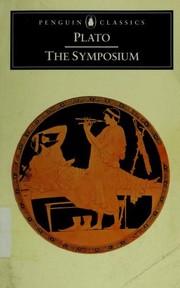
The Symposium
2,147-word summary 10 min read 144 pages in the book
- First published
- 1999
- Publisher
- Penguin Classics
- Pages
- 144
- ISBN
- 9780140446166
- Original title
- Συμπόσιον
Reading options
What's inside (9 sections)
I had always assumed the Symposium was a short, neat companion to The Republic, the bit with the famous speech about love that people quote out of context. Reading it properly was a surprise. It is an argument in the sense that nobody settles anything. Seven men stand up and say remarkable things about Eros, and Plato leaves you to decide which of them is talking sense. The dialogue was written around 385 BCE, though the banquet it describes is set much earlier, in 416 BCE. What survives on the page is a contest with no judge, which is a far more interesting shape than a lesson.
The banquet and the frame
The scene is a drinking party at the house of the tragedian Agathon in Athens, held to celebrate his first victory in a dramatic competition. Socrates arrives late because he has stopped on the way, lost in thought. Once the meal is over, Eryximachus picks up a suggestion from Phaedrus: each man should deliver a speech in praise of Eros, the god of love and desire. They agree to take turns, and because this is a drinking party, the tone is loose and competitive.
Before any of that, Plato puts a frame around the story. Apollodorus of Phalerum tells an unnamed friend what happened, and he says he heard it from Aristodemus and checked the details with Socrates himself. He was a boy at the time and was not there. That matters. The whole banquet is a report of a report, and the opening pages are careful about how a story passes from one mouth to another. It is easy to skip this part as setup. I would not, because it changes how you read everything afterward. Nobody in this book is speaking with the authority of a transcript.
The party setting is also a piece of design. In ancient Greece a symposium was a meal followed by drinking, music and conversation. Wine lowers caution. Men say things they would not say in a court or an assembly, and they take risks with their ideas. Plato uses that freedom to let each speaker show off, fail, and sometimes embarrass himself.
The first speeches: Eros as old and as civic
Phaedrus goes first and takes the simplest line. Eros is one of the oldest gods, he says, and because he is old he is also the source of the greatest benefits. He points to the shame a man feels in front of a beloved, which can make him brave in battle, and to figures from myth who died for the person they loved. The speech is short and slightly blunt, and it establishes the terms of the contest. Love makes people do things they would not otherwise do.
Pausanias follows with a distinction that will echo through the rest of the dialogue. He separates a common, physical love from a nobler love between an older man and a young man, in which physical pleasure is exchanged for teaching and character. This is an Athenian argument with its own rules about who may pursue whom and for what reason, and the speech spends time cataloguing how different cities treat it. Modern readers will find parts of it uncomfortable, and they should. The text belongs to its time, and the calm with which Pausanias sorts permissible from shameful desire is itself a piece of evidence about that time.
Eryximachus, a physician, then widens the claim until it covers nearly everything. Love, he says, governs not only people but plants, animals, the body, medicine, music and even the balance of hot and cold, wet and dry. His speech turns Eros into a principle of health and order, which is a clever move because it lets him treat the god as a force rather than a personality. Before Aristophanes can take his turn, he has a fit of hiccups, and Eryximachus prescribes the cures. The comic business is not filler. It gives the next speaker, a comic poet, a stage entrance.
Aristophanes and the divided self
Aristophanes warns the company that what he has to say may be absurd, then tells the most famous story in the book. Human beings, he says, were once doubled creatures, spherical, powerful, with faces and limbs turned in different directions. There were three kinds, descended from the sun, the earth and the moon. They grew so confident that they tried to climb to the gods, and Zeus, unwilling to destroy them outright, cut each one in half. Ever since, people have been searching for the half they lost.
The myth is doing several jobs at once. It explains why lovers say they feel complete when they find the right person, and it gives a comic origin story for the different kinds of desire the earlier speakers were arguing about. Aristophanes also turns the tale into a joke about politics, claiming that those who love other men show particular courage in public life. Whether Plato intends this as sincere or as teasing is left open, and that openness is the point. The comic poet has made the best story in the room, but nobody treats it as the best argument.
That gap between a good story and a good proof is one of the book's quiet themes. Aristophanes finishes by warning his listeners to respect the gods, in case they are split again. The laughter has an edge to it.
Socrates, Diotima, and the ladder
Agathon speaks next and complains that the others have praised what love gives to humans rather than praising the god himself. He describes Eros as young, delicate and fond of beauty, and credits him with the virtues. It is a polished performance, and Plato lets it sound exactly like the work of a trained rhetorician.
Socrates then asks Agathon a few questions, in the short question-and-answer style familiar from the earlier dialogues. If love desires beauty and youth, he asks, can love itself possess them? Agathon agrees that one does not desire what one already has, and so he is led to admit that love must be ugly and old. It is a neat trap, and it clears the ground for the longest and strangest speech in the book.
Rather than argue in his own voice, Socrates says he once heard a wise woman from Mantinea named Diotima explain these things. Her account changes the subject. Eros is neither a god nor a mortal but a spirit between the two, conceived at the feast for Aphrodite's birth by Plenty and Poverty. From his mother he is poor and rough, from his father he is clever at pursuing beauty. He is not wise, and he is not beautiful. He desires those things, and that is why he is always searching.
Diotima then gives the ladder that readers have been arguing about ever since. A person begins by loving one beautiful body, then comes to love all beautiful bodies, then beautiful minds, then knowledge, and finally reaches the sight of beauty itself, without any image or example. The movement is upward, from something particular and physical to something that can be known only by thought. It is a hard idea, and I think the dialogue is wiser for refusing to make it easy. Plato also ties this climb to reproduction, in body and in mind, so that the desire for permanence becomes part of the argument.
Socrates presents all of this as something he was taught. That choice matters. The man who usually asks the questions in Plato's books spends this speech answering them, and he does it by quoting a woman whose name most readers had never heard before the Symposium.
Alcibiades breaks in
Just as Socrates finishes, Alcibiades crashes into the room drunk. He was a real general and politician, and a year after the banquet he would flee Athens and change sides. Plato puts him at the door at exactly the right moment. After an evening of carefully balanced speeches, a man who cannot stand upright arrives and praises Socrates instead of Eros.
Alcibiades compares Socrates to the ugly little statues of Silenus that open to reveal figures of the gods inside. He says he tried to seduce Socrates and was refused, and that Socrates is the only man who ever made him feel shame. He praises Socrates' courage in battle, his indifference to cold and hardship, and the way his words can unsettle a person for life. It is a love speech in disguise, and it is also a trap. Everything the earlier speakers said about desire is now embodied in a man who cannot get what he wants.
This is where the book stops being a contest of theories. Alcibiades is living proof that the things people say about love are rarely clean, and that the person who teaches you to question your life may be the person you cannot live with. He compares Socrates to a satyr as well as a Silenus figure, and the double image keeps the speech physical even while it talks about virtue. The scene is funny and awkward, with a sadness underneath.
The ending and what Plato is doing
After Alcibiades there is no grand conclusion. The party becomes wild, people leave, and Aristodemus falls asleep. When he wakes in the morning, Socrates is still talking, arguing that a good playwright should be able to write comedy and tragedy. Once Agathon and Aristophanes are asleep, Socrates washes at the Lyceum and goes about his day, not returning home until evening.
That ending is deliberately flat. The book does not crown a winner. Instead it leaves you with the sense that each speech captured one piece of something too large for any single speech. Phaedrus thought of honor, Pausanias of rules, Aristophanes of loss, and Socrates of a climb toward knowledge. Then Alcibiades shows what happens when none of those accounts fits the person sitting next to you. They are not versions of the same answer. They are different accounts of what love feels like from where each man stands.
The dialogue also plays with how a philosophical text gets made. A story told by Aristodemus to Apollodorus, retold to a friend, containing a speech by Socrates that quotes a woman nobody can verify. Plato is showing you that ideas arrive through people, with all the mess that implies. For a book so often quoted as if it were a manual, that is a useful correction.
A little publication history helps here. The dialogue is also known in the tradition as On the Good, which tells you how readers came to frame it. The collected dialogues were organized by Thrasyllus of Mendes, and the first printed edition appeared in 1513 from Aldus Manutius. The book you hold is much younger than the text, and that gap is part of what makes an ancient dialogue strange to read. It was written for people who already knew the players and the jokes, then handed down through copies and translations to readers who know almost none of it.
Reading it now, with fair warnings
The Symposium is short, and it rewards slow reading. It is worth noticing the order of the speeches, because Plato has arranged them so that each one complicates the last. It is also worth keeping the frame in mind. When a claim sounds too tidy, remember that somebody is reporting it after a long night of drinking.
There are real obstacles. Pausanias' speech assumes a system of desire and status that belongs to ancient Athens, and a modern reader will feel the distance. The physician's account of love as a balance of bodily fluids belongs to an old science that no longer holds. The ladder of beauty can sound cold if you are looking for comfort, and the book offers very little in the way of practical advice about relationships. If you want a philosophy of love that tells you what to do on a Friday night, this is not it.
What it offers instead is a demonstration of thinking in public. Seven people try to say what Eros is, and the attempts are better than any answer would have been. I finished the book with more questions than I began with, and that feels like the intended result. The dialogue was written more than two millennia ago, yet its method still works on a reader who is willing to argue back.
This summary follows Christopher Gill's translation for Penguin Classics, first published in 1999 and running 144 pages. Translation matters here, because words like Eros, eros as a feeling, and the Greek terms for different kinds of love do not map neatly onto English. A different version will shade several of these speeches differently. That is another reason to read the book rather than trust a single famous line pulled out of it.
FAQ
Who actually speaks in the Symposium?
Seven men deliver the main speeches: Phaedrus, Pausanias, Eryximachus, Aristophanes, Agathon, Socrates and Alcibiades. Socrates' own account is reported speech, since he says he learned it from Diotima.
Is this a back-and-forth dialogue like The Republic?
Not really. Instead of long questioning, it is a series of set speeches at a banquet, with one short exchange between Socrates and Agathon before the longest speech.
Which translation does this summary follow?
It follows Christopher Gill's Penguin Classics translation, published in 1999, which runs 144 pages with ISBN 9780140446166.
Similar books
The Republic
Socrates debates justice and sketches a city ruled by philosophers, with the cave and the soul.
2,167-word summary · 10 min read
Beyond Good and Evil: Prelude to a Philosophy of the Future
A guide to Friedrich Nietzsche's Beyond Good and Evil: its attack on moral prejudice, the will to power, master and slave morality, and the philosopher of the…
2,597-word summary · 12 min read
Thus Spoke Zarathustra
A prophet comes down from ten years alone to preach the overman after the death of God.
1,983-word summary · 9 min read

Eating Animals
A new father's question about what to feed his son becomes a wide-ranging investigation of factory farming, food labels, and the stories we tell about meat.
2,100-word summary · 9 min read
The Zahir
A bestselling novelist's wife vanishes from their Paris home, sending him on a search that becomes a reckoning with his own marriage and attention.
2,433-word summary · 11 min read
The Art of Loving
Fromm argues that love is an art requiring care, responsibility, respect and knowledge, not a feeling we simply fall into. A short, stern classic of 1950s…
3,175-word summary · 14 min read
Momo
A girl with a gift for listening takes on grey-clad thieves who persuade a city to save its time, in Michael Ende's 1973 fable about efficiency and attention.
2,275-word summary · 10 min read

Brida
A young Irishwoman convinced she has a spiritual Gift seeks out a forest Magus and a Dublin witch, and learns that her gift is to bridge the visible and…
2,012-word summary · 9 min read
As You Like It
A usurped duke, two runaway cousins, and a girl disguised as a boy turn a forest exile into Shakespeare's most playful comedy about love, loyalty and freedom.
2,815-word summary · 13 min read
The Autobiography of Benjamin Franklin
Franklin writes his own life in four parts, from a Boston boyhood and a runaway apprenticeship to printing, science, and public service, while keeping careful…
2,259-word summary · 10 min read
Invisible Cities
Marco Polo describes fifty-five impossible cities to Kublai Khan, and each one turns out to be a way of talking about memory, desire and the place we call home.
2,465-word summary · 11 min read
As a Man Thinketh: A book that will help you to help yourself
In seven short chapters, James Allen argues that character and circumstance grow from thought, and that changing how you think is the practical route to…
2,673-word summary · 12 min read
Rosencrantz and Guildenstern Are Dead
Stoppard's 1966 play retells Hamlet from the wings, where two minor courtiers wait, joke, and walk toward a death they cannot see.
2,021-word summary · 9 min read

Fathers and Sons
Arkady brings the nihilist Bazarov home to his father's estate, and a generational argument turns into love, a duel, and an early death.
2,192-word summary · 10 min read
The Dharma Bums
Ray Smith rides freight trains, climbs Matterhorn Peak and argues about Zen with the poet Japhy Ryder in Kerouac's 1958 road novel.
2,729-word summary · 12 min read
The Gift of the Magi
A young couple with almost no money each sells the thing they treasure most to buy a Christmas present for the other.
1,978-word summary · 9 min read
Out of the Silent Planet
A Cambridge philologist is kidnapped and taken to Mars, where the natives are civilized and the humans are the dangerous invaders.
2,612-word summary · 12 min read
Ishmael: An Adventure of the Mind and Spirit
A gorilla named Ishmael teaches a disillusioned man that civilization is a story, and that humans may compete but must not wage war on other species.
2,015-word summary · 9 min read
By the River Piedra I Sat Down and Wept
Pilar, 29, meets her childhood friend again in Madrid and finds a rumored miracle worker. One winter week through the Pyrenees to the river Piedra, and the…
2,845-word summary · 13 min read
Leaves of Grass
Free verse songs of self, America, bodies and democracy.
2,240-word summary · 10 min read
A Canticle for Leibowitz
After nuclear war, monks save books across centuries while the world rebuilds and falls again.
2,381-word summary · 11 min read
The Fall
A fallen Paris lawyer confesses in an Amsterdam bar, tracing guilt from Paris success to a bridge he failed to face.
2,220-word summary · 10 min read
Solaris
Kelvin reaches a silent station above Solaris and finds grief made solid when the ocean returns his dead wife Rheya, testing memory, science, and the limits of…
2,548-word summary · 11 min read

One Day in the Life of Ivan Denisovich
One freezing day with prisoner Shch-854 in a Soviet camp: roll call, bricklaying in the cold, bread rations, and small wins that let Shukhov call the day…
2,668-word summary · 12 min read
Demian
Hesse's 1919 German classic of Emil Sinclair, from Kromer blackmail to Demian, Abraxas, Beatrice and Frau Eva, ending in war: a short, strange guide to growing…
2,510-word summary · 11 min read

The Island of Doctor Moreau
Shipwrecked Prendick finds Doctor Moreau shaping beasts into men by pain on lost island.
2,137-word summary · 9 min read
The Dispossessed: An Ambiguous Utopia
Physicist Shevek leaves anarchist Anarres for capitalist Urras to share time theory, finding walls both places.
2,288-word summary · 10 min read
Nausea
Historian Roquentin in Bouville catalogs dread as objects turn strange in Sartre diary novel.
2,134-word summary · 9 min read
Faust, Part One
A restless scholar bets his soul against one perfect moment, then ruins an innocent girl in Goethe's 1808 verse tragedy.
2,568-word summary · 11 min read
Aesop's Fables
Short animal tales of hares, foxes, ants, and wolves that still sting: old fables in plain modern English.
2,916-word summary · 13 min read