
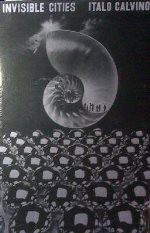
Invisible Cities
2,465-word summary 11 min read 165 pages in the book
- First published
- 1972
- Publisher
- Harcourt Brace Jovanovich
- Pages
- 165
- ISBN
- 9780151452903
- Original title
- Le città invisibili
Reading options
What's inside (9 sections)
I picked this book up on a friend's recommendation, and I honestly did not know what I was getting into. I had heard it called a novel, a poem cycle, a philosophical puzzle. What I found was something smaller and stranger than any of those labels: a slim collection of short prose pieces that reads like dreams someone wrote down on index cards. It first appeared in Italian in 1972 as Le città invisibili, and the English translation by William Weaver came out in 1974 from Harcourt Brace Jovanovich, running about 165 pages. None of those facts prepared me for the actual experience of reading it. You can finish it in an evening, then keep turning parts of it over in your head for months.
An old emperor and a travelling merchant
The whole book is built on a frame, and the frame is almost absurdly simple. Kublai Khan, aging and bored with the business of ruling an enormous empire, sits in his garden and listens to Marco Polo describe cities he claims to have visited. The Khan is worried about the future of his dominions, about whether anything he built will last. He wants reports, inventories, facts he can use to understand the territory he governs. Polo gives him something else entirely: a long series of portraits of places that do not exist.
What makes the frame work is the mismatch between the two men. The Khan wants solid information, the kind you can put on a map or write into a tax ledger. Polo describes streets and markets and customs with great precision, but the cities are impossible. They float, or they are built on stilts over an abyss, or they appear only at certain hours. The Khan keeps listening anyway, because he senses that Polo is telling him something he cannot get from his officials. The conversations between them are short, often only a few lines, and they arrive like the tolling of a bell between the descriptions. They keep the book from becoming a mere catalog and turn it into an argument about what language can and cannot do.
I should say at the outset that if you are looking for a plot, you will not find one. Nothing happens in the conventional sense. No one changes, no one resolves anything, the Khan never gets his answer. The book is a series of verbal objects placed side by side. That can be frustrating, and at points it is, but once I stopped waiting for a story to start I began to enjoy the strange rhythm of the thing.
Memory, desire, and the first cities
The early descriptions set the pattern. Diomira is a city of sixty domes and bronze statues and three theaters, but its real feature is what happens at dawn, when a woman in a white dress walks toward it and a man with a falcon on his wrist passes by. The point is not that these figures are real. It is that they are exactly the sort of thing a traveller remembers, the small vivid details that stand in for a whole place. Here Calvino is writing about how memory works, how a city survives in us as a handful of images rather than a full account.
Maurilia is the city that returns you to the past in a uncomfortable way. The narrator of that portrait describes going back after many years and finding that the place has changed, that the old names and faces are gone. What bothers him is not the change itself but the realization that he had been keeping a version of Maurilia intact in his mind, and that this private city mattered more to him than the actual one. I read that piece twice, because it put its finger on something I had felt on returning to places from my own childhood.
Zobeide is the city built around a dream. Several men had the same dream of a woman running through a maze of streets, and when they woke they built the city to match it, arranging the roads so that the figure in the dream could never be caught. Over time the original meaning faded, and later generations live in the city without knowing why it was made in that shape. This is one of my favorites, because it is really about how the reasons for the things we inherit get lost, even as the things themselves keep shaping our lives.
Desire gets its own group of cities, and Isidora is the one that stayed with me. It is described as a city where the buildings have staircases that lead nowhere and doors that open onto emptiness, and where people seem to be perpetually arriving at a place they have always wanted to reach. Calvino connects desire to a kind of suspension, a state of always being about to live rather than actually living it. The portrait is short, but it says something sharp about how wanting can become its own kind of home.
Signs, thin cities, and trade
As the catalog continues, the categories shift. Zoe belongs to the cities of signs. In Zoe, every gesture and object means something, the city is a dense system of references where nothing is merely itself. The narrator complains that he cannot tell what is real anymore, that he is trapped in a world of pure signification. There is a comic edge to this, but also a genuine unease, because it is not hard to recognize a version of our own habit of reading meaning into everything.
Then come the thin cities, and here Calvino's invention turns almost architectural. Zaira is a city stretched so thin that it has no thickness, just an endless surface of streets and doorways spread across the plain. Trude is a city raised on stilts above a lake, with houses hanging from poles and walkways suspended in the air, built by people who wanted to rise above the earth. I loved the physical boldness of these images. Calvino treats a city the way a sculptor might treat a block of material, pulling it out into strange new shapes to see what the idea of a city can tolerate.
Euphemia, from the trading cities, is a place of markets where goods are exchanged in elaborate rituals, where merchants sit in a courtyard and slide objects across a table while saying almost nothing. What struck me is that the trade in Euphemia seems less about the goods than about the ceremony of trading itself. The object changes hands, but the real transaction is the performance, the mutual recognition between the two people. It is a sly joke about commerce and also a quiet observation that exchange is always a kind of language.
Eyes, names, and the dead
A group of cities organized around eyes and seeing follows. Esmeralda is the city you see when you travel toward it rather than when you arrive, a place made of the way light falls on towers and bridges at a distance. The portrait insists that the city exists properly only in the act of looking, that up close it dissolves into ordinary streets. This connects to one of the book's quiet themes, which is that a place is never just its physical fact. It is also the angle from which you encounter it.
Adelma deals with names. In this city, everything has a double existence: the thing itself and the word for the thing, and the two do not line up. The people of Adelma seem to live among labels that have slipped free of their objects, and the narrator wanders through a world where naming feels like a kind of loss. I found this one harder to grasp than some of the others, a little too clever for its own good, but the best of these pieces reward a second reading, and this one did on the second pass.
The cities of the dead are among the strongest in the book. Baucis is a city built on a cliff, where the living and the dead share the same streets and the dead are carried through the town on litters, with the living stepping aside to let the processions pass. There is a tenderness here that caught me off guard. Calvino does not make the dead frightening. He makes them neighbors, part of the ordinary traffic of the place, and in doing so he suggests that a city is defined as much by how it holds its dead as by anything else.
Leonia is the city that throws everything away. Each day its residents discard the previous day's possessions, and the discarded things pile up outside the walls in enormous heaps. The city's wealth and elegance depend on this constant disposal, and the narrator points out that the garbage of Leonia is the true record of what the place is. I read Leonia as a fable about consumption, and it felt more pointed the more I thought about it. It is the rare piece in the book that is willing to be plainly critical of the world it describes.
The later chapters, from sky to hidden cities
The final groups widen the frame. The cities of the sky, such as the one where the city hangs suspended above the ground, push the invention into pure fantasy. The continuous cities are places that never seem to end, where you can travel for days through endless suburbs and never arrive anywhere distinct. I have driven through enough stretches of identical roadside development to recognize the continuous cities immediately, and Calvino's version of that experience is both funny and bleak.
The hidden cities are the most mysterious of all. These are places that exist only as rumors or fragments, cities you might glimpse out of the corner of your eye, cities that cannot be found twice. The idea is fitting for a book that is itself built out of glimpses. By the time I reached these pieces I had accepted that the city portraits were not going to add up to a single message, that their purpose was to keep generating variations on a set of themes.
There is a hidden structure underneath all this, and it is worth knowing about even if you do not go looking for it on a first read. The fifty-five cities are organized into eleven thematic groups of five each, and the whole sequence has a mathematical symmetry, with the city of Baucis sitting at the exact center of the arrangement. Calvino built this pattern deliberately. You do not need to notice it to enjoy the book, but discovering it made me want to reread the whole thing, this time paying attention to the architecture rather than the individual rooms.
Venice and the argument underneath
The threads come together in the dialogues between the Khan and Polo. At one point the Khan asks why Polo never describes Venice, his own home, and Polo answers that every time he describes a city he is saying something about Venice. That line is the key to the entire book. The imaginary cities are not escapes from a real place. They are ways of circling it, of approaching it from fifty-five different angles because it cannot be captured from any single one.
That admission reframes everything that comes before it. The cities are exercises in memory and desire, yes, but they are also a way of talking about the one place Polo cannot bear to name directly. The Khan, for his part, begins to understand that he will never possess his empire the way he wanted to, that the map is not the territory and that the stories his merchant tells are a different kind of knowledge than the reports of his officials. By the end, the Emperor is less a ruler than a listener, and the book has quietly shifted its allegiance from power to imagination.
The book was nominated for a Nebula Award in 1975, and it has had a surprising second life beyond the page. Christopher Cerrone composed an opera based on it in 2013, which makes sense given how musical the prose is, with its repeated phrases and its careful, measured cadences. I can see why a composer would be drawn to it.
Where it loses its grip
I want to be honest about the parts that did not work for me. The book is short, but the catalog format means that after a while the descriptions begin to blur together. I found myself skimming the middle chapters, and a few of the city portraits felt like variations on a trick I had already figured out. When every city is a meditation on memory or signs or names, the meditations start to crowd each other, and the surprise that made the first pieces so bracing wears thin.
It is also a book with almost no human warmth in the ordinary sense. The people in these cities are types, figures in a landscape, names attached to a gesture. Calvino is not interested in character, and if you read looking for the emotional texture of a novel you will come away cold. The dialogues help, because the Khan and Polo have a real rapport, a faint affection and a shared weariness that makes their exchanges the most alive parts of the book. But they are too few and too brief to carry the whole thing.
There is a risk, too, in a book this self-aware. It keeps telling you that language is slippery and that places exist only in the mind, and after the twentieth variation the point stops feeling like a discovery. I think the book is at its best when it is concrete, when it gives you the bronze statues of Diomira or the refuse heaps of Leonia and trusts you to draw the conclusion. It is at its weakest when it states its own thesis too plainly.
Even so, I finished it with a strange reluctance, the feeling you have when a dream is ending and you want to stay in it a little longer. Several of these city portraits have stuck with me more stubbornly than entire novels I read that year. I keep thinking about Zobeide and the men who built a city to keep a dream woman running forever. I think about Leonia and its mountains of yesterday's things. I do not know that I could explain what the book means if someone asked me directly, and I am not sure Calvino would want me to. What I know is that it changed the way I look at the places I pass through, and that is no small thing for a book of a hundred and sixty-five pages.
FAQ
Is Invisible Cities a novel?
It is usually classified as a short postmodern novel, first published in Italian in 1972. It is built from fifty-five brief prose poems and nine chapters of dialogue rather than a continuous plot, so it reads more like a sequence of meditations.
Are the cities in Invisible Cities real places?
No. All fifty-five are invented, though they echo the fantastic travel accounts in The Travels of Marco Polo. Calvino uses the frame of Polo describing his journeys to the court of Kublai Khan, and the cities carry women's names.
Why does Venice keep coming up in Invisible Cities?
When the Khan asks Polo why he never describes his hometown, Polo answers that every time he describes a city he is saying something about Venice. Venice becomes the reference point behind all the imaginary places, and the clue that the catalog is really about memory and desire.
Similar books
The Dharma Bums
Ray Smith rides freight trains, climbs Matterhorn Peak and argues about Zen with the poet Japhy Ryder in Kerouac's 1958 road novel.
2,729-word summary · 12 min read
Momo
A girl with a gift for listening takes on grey-clad thieves who persuade a city to save its time, in Michael Ende's 1973 fable about efficiency and attention.
2,275-word summary · 10 min read

Fathers and Sons
Arkady brings the nihilist Bazarov home to his father's estate, and a generational argument turns into love, a duel, and an early death.
2,192-word summary · 10 min read

Orlando
A young Elizabethan nobleman becomes a woman and lives for centuries, moving through English history while writing a single poem about an oak tree.
2,030-word summary · 9 min read
The Buried Giant
An old couple crosses a misty post Arthur Britain searching for a son.
2,593-word summary · 12 min read
The Fall
A fallen Paris lawyer confesses in an Amsterdam bar, tracing guilt from Paris success to a bridge he failed to face.
2,220-word summary · 10 min read
Nausea
Historian Roquentin in Bouville catalogs dread as objects turn strange in Sartre diary novel.
2,134-word summary · 9 min read
Steppenwolf
Harry Haller, half man and half wolf in his own mind, dances, loves, and enters a magic theatre in Hesse's strange 1927 novel.
3,181-word summary · 14 min read
How to Stop Time
Tom Hazard, aging one year in fifteen, hides behind new identities until a London classroom and a lost daughter force him to live.
2,597-word summary · 12 min read
Sophie's World
Sophie gets philosophy lessons by mail, then finds she is fiction in a father birthday book for Hilde.
2,013-word summary · 9 min read
Gulliver's Travels
A ship's surgeon meets tiny Lilliputians, giant Brobdingnagians, Laputa's projectors, and rational horses in Swift's 1726 satire.
2,600-word summary · 12 min read
The Master and Margarita
Devil Woland visits 1930s Moscow while Master writes Pilate and Margarita bargains.
2,535-word summary · 11 min read
The Karamazov Brothers
Dmitri, Ivan, and Alyosha Karamazov face their father, murder, faith, and doubt in Dostoevsky's final novel.
2,512-word summary · 11 min read
The Picture of Dorian Gray
Dorian Gray retold: Basil paints, Henry talks, wish holds youth while canvas bears years.
2,061-word summary · 9 min read
The Midnight Library
Matt Haig's The Midnight Library retold: Nora between lives, Mrs Elm, regrets tried on, and choosing to live.
2,410-word summary · 11 min read
The Little Prince
Saint-Exupery's The Little Prince retold: a pilot, a rose, the fox, and what matters is invisible.
2,492-word summary · 11 min read
If on a Winter's Night a Traveler
You, the Reader, chase a defective novel through bookshops and translators while ten other novels keep interrupting. Calvino's famous puzzle about the act of…
2,173-word summary · 10 min read
The Symposium
At a banquet in Athens, seven men compete to praise Eros, ending with Socrates' account of Diotima and a drunken interruption by Alcibiades.
2,147-word summary · 10 min read
The New York Trilogy
Three linked novels turn a wrong-number call into a puzzle about names, authorship, and the stories people tell to stay sane.
2,259-word summary · 10 min read
One Boat
A woman returns to a Greek coastal town after her father's death, and the holiday she took nine years earlier after her mother's death keeps breaking through.
2,143-word summary · 10 min read
What We Can Know
In McEwan's eighteenth novel, a lonely scholar in a flooded, diminished Britain chases a vanished poem that could win him the professorship he has long wanted.
2,408-word summary · 11 min read

The Zahir
A bestselling novelist's wife vanishes from their Paris home, sending him on a search that becomes a reckoning with his own marriage and attention.
2,433-word summary · 11 min read
The Tunnel
A painter in a Buenos Aires prison recounts the glance, the woman and the jealousy that led him to murder the only person who understood him.
2,313-word summary · 10 min read
The Portrait of a Lady
A young American woman inherits a fortune, refuses two suitors, and marries a polished expatriate who makes her independence a trap. James watches her mind at…
2,903-word summary · 13 min read
The Luminaries
Eleanor Catton's Booker-winning novel drops a young prospector into an 1866 New Zealand gold town where twelve men untangle a web of hidden gold, murder and…
2,949-word summary · 13 min read
The Collector
A lonely clerk wins the football pools, buys a Sussex farmhouse, and kidnaps an art student he hopes will love him. Fowles's debut splits the story between…
2,618-word summary · 12 min read
The Book of Three
A restless assistant pig-keeper in mythical Wales chases his escaped oracle pig and finds himself beside Prince Gwydion in a war against the Lord of Annuvin.
2,019-word summary · 9 min read
The Bonfire of the Vanities
Tom Wolfe's first novel follows a Wall Street bond trader whose life unravels after a hit-and-run in the Bronx, in a satire of 1980s New York money, race and…
2,268-word summary · 10 min read
Still Life with Woodpecker
An environmentalist princess and an outlaw bomber fall in love, then argue about freedom, sacrifice, and a pack of Camel cigarettes.
2,061-word summary · 9 min read
Possession: A Romance
A London Library discovery sends two scholars chasing a secret Victorian love affair, in a Booker-winning novel of invented letters, poetry and the race to own…
2,394-word summary · 11 min read