
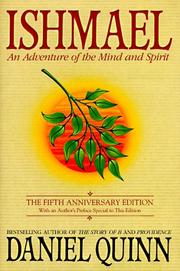
Ishmael: An Adventure of the Mind and Spirit
2,015-word summary 9 min read 266 pages in the book
- First published
- 1992
- Publisher
- Bantam/Turner Book
- Pages
- 266
- ISBN
- 9780553078756
- Series
- Ishmael (#1)
Reading options
What's inside (10 sections)
I found this book in a used shop with a cover that promised exactly the kind of earnest nineties paperback you make fun of until you read it. Daniel Quinn's Ishmael came out from Bantam/Turner in 1992, 266 pages, and it has the strangest premise of any bestseller I can think of: a disillusioned man answers a newspaper ad placed by a gorilla, and the gorilla teaches him how civilization works. It sold slowly, then enormously, and then became one of those books passed hand to hand by people who want to change the conversation at Thanksgiving.
The ad reads: "Teacher seeks pupil. Must have an earnest desire to save the world. Apply in person." The narrator, a man who wanted to save the world in the sixties and has spent the years since watching his idealism curdle, goes to the address expecting a joke. He finds a full-grown lowland gorilla in Room 105 of the Fairfield Building. The gorilla calls himself Ishmael and speaks to him mind to mind. The narrator's first instinct is to run. His second is to come back the next day, and the next.
Who Ishmael Is
Quinn gives his teacher a history, and the history is doing argumentative work. Ishmael was born in equatorial West Africa in the 1930s, captured, and passed through a zoo and a traveling menagerie where he was known as Goliath. A wealthy Jewish émigré named Walter Sokolow bought him, discovered they could speak telepathically, and treated him as a student rather than a pet. After Sokolow died in 1985, his daughter Rachel paid for Ishmael's upkeep, and the gorilla put the ad in the paper. Rachel and the butler Partridge hover offstage. A previous pupil named Charles Atterley also hovers, mostly as a warning about what happens when the teaching is misunderstood.
The choice of a gorilla is not decoration. Ishmael is a captive, and captivity is the book's master metaphor. He cannot leave Room 105. He has been fed, displayed, and kept alive by a civilization that congratulates itself on its kindness while holding him in a box. When he asks the narrator to explain why human beings live the way they do, he is asking as someone who has watched the answer from the outside. That distance is the whole engine.
The Lessons Begin
The teaching proceeds like a good seminar, one definition at a time. A story, Ishmael says, is a way of interrelating the gods, human beings, and the earth, with a beginning, a middle, and an end. To enact a story is to behave in a way that makes the story come true. A culture is a people enacting a story. From there he builds the book's central distinction.
Most of the world, he argues, belongs to the Leavers: cultures that lived by hunting, gathering, herding, or small-scale farming, and that understood themselves as one species among many. The globalized civilization that began with agriculture in the Near East roughly ten thousand years ago belongs to the Takers: cultures that see themselves as separate from nature, destined to conquer it, and entitled to manage the world for human benefit. The Takers call everyone else primitive. Ishmael calls that a story told by the winners, and asks the narrator to examine what the winners have to believe in order to keep winning.
He lists those beliefs and then takes them apart: that human beings are the pinnacle of evolution; that the world was made for humans to rule; that mastery will produce paradise; that humans are fundamentally flawed and can never learn how to live correctly; that they will therefore inevitably destroy the world; and that the civilizing project must continue or humanity will perish. Each premise props up the next. Remove one and the architecture wobbles.
The narrator resists. He is not a straw man. He points out the good things civilization has produced, the medicine and the art and the comfort, and Ishmael does not wave them away. The argument is not that everything modern is bad. It is that the Takers have built a machine whose operating instructions are invisible to the people inside it, and that invisible instructions still run.
The Law of Limited Competition
The book's most quoted passage comes when Ishmael asks the narrator to derive a law from biology. Every species competes. But no species, except the Takers, hunts its competitors to extinction, destroys their food supply, or denies them access to food. The rule is something like: you may compete to the full extent of your abilities, but you may not wage war on competitors. Species that violate it go extinct. The Takers violate it everywhere, with agriculture, fences, pesticides, dams, and markets, and then call the resulting abundance progress.
The narrator's objection is the obvious one. If Takers stopped, wouldn't people starve? Ishmael's answer is that the system produces the starvation it promises to prevent, because surplus food supports more people, who need more surplus, who are then vulnerable when the surplus fails. The argument is not a policy manual. Quinn is not asking anyone to return to hunting and gathering, and Ishmael explicitly calls that idea inane. The ask is to give up the claim to own the world, and to stop forcing every other culture to enact the Taker story.
Genesis, Cain, and Abel
The section that made the book famous, and the one that gets it banned in some schools, reinterprets the early chapters of Genesis from the Leaver side. Most readers, Ishmael says, read the Fall as a story about human disobedience and the loss of paradise. He reads it as a story written by Leavers about the origin of the Takers. The Tree of the Knowledge of Good and Evil is not moral knowledge in general. It is the knowledge the gods have: the knowledge of who shall live and who shall die. Agriculture claims exactly that knowledge. Eating the fruit is not a fall into sin. It is the Takers taking the gods' prerogative, and believing they have become wise when they have only become dangerous.
Cain and Abel is the same argument in miniature. Cain the tiller kills Abel the herder, and the story records agriculturalists displacing pastoralists. The mark on Cain protects him, and the curse of toil is the kind of detail a herder would write about a farmer. Quinn is careful to say he is not doing archaeology. He is doing literary criticism of a foundational story, asking what it looks like from the losing side.
Some readers find this brilliant. Some find it a house of cards built on one clever reading. I land in the middle. The Genesis chapter is the most rhetorically effective part of the book and also the part where Quinn's confidence runs furthest ahead of the evidence. He tells a good story about a story. Whether the historical claim holds is another matter, and he does not always signal the difference.
What the Book Gets Right
What still works is the diagnosis of a civilization that cannot see its own script. The Takers in Ishmael are not villains twirling mustaches. They are people doing their jobs inside a story that tells them the world is a resource and that more is the same as better. Quinn's portrait of how good intentions scale into extraction is sharper than most nonfiction on the subject, and it lands because it arrives through a conversation rather than a lecture.
It also works as a lesson in teaching. Ishmael never hands over conclusions. He asks, waits, lets the narrator get it wrong, and only then reframes. The book is a decent model for arguing with someone you love without needing to win the evening. That patience is the reason it became a cult text for teachers and book clubs.
The Ending
The novel ends with a death, and it is the only section that feels like it might have cost Quinn something to write. The narrator goes to buy Ishmael and bring him somewhere better. The carnival has moved on. He learns that Ishmael caught pneumonia and died, and that his body was cremated with roadkill. The man who spent the book learning to see civilization from the outside ends up holding a few belongings and a phone call to Partridge, trying to make sense of a life that was owned by other people from beginning to end.
Then comes the poster. Ishmael had two versions of it. One side asked: "WITH MAN GONE, WILL THERE BE HOPE FOR GORILLA?" The other side asked: "WITH GORILLA GONE, WILL THERE BE HOPE FOR MAN?" The narrator has spent the book answering the first question without realizing it. The novel, which he is writing, is his answer to the second. That is a neat piece of construction, maybe too neat, but it earns its neatness because the loss is real within the story. Ishmael does not get to see the answer. The pupil has to carry it.
I will not pretend the ending made me cry. It is too controlled for that. But it reframes the lessons. The book is not a manual for saving the world. It is a memorial to a teacher who could not leave his room, written by a student who can. That is a more modest and more honest project than the advertisements around the book suggested, and it is the reason the final pages work better than the argument that precedes them.
A Note on the Teaching
The dialogue form is worth studying if you teach anything. Ishmael never says "here is the answer" until the narrator has said the wrong answer several ways. He asks questions that seem simple and lets the silence do the pushing. When the narrator gets defensive, Ishmael does not crush him. He waits. That rhythm is why the book persuades readers who would resist a manifesto.
It is also why the book can be frustrating. A teacher who never states a conclusion can seem evasive, and Ishmael sometimes withholds clarity for effect. The narrator is a stand-in for the reader, and the reader may want to raise a hand and ask for the short version. Quinn rarely gives one. The novel believes that the long way around is the only way that sticks. Sometimes that is true. Sometimes it is just a way of making a simple idea feel deeper than it is.
Where It Struggles
The weaknesses are real. The dialogue format becomes a Socratic machine, and after a while you can hear the gears: narrator objects, Ishmael reframes, narrator concedes. The narrator has no life outside the room, no family, no money problems, no scenes that are not lessons. The ending, which I will not spoil beyond saying it is sad and strange and involves the carnival, is the only time the book risks unmanaged emotion, and it works partly because the rest is so airless.
Quinn also tends to treat "the Takers" as a single agent with a single story, which flattens enormous differences between cultures, economies, and eras. Critics from anthropology and history have objected to the broad strokes, and they are right to. The book is an essay in the shape of a novel, not a work of scholarship, and it should be read that way.
Still, I understand why people hand it to teenagers. It gives a young reader permission to ask whether the way things are is the way things have to be. The question is not new, and the answer is not a plan. But the asking is a skill, and Ishmael teaches it better than most books that come with a curriculum. Read it with a pencil, argue with it in the margins, and do not mistake a gorilla's clarity for the whole truth. The book is best when it makes you uncomfortable enough to check a belief you did not know you were carrying, and worst when it makes you feel that the checking is finished.
FAQ
When was Ishmael published?
Bantam/Turner published it in 1992 as a hardcover of 266 pages. The subtitle An Adventure of the Mind and Spirit appears on the 1995 Bantam paperback.
What are Takers and Leavers?
Takers are the globalized civilization that began with agriculture about ten thousand years ago and sees itself as entitled to rule nature. Leavers are the cultures that live as one species among many.
Does Ishmael want everyone to go back to hunting and gathering?
No. Ishmael calls a return to hunting and gathering inane. The ask is to give up the claim to own the world and stop forcing other cultures to enact the Taker story.
Similar books
More from Ishmael first, then related titles.
Beyond Good and Evil: Prelude to a Philosophy of the Future
A guide to Friedrich Nietzsche's Beyond Good and Evil: its attack on moral prejudice, the will to power, master and slave morality, and the philosopher of the…
2,597-word summary · 12 min read

Stories of Your Life and Others
Eight stories about language, time and choice, including the tale behind Arrival.
2,402-word summary · 11 min read

Drive Your Plow Over the Bones of the Dead
An old woman in Poland blames animal revenge for murdered hunters.
2,597-word summary · 12 min read
The Time Keeper
Mitch Albom's 2012 fable follows Dor, the first measurer of time punished in a cave, as he returns to guide a heartbroken teen and a dying businessman toward…
2,466-word summary · 11 min read
The Fall
A fallen Paris lawyer confesses in an Amsterdam bar, tracing guilt from Paris success to a bridge he failed to face.
2,220-word summary · 10 min read
The Celestine Prophecy
A restless American chases a missing manuscript through Peru and learns Nine Insights about coincidence, energy, and how people vie for attention.
2,599-word summary · 12 min read

One Day in the Life of Ivan Denisovich
One freezing day with prisoner Shch-854 in a Soviet camp: roll call, bricklaying in the cold, bread rations, and small wins that let Shukhov call the day…
2,668-word summary · 12 min read

Demian
Hesse's 1919 German classic of Emil Sinclair, from Kromer blackmail to Demian, Abraxas, Beatrice and Frau Eva, ending in war: a short, strange guide to growing…
2,510-word summary · 11 min read
The Dispossessed: An Ambiguous Utopia
Physicist Shevek leaves anarchist Anarres for capitalist Urras to share time theory, finding walls both places.
2,288-word summary · 10 min read
Aesop's Fables
Short animal tales of hares, foxes, ants, and wolves that still sting: old fables in plain modern English.
2,916-word summary · 13 min read
Thus Spoke Zarathustra
A prophet comes down from ten years alone to preach the overman after the death of God.
1,983-word summary · 9 min read
21 Lessons for the 21st Century
Twenty one essays on work, liberty, truth, and meaning when algorithms flood the world with noise.
2,101-word summary · 9 min read
The Republic
Socrates debates justice and sketches a city ruled by philosophers, with the cave and the soul.
2,167-word summary · 10 min read
Jonathan Livingston Seagull
A gull who loves flight over food is exiled, learns perfection, and returns to teach dawn lessons.
1,998-word summary · 9 min read
The Fountainhead
An architect who will not copy faces a rival who pleases everyone, a lover who fears the world, and a trial over dynamite.
2,988-word summary · 13 min read
The Little Prince
Saint-Exupery's The Little Prince retold: a pilot, a rose, the fox, and what matters is invisible.
2,492-word summary · 11 min read
Animal Farm
George Orwell's Animal Farm explained: Old Major's vision, the seven commandments, Napoleon's dogs, Boxer, and how all animals end up equal but some more equal.
1,985-word summary · 9 min read
The Alchemist
The Alchemist from start to finish: Santiago's dream, the Personal Legend, the crystal merchant, the desert, and the treasure that was never where he thought.…
2,166-word summary · 10 min read

Take My Hand
In 1973 Montgomery, a young nurse discovers that two sisters were sterilized without consent, and spends the rest of her life living with what she could not…
2,126-word summary · 9 min read
Nudge: Improving Decisions About Health, Wealth, and Happiness
Thaler and Sunstein show how defaults, framing, and social cues steer choices, and argue for choice architecture with an opt-out.
3,146-word summary · 14 min read
1491: New Revelations of the Americas Before Columbus
Charles C. Mann gathers archaeology, ecology, and demography to argue that the Americas before Columbus were older, fuller, and more deliberately shaped than…
2,712-word summary · 12 min read

The Courage to Be Disliked: The Japanese Phenomenon That Shows You How to Change Your Life and Achieve Real Happiness
A philosopher and an angry young man argue over five nights about Adlerian psychology, trauma, approval, and the freedom to be disliked.
2,054-word summary · 9 min read
Rosencrantz and Guildenstern Are Dead
Stoppard's 1966 play retells Hamlet from the wings, where two minor courtiers wait, joke, and walk toward a death they cannot see.
2,021-word summary · 9 min read
Nothing to Envy
Barbara Demick follows six defectors from Chongjin through the North Korean famine, showing how ordinary people lived, believed, and finally left.
2,068-word summary · 9 min read
Little Earthquakes
Four Philadelphia women meet during pregnancy and discover that new motherhood is nothing like the plan, while friendship becomes the thing that holds them…
1,997-word summary · 9 min read
Authority
The new director of the Southern Reach takes over an agency that is hiding the truth about Area X, and the building starts to change around him.
2,029-word summary · 9 min read
The Diamond Age: Or, A Young Lady's Illustrated Primer
A stolen nanotech primer raises a poor girl in 22nd-century Shanghai, and Neal Stephenson turns her education into an argument about class, freedom, and who…
2,055-word summary · 9 min read
Foundation's Edge
Exiled councilman Golan Trevize hunts for the Second Foundation and the lost world of Earth, and finds a planet with one mind waiting to change the galaxy.
2,335-word summary · 10 min read

Fathers and Sons
Arkady brings the nihilist Bazarov home to his father's estate, and a generational argument turns into love, a duel, and an early death.
2,192-word summary · 10 min read
The Story of Ferdinand
A gentle Spanish bull would rather smell flowers than fight, and when he is taken to the bullring he simply sits down among the flowers in the ladies' hats.
2,135-word summary · 9 min read