
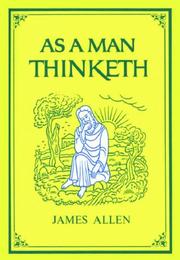
As a Man Thinketh: A book that will help you to help yourself
2,673-word summary 12 min read 80 pages in the book
- First published
- 1903
- Publisher
- Tarcher
- Pages
- 80
- ISBN
- 9781585425648
Reading options
What's inside (8 sections)
A shilling book you could carry in your pocket
I expected something thicker. The modern self-help shelf has trained readers to expect a program, worksheets, a foreword by someone with a podcast. James Allen's little book of 1903 is none of that. In his own foreword he calls it "the result of meditation and experience" and says plainly that it is "suggestive rather than explanatory." He wanted to stir readers toward a single idea: that they are "makers of themselves" through the thoughts they choose and encourage. He describes mind as "the master-weaver," working at two looms at once, the inner garment of character and the outer garment of circumstance.
The physical book matched that ambition. Allen advertised it as costing one shilling and being small enough to carry in a pocket. The famous line he took for the title comes from Proverbs, chapter twenty-three, verse seven: "As a man thinketh in his heart, so is he." In its original setting that verse is a warning about the motives of a host who is being generous with food while his heart is elsewhere. Allen turns it inward. The book is about the reader, not the host. He also gave it the subtitle that appears on the title page of this edition, "A book that will help you to help yourself," and called it a pocket companion for thoughtful people.
What follows is seven short chapters, no longer than a long essay in total. The edition cited here is the Tarcher hardcover of 2006, which runs to eighty pages. The argument has not been repackaged for a modern audience, and much of its power comes from how compact it is. Allen says a thing once, in plain language, and moves on. That makes it easy to read in an hour and strangely hard to shake.
Thought and Character: the seed and the plant
The opening chapter starts with the title verse and draws out what Allen thinks it means. His claim is blunt: a person is literally what he thinks, with character being the complete sum of all his thoughts. He reaches for a gardener's comparison. Just as a plant could not exist without the seed it came from, every act springs from hidden seeds of thought, including the acts people call spontaneous or unpremeditated. Act is the blossom, he writes, and joy and suffering are the fruit.
I have always found this the most persuasive part of the book, and also the most demanding. Allen is not saying that bad moods cause bad things. He is saying that cause and effect work in the hidden world of thought just as surely as they work in the visible world of matter. A noble character is not a gift of favor or chance, on this account. It is the result of long, continued effort in right thinking. An ignoble one comes from harboring base thoughts over years.
He puts the responsibility squarely on the individual. A person forges the weapons by which he destroys himself in the armory of thought, and fashions the tools for building what he calls heavenly mansions of joy and strength and peace. Even in weakness, Allen insists, a man remains the master, though he is a foolish master who misgoverns his own household. The person who begins to reflect on his condition and search for the law behind it becomes the wise master instead.
The chapter ends with an image of mining. Gold and diamonds come only from much digging, and truth about oneself comes from searching deep into the mine of the soul. Allen quotes the line about seeking and finding, and about the door being opened to whoever knocks. What he means by all this is practical and almost tedious: watch your thoughts, notice their effects on yourself and other people, link cause to effect through patient practice, and treat even the most trivial daily occurrence as evidence. There is no shortcut in his version of self-knowledge.
Circumstances: the garden and the three cases
The second chapter gives the book its most repeated image. A man's mind is like a garden. It can be cultivated or left wild, but either way it will produce something. If useful seeds are not planted, weed seeds will fall in and keep reproducing. The gardener who wants flowers and fruit has to pull the weeds out, and Allen says a person can do the same with wrong, useless, and impure thoughts. Do this long enough, he promises, and you discover that you are the master gardener of your own soul.
From there he argues that thought and character are one, and that character can only show itself through circumstance. His formulation is worth holding onto: circumstance does not make the man, it reveals him to himself. Nothing in a life is chance, in this view. A person is where he is because of the thoughts he has built into his character, and each situation is there to teach something. Once the lesson is learned, the circumstance passes and another takes its place.
To make this concrete, Allen gives three cases, and they are the closest the book comes to actual scenes. The first is a poor man who is anxious to improve his home but shirks his work and thinks he is justified in deceiving his employer because the wages are too low. Allen says this man is not merely failing to rise out of wretchedness; he is attracting more of it by acting out indolent and dishonest thoughts. The second is a rich man who has made himself sick through gluttony and is willing to pay any amount to be well, provided he can keep eating rich food. The third is an employer who cuts his workers' wages and uses crooked accounting to avoid the agreed rate, then calls himself a victim when bankruptcy comes.
These are types rather than people, and I could feel Allen stacking the deck. Each man is clearly the author of his own trouble in a way real people rarely are. Still, the mechanism he is describing is sharp. He says that men do not attract what they want but what they are. Their passing fancies get thwarted, while their deep thoughts and desires get fed. He then lays out a chain: thought crystallizes into habit, and habit solidifies into circumstance. Fear, doubt, and indecision harden into irresolute habits and then into failure. Courage and self-reliance harden into different habits and different outcomes. The world, he writes, is a kaleidoscope whose shifting colors are exact pictures of a person's moving thoughts.
Health and the Body: the servant of the mind
The third chapter is the one I argued with most. Allen opens by saying the body is the servant of the mind and obeys it whether the thought is chosen deliberately or merely allowed to surface. Disease and health are rooted in thought, he says. Fear has been known to kill as quickly as a bullet, and anxiety demoralizes the whole body and leaves it open to illness. Impure thoughts, even when they are not acted on, will wreck the nervous system.
Then comes a line that is repeated often in summaries of this book: a change of diet will not help a person who will not change his thoughts. When thoughts become pure, Allen claims, the desire for impure food falls away. He follows it with the claim that no saint who neglects to wash his body is really a saint, and that a person with purified thoughts need not fear the microbe.
I want to be fair to the man. He is writing in 1903, before antibiotics, and he is reacting against a habit of treating the body as a separate machine that can be fixed while the mind keeps doing whatever it likes. His best observations are about the face. He knows a woman of ninety-six whose face is as bright and innocent as a girl's, and a man well under middle age whose features are drawn into hard contours. The difference, he says, is a sweet and sunny disposition in one case and passion and discontent in the other. He distinguishes wrinkles made by sympathy from those carved by folly and pride. He describes a philosopher dying peacefully, not old except in years. His conclusion is that there is no physician like cheerful thought and no comforter like goodwill.
But the chapter leaves no room for germs, genetics, accidents, or plain bad luck. A reader living with a chronic illness will find parts of it brittle, even unkind. The claim that purified thought makes a person immune to a malicious microbe is simply wrong. What survives is the narrower observation, which is still useful: the way a person habitually thinks does leave a mark on the face, the posture, and the tone of a life. Allen overstates it because he wants the law to be absolute. The overstatement is the price of the book's clarity.
Purpose and achievement: the straight line
The fourth chapter is about direction. Until thought is linked with purpose, Allen writes, there is no intelligent accomplishment. He compares most people to a boat allowed to drift on the ocean of life and calls aimlessness a vice. People without a central purpose fall prey to petty worries, fears, and self-pity, which he treats as weaknesses leading to failure by a slower route than outright sin.
His advice is to conceive a legitimate purpose and make it the center of your thoughts. It can be a spiritual ideal or a worldly object, depending on where you are. Focus on it, make it your supreme duty, and do not let the mind wander into fancies. Crucially, he says that failing again and again does not mean you have failed. The strength of character gained through the attempt is the measure of real success, and it becomes the starting point for more power later. For people not ready to hold a great purpose, he recommends doing the duty in front of them faultlessly, however small it appears. That, he says, is how thought gets gathered and resolution built.
A physically weak person becomes strong through patient training, and a person with weak thoughts does the same through right thinking, in his comparison. Then comes the warning about doubt and fear. They are disintegrating elements that break the straight line of effort and make it crooked. He writes that the will to do springs from the knowledge that we can do, and that doubt and fear are the enemies of that knowledge. Thought allied fearlessly to purpose becomes creative force.
The fifth chapter widens this into a claim about all success. Everything a person achieves or fails to achieve is the direct result of his own thoughts, Allen writes, and individual responsibility is absolute. His compressed version of the whole argument is a pair of sentences: as a man thinks, so he is; as he continues to think, so he remains. A strong person cannot help a weaker one unless the weaker consents to be helped, and even then the work of becoming strong must be done by the person himself.
This is where the book shows its blind spot most clearly. Allen discusses the old saying that men are slaves because one man is an oppressor, and the newer reversal that one man is an oppressor because many are slaves. He rejects both and concludes that oppressor and slave are cooperators in ignorance, afflicting themselves while seeming to afflict each other. It is a beautiful sentence and a poor piece of social analysis. It folds whole systems of power into a matter of individual thought and suggests that the way out of oppression is for the oppressed to lift their thoughts. I think he means to be compassionate, and he explicitly says a perfect compassion embraces both. But the effect is to make structural injustice disappear.
The chapter closes on sacrifice. He who would accomplish little must sacrifice little, he writes; he who would achieve much must sacrifice much; he who would attain greatly must sacrifice greatly. Achievement is the crown of effort and the diadem of thought, and victories won by right thinking have to be maintained by watchfulness, because many people let go once success feels secure.
Visions, ideals, and the quiet ending
The sixth chapter opens with a line that has been quoted more than almost anything else in the book: the dreamers are the saviors of the world. Allen means artists and thinkers, the composers, sculptors, painters, poets, prophets, and sages who keep a vision alive for the rest of humanity. He names Columbus, Copernicus, and Buddha as people who cherished a vision of something not yet seen and then entered into it. Dreams are the seedlings of realities, he writes. To desire is to obtain, to aspire is to achieve.
His example is a young man trapped in an unhealthy workshop, poor, unschooled, and working long hours. The youth dreams of intelligence and refinement, builds an ideal life in his mind, and uses every spare hour to develop his powers. Eventually the workshop no longer fits him, and it falls away like a garment. Years later he is a man of wide influence, holding responsibilities that reach across the world. Allen also quotes the writer Stanton Kirkham Davis on a bookkeeper who walks out of his office one day and pours out a torrent of inspiration, and a shepherd who wanders into a master's studio and is at last told there is nothing more to teach him.
The point of all this is that luck is a word people use when they have not seen the effort. Someone grows rich and is called lucky. Someone becomes learned and is called favored. Allen says what onlookers miss is the trials, failures, sacrifices, and long darkness that preceded the visible result. Chance is not, he writes at one point. Gifts are thoughts completed and visions realized.
The last chapter is called Serenity in the contents, though the heading in the older text I read is simply about calmness of mind. Allen calls calmness one of the jewels of wisdom and the result of long, patient effort at self-control. A person becomes calm in proportion as he understands himself as a being shaped by thought, because that understanding leads to understanding others the same way. He stops fussing and worrying and grieving and remains poised. The calm man is like a shade-giving tree in a dry country, or a sheltering rock in a storm. The more tranquil a person becomes, the greater his influence, and even an ordinary trader will find business improving, because people prefer to deal with someone whose manner is steady.
The book ends with a command to stop reasoning and be quiet. To tempest-tossed souls he says that the islands of blessing are smiling and the shore of the ideal is waiting. Keep your hand on the helm of thought, he writes; the master in the boat is only sleeping, so wake him. Self-control is strength, right thought is mastery, calmness is power. Say to your heart, peace, be still.
I keep coming back to the shape of the thing. Allen wanted a book that could be carried in a coat pocket and read on a train, and that is still what it is. It asks for no belief system, no teacher, and no purchase beyond the eighty pages in your hand. Its stubbornness is partly its charm. When it is wrong, it is wrong in a way you can see clearly, which is more than can be said for a lot of advice that sells itself as science. When it is right, it is right in a way that needs no equipment: notice what you keep thinking about, because it is quietly becoming the shape of your life.
FAQ
Is As a Man Thinketh a religious book?
It takes its title from the Book of Proverbs and uses spiritual language, but it presents itself as practical self-help rather than doctrine. Allen's own subtitle calls it a book that will help you to help yourself.
How long is As a Man Thinketh and what are its chapters?
The Tarcher edition cited here is 80 pages. Its seven chapters cover thought and character, circumstances, health and the body, purpose, achievement, visions and ideals, and serenity.
Does the book's advice about health hold up?
Only partly. Allen's claim that cheerful thought can ward off disease leaves no room for germs or bad luck, though his observations about how habit shows on the face are still worth reading.
Similar books
You Can Heal Your Life
Louise Hay's 1984 bestseller argues that thoughts and beliefs shape the body, pairing a mirror-and-affirmation workbook with an A to Z list of ailments and…
3,672-word summary · 16 min read
The Power of Your Subconscious Mind
Joseph Murphy argues that the subconscious accepts whatever the conscious mind repeats, so worry and confidence quietly grow into very different lives.
2,259-word summary · 10 min read

Ikigai: The Japanese Secret to a Long and Happy Life
Two Spanish writers explain the Japanese idea of a reason for being, drawing on Okinawan centenarians, flow, friendship and the acceptance of imperfection.
2,030-word summary · 9 min read
Flow: The Psychology of Optimal Experience
Csikszentmihalyi's 1990 study of optimal experience asks when people feel most alive and finds the answer in a balance of challenge and skill. Drawing on…
3,073-word summary · 14 min read
The Courage to Be Disliked: The Japanese Phenomenon That Shows You How to Change Your Life and Achieve Real Happiness
A philosopher and an angry young man argue over five nights about Adlerian psychology, trauma, approval, and the freedom to be disliked.
2,054-word summary · 9 min read
Four Thousand Weeks: Time Management for Mortals
Oliver Burkeman turns the whole productivity project on its head, arguing that a human lifespan of roughly four thousand weeks is not a problem to optimize…
2,447-word summary · 11 min read
The Road Less Traveled: A New Psychology of Love, Traditional Values and Spiritual Growth
M. Scott Peck argues that maturity begins with accepting difficulty, then builds discipline, love, and spiritual growth through honest, often painful work.
2,200-word summary · 10 min read
The Untethered Soul
Singer names the noisy inner voice and shows how watching thoughts, loosening old hurt, and keeping the heart open through surrender can ease daily suffering…
2,752-word summary · 12 min read
The Art of Happiness
The Dalai Lama and psychiatrist Howard Cutler link lasting happiness to training the mind, human warmth, compassion, and basic spiritual values for daily life.
3,394-word summary · 15 min read
Tao Te Ching: Annotated & Explained
Eighty one brief verses on the Way and effortless action, with Lin's translation and facing notes.
2,140-word summary · 10 min read
A New Earth
Tolle maps ego pain and shows how presence can loosen roles, thoughts, and suffering.
1,909-word summary · 8 min read
The Four Agreements
Don Miguel Ruiz offers four Toltec agreements for personal freedom: impeccable word, detachment, curiosity, and effort.
2,289-word summary · 10 min read
The Defining Decade: Why Your Twenties Matter - and How to Make the Most of Them Now
A clinical psychologist argues that the twenties are not a holding pattern and urges readers to build skills, ties, and commitment now.
2,443-word summary · 11 min read
The Pursuit of God: The Human Thirst for the Divine
Ten short chapters on wanting God rather than merely knowing about him, from a pastor who wrote the book in a single night on a train.
2,014-word summary · 9 min read
The Miracle Morning
Hal Elrod argues that the first hour of the day sets its tone, and offers six short practices, silence, affirmations, visualization, exercise, reading and…
2,240-word summary · 10 min read
Rising Strong: The Reckoning. The Rumble. The Revolution.
Brené Brown's 2015 book asks what happens after we fall, and argues that examining the stories we invent about failure and heartbreak is the path to getting…
2,271-word summary · 10 min read
My Utmost for His Highest
A posthumous collection of 366 daily devotional readings assembled from Oswald Chambers's sermons, built around surrender, discipleship and the gap between…
2,015-word summary · 9 min read
Digital Minimalism: Choosing a Focused Life in a Noisy World
Cal Newport argues that willpower cannot beat an attention economy designed against you, and offers a thirty day reset to rebuild your digital habits around…
2,701-word summary · 12 min read
Captivating: Unveiling the Mystery of a Woman's Soul
A Christian companion to Wild at Heart in which John and Stasi Eldredge argue that women carry three God-given desires that wounds can bury. Warm, scriptural…
2,722-word summary · 12 min read
Boundaries: When to Say Yes, How to Say No to Take Control of Your Life
A Christian self-help book that treats a boundary as a personal property line and applies the idea to family, friendship, marriage, work and the self.
2,047-word summary · 9 min read
The Prayer of Jabez: Breaking Through to the Blessed Life
A tiny 2000 devotional built on two verses in Chronicles became a publishing phenomenon and a lightning rod for criticism.
2,296-word summary · 10 min read
The Obstacle Is the Way: The Timeless Art of Turning Trials into Triumph
A 2014 Stoic self-help book arguing that perception, action and will can turn setbacks into fuel, told through historical anecdotes.
2,669-word summary · 12 min read
The Light We Carry: Overcoming in Uncertain Times
Michelle Obama's follow-up to Becoming offers ten practical habits for meeting fear, self-doubt and uncertainty, told through stories of her family,…
2,327-word summary · 10 min read
The Autobiography of Benjamin Franklin
Franklin writes his own life in four parts, from a Boston boyhood and a runaway apprenticeship to printing, science, and public service, while keeping careful…
2,259-word summary · 10 min read
Everything is F*cked: A Book About Hope
Manson argues that hope, built on control, values, and community, keeps despair at bay, then takes apart the stories and diversions we use to sustain it.
2,789-word summary · 12 min read
Concerning the Spiritual in Art
Kandinsky argues that art must come from an inner need and that colour and form can speak directly to the soul, in a book that also made the case for…
2,289-word summary · 10 min read
Don't Sweat the Small Stuff ... and It's All Small Stuff: Simple Ways to Keep the Little Things from Taking Over Your Life
Richard Carlson’s 1997 bestseller offers one hundred short chapters on lowering the volume on daily irritations, and it is more pragmatic than its title…
2,502-word summary · 11 min read
The Dharma Bums
Ray Smith rides freight trains, climbs Matterhorn Peak and argues about Zen with the poet Japhy Ryder in Kerouac's 1958 road novel.
2,729-word summary · 12 min read

Beyond Good and Evil: Prelude to a Philosophy of the Future
A guide to Friedrich Nietzsche's Beyond Good and Evil: its attack on moral prejudice, the will to power, master and slave morality, and the philosopher of the…
2,597-word summary · 12 min read
The Artist's Way: A Spiritual Path to Higher Creativity
A twelve week course with morning pages and artist dates to recover creativity.
2,345-word summary · 10 min read