
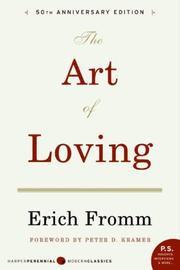
The Art of Loving
3,175-word summary 14 min read 180 pages in the book
- First published
- 1956
- Publisher
- Harper Perennial Modern Classics
- Pages
- 180
- ISBN
- 9780061129735
Reading options
What's inside (9 sections)
I picked this up expecting a small book of comfort and got something closer to a scolding. Erich Fromm's The Art of Loving first appeared in 1956, published by Harper & Brothers as part of the World Perspectives series edited by Ruth Nanda Anshen. It is a short book, about 180 pages in the Harper Perennial Modern Classics paperback I read. It became Fromm's bestseller, sold in the millions, and had what The Washington Post called an enormous vogue on campuses in the 1960s, when he became something of a cult figure among students. Reading it now, I can see why people looking for a new language to talk about love and freedom seized on it. I can also see why some of those same readers eventually found its certainties hard to live with.
Fromm was a psychoanalyst and social philosopher who had been central to the Frankfurt School in its early years, before a sour break with Max Horkheimer and Theodor Adorno. The ideas here do not arrive from nowhere. In the preface he says they restate themes from his earlier books Escape from Freedom, Man for Himself and The Sane Society. He also links the book to the new feeling of possibility he found while courting Annis, the woman who became his wife. That origin is worth keeping in mind. This is a book written by someone who believes he has found a way to live and wants very much to tell other people about it.
The wager: love is an art, not a mood
The preface announces the argument plainly. Fromm says the book is not a set of instructions in what he calls the art of loving. Instead it argues that love is a practice requiring the whole personality, and that anyone who tries to love without committing themselves to learning and practising it will fail. He puts the condition starkly: individual love cannot be attained without the capacity to love one's neighbour, without true humility, courage, faith and discipline. An epigraph from Paracelsus, set in the front matter, ties love to knowledge. The two belong together, Fromm suggests, and separating them is where most of our trouble starts.
Chapter One, headed "Is Love an Art?", begins by describing how little thought people give to learning it. Love matters enormously to us, Fromm says, yet we assume there is nothing to learn. One reason is that most people treat the problem of love as the problem of being loved rather than the problem of loving. They work on being attractive instead of working on their capacity to love. In Western society, Fromm writes, what counts as being lovable is "essentially a mixture between being popular and having sex appeal." That line landed when the book came out, and it still has a sting.
A second mistake is to treat love as a matter of finding the right object rather than acquiring a skill. Loving is assumed to be easy, while finding the right person is assumed to be hard. Fromm compares the resulting habits to a labour market, in which people size up a potential partner's social value against their own limitations and hope to strike a good bargain. If you have ever watched a dating profile turn into a list of assets and liabilities, you will recognise the scene he is describing, even if his 1950s language sounds quaint now.
The third confusion is between falling in love and what he calls standing in love. Falling in love is by nature not lasting, he argues. Once two people know each other well, the miraculous quality drains away and antagonism, disappointment and boredom move in. The intensity of the initial rush is no proof of the depth of the relationship. In one of his sharper observations, Fromm says that the violence of falling in love "may only prove the degree of their preceding loneliness." He closes the chapter with a complaint that still feels fair: hardly any human undertaking begins with such tremendous hope and ends so regularly in failure.
His explanation is that we neglect love as an art, which means neglecting both its theory and its practice. To master any art, he insists, the mastery must become a matter of ultimate concern, with nothing else in the world more important. Here the argument turns social. Most people, he says, want success, prestige, money and power more than they want to love, especially in a capitalist society that rewards those things. Love is pushed down the list. I found this convincing as a description of priorities, but it is also where the book starts to sound less like a friend talking and more like a lecturer with a favoured theory.
Why we need love at all
Chapter Two opens with a claim that governs everything after it: any theory of love must begin with a theory of human existence. Fromm's account is that reason is our defining trait. Before we had reason, he says, we lived in harmony with the animal world, and we cannot go back to that state. We have to move forward into a new harmony. Reason makes us, in his phrase, "life being aware of itself," and that awareness separates us from every other creature. The separation is, for him, the source of all anxiety.
He uses the story of Adam and Eve to explain the problem. Once man and woman become aware of their difference from each other, they remain strangers, and shame, guilt and anxiety follow. Reunion through love is the way back. The underlying question for every human being is how to overcome separateness, how to achieve union, how to transcend one's individual life and find at-onement. Different cultures and religions have answered that question in different ways, and Fromm walks through several of them.
The first is the orgiastic state, in which separateness is washed away through drugs or sexual orgies. The trouble is that the unity does not last. The second is conformity, which Fromm sees as the characteristic solution of modern capitalist society. Equality, he argues, has quietly changed meaning from oneness to sameness. People become interchangeable, the "nine to fivers" who hand their fulfilment over to a job. He even connects this to the loss of sexual polarity and, with it, a certain kind of erotic love, a claim that has aged less well than the rest.
Then there is what he calls symbiotic union, which he divides into sadism and masochism. In that arrangement both people depend on the other, and the integrity of each is diminished. Domination is the harshest version of the same impulse, and his example is a child pulling a butterfly apart to see how it works. Against all of these he sets mature love: union on the condition that each person keeps their own integrity and individuality. It is a demanding definition, and it rules out a great deal of what passes for love.
Care, responsibility, respect and knowledge
Having said that love is an active power, Fromm argues that its active character is chiefly a matter of giving. Not giving in the sense of sacrifice, but giving as the highest expression of one's own vitality. He then names four elements that any loving relationship must contain.
Care comes first. Love is "the active concern for the life and the growth of that which we love." His example is deliberately plain. No one would believe a mother loved her baby, whatever she said, if she refused to feed it, bathe it or comfort it. Care is visible in what you actually do. He adds a line I kept returning to: one loves that for which one labours, and one labours for that which one loves.
Responsibility follows, and Fromm takes care to separate it from duty. Responsibility is a voluntary response to the needs of the other person. On its own, though, it can become meddling or exploitation, which is why respect has to come with it. He quotes the French line that love is the child of liberty, and insists that love must want the other person to grow as they are, not as we would like to remake them. Respect, he says, is possible only if I have achieved independence myself.
Knowledge is the fourth element, because we cannot respect someone we do not know. Fromm's version of knowledge goes beyond collecting facts about a person. It means knowing them from the inside, their capacities and their weaknesses, and it is tied to the humility of accepting that we do not know everything. All four attitudes, he says, are possible only in a mature person who has given up what he calls narcissistic dreams of omniscience and omnipotence and has found a grounded humility through genuine productive work.
This is the heart of the book, and it is also the part that tries my patience. The four elements are useful, and I have thought about them since finishing. But the vocabulary of maturity and productiveness is never quite unpacked, and Fromm sometimes writes as though agreeing with him is a sign of health and disagreeing is a symptom. The chapter ends with a swipe at Freud for not understanding sex properly, which feels like a digression picked up from an older argument the reader was never part of.
Mother, father and the love we learn to give
Fromm then looks at the earliest relationships, starting with the baby's sense of being loved for what it is, or simply because it is. This love is unconditional, he says. It need not be acquired and it need not be deserved, which is a blessing when it is present and a disaster when it is absent, since there is nothing a child can do to produce it. Before roughly the age of nine, he argues, children experience being loved without yet loving in return. The first stirrings of giving, such as offering a parent a gift, come later, and mature love takes many years beyond that.
He puts the difference in four short phrases. The immature person says "I love because I am loved" or "I love you because I need you." The mature person arrives at "I am loved because I love" and "I need you because I love you." The direction of dependence flips. Where the child needs love in order to feel secure, the adult loves from a position of security and no longer needs to be good in order to deserve affection.
Motherly and fatherly love occupy opposite poles in his scheme. The mother represents the natural world, the world of warmth and the conditions of life. The father stands for thought, for things made by human beings, for adventure and for the world beyond the home. Motherly love is unconditional, while fatherly love is conditional and can be earned. In infancy, he says, we want the mother's love most; later we begin to crave the father's. A well-adjusted adult eventually carries both inside, becoming their own source of unconditional acceptance and of earned approval.
I read these pages with mixed feelings. The broad shape of the argument, that we move from being carried by love to being able to give it, seems right to me. The details belong to a particular time. His picture of mothers and fathers as fixed symbolic poles, and his use of "man" throughout, make the chapter feel like a document of the 1950s rather than a description of every family. Fromm would probably have said that the underlying psychology is universal and the surface details are incidental. A present-day reader may not be so willing to separate the two.
The five objects of love
Fromm rejects the idea that loving one person and nobody else proves how intense that love is. On the contrary, he says, you can truly love one person only if you are capable of loving anyone. He then sorts love into five kinds, and much of the interest lies in the distinctions.
Brotherly love is his term for the regard one feels for other people simply because they are human. It is love between equals, though as he notes, even equals are not always equal, since "today I, tomorrow you" may be the one who needs help. He traces it to care for the helpless, the poor and the stranger, and quotes the Book of Exodus: "You know the heart of the stranger, for you were strangers in the land of Egypt." The command that follows, to love the stranger, gives the section its moral weight.
Motherly love returns with an added layer. A mother owes her child more than the milk of basic care and affirmation, Fromm says. She also owes it the honey, the sweetness of being alive, which only a genuinely happy mother can pass on. Unlike brotherly love, this love is not between equals. Most mothers manage it while their children are small, he claims, and the real test comes when the child grows, matures and pulls away. Loving someone who no longer needs you in the same way is harder than loving a dependent infant.
Erotic love is the craving for complete fusion with one other person, with sexual union as a vital part of that fusion. Fromm is careful about sex. Desire can be blind, he writes, and can be stirred by any strong feeling, not only love. Sex without love may create an illusion of unity, but afterwards the two people are as much strangers as before, and shame or hatred can follow. He also attacks what he calls "egotism à deux," the common case of two people who love each other and nobody else. Exclusivity gets mistaken for possession, when in his view the love of one person should open outwards to all of humanity.
Self-love gets the most space, because Fromm is arguing against a long tradition. In Western thought, he says, it is treated as virtuous to love others and sinful to love oneself. He takes on Calvin and Freud in particular, and insists that self-love is neither narcissism nor a turning inward of the libido. If we are to love our neighbour for the sake of humanity, he reasons, we must love ourselves for the same reason. "Love of others and love of ourselves are not alternatives," he writes. Love is indivisible where the connection between other people and the self is concerned.
His sharpest move is to separate self-love from selfishness. They are, he says, opposites. The selfish person's problem is not loving oneself too much but too little, a failure of fondness and care that leaves them empty and anxious. He is equally hard on what he calls neurotic unselfishness, the person who gives everything to others and takes pride in it. His example of the unselfish mother is unsettling: her children do not show the happiness of people who feel loved, but anxiety and fear of her disapproval. Her unselfishness, he says, can be worse than selfishness, because the children cannot criticise her.
The last object is the love of God, which Fromm treats as a religious form of the same need for union. His claim is that the kind of god a person imagines, and the way they relate to it, reflect their level of maturity as an individual and as a member of a society. He leans on what he calls paradoxical logic, the ability to hold opposing ideas together, in this section and in the one on erotic love. This is the briefest and least persuasive part of the argument for a secular reader, and it depends on assumptions about religious imagery that he does not pause to defend.
Where love comes apart
Chapter Three, "Love and Its Disintegration in Contemporary Western Society," is short and largely restates the early warning about egotism à deux. Fromm calls the modern couple a well-assorted team, matched sexually and functionally, working towards a shared aim. He misses the older idea of a willful commitment to one unique person, and he argues that a person who cannot love all of mankind, themselves included, cannot truly love a partner either. The alienated person, in his account, relates to other human beings as things to be used.
I found this chapter the weakest in the book. It names a real problem, the way partnership can become a practical arrangement with emotional benefits, but it offers little that the first chapter has not already said better. The social critique also stays at a high level of generality. Capitalism and alienation do a lot of work in Fromm's writing, and here they are asserted rather than shown. If you want the fuller version of that argument, you would need to go to his other books.
Practice, patience and the last page
The final chapter is called "The Practice of Love," and Fromm immediately warns away readers who expect a recipe. Anyone hoping to be told how to do it to yourself, he says, will be gravely disappointed. What he offers instead is a set of general conditions for mastering any art: discipline, concentration and patience, followed by what he calls supreme concern. Without those, he argues, no amount of reading or good intention will change anything.
The point I took from these pages is that Fromm treats love as a decision you keep making, not a state you fall into and then inhabit. Falling in love supplies the spark, but standing in love requires the daily work of care, responsibility, respect and knowledge. He is not offering a technique for getting someone to love you. He is asking whether you have the kind of character that can love at all, and he thinks most people avoid the question.
The epilogue gives the book its most quoted line. Fromm calls love the only sane and satisfactory answer to the problem of human existence, which is the claim he has been building towards since the chapter on separateness. It is a large claim for a short book, and it is easy to see how it could sound both liberating and oppressive. The book's reputation reflects that split. It was praised for making difficult ideas available to ordinary readers, and criticised in leftist circles on publication for being insufficiently emancipatory, with Harvard's student paper arguing that Fromm was attacking modern loving rather than offering a politics of it.
I closed it feeling that the storms around this book say more about the 1950s and 1960s than about the advice itself. What lasts is the insistence that love is something you do, and that you can get better at it only by paying attention to the person in front of you. The language is dated in places and the tone can be stern, but I know people who have kept this book on a shelf for decades and returned to it at every breakup. That is a stranger sort of praise than a bestseller number, and probably a more useful one.
FAQ
Is The Art of Loving a self-help book?
It is often shelved that way, but Fromm states in the preface that it gives no step-by-step instructions. It is a work of social psychology and philosophy about the kind of character needed to love.
When was The Art of Loving published?
It first appeared in 1956 from Harper & Brothers as part of the World Perspectives series. The edition cited here is the 2006 Harper Perennial Modern Classics paperback, with a foreword by Peter D. Kramer.
What does Fromm mean by self-love?
He treats it as the affirmation of one's own life and growth, and argues it is the opposite of selfishness. He claims that a person who cannot love themselves cannot truly love anyone else.
Similar books
Attached
A psychiatrist and a psychologist explain adult attachment styles and show how anxious, avoidant, and secure patterns shape dating, conflict, and the search…
2,157-word summary · 10 min read
All About Love: New Visions
bell hooks borrows a definition of love as an action rather than a feeling, then spends thirteen chapters showing how hard it is to practice.
2,385-word summary · 11 min read
The Defining Decade: Why Your Twenties Matter - and How to Make the Most of Them Now
A clinical psychologist argues that the twenties are not a holding pattern and urges readers to build skills, ties, and commitment now.
2,443-word summary · 11 min read
The Power of Your Subconscious Mind
Joseph Murphy argues that the subconscious accepts whatever the conscious mind repeats, so worry and confidence quietly grow into very different lives.
2,259-word summary · 10 min read

Ikigai: The Japanese Secret to a Long and Happy Life
Two Spanish writers explain the Japanese idea of a reason for being, drawing on Okinawan centenarians, flow, friendship and the acceptance of imperfection.
2,030-word summary · 9 min read
Flow: The Psychology of Optimal Experience
Csikszentmihalyi's 1990 study of optimal experience asks when people feel most alive and finds the answer in a balance of challenge and skill. Drawing on…
3,073-word summary · 14 min read
Digital Minimalism: Choosing a Focused Life in a Noisy World
Cal Newport argues that willpower cannot beat an attention economy designed against you, and offers a thirty day reset to rebuild your digital habits around…
2,701-word summary · 12 min read
Boundaries: When to Say Yes, How to Say No to Take Control of Your Life
A Christian self-help book that treats a boundary as a personal property line and applies the idea to family, friendship, marriage, work and the self.
2,047-word summary · 9 min read
Atlas of the Heart: Mapping Meaningful Connection and the Language of Human Experience
Brené Brown maps 87 emotions and experiences into thirteen 'places we go,' arguing that precise language changes what we can ask for and how we connect.
2,491-word summary · 11 min read
Everything is F*cked: A Book About Hope
Manson argues that hope, built on control, values, and community, keeps despair at bay, then takes apart the stories and diversions we use to sustain it.
2,789-word summary · 12 min read
The Courage to Be Disliked: The Japanese Phenomenon That Shows You How to Change Your Life and Achieve Real Happiness
A philosopher and an angry young man argue over five nights about Adlerian psychology, trauma, approval, and the freedom to be disliked.
2,054-word summary · 9 min read
Four Thousand Weeks: Time Management for Mortals
Oliver Burkeman turns the whole productivity project on its head, arguing that a human lifespan of roughly four thousand weeks is not a problem to optimize…
2,447-word summary · 11 min read
The Road Less Traveled: A New Psychology of Love, Traditional Values and Spiritual Growth
M. Scott Peck argues that maturity begins with accepting difficulty, then builds discipline, love, and spiritual growth through honest, often painful work.
2,200-word summary · 10 min read
The Untethered Soul
Singer names the noisy inner voice and shows how watching thoughts, loosening old hurt, and keeping the heart open through surrender can ease daily suffering…
2,752-word summary · 12 min read
The Art of Happiness
The Dalai Lama and psychiatrist Howard Cutler link lasting happiness to training the mind, human warmth, compassion, and basic spiritual values for daily life.
3,394-word summary · 15 min read
Men Are from Mars, Women Are from Venus
Gray's Mars-and-Venus guide to why men withdraw and women talk, and how small daily acts of care keep a relationship working.
2,073-word summary · 9 min read
A New Earth
Tolle maps ego pain and shows how presence can loosen roles, thoughts, and suffering.
1,909-word summary · 8 min read
12 Rules for Life
Twelve essays on responsibility from posture to truth to petting cats.
2,045-word summary · 9 min read
The Symposium
At a banquet in Athens, seven men compete to praise Eros, ending with Socrates' account of Diotima and a drunken interruption by Alcibiades.
2,147-word summary · 10 min read
How to Change Your Mind
Pollan blends the history of psychedelic research, his own guided trips, and current neuroscience to ask what these drugs reveal about consciousness.
2,466-word summary · 11 min read
Women
Charles Bukowski's semi-autobiographical novel of Henry Chinaski at fifty, drinking heavily and sleeping his way through Los Angeles while fame arrives late.
2,124-word summary · 9 min read
Wild at Heart: Discovering the Secret of a Man's Soul
Why do men feel bored and tame? John Eldredge argues a man's heart is wild by design, and that recovering it means facing the wound and the question of whether…
2,289-word summary · 10 min read
The Zahir
A bestselling novelist's wife vanishes from their Paris home, sending him on a search that becomes a reckoning with his own marriage and attention.
2,433-word summary · 11 min read
The Miracle Morning
Hal Elrod argues that the first hour of the day sets its tone, and offers six short practices, silence, affirmations, visualization, exercise, reading and…
2,240-word summary · 10 min read
Rising Strong: The Reckoning. The Rumble. The Revolution.
Brené Brown's 2015 book asks what happens after we fall, and argues that examining the stories we invent about failure and heartbreak is the path to getting…
2,271-word summary · 10 min read
Release Me
A guarded engineering graduate newly arrived in Los Angeles is used as bait at an art gala, then offered a million dollars to pose for a powerful man's private…
2,070-word summary · 9 min read
Getting to Yes: Negotiating Agreement Without Giving In
Fisher and Ury propose negotiating on interests rather than positions, using fair standards and a clear alternative if no deal is reached.
2,231-word summary · 10 min read
Emotional Intelligence 2.0
Bradberry and Greaves turn emotional intelligence into four learnable skills, a self-assessment and dozens of strategies, while their headline numbers rest on…
3,276-word summary · 15 min read

Brida
A young Irishwoman convinced she has a spiritual Gift seeks out a forest Magus and a Dublin witch, and learns that her gift is to bridge the visible and…
2,012-word summary · 9 min read
The Obstacle Is the Way: The Timeless Art of Turning Trials into Triumph
A 2014 Stoic self-help book arguing that perception, action and will can turn setbacks into fuel, told through historical anecdotes.
2,669-word summary · 12 min read