
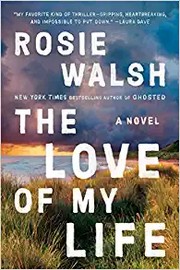
The Love of My Life
2,803-word summary 12 min read 372 pages in the book
- First published
- 2022
- Publisher
- Pamela Dorman Books
- Pages
- 372
- ISBN
- 9780593296998
Reading options
What's inside (7 sections)
I nearly put this down in the first chapter, not because it was bad but because I thought I had picked up the wrong sort of book. A man wakes to find his wife leaning over their three-year-old daughter, checking that she is still breathing. Downstairs, an anxious rescue dog called John Keats needs someone to sing to him before he will settle. For two pages it reads like a warm domestic comedy. Then the husband admits, almost in passing, that he has been drafting his wife's obituary at night while she sleeps, and the floor drops out. I finished it in two sittings. The Love of My Life was published in 2022, in the United States in March by Pamela Dorman Books, an imprint of Viking, and in Britain by Mantle that June. It is a standalone novel, and Walsh had already written The Man Who Didn't Call.
The trick at the centre of it is this. The marriage looks happy from the outside, but nearly everything the wife has told people about herself is made up, including her name. The line Walsh uses to sell the book is blunt: someone has held another person every night for ten years without knowing who that person really is. That is the promise, and the novel spends its length working out who is entitled to say it and what it costs.
The obituary writer and the woman he cannot file
Leo Philber writes obituaries for a local paper. It is a small, slightly comic job that he is good at, and he talks about it with the fond irritation of someone who knows the work is beneath his abilities. His wife Emma is an intertidal ecologist, a scientist who studies the creatures and places exposed when the tide goes out. She once hosted a BBC nature series, and she still gets strange messages from strangers on the fan page. She has also just come through treatment for cancer. The scan is clear, and the relief in the house is enormous, but the fear has not gone anywhere.
Her diagnosis arrived during IVF, while they were trying for Ruby. It was low grade for years and then turned serious six months before the book opens. Leo promised Emma he would stop pre-writing her obituary if she asked him to. He immediately breaks that promise, and he does it in the open enough that the reader understands this is how he copes, not a betrayal. At night, while Emma sleeps, he assembles the facts of her life into the neat shape of a newspaper notice.
His editor, Kelvin, asks him to write a proper one for the files, since Emma is a public figure of sorts and a stock obituary will be needed eventually. That is when the trouble starts. Leo sits down to write and discovers he does not know the basic things. How exactly did her mother die? Did she really graduate from St Andrews? The answers he thinks he has turn out to be soft. A letter from a professor suggests she left before finishing. A graduation photograph shows a gown in the wrong colour for that university. The papers she keeps in a locked cabinet, normally meticulous, have been moved into a shopping bag among her grandmother's things.
The house itself matters here. It once belonged to Emma's grandmother Gloria Bigelow, a Member of Parliament in the 1950s, and it is still crammed with the old woman's hoarded belongings. Gloria's funeral is where Emma and Leo met a decade earlier. Leo was sent to write the obituary, spoke to Emma on the phone, turned up at the service, and ended up walking with her the next day. They started dating almost at once. She moved to London for him. She proposed. On their first night together she told him she was complicated and then stopped, and he never asked her to finish. Now, surrounded by Gloria's papers, he understands what that unfinished sentence was hiding.
There is a gentler thread running through these chapters. Leo discovered not long after they met that he was adopted, and the news shattered him. His biological mother had died, so there could be no meeting, no explanation. He was angry with the parents who had kept it from him, and that anger changed his relationship with them. Emma watched this happen and decided her own confession would have to wait. She tells the reader plainly that she meant to explain everything early on, and that every year afterwards made it harder. Walsh is careful to make Leo's hurt believable, because it is the reason the secret grows teeth. He is the last person Emma thinks can be trusted with one.
The missing actress and the man in the cap
Running alongside the marriage is a second story that looks, for a while, like a separate thriller. Janice Rothschild, a well-known actress, has vanished. She walked away from rehearsals and has not been seen since. Leo's colleague Sheila is friends with the family, and Sheila keeps asking Leo odd questions about Emma, questions that suggest she knows a connection between them. Leo writes a stock obituary for Janice too, because that is what his job does with missing people. He finds photographs of her leaving a psychiatric hospital almost twenty years earlier, after the birth of her son.
Janice is married to Jeremy Rothschild, and Jeremy has been in touch with Emma. Leo does not know this yet, but the reader does. Emma has been answering messages from an unnamed man, meeting him in secret, and lying to Leo about where she is going. She tells him she is having dinner with her university friend Jill and then calls Jill to cover for her. The man is Jeremy. They meet in Alnmouth, on the Northumberland coast, where Emma has gone for a conference and, officially, to look for a living specimen of a crab she once found dead and photographed. Janice's letter to Emma mentions that same crab, and the mention is what makes the meeting strange rather than merely adulterous.
Leo, meanwhile, keeps finding threads. A name, Robbie, appears in Emma's papers and in a Facebook message. He looks Robbie up and learns he was a runner on Emma's BBC show. Leo travels to Glasgow to meet him under a false pretext, pretending to be a journalist gathering material for an obituary. Robbie tells him that Emma did not lose her job the way she said she did, that her agent Mags Tenterden was part of it, and that he once saw Emma with Jeremy Rothschild. The suggestion that Jeremy had something to do with Janice's disappearance hangs in the air.
There is also a man in a baseball cap who turns up outside the house and near Emma's workplace. Emma is frightened of him and assumes he is interested in the neighbouring house, which is for sale. The book lets the reader worry about a stalker for a good stretch before it reveals who he is, and I have to admit the reveal made me want to reread those scenes. He is not a threat in the way the book lets you fear. He is a young man working up the nerve to approach her.
The breaking point comes from a message Leo is not meant to see. Emma has drafted a text to Jeremy referring to him as the father of her child. Leo reads it and leaps to the conclusion that Ruby is not his daughter. He leaves the house without letting Emma explain. When he is willing to listen and comes back, she is gone. Worried, he calls Jeremy and asks for answers, and Jeremy gives him enough of the story to end the first part of the book.
Emily, and the baby she gave away
The second part goes back twenty years and changes the narrator. Emma was called Emily then. She was at university, sharing a flat with Jill, and she went home with a man she met while they were drinking. In the morning Jill told her the man was married. His name was David Rothschild, a cousin of Jeremy's. Emily was unsure whether they had used protection. Months later she realised she had missed several periods, took a test, and learned she was fifteen weeks pregnant. She considered termination and could not go through with it.
She and Jill looked up Jeremy Rothschild because he was a public figure and therefore easy to find. They wrote to him, and he called back quickly. His explanation is careful and kind. David wants nothing to do with the pregnancy. Jeremy and Janice have been trying to have a child and have started adoption proceedings. Would Emily consider letting them adopt her baby? She thinks about it hard. She has an elderly grandmother, no job, and a rental property left by a father who drank himself to death after her mother died of a postpartum haemorrhage days after Emily's birth. Janice's phone call, full of longing and warmth, convinces her the Rothschilds can offer more than she can.
The Northumberland beach scenes in this section are the quiet centre of the novel. Emily and Janice go there during the adoption process. They take shelter from the rain in a small stone sheep shed. Afterwards they find the carcass of a crab, the creature Emily later spends years trying to find alive, and she bends to photograph it. Then she bleeds and fears she is miscarrying. She goes to hospital alone, spooked by how possessive Janice has become, and the midwife tells her the baby is fine. That scare is enough to reverse her decision. She keeps the child.
What follows is the part of the book that is hardest to read. After the birth Emily develops postpartum psychosis. She becomes convinced the baby is a girl, and that the boy in her arms is a child someone has substituted. Her grandmother and the midwife have her hospitalised. She slowly begins to accept that Charlie is hers. Janice comes to visit, against Jeremy's advice, and believes she hears someone playing peek-a-boo in the corridor. She walks into the room and sees Emily with a pillow over the baby's face. She screams for help. Emily, confused and drugged, remembers putting the pillow there and accepts the version Janice insists on, that she tried to smother her son. She asks Jeremy and Janice to adopt Charlie because she believes he is not safe with her.
Walsh handles this by switching voices again. Janice's chapters are written as diary entries in the present tense, and her entries make it plain that the smothering was never what it seemed. At the time she believed it. The guilt of what she thinks she saw, and of the hold it gives her over Emily, shapes the rest of her life. The adoption goes through after a year, and the press has a field day with photographs of Jeremy and Janice leaving hospital with the baby. Emily begins watching the house to catch sight of Charlie. In a park, four months on, he wanders towards her and she hugs him before slipping away. Jeremy catches her leaving and she is arrested. The only penalty is a restraining order, which enrages Janice.
Emily later studies through the Open University, earns a master's degree, changes her name to Emma, and builds the career in marine ecology that makes her famous. Walsh does not dwell on the years between the court case and the marriage. She saves her space for the moment the past is forced back into the open.
The diary, the shed and the beach
The third part brings everyone into the present. Jeremy has told Leo a version of the story, which is why he goes to find Emma at Jill's house. Jill has arranged for Emma to meet Charlie, now a young man at college in Boston, and she has lied to do it. Charlie is the man in the baseball cap. He has known all his life that he was adopted and who his birth mother is. He has been trying to reach Emma because he is worried about Janice, who has disappeared, and because he wants to know her himself. He tells Emma that he has been reading his mother's diaries.
Those diaries undo the central lie. Charlie has found the entry in which Janice admits that Emily was playing peek-a-boo, not trying to kill him. Janice knew the truth for years and let Emma live with the belief that she had harmed her own child. Charlie confronted her with it, and soon afterwards she vanished. He also found a reference to a sanctuary in Northumberland that Janice connected with Emma, and he wonders whether Emma knows the place. She does not, at first. The letter Janice wrote about the crab and the stone shed puts her on the trail.
A shop owner in Alnmouth calls Jeremy to say Janice has bought two packets of paracetamol. Charlie and Emma drive up to look for her. The old sheep shed is abandoned, but nearby there are glamping cabins with the same view of Coquet Island, and Janice has checked into one of them. Emma finds her there, surrounded by empty packets and barely conscious. Leo has worked out where they went from a conversation with Sheila, and he arrives having already called an ambulance. He keeps Emma outside so that Ruby, and the paramedics, will not see her standing over the woman who tried to take her child.
The aftermath is handled more gently than the preceding suspense. Leo is angry, and fairly so, that Emma never trusted him with any of it. He can understand why she was afraid, but he cannot get over the fact that he did not know his wife's name. They talk about the small daily lies that held the big one in place, including the fact that Jill stayed with them after Ruby's birth in case the psychosis returned. They also discover that their marriage may not be legal, because Emma lied about her name on the application. On the beach, Leo asks her to marry him again. The epilogue shows them settling into ordinary life, with Charlie now texting about a visit and Emma thinking of Leo, Ruby and Charlie as the loves of her life.
What works, and what I would tighten
The structure is the thing I admired most. Three parts, with the narrator shifting between Emma and Leo in the present, then Emily and Janice in the past, then all three again at the end. Janice's sections are diary entries, Emily's past chapters use the past tense, and the present moves in the first person. It sounds like a gimmick written down, but in reading it feels like a way of showing how much of a life can be sealed off from the person living beside it. The crab, the shed, the dog who needs singing to, and the grandmother's cluttered house all return with a purpose.
The fair criticism is that the book leans on coincidence near the end. Emma happens to think of the cabins, Leo happens to reach the same conclusion from a phone call, and the evidence of Janice's diary arrives at exactly the moment it is needed. A reader who wants every turn earned may find that convenient. I also thought the obituary device was worked a little hard. Leo is the only truly gentle figure in the book, and the story asks him to absorb an extraordinary amount of betrayal with very little interest in his own damage. The title points at one kind of love while the book is more interested in another, and that is clever, though it can feel like a bait and switch if you arrive expecting a straightforward romance.
Read this if you like a domestic mystery with a love story underneath it, and if you are willing to sit with a narrator who has lied to you for two hundred pages. I would not hand it to someone who wants clean lines between the guilty and the innocent, or to a reader who cannot abide a coincidence or two. Walsh writes about the fear of losing a child from more than one angle here, and that is the material that gives the twists their weight. The obituary is what makes the reader ask the question, but the answer has to do with motherhood and guilt, and the names we give ourselves. By the last page I believed Emma and Leo had earned their quiet morning, even if the road there was paved with more luck than I quite credit.
FAQ
Is The Love of My Life a romance or a thriller?
It is both. Walsh, who also wrote The Man Who Didn't Call, wraps a mystery in a domestic love story, alternating tender scenes about a husband, wife and dog with a steady drip of clues.
Who is the love of the title?
On the surface it is Leo, the husband Emma almost loses. By the epilogue she also counts Charlie, the son she gave up for adoption, and their daughter Ruby.
Do I need to have read Rosie Walsh's other novels first?
No. This is a standalone book with no series, and the twenty-year-old backstory it depends on is explained within these pages.
Similar books
Ghosted
After seven perfect days with Eddie, Sarah is ghosted, and her search for answers uncovers a secret tied to the accident that changed both their lives.
2,011-word summary · 9 min read
We Live Here Now
After a near-fatal fall, a woman moves with her husband to a remote Dartmoor house where strange events happen only when she is alone, and a raven watches from…
2,016-word summary · 9 min read
The Wrong Bride
In Catharina Maura's Windsors opener, model Raven Du Pont takes her absent sister's place at the altar beside billionaire Ares Windsor, the man she has…
2,397-word summary · 11 min read
The Obsession
After a childhood in the shadow of her serial killer father, photographer Naomi Carson puts down roots in a coastal town, only to face a copycat killer…
2,230-word summary · 10 min read
Blood Orange
A criminal barrister with a drinking problem takes on her first murder case and finds the defendant's story mirroring her own crumbling marriage in this sharp…
2,469-word summary · 11 min read
When She Returned
Eleven years after vanishing from a California parking lot, Kate Bennett reappears in Montana with an infant, and her family learns that coming home may not…
2,338-word summary · 10 min read
The Divorce
A Long Island mother is evicted by her hedge-fund husband on their anniversary, and a twisty custody fight hides an older secret about her son.
2,227-word summary · 10 min read
The Unmaking of June Farrow
A woman in a North Carolina flower-farming family walks through a red door into 1951, where she must solve her mother's disappearance and decide whether to…
2,701-word summary · 12 min read
Strange Sally Diamond
Sally Diamond takes her dying father's joke literally and burns his body, then learns her whole childhood was built on a kidnapping and a lie.
2,411-word summary · 11 min read
The Widow
A widow of a suspected criminal faces reporters and police while hiding what her marriage really cost.
2,599-word summary · 12 min read
Everything We Keep
A widow questions her husband's death when a stranger claims his past.
2,307-word summary · 10 min read
Suzanne's Diary for Nicholas
A dumped editor reads a Vineyard mother's diary that reframes everything.
2,087-word summary · 9 min read
The Wives
A woman who sees her husband only on Thursdays tracks down his other wives and learns her marriage is not what she believed.
2,454-word summary · 11 min read
The Hawthorne Legacy
Avery hunts for lost Toby Hawthorne while old wills, postcards and a violent rival force her to face what the inheritance really costs.
2,576-word summary · 11 min read
Verity
Colleen Hoover's Verity explained: Lowen, injured Verity Crawford, the hidden autobiography, and the letter that flips everything.
2,593-word summary · 12 min read
The Last Coyote
On stress leave, Harry Bosch reopens the unsolved murder of his mother, a prostitute strangled when he was twelve, and finds corruption reaching the DA's…
2,069-word summary · 9 min read

Revelations
Schuyler is pulled into the Force household as Silver Bloods rise, and a Conclave gathering in Rio ends in bloodshed.
2,166-word summary · 10 min read
Love Forms
A Trinidadian mother sent away at sixteen returns to the loss of her daughter forty years later, in Claire Adam's quiet, longlisted novel.
2,153-word summary · 10 min read
You Are Not Alone
A lonely New Yorker witnesses a subway suicide and falls in with the dead woman's friends, where a makeover and a framed murder hide a hidden mastermind.
2,588-word summary · 12 min read
Wild Dark Shore
On a remote island between Tasmania and Antarctica, a family guards a vast seed bank until a storm washes a stranger ashore and the radios go dead.
2,449-word summary · 11 min read
Wake
Seventeen-year-old Janie Hannagan is pulled into other people's dreams whenever they sleep near her. A nursing-home job, a secretive boy and a drug bust give…
2,488-word summary · 11 min read
Twisted Palace
Twisted Palace closes The Royals with Reed accused of murder and a father back from the dead. Ella fights to clear his name while the family finally acts like…
2,303-word summary · 10 min read

The Winter People
A century-old ritual for calling back the dead connects a Vermont farmhouse, a girl who came back from the well and a modern investigation into a…
2,037-word summary · 9 min read
The Summons
A law professor is summoned home to find his judge father dead and more than three million dollars hidden in the house.
2,265-word summary · 10 min read
The Shoemaker's Wife
Two young Italians meet in the Alps, are separated by fate, and find each other again in New York before war pulls them apart, in a saga drawn from Adriana…
2,261-word summary · 10 min read
The Paying Guests
A widowed mother and her unmarried daughter take in lodgers in 1922 south London, and a secret affair between Frances and Lilian pulls them into a murder case.
2,661-word summary · 12 min read
The Maid's Diary
A cleaner who snoops through her wealthy clients' lives finds a secret that could destroy them, while a detective investigates a bloody waterfront house with…
3,459-word summary · 15 min read
The Lunatic Cafe
Anita Blake takes a missing-shapeshifter case into St. Louis werewolf politics while Jean-Claude and Richard both press their claim on her.
2,327-word summary · 10 min read
The Distant Hours
A letter posted in 1941 reaches Edith Burchill in 1992 and draws her to Milderhurst Castle, where three elderly sisters still guard the secret of a stormy…
2,261-word summary · 10 min read
The Cellar
Abducted in her small English town, sixteen-year-old Summer is locked in a cellar with three other girls. Their captor calls himself Clover and wants a perfect…
2,551-word summary · 11 min read