
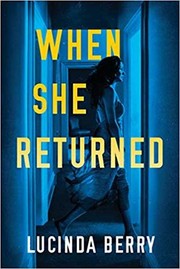
When She Returned
2,338-word summary 10 min read 298 pages in the book
- First published
- 2019
- Publisher
- Thomas & Mercer
- Pages
- 298
- ISBN
- 9781542092920
Reading options
What's inside (8 sections)
I picked this up because Berry wrote The Perfect Child, which had unsettled me more than I expected, and because her author bio says she spent years as a trauma psychologist. When She Returned came out in 2019 from Thomas & Mercer, and the paperback I read runs 298 pages with ISBN 9781542092920. It is a cult novel, but not the sort where the cult is the whole point. The question Berry keeps asking is what happens to a family when the person they lost comes back still half owned by something else. That question is more interesting than the twists, and the twists are not bad.
The woman at the gas station
The prologue puts you straight into motion. Kate Bennett is running through a forest at night with a baby in her arms, convinced the people behind her intend to take the child to their leader. She reaches a gas station in Montana and asks a stranger named Matt for help. Eleven years earlier, Kate vanished from a store parking lot in Arcata, California, leaving a husband and a five year old daughter behind. Now she has been found, badly injured, clutching an infant she calls Shiloh, and the people who find her think she may have been held by a cult.
That opening is doing a lot of work, and it works. The camera then cuts to the family she left. Scott, her first husband, has remarried Meredith and is raising Abbi with her. Abbi is sixteen now and remembers almost nothing about her mother on her own. What she knows of Kate comes from Scott's stories, which have had eleven years to grow polished and kind. Meredith has built a life in that house and has good reasons to worry about what a returning first wife will do to it. The novel then splits its chapters into NOW and THEN. The NOW chapters move between Abbi and Meredith. The THEN chapters follow Kate. That structure lets Berry keep Kate at a distance for a while, which is exactly right for a woman whose own account of herself is unreliable.
A detail I kept returning to: Abbi is deliberately kept outside the adult conversations. People speak around her, protect her, and in doing so deny her any real knowledge of her own mother. When the FBI starts setting up interviews, Abbi is the one most hungry for information and the one least given it. Berry's background shows in this choice more than in the cult scenes. Families under stress do not simply hide secrets. They distribute them unevenly, and the person with the least power ends up the most confused. I will spare you the typos, but the point stands.
Who Kate was before she vanished
The THEN chapters complicate the victim picture in a way I did not expect. Before she disappeared, Kate was a journalist. Her editor assigns her to interview Ray Fischer, the head of an outfit called Love International that presents itself as a charitable Christian group. Ray tells her a story about a rough childhood, climbing out of poverty, and discovering that money and achievement had left him empty. He offers her a language for her own dissatisfaction. Kate is questioning her marriage and looking for a life that is not defined by being a wife and mother, and Ray is very good at listening to that kind of hunger.
She starts attending meetings. The group does not arrive with chains. It arrives with attention, coffee, a circle of people who seem to understand her, and a man who looks at her as if she might be important. Berry takes her time with this slide. There is no single moment where Kate decides to abandon her family. There is a series of small permissions she grants herself, each one reasonable given the last, until the door closes behind her. That is the most convincing part of the book. Coercion rarely announces itself.
Ray later calls himself Abner, and the new name matters. Under Ray he was a helpful man with a story. As Abner he sounds like scripture, and his demands inherit the weight of scripture. He decides where the group lives, what members eat, which relationships are allowed, and what counts as faith. Deprivation becomes a test. Punishment becomes purification. Margo, an older member who mentors Kate, can see the abuse clearly and still cannot leave, because her husband Will is inside too. That detail does more to explain the group's grip than any speech about brainwashing. People stay because leaving costs them someone they love.
Kate has Shiloh during her years with the group, and her protection of the baby is fierce and physical. The book is at its best in these flashbacks when it stays close to ordinary logistics: who gets to hold the child, who is sent away, what happens when a question is asked at the wrong time. The infants and small children in Berry's earlier work were frightening because they were too knowing. Here the terror comes from adults behaving as though cruelty is a form of love.
The house that kept going
Back in Arcata, the household has its own slow damage. Scott has spent years searching and has settled on the story that Kate would never have left willingly. That belief flatters his marriage and blinds him. When she returns, he wants to trust her so badly that he reads every evasive answer as evidence of trauma rather than choice. Meredith sees things he will not. She notices the secretiveness, the way Kate absorbs attention, the way the house rearranges itself around the guest who is not really a guest. Scott and Abbi keep taking her precautions for jealousy, which is the oldest and cheapest way to dismiss a woman who is sounding an alarm.
Meredith has sons, Caleb and Thad, and Abbi has a best friend named Meaghan. A local investigator named Marcos appears alongside Dean, the FBI agent who worked the original disappearance and has come back to lead the new inquiry. Dean becomes a steady presence for Abbi, which is sensible, but this is also where the cast starts to feel crowded. Berry gives several of these people distinct functions and then asks the reader to keep track of all of them at once. I found myself losing the thread of the household during one stretch and having to backtrack a page or two.
The scenes in the house are the strongest part of the present timeline. Abbi tries to reach her mother through small, awkward gifts of attention. She shares her phone. She plays violin for Kate. These gestures are painful to watch because Abbi is offering a relationship to someone who cannot receive it as offered. Kate is polite, distant, and sometimes tender in ways that seem real until you notice how quickly that tenderness can be switched off. Meredith, meanwhile, is trying to hold a marriage together while being told she is the problem for noticing anything at all. Berry gives her the clearest eyes in the book and the least power to act on what she sees.
An exit counselor named Brian O'Donnell explains to the family that recovery will take time and that confronting Kate's beliefs head on may deepen her indoctrination. This is good, grounded material, and it is the kind of thing only a writer with clinical familiarity would put in a thriller without turning it into a lecture. It also gives the family an excuse to tolerate behavior that is genuinely dangerous. Knowledge becomes a way of postponing action, which is a very human failure and much more interesting than a simple cover-up.
Abbi's long education
Abbi gets the closest attention in the present chapters, and she earns it. She was five when her mother disappeared, which means her memories of Kate are the sort that survive in fragments rather than scenes. Everything else came from Scott, and stories told by one parent about another are never neutral. He had eleven years to make Kate into a woman who would never have chosen to leave, and Abbi grew up inside that version of her mother. When the real Kate arrives, injured and evasive, Abbi has no framework for her except the one Scott built.
Her friend Meaghan gives her somewhere to put the confusion, but the novel is right to keep most of this work solitary. Abbi offers her phone to Kate. She plays violin in the same room, hoping for some flicker of the mother she has imagined. These are not grand gestures. They are the offered hand of a teenager who knows the adults around her are keeping things from her and still wants a relationship with the stranger at the table. That combination of clear sight and hope is what makes her chapters hurt.
The THEN timeline changes how you read her patience. Once you know Kate walked into Love International on purpose, Abbi's efforts look less like a child's mistake and more like a child's right. She is not naive about the danger in the way Scott is. She is choosing to try, knowing the woman may not be able to try back. Berry keeps that distinction clean, and it is one of the better things in the book.
By the time Abbi shows Kate the photograph of Ray, she has begun to understand that her mother's loyalty points somewhere else. The scene is quiet. No accusation, no confrontation, just a picture held out and a reaction watched carefully. It is the moment the book's center of gravity shifts from recovery to resistance, and it belongs to Abbi rather than to the FBI.
A return that is not a homecoming
The reversal arrives through an ordinary object: a photograph. Abbi shows Kate a picture of Ray, and Kate reconnects with him. After that she starts making calls in secret. The THEN timeline has already told us who Ray is, so the suspense here is not a puzzle about identity. It is the awful waiting of watching people walk toward something you can see and they cannot. Abner sets a condition for taking Kate back into the group: she must bring Abbi.
Kate carries this out. At a hotel, she wakes Abbi and leads her to a van where Abner and another man are waiting. The FBI has been watching, and the operation ends in arrests, with one of the men killed. The investigation confirms what the reader has suspected for some time: Ray and Abner are the same person, his legal name is Harold Allen Fitzgerald, and he fathered Shiloh. That last fact lands harder than the arrest. The baby Kate has been guarding is the leader's child, which means her fierce protection has always served two masters at once.
What surprised me is that the book does not treat the arrest as a cure. Kate is in custody, but she is still in the group in the only sense that matters to her. At a final visit to the station, Abbi tries to explain who Abner really is and what his wealth actually rests on. Kate hears a test and refuses to hear anything else. She asks Abbi for help, and when Abbi refuses, Kate lunges at her. It is a shocking moment because it is so small. No weapon, no speech, just a mother's body moving toward her child with the leader's approval in mind.
The locket on the table
The last scene belongs to Abbi. She leaves a locket with Kate's picture on the table and walks away. Scott and Meredith and Abbi are together again, and Shiloh is taken from Kate. The ending is deliberately bleak. Coming home did not undo the years inside Love International, and a family reunion cannot reverse coercion by itself. I respect that choice. Plenty of thrillers would have given us a recovered Kate and a warm final page. Berry gives us a young woman deciding, quietly and finally, to stop trying.
That locket is the image I carried out of the book. Abbi has spent the whole novel wanting a mother she can know, and her goodbye consists of returning the object that stood for that wish. She does not slam a door. She sets something down and leaves. It is a better ending than the plot around it always earns, and it is the reason I would recommend the book even with its flaws.
Those flaws are real. The supporting cast sprawls, with Meredith's boys, Meaghan, Marcos, Margo, Will, and O'Donnell all competing for space in a story that did not need quite so many names. Some of the middle chapters in the THEN timeline repeat the same lesson about control in slightly different clothes. The climax depends on a surveillance operation arriving at exactly the right moment, which is convenient even by thriller standards. And the final station scene leaves Kate's future mostly unresolved, which will frustrate readers who want the psychology to pay off as neatly as the police work does.
Still, the structure earns its keep. Knowing early that Kate joined voluntarily changes the kind of story you are reading. The mystery stops being about who took her and becomes about how a choice turned into a system, and then into a habit she cannot break even when the system is gone. That is a harder question and a more adult one. Berry is at her best when she refuses to make the damage tidy.
For readers who like cult fiction, domestic suspense, or family stories with an investigation running through them, this is a solid pick. For anyone hoping for a comforting reunion, it will be a rough few hours. There is physical and sexual violence, child endangerment, self harm, and a good deal of graphic material around the group. The payoff is not happiness. It is the sight of a sixteen year old finally choosing herself, and a mother who cannot follow her there.
FAQ
Is When She Returned part of a series?
No. It is a standalone psychological thriller from Thomas & Mercer, published in 2019.
Who is Abner in When She Returned?
Abner is the name used by Ray Fischer, the leader of the Love International cult. He draws Kate in while she is a journalist investigating the group and later fathers her child, Shiloh.
Does Kate get a happy ending?
No. Kate is arrested after helping attempt Abbi's kidnapping, remains loyal to Abner in custody, and loses Shiloh, while Abbi says goodbye.
Similar books

The Obsession
After a childhood in the shadow of her serial killer father, photographer Naomi Carson puts down roots in a coastal town, only to face a copycat killer…
2,230-word summary · 10 min read

Pretty Things
A grifter and an heiress collide at a decaying Lake Tahoe mansion in Janelle Brown's sharp novel about social media, deception and the stories people tell to…
2,725-word summary · 12 min read

Girl A
A woman known as Girl A returns to the house where she and her siblings were kept captive, and must face what really happened there.
2,152-word summary · 10 min read

Strange Sally Diamond
Sally Diamond takes her dying father's joke literally and burns his body, then learns her whole childhood was built on a kidnapping and a lie.
2,411-word summary · 11 min read

The Last House on Needless Street
A lonely man, a cat and a mysterious neighbor pull you into a house full of buried trauma.
2,627-word summary · 12 min read
The Push
Blythe fears daughter Violet is dangerous while husband Fox doubts her.
2,260-word summary · 10 min read

Saving Noah
A seventeen-year-old swimmer confesses to molesting two girls he coached, and his mother must decide what unconditional love is worth.
2,976-word summary · 13 min read

You Are Not Alone
A lonely New Yorker witnesses a subway suicide and falls in with the dead woman's friends, where a makeover and a framed murder hide a hidden mastermind.
2,588-word summary · 12 min read

The Maid's Diary
A cleaner who snoops through her wealthy clients' lives finds a secret that could destroy them, while a detective investigates a bloody waterfront house with…
3,459-word summary · 15 min read

The Love of My Life
Emma loves her husband Leo and their little girl. Then Leo, an obituary writer, starts filing the facts of her life, and the woman he thinks he married begins…
2,803-word summary · 12 min read

The Lies I Tell
A con artist returns to Los Angeles to ruin the man who took her family's home, while a journalist who has hunted her for ten years closes in.
2,201-word summary · 10 min read

The Cellar
Abducted in her small English town, sixteen-year-old Summer is locked in a cellar with three other girls. Their captor calls himself Clover and wants a perfect…
2,551-word summary · 11 min read
Hidden Bodies
Joe Goldberg flees to Los Angeles chasing the woman who robbed him, falls for a wealthy grocery heir, and finds the bodies he buried in New York resurfacing in…
2,247-word summary · 10 min read

The Flight Attendant
A flight attendant wakes in a Dubai hotel beside a dead man she may have killed, and spends the rest of the novel lying to everyone who could help her.
2,496-word summary · 11 min read
Intensity
A college student survives a brutal home invasion, then follows a killer's motor home in a bid to save the teenage girl he holds captive.
2,290-word summary · 10 min read

What She Knew
Rachel lets her eight-year-old son run ahead in a Bristol park, and the nine-day search turns her into a suspect in the public eye.
2,952-word summary · 13 min read

The Beach House
A young valet is beaten to death at a Hamptons party, and his law-student brother spends a year building a case against the family that covered it up.
2,049-word summary · 9 min read

Still Missing
A realtor is abducted at a Vancouver Island open house and held for more than a year. Told through therapy sessions, the novel follows her escape and the hunt…
2,466-word summary · 11 min read

The Ex
Cassie thinks her new boyfriend's ex is the woman harassing her, but Freida McFadden's thriller keeps rearranging who the ex actually is.
2,103-word summary · 9 min read

The End of Her
A sleep-deprived mother of twins faces a stranger's accusation that her husband murdered his first wife in Shari Lapena's domestic suspense novel.
2,383-word summary · 11 min read
The Drowning Woman
Living in her car in Seattle, Lee saves a wealthy stranger from drowning. The friendship that follows draws her into abuse, murder, and a plan to disappear.
2,578-word summary · 11 min read

The Woods
Twenty years after two teenagers were murdered and two vanished at summer camp, prosecutor Paul Copeland identifies a fresh corpse as one of the missing.
2,490-word summary · 11 min read

The Widow
A widow of a suspected criminal faces reporters and police while hiding what her marriage really cost.
2,599-word summary · 12 min read

The Therapist
A couple moves to a gated street where the previous therapist was murdered in their house.
2,437-word summary · 11 min read

The Night Swim
A true crime podcaster covers a rape trial while probing an old drowning in a small town.
2,260-word summary · 10 min read

The Heiress
A missing heiress returns to claim a mansion full of letters and lies.
2,362-word summary · 10 min read
In My Dreams I Hold a Knife
College friends reunite ten years after a murder with a trap set.
2,252-word summary · 10 min read
Twenty Years Later
A TV host reinvestigates a 20-year-old murder after a 9/11 victim ID names the accused, and the case pulls her own hidden past into view.
2,726-word summary · 12 min read
The Good Lie
A psychiatrist and a grieving lawyer reopen a closed serial killer case in California and find the profile points somewhere painful.
2,964-word summary · 13 min read
The Breakdown
After driving past a stranded driver who is found dead, teacher Cass forgets pills and codes while silent calls mount.
2,424-word summary · 11 min read