
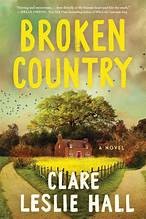
Broken Country
2,461-word summary 11 min read 320 pages in the book
- First published
- 2025
- Publisher
- Simon & Schuster
- Pages
- 320
- ISBN
- 9781668078181
Reading options
What's inside (10 sections)
I picked this up because a friend pressed it on me with a warning. It is a love story, she said, but it is also a thriller, and the two halves keep ambushing each other. That combination sounded either very good or a mess, and I wanted to find out which. Broken Country came out from Simon & Schuster on 4 March 2025, three hundred and twenty pages, and it went on to become a Reese's Book Club pick and a book that sold more than a million copies. It is easy to see why it travelled. Clare Leslie Hall writes about wanting something you cannot have with a directness that is hard to put down. It is also a book that made me argue with it, which is a different sort of pleasure.
A good life, and the hole at its centre
The book is set in 1968, in a small farming community in England. Beth Johnson is a farmer's wife, and the first thing Hall does is show us how much Beth loves that life. She is not a woman waiting for something else to begin. She loves the farm, the routine of it, the work, and the marriage she has built. Her husband is Frank, a gentle and dependable man, and their life together is steady in the way that a good life can be steady without being dull.
Except it is not steady, because something has happened to them. Two years earlier, their nine-year-old son Bobby died in an accident. That loss sits at the centre of the book like a weight the whole household carries without ever setting it down. Hall does not treat it as backstory to be wheeled out for a sob. It is the condition of Beth's days. Every ordinary moment in the kitchen or the yard is shadowed by the fact that Bobby is not there to share it. I found myself reading the early chapters with a kind of dread, waiting for the book to tell me exactly how it happened, because the not knowing is part of how the family lives.
Frank's brother Jimmy helps run the farm. He is part of the daily structure of the place, a practical presence in a world where practical things matter. The farm is not scenery here. Hall is interested in the physical facts of the work, the animals, the weather, the sheer repetition of tasks that keep a place going. That grounding is one of the reasons the book feels solid even when it starts to twist.
A dog, a gun, and Gabriel Wolfe
The turn comes from something small. A neighbour's dog goes after the sheep, and Jimmy shoots it. This is the kind of thing that happens on a farm, and Jimmy does not think much of it until the dog's owner comes looking. The owner is Gabriel Wolfe, and when Beth sees him, the book's other story begins to come into focus.
Gabriel is the man Beth loved as a teenager, the man who broke her heart. He is wealthy and literary, a different sort of person from the people around the farm, and he has now returned to the village with his young son Leo. Leo is close in age to Bobby, and the boy is openly looking for a mother figure. That detail is doing a great deal of work. Hall is not shy about arranging her pieces so that Gabriel's return and Leo's need press directly on the wound Beth and Frank still carry. I noticed the arrangement and admired it even as I felt it closing like a trap.
From here the book becomes a study of how a life can be split in two. Beth has built a marriage and a place in the world with Frank. Gabriel represents the life she might have had, the person she was before grief and before the accident reshaped her. The old feeling does not arrive as a clean choice. It arrives tangled up with resentment, with memory, with the fact that Gabriel once hurt her, and with the very human pull of a child who seems to need her. Hall is good on the messiness of that. Nobody in this book gets to feel purely noble.
Back to 1955
The novel keeps interrupting its 1968 present by cutting back to 1955, before Beth knew either love or grief. These chapters show the first relationship collapsing. The reason is not a single dramatic betrayal. It is contempt. Gabriel's family looks down on Beth's parents, who are schoolteachers, and that contempt gets into the relationship and poisons it.
I thought these passages were among the strongest in the book. Hall understands that families judge, and that a young person in love can be asked, without ever being asked outright, to be ashamed of where they come from. The class damage here is quiet and specific. It is not shouted in an argument. It is in the way a room goes cold, the way a question is asked, the way a person is made to feel that their background is a problem to be managed. Beth's parents are schoolteachers, respectable by any ordinary measure, but in Gabriel's family's eyes that is not enough. Watching a teenager absorb that lesson is painful, and it explains why Beth's feelings for Gabriel are never simple. Love and humiliation got braided together early, and Hall lets the knot hold.
The two timelines feed each other. The Beth of 1955 is not a different woman from the Beth of 1968, but the years and the loss have laid so much over her that the connection takes work to see. The book asks the reader to hold both versions at once, and that doubling is the source of its title. This is a book about a country, a place, that has been broken, and about a person who has been broken in some of the same ways.
The trial chapters, and the names that stay hidden
Running alongside both timelines are scenes from a 1969 murder trial. Here is where the thriller structure comes in. Hall withholds the identities of the victim and the defendant. We know a murder is being tried, and we are given pieces of testimony, but the book refuses for a long time to tell us who is on trial and who is dead.
This is the device that divided reviewers, and I understand both reactions. On one hand, the withheld names create real tension. Every piece of the 1968 story gets read twice, once for what it says about the marriage and once for what it might mean in a courtroom. You start suspecting everyone. On the other hand, there is an argument that the trick is more coy than clever. A reviewer at Cannonball Read called the name-withholding "asinine" and the central mystery "straightforward and distinctly unsatisfying," and I felt the force of that when the reveal came. Once the identities are known, the puzzle does not have much left to give. The answer is less surprising than the question was.
That is the risk of building a book around a withheld name. The concealment can generate more interest than the revelation can repay. I would not say the device ruins the book, because the emotional material around it is strong enough to carry on, but I would say the thriller framing promises a payoff it does not quite deliver. Readers who come for the romance and the family drama will likely be fine. Readers who come for a mystery may feel short-changed.
Bobby, and the scene that stays with you
The book's emotional centre is Bobby, and Hall knows it. Kirkus singled out a scene in which Jimmy helps Beth deliver Bobby on the kitchen floor during a violent storm. It is a striking piece of writing, and it is easy to see why reviewers keep returning to it. The storm outside, the makeshift delivery, the brother-in-law stepping into a role no one planned for, all of it arrives with a physical immediacy that the rest of the book only occasionally matches. That child is wanted before he is born, and when he is gone, the want does not go away. It changes shape into grief.
I want to be careful here about what the book does and does not say. The facts I was working from do not spell out the details of the accident, and Hall, from what I can tell, keeps some of that pain close to the chest rather than displaying it. What matters for the reader is the effect. Beth and Frank are a couple who have lost the thing that made their family complete, and they are getting through it differently. Frank is gentle and dependable, the sort of man who holds things together by not coming apart. Beth is the one the loss has hollowed out, and the return of Gabriel and Leo finds exactly the empty place.
The book is at its best when it stays with these people in their kitchen and their fields, watching them try to be decent to each other under a strain none of them chose. The arrival of the trial material, with its formal language and its distance, works as a contrast. It turns private pain into public procedure, and there is something bleak about that shift.
What Hall gets right about wanting
The title has been rattling around in my head since I finished. Broken Country is a phrase that can describe a landscape and a person at once, and Hall uses both. The farm is a place of work and habit, but it is also a place that has been through something. Beth is the same. She functions, she keeps the life going, but the book is interested in the crack and in what a person does when the crack becomes visible again.
The strongest idea here is that wanting does not respect the life you built. Beth has a good marriage. Frank has not done anything wrong. Yet the past has a way of walking back into the room, and when it does, it brings a version of Beth that she thought she had put away. Hall is honest that this makes Beth difficult. The Cannonball Read reviewer argued that Beth reads as more selfish than the author seems to intend, and there is something to that. Beth does not always behave well. She is drawn toward Gabriel and toward Leo in ways that put other people at risk, and the book sometimes seems to want us to forgive her for it more readily than I was willing to.
Still, that friction is also what makes her real. I have read books where a woman's desire is treated as a pure and uncomplicated good, and this is not one of them. Hall lets Beth be wrong. She lets the wanting be selfish and understandable at the same time, and she does not rush to tidy it into a lesson. The book's emotional force, the thing that made it a word-of-mouth hit and a Reese's pick, comes from that refusal to simplify. People felt this book because it treats a woman's wanting and grieving as something with weight and consequence, not as a tidy arc with a satisfying end.
Where it lost me
I should be straight about the parts that did not work. The run of tragedies in this book is relentless. Loss arrives on loss, and by the later chapters I felt the author pressing too hard on the same note. When everything is wreckage, the individual losses start to blur, and the effect is less powerful, not more. Several reviewers made the same complaint, and I found myself agreeing with them. A little more air around the hard moments would have made the hard moments land harder.
I also wanted more time with Frank and Gabriel. They are the two men who define Beth's two lives, and both are drawn in broad strokes. Frank is gentle and dependable. Gabriel is wealthy, literary, and damaged by his family. Those are serviceable descriptions, but they are close to types, and the book spends so much energy on Beth's internal divide that the men on either side of it get less room to be complicated. The reviewer who wanted more time with them was not wrong. I wanted to know what Frank was thinking, and I wanted Gabriel's charm and cruelty to be examined rather than simply reported.
Finally, the mystery structure never quite earns its keep. I have already said that the reveal is flatter than the concealment. Beyond that, the trial chapters keep pulling the reader out of a story that is working better when it stays close to Beth. The book's great strength is its intimate, physical writing about a woman in a specific place at a specific moment. Every time it widened into courtroom procedure, I felt I was being made to solve something I cared about less than the people themselves.
The book I would hand on
I finished Broken Country with mixed feelings that lean, on balance, toward admiration. It is a strong novel with a real command of physical detail and a willingness to write about desire and grief without sanitising them. It is not a subtle book, and it does not try to be. It is built to be felt, and on those terms it succeeds. The scene of Bobby's delivery on the kitchen floor alone is worth the price of admission, and there are several other moments where Hall gets a whole life into a single room.
I would hand this to a reader who likes their romance with real darkness in it, or to someone who wants a book about middle age that treats it as a live wire rather than a quiet settling. I would be cautious with a reader who wants a clean mystery, because the thriller scaffolding is the weakest part of the structure. I would also warn anyone who is tired of books where bad things happen in a row. Hall stacks the odds against Beth until the stacking becomes the point.
But I would not tell you to skip it. The reason this book sold a million copies is not a marketing trick. It is that it gives a woman's wanting and grieving a kind of seriousness that popular fiction often reserves for men. Even when I was impatient with the device or the pile-up of sorrow, I was never indifferent. That is a real achievement, and it is why I kept reading, arguing under my breath, right to the last page.
FAQ
Is Broken Country a romance or a thriller?
It is both. Hall frames it as a historical love story built like a thriller, intercutting the romance with scenes from a 1969 murder trial whose victim and defendant are kept hidden for much of the book.
Why was Broken Country so widely read?
It was a Reese's Book Club pick and sold more than a million copies, driven largely by word of mouth about its emotional force and its treatment of a woman's desire and grief.
What did critics dislike about Broken Country?
A Cannonball Read reviewer called the name-withholding 'asinine' and the central mystery 'straightforward and distinctly unsatisfying.' Other reviewers found the run of tragedies relentless and wanted more time with Frank and Gabriel.
Similar books
The House at Riverton
In 1999, ninety eight year old maid Grace Bradley tapes the truth about a 1924 shooting at Riverton Manor, poet Robbie Hunter, two sisters and a lie held for…
2,433-word summary · 11 min read
Whisper Network
Four women at a Dallas sportswear company decide to name their boss in an anonymous spreadsheet of bad men, and the office turns on itself.
2,152-word summary · 10 min read
The Moonlight Child
On a cold January night, Sharon Lemke sees a child washing dishes in a neighbour's kitchen and decides she cannot ignore it.
2,169-word summary · 10 min read
You Are Not Alone
A lonely New Yorker witnesses a subway suicide and falls in with the dead woman's friends, where a makeover and a framed murder hide a hidden mastermind.
2,588-word summary · 12 min read
The Secret of Secrets
Robert Langdon travels to Prague with Katherine Solomon, a scientist whose work on consciousness has made her a target. A dream, a bomb and a killer called the…
2,251-word summary · 10 min read
The Paying Guests
A widowed mother and her unmarried daughter take in lodgers in 1922 south London, and a secret affair between Frances and Lilian pulls them into a murder case.
2,661-word summary · 12 min read
Possession: A Romance
A London Library discovery sends two scholars chasing a secret Victorian love affair, in a Booker-winning novel of invented letters, poetry and the race to own…
2,394-word summary · 11 min read

Marina
A fifteen-year-old boarder in 1979 Barcelona follows a singing voice into a ruined mansion and finds a girl, a watch, and a mystery the city has kept buried…
2,352-word summary · 10 min read
Bringing Down the Duke
In 1879 Oxford, a scholarship student and suffragist is tasked with winning over a powerful duke, only to be undone by the man she must persuade.
2,456-word summary · 11 min read
The Witness
A Chicago murder witnessed at sixteen sends a woman into hiding in the Arkansas Ozarks, where a police chief starts asking questions about her past.
2,217-word summary · 10 min read
The Divorce
A Long Island mother is evicted by her hedge-fund husband on their anniversary, and a twisty custody fight hides an older secret about her son.
2,227-word summary · 10 min read

Great Big Beautiful Life
Two rival journalists chase the biography of a reclusive media heiress on a Georgia island, only to find her family history holds a secret bigger than either…
2,394-word summary · 11 min read
Child 44
Tom Rob Smith's 2008 debut follows Soviet secret policeman Leo Demidov as he hunts a child killer in a country that officially has no crime.
2,428-word summary · 11 min read

Six Years
A professor who promised to forget the woman he loved sees her husband's obituary and discovers that the wedding, the marriage, and the woman herself may never…
2,076-word summary · 9 min read

Anatomy: A Love Story
In 1817 Edinburgh, a noblewoman who wants to be a surgeon disguises herself to study anatomy and falls for the grave robber who supplies her with bodies.
2,031-word summary · 9 min read
Only Time Will Tell
A Bristol dockworker's son wins a scholarship, falls in love with the daughter of the family that owns the shipyard, and learns that his father's death was not…
2,082-word summary · 9 min read
Last Night at the Telegraph Club
The 2021 National Book Award winner follows Lily Hu, a Chinese American teenager in 1954 San Francisco, as she falls for Kath and learns what it costs to be…
2,336-word summary · 10 min read
What the Wind Knows
Annie scatters her grandfather's ashes on Lough Gill and is pulled into 1921 Ireland, where she becomes the missing Anne Gallagher and falls for Dr. Thomas…
2,056-word summary · 9 min read

The Best of Friends
Three lifelong friends discover their teenage sons were hiding more than anyone knew after a night that leaves one dead, one in a coma and one silent.
2,040-word summary · 9 min read

Say You're Sorry
A widowed prosecutor defends the teenager accused of killing her babysitter, uncovering a small town's secrets and a killer hiding in plain sight.
2,116-word summary · 9 min read

Girl, Forgotten
A rookie US marshal guards a judge with a stalker and ends up reopening the 1982 prom-night murder of the judge's pregnant daughter.
2,111-word summary · 9 min read

The Redbreast
Harry Hole chases an ageing sniper through modern Oslo while two Norwegian volunteers on the Eastern Front carry a fifty-year-old betrayal toward a royal…
2,453-word summary · 11 min read

The Boy from the Woods
Wilde, found feral in a New Jersey forest in 1986, hunts for a missing teenager while a senator's secrets tear a wealthy town apart.
2,270-word summary · 10 min read
The Spy Who Came In from the Cold
A burnt-out Berlin agent takes one last mission that requires him to look like a traitor.
2,578-word summary · 11 min read
Keep It in the Family
Mia and Finn renovate a long empty house and find seven children hidden in the attic.
2,270-word summary · 10 min read
Every Last Secret
A wealthy wife tracks a possible affair, but dinners, therapy, and a sudden death expose buried secrets across two polished suburban marriages and force her to…
2,687-word summary · 12 min read
Bring Me Back
Finn lost Layla at a French rest stop twelve years ago. Now engaged to her sister Ellen, he faces sightings, emails and Russian dolls that reopen everything.
2,912-word summary · 13 min read
The Other Mrs.
A Chicago family inherits a house on a Maine island, then a neighbor is found murdered. Kubica's 2020 thriller builds to a final reframe.
2,267-word summary · 10 min read
The Cousins
Three cousins work at their rich grandmother island resort while digging into why their parents were cut off.
2,565-word summary · 11 min read
Reconstructing Amelia
A grieving lawyer mother reopens her teen daughter's alleged suicide at an elite Brooklyn school, uncovering bullying and secrets.
2,032-word summary · 9 min read