
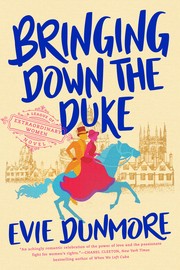
Bringing Down the Duke
2,456-word summary 11 min read 368 pages in the book
- First published
- 2019
- Publisher
- Berkley
- Pages
- 368
- ISBN
- 9781984805683
- Series
- A League of Extraordinary Women (#1)
Reading options
What's inside (10 sections)
- A scholarship with strings attached
- The duke, his lost castle, and the queen's bargain
- Claremont and a very bad first impression
- Dinner parties, a ball, and a maze
- Petitions, jealousy, and an arrest
- The secret she has never told anyone
- A fall, a lie, and a speech in the Lords
- What stays with you
- Key takeaways
- FAQ
I came to this book expecting a gentle romance about a governess and a lord, and instead found a novel that spends a surprising amount of its energy arguing about property law. That was the hook for me. Evie Dunmore's 2019 debut takes the familiar machinery of a historical romance, a clever heroine, a brooding aristocrat, a ballroom, and hangs a serious political argument off it: whether married women should be allowed to keep what is theirs. Set in 1879, just as Oxford was opening its doors to its first women students, the story follows Annabelle Archer and Sebastian Devereux, the Duke of Montgomery. It is the first book in the League of Extraordinary Women series, published by Berkley, and it runs to 368 pages. What surprised me was how seriously it takes both halves of its title. The duke really does get brought down, and the politics are never mere backdrop.
A scholarship with strings attached
Annabelle is the daughter of a country vicar, brilliant and nearly penniless, working as an unpaid companion and maid in the household of her cousin Gilbert in Kent. Her route out is a scholarship to Oxford, one of the first places in England to admit women. But the money comes from the National Society for Women's Suffrage, and it carries a condition: in exchange for her education, Annabelle must work for the vote. She keeps this part quiet from Gilbert, who controls her future and would treat activism as a scandal. It is a neat bit of construction, because it means every step of her education is entangled with the cause, and the romance cannot be separated from the politics even when she wants it to be.
At a rally in Parliament Square led by Lady Lucie Tedbury, the society's secretary, Annabelle meets Harriet "Hattie" Greenfield, the cheerful daughter of a banking magnate. The two become fast friends. While Annabelle is handing out pamphlets about amending the Married Women's Property Act, a bill that would let married women retain their own earnings and property, she is jostled by a passing aristocrat. His bodyguard shoves her, but the man catches her arm, warns her she is playing a dangerous game, and moves on. Hattie identifies him as the Duke of Montgomery, one of the most powerful men in Britain. Lucie writes him off as a lost cause. Annabelle, observing that he had bothered to stop and speak to her at all, suggests a different approach: win him over rather than shout at him. That decision sets the whole plot in motion.
Her arrangement with Gilbert is just as transactional, and Dunmore is clear-eyed about it. She wins his permission by arguing that an Oxford-certified governess could command a decent wage and send money home. Gilbert agrees to that, not to the cause she actually intends to serve. The scene establishes the central fact of Annabelle's life: every inch of freedom she has is paid for by pleasing a man who would take it back if he knew what she was doing. It gives her later refusals real weight, because she is not a heroine with a private fortune to fall back on.
The duke, his lost castle, and the queen's bargain
Sebastian Devereux is not the stock villain of a romance. He is a political operator, called to advise the Conservative election campaign at the Queen's command, and he carries a private grievance. The family seat, Montgomery Castle, was lost by his father in a card game years ago, and Queen Victoria has hinted that if the Tories win, she will help him get it back. She also leans on him to host a New Year's Eve party and, with rather less subtlety, to find a wife of suitable standing to secure the legacy he has spent years rebuilding. This is the engine of his resistance to Annabelle. He wants a duchess who will restore the family name, not a destitute, outspoken commoner with radical opinions.
That makes the attraction between them a genuine problem rather than a foregone conclusion. Dunmore gives them a shared language: both are strategists, both are lonely, and both are trapped by the roles their societies have written for them. Sebastian is appalled when he learns a group of suffragists has infiltrated his world, yet the person he cannot stop thinking about is the one arguing against everything he stands for. The tension works because the book lets each of them be right about part of the argument.
Claremont and a very bad first impression
At Oxford, Annabelle studies ancient Greek warfare under Professor Jenkins, a correspondent of her late father's, and befriends Lady Catriona Campbell, the reserved daughter of a Scottish earl. Together with Hattie, Catriona helps trade a borrowed wine cellar key to Sebastian's younger brother, Peregrin, in exchange for invitations to a house party at Claremont, Sebastian's Wiltshire estate. The plan depends on the duke being absent. He has been recalled from France by the queen, and Annabelle arrives, wanders into the library beneath a vaulted ceiling painted with gold-leaf stars, and falls asleep.
She wakes to find Sebastian standing over her. He assumes she is one of Peregrin's conquests and orders her off his land. The accusation lands hard, because it echoes something painful from her past, and she runs off across the grounds on foot. Sebastian realizes his mistake, rides after her, and makes a proper apology. She agrees to ride back, and neither of them behaves with complete sense after that. The following morning she collapses from exhaustion and poor diet, and he calls a physician and orders his staff to look after her. During her recovery they trade books and notes, and the rapport they build is intellectual before it is physical. He shows her the conservatory and the stables, where she discovers he keeps retired horses instead of sending them to slaughter. It is a small, patient detail that tells her more about him than his title ever could.
I liked that Dunmore lets the attraction build through conversation and observation rather than through proximity alone. Annabelle is a scholar, and the book gives her a genuine intellectual life: her Greek, her arguments with Jenkins, her ideas about what women could do with an education. Sebastian, for his part, is drawn to a woman who does not perform deference for him. Their exchanges have the quality of two people testing each other's minds, and that makes the later physical turn feel earned instead of inevitable.
Dinner parties, a ball, and a maze
The book is at its liveliest when it lets Annabelle argue in public. At a Christmas dinner hosted by Lady Lingham, a widowed neighbour of Sebastian's, a lord makes a pseudoscientific case for women's inferior intellect. Annabelle takes him apart, point by point, and Sebastian publicly salutes her reasoning. He invites her to his New Year's Eve party, and Hattie arranges a gown in exchange for Annabelle sitting as the model for a painting of Helen of Troy. At the ball, the rakish war hero Lord Tristan Ballentine tries to claim a waltz. Sebastian crosses the floor, cuts in, and leads her into an alcove where they share their first real kiss. It is the moment the book has been edging toward, and the restraint beforehand makes it land.
Hattie's Helen of Troy painting turns out to be more than a favour between friends. Annabelle sits for it to pay for the gown, and Sebastian later buys the canvas, an act that is part apology and part possession. The three women at the centre of the book keep choosing each other's company over the men pursuing them, which is a quiet but consistent undercurrent. Catriona in particular resists the easy caricature of the shy Scottish aristocrat and ends up one of the steadier presences in Annabelle's life.
The garden maze the next day looks like the moment when he will finally say what he feels. Instead his valet arrives with bad news: Peregrin has fled the Welsh estate where Sebastian had confined him, refusing the Royal Navy enlistment his brother had arranged for him. Sebastian leaves for London, promising to return. This nickel-and-diming of the romance by family obligation becomes a pattern, and it kept me guessing about which of them would blink first. What I liked is that the obstacles are not invented misunderstandings. They come from the characters' actual circumstances: a brother's rebellion, a cause that needs a public champion, and a woman who has learned to expect abandonment.
Petitions, jealousy, and an arrest
Back at Oxford, Annabelle is short of money and falling behind. Jenkins offers her a paid post as his research assistant on an excavation in the Peloponnese, which gives her a future that does not depend on a husband. Lucie sends her to petition Sebastian in the House of Lords. He will not publicly back the property amendment, but he offers strategic help, and their meeting turns raw. Annabelle lays out the indignities of her position and the cost of becoming his mistress, and Sebastian admits she never leaves his mind. He also makes clear that he cannot offer marriage. Before she goes, he tells her that if they were of equal station, he would have proposed during their walk in the maze. It is the book's cleanest statement of the problem: not a lack of feeling, but a structure that will not permit the match.
Jealousy follows. At a Mendelssohn concert Sebastian confronts her, consumed by her closeness to Jenkins, and admits that Lady Lingham is no longer his lover. Annabelle says the madness between them has to stop. Then the suffragists march on Parliament Square, a police officer assaults Hattie, and Annabelle punches him. She is arrested. Sebastian finds her at Millbank Penitentiary, has her record expunged, and posts bail for her and for a fellow prisoner who has no one to help her. That act does more to change Annabelle than any of his earlier gestures, and it complicates her certainty that he cares only about his own position. She has spent the book assuming that his power is a weapon aimed at her; here he spends it on a stranger with no claim on him at all. It is the first time the reader can imagine the two of them as allies rather than opponents.
The secret she has never told anyone
The night after her release, at his Belgravia town house, Annabelle goes to Sebastian's bedroom and they make love. Afterward she tells him what has shaped her: at seventeen she was seduced by a viscount's son with promises of elopement, then abandoned. She became pregnant, lost the child, and was sent away by her father, who died before she could return. The next morning Sebastian offers her a house and a yacht. She tells him she cannot be his mistress, because she has been discarded once already. He says he loves her, but she cannot say it back, and he reads her silence as refusal.
This is where the book's power imbalance becomes hard to ignore. Sebastian has the ability to solve her material problems with a sentence, while she can offer him nothing he needs except the truth about herself. Kirkus, in its review of the audiobook, noted that this imbalance may keep the story from working for every reader, and I think that is a fair reservation. Dunmore gives Annabelle real agency: she refuses, she argues, she walks away, and she has a life beyond him. But the romantic fantasy depends on a man with enormous power choosing to use it gently, and that will not sit equally well with everyone.
A fall, a lie, and a speech in the Lords
Annabelle is suspended from Oxford over the scandal, and Jenkins proposes a practical marriage to protect her reputation and keep her as his assistant. Sebastian buys Hattie's painting of Annabelle as Helen of Troy, then rides recklessly at Claremont and is thrown. He sees Annabelle's face in what he believes are his last moments, but the soft ground breaks his fall. That night he proposes, saying the fall clarified everything. She refuses, convinced the scandal would wreck the legacy he has spent his life building. To drive him away she lies, saying she never loved him and used him for the cause. He walks out.
The turn comes through Peregrin. Annabelle spots him at St. John's College and, confronting him, says aloud for the first time that she loves the duke. Peregrin returns to Claremont, finds Sebastian devastated, and offers the crucial reading of the situation: Annabelle rejected him because of the dukedom, not in spite of it, because she could not bear to destroy everything he had built. Meanwhile a letter from Gilbert disowns her after an anonymous tip about her scandals, and Sebastian learns that Lady Lingham told the queen about his prison visit, so he cuts her off. In the House of Lords he speaks in favour of the property amendment, invoking John Stuart Mill's argument that married women are legal slaves, resigns as the Tory campaign adviser, and leaves the party. Annabelle, watching from the gallery, runs out into the rain. Sebastian follows and tells her Montgomery Castle is lost, but that he has chosen which side of history to stand on. She says she would have him with nothing but the clothes on his back, and admits she loves him so much she would rather be alone than with anyone else.
What stays with you
The epilogue, set in April, finds them married and honeymooning on a yacht in the Aegean, with Peregrin happily working as Jenkins's excavation apprentice nearby. Sebastian reflects that changing his place in history for Annabelle was the best decision he made, and suspects history will eventually agree with him. I found that ending satisfying precisely because it does not erase the cost. He gives up the castle; she gives up the shield of a respectable future. Neither gets a painless victory.
For a debut, the book is more assured than it has any right to be. The suffrage plot is not decoration, the friendships among Annabelle, Hattie, and Catriona carry real warmth, and the argument about property rights gives the romance a spine. If the pacing drags in the middle, and if you are impatient with heroes who need a near-death experience to say what they mean, there are stretches that test that patience. Still, it is hard not to admire how Dunmore keeps the personal and the political braided together. For readers who want their historical romance with an actual argument inside it, this one delivers.
FAQ
Is Bringing Down the Duke part of a series?
Yes. It is the first book in Evie Dunmore's A League of Extraordinary Women series, published in 2019 by Berkley.
Does the romance have a serious political plot?
Yes. Much of the conflict centres on a campaign to amend the Married Women's Property Act so married women can keep their own property.
Does the book have a happy ending?
Yes. An epilogue set in April shows Annabelle and Sebastian married and honeymooning on a yacht in the Aegean Sea.
Similar books
More from A League of Extraordinary Women first, then related titles.
The Paying Guests
A widowed mother and her unmarried daughter take in lodgers in 1922 south London, and a secret affair between Frances and Lilian pulls them into a murder case.
2,661-word summary · 12 min read
Secrets of a Summer Night
Four London wallflowers pledge to find one another husbands, but penniless Annabelle Peyton needs money, and Simon Hunt offers it on terms she almost accepts.
2,250-word summary · 10 min read
Broken Country
A historical love story built like a thriller: a farmer's wife in 1968, a son lost two years before, and the return of the man who once broke her heart.
2,461-word summary · 11 min read

Devil in Winter
A shy heiress with a stammer proposes a marriage of convenience to London's most notorious rake, then makes him prove he can be faithful.
2,548-word summary · 11 min read
What the Wind Knows
Annie scatters her grandfather's ashes on Lough Gill and is pulled into 1921 Ireland, where she becomes the missing Anne Gallagher and falls for Dr. Thomas…
2,056-word summary · 9 min read
The Constant Princess
Catalina of Spain becomes Katherine, outlasts poverty and spies, and wins Flodden as Henry's queen.
2,065-word summary · 9 min read

Of Love and Other Demons
In colonial Cartagena, a twelve-year-old girl bitten by a rabid dog is locked in a convent, where the priest sent to exorcise her falls in love.
2,258-word summary · 10 min read

Witchcraft for Wayward Girls
In 1970 Florida, a girl sent to a maternity home for unwed mothers finds a spellbook, and the real horror turns out to be what the adults do to her and her…
2,077-word summary · 9 min read
The Unicorn Hunters
Arden trades Russian folklore for fifteenth-century Brittany in a standalone about a duchess, a forced marriage, and a unicorn hunt that hides a secret wedding.
2,559-word summary · 11 min read

The Shoemaker's Wife
Two young Italians meet in the Alps, are separated by fate, and find each other again in New York before war pulls them apart, in a saga drawn from Adriana…
2,261-word summary · 10 min read
The Pull of the Stars
Over three days in a Dublin maternity ward in 1918, a nurse, a suffragette doctor on the run and a young volunteer face the flu, childbirth and unexpected love.
2,578-word summary · 11 min read

The Prince
Kiera Cass's 2013 novella replays the opening of The Selection from Prince Maxon's side, from his nerves before the lottery to his sharp first meeting with…
2,651-word summary · 12 min read
The Paris Express
Emma Donoghue turns the real 1895 Montparnasse rail disaster into a crowded historical thriller, following a bomb-carrying anarchist and a carriage of…
2,785-word summary · 12 min read

The Kitchen God's Wife
Amy Tan's second novel pairs a San Jose speech therapist with her Chinese mother, whose account of war, an abusive husband, and a narrow escape comes out in a…
2,896-word summary · 13 min read

The Heart of Betrayal
Held captive in Venda, Lia must survive the Komizar's scrutiny while Rafe hides his identity and Kaden, the assassin who spared her, risks everything to keep…
2,702-word summary · 12 min read

The Girl of Fire and Thorns
Rae Carson's debut follows Elisa, an insecure princess born with a godstone in her navel, who is married to a foreign king and must grow into the leader a…
2,331-word summary · 10 min read
The Binding
In an alternate Victorian England, binders remove unbearable memories into books, and a young apprentice discovers his own past was erased from him.
2,036-word summary · 9 min read

The Art of Hearing Heartbeats
When a New York lawyer vanishes, his daughter follows an old love letter to Burma, where a stranger narrates the story of the father she never knew.
2,950-word summary · 13 min read

Spark of the Everflame
A village healer stops taking the powder that keeps her strange powers quiet. After a dying king names her his heir, Diem Bellator faces a choice between a…
2,293-word summary · 10 min read
Possession: A Romance
A London Library discovery sends two scholars chasing a secret Victorian love affair, in a Booker-winning novel of invented letters, poetry and the race to own…
2,394-word summary · 11 min read

My Policeman
In 1999 a retired teacher writes a confession to the dying man her husband once loved, unpacking a 1950s Brighton love triangle that cost three people…
2,450-word summary · 11 min read

Marina
A fifteen-year-old boarder in 1979 Barcelona follows a singing voice into a ruined mansion and finds a girl, a watch, and a mystery the city has kept buried…
2,352-word summary · 10 min read

Endling
A Ukrainian scientist breeds endangered snails from her van and funds the work by posing as a mail-order bride, until a kidnapping plot meets the outbreak of…
3,041-word summary · 14 min read
Chain of Iron
In Edwardian London, a fake marriage, a murderer stripping Shadowhunters of their runes and a dead brother in a glass coffin draw the Herondales into a bargain…
2,029-word summary · 9 min read

Birdsong
A love affair in Amiens before the First World War and a granddaughter's search through encoded journals decades later, joined by the tunnels of the Somme.
2,041-word summary · 9 min read

At the Water's Edge
A Philadelphia socialite follows her husband and his friend to wartime Scotland to hunt the Loch Ness monster, and finds herself instead: a novel of friendship…
2,906-word summary · 13 min read
The True Confessions of Charlotte Doyle
A sheltered thirteen-year-old sails from Liverpool in 1832 and finds herself the only woman aboard a ship with a charming, dangerous captain.
2,330-word summary · 10 min read

The Paper Magician
A graduate magician is assigned to paper magic instead of metal, then must face a woman who tears out her mentor's heart.
2,454-word summary · 11 min read
The Lady of the Rivers
Jacquetta of Luxembourg, mother of Elizabeth Woodville, narrates the years of Henry VI's reign, from Joan of Arc to the Wars of the Roses, in this prequel to…
2,296-word summary · 10 min read

The Bronze Horseman
On the day Germany invades the Soviet Union, Tatiana Metanova meets a mysterious Red Army officer, and their love is tested by the Siege of Leningrad.
2,461-word summary · 11 min read