
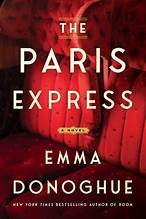
The Paris Express
2,785-word summary 12 min read 288 pages in the book
- First published
- 2025
- Publisher
- Summit Books
- Pages
- 288
- ISBN
- 9781668082799
Reading options
What's inside (9 sections)
I picked this up knowing almost nothing about the accident it is built around, and I finished it with a strong urge to go and find the photographs. That, I have come to think, is the whole effect Donoghue is after. The Paris Express is her sixteenth novel, published in the United States by Summit Books on 18 March 2025 at 288 pages, with Picador handling it in Britain. It takes a real railway disaster, the crash at Montparnasse station on 22 October 1895, and crowds it with people whose lives brush against one another on a journey some of them will not survive. It is a thriller, but an oddly light hearted one, and I mean that as a compliment.
I want to be honest about my first reaction, because it colours everything that follows. I assumed a book about a bomb and a train wreck would be a grim affair. Instead I found a novel that is more interested in the busy, hopeful, slightly ridiculous business of being alive in 1895. There is a child worrying about clocks, a secretary with a scheme, two men in a cab who are shy about their feelings, and a woman trying to decide whether to kill a carriage full of strangers. Donoghue lets all of them have their moment before the track runs out.
A bomb on the Granville express
The story begins on the Normandy coast, where a woman called Mado Pelletier boards the Granville express bound for Paris. She is carrying a bomb. Donoghue does not keep this a secret from us, and that is a wise choice. The suspense is never about whether the device will be discovered. It is about whether Mado will go through with what she has planned.
Mado is an anarchist. Her intended victims are not the ordinary passengers but the deputies travelling back to the National Assembly, politicians she holds responsible for the way the country is run. About those men she has made up her mind. What she cannot settle is the certain knowledge that innocent people will die with them. That problem is not a brief pause before the real action gets going. It takes up much of the book. Donoghue keeps returning to Mado's hesitation, walking beside her as she weighs the justice of her cause against the faces of the people sitting near her, and the novel is at its most serious whenever it stays in that uncomfortable place.
I found this the most gripping thread in the whole book, precisely because it refuses to be tidy. It would have been easy to write Mado as either a monster or a heroine. Donoghue does neither. She gives her a political conviction that is clear and a personal mercy that will not go away, and lets the two pull against each other for hundreds of pages. By the time the train nears Paris, the question is no longer what Mado will do but what it will cost her to do it.
There is a quiet irony in the fact that she is not even travelling under her own name. Everyone on this train is performing a version of themselves, and Mado is simply the most extreme case. She sits among people who have their own reasons for being on the Granville express, none of whom have any idea what she is carrying in her luggage.
The strangers in the carriages
The real pleasure of the book is the crowd Donoghue packs into the carriages. She introduces us to a remarkable set of people, gives each of them a small, sharp concern, and then lets the journey push them together. Some of them are drawn from history, which I will come back to, and all of them are given a way of seeing the world that is entirely their own.
There is Jules-Felix Gevelot, a manufacturer of ammunition. The irony of a man who makes his living from explosives sharing a train with a bomb is not lost on the author, and the book lets it sit there without making a speech about it. Gevelot is a businessman on his way back to the capital, a man of his century, and Donoghue uses him to bring the industrial side of France aboard the same train that carries the woman who wants to break its political order.
Henry Tanner is an African American artist, and he finds a kindred spirit in Marcelle de Heredia, a medical student of Cuban descent. Their conversations are among the warmest passages in the book. Two people who know what it means to be regarded as outsiders in a place that claims to be welcoming recognise something in each other, and Donoghue writes the growing understanding between them with a lightness that keeps it from ever sounding like a lesson. I liked these two immediately and wanted more time with them, which is probably the surest sign that a writer has done her job with minor characters.
Alice Guy is the secretary at Gaumont who is trying to persuade her employer that moving pictures have a future. Anyone who knows what comes next in the history of cinema will read her scenes with a smile, because we can see the answer that her boss cannot. Donoghue is careful not to make her a smug prophet. Alice is a young woman doing a job she believes in, up against a man who sees her as a secretary first and a visionary second, and the frustration is immediate and recognizable. Her storyline is the one that most clearly points beyond the disaster, toward a life that will continue long after the train has reached its end.
Then there is Maurice Marland, a boy of seven and a half who is travelling alone. His problem is small and wonderful: he cannot work out why the station clock and the platform clock disagree by five minutes. This is the kind of detail that tells you what sort of book you are in. While adults carry bombs and political grievances and unspoken desires, a child is trying to make sense of two clocks that should match but do not. Donoghue lets his confusion stand. It is not a mystery to be solved or a symbol to be explained. It is simply what is on his mind, and it makes him the most real person in the carriage for a while.
A medical student notices that a girl on board appears to be dying, and that observation hangs over the journey like a small, private shadow. Elsewhere, a driver and a stoker perform their work in perfect synchrony, and the precision of their shared labour slowly reveals a private affection between them. This is Donoghue writing about longing in the way she often writes about it best, through the details of a task done together rather than through declarations. The men barely say what they feel. The rhythm of their work says it for them.
Mado's hesitation and the weight of other people
What holds these separate lives together is Mado's decision, or her failure to make one. The train is a container, and the ticking is not only in the bomb but in her. Every conversation she has with another passenger raises the same obstacle in a new form. These people are not abstractions. They have jobs and worries and people waiting for them, and she knows it.
Donoghue handles this by moving between the carriages rather than staying with one point of view. The effect is that we keep seeing the same journey from different angles, and each angle makes Mado's task harder. This is a structural choice that earns its place. A single narrator could not have shown us how many lives the bomb threatens, and the whole argument of the book depends on that number being large and specific.
I did notice that the frequent shifts of focus can make the middle of the novel feel slightly restless. Just as I settled into one passenger's story, the book would lift me out and set me down with someone else. At 288 pages there is room for all of them, but not always room to linger. A few of the people I liked most, Tanner and Marcelle especially, feel sketched rather than fully drawn because the novel has so many names to introduce before the rails run out. That is a fair criticism, and I suspect it is the price of the design. Donoghue wants a crowd, and a crowd means some faces pass quickly.
Still, the device works on the whole. By the time the express is close to Paris, I found that I cared about almost everyone aboard, and that made Mado's dilemma genuinely painful rather than merely theoretical. The book asks a question that is easy to state and hard to answer: how many strangers are you willing to kill for a cause you believe is just? It does not answer it in a speech. It answers it by making us sit with the people who would die.
Real names and invented company
One of the strangest pleasures of The Paris Express is the knowledge that many of the passengers were real people. Henry Tanner, the painter, and Alice Guy, the early filmmaker, were actual figures in the period, and the world they move in here is the world of 1895, when the future of moving pictures was still an open question. Donoghue is not shy about borrowing their names and their ambitions.
Kirkus pointed out that some of these historical figures were not actually on the train that day. That matters, and I think it is worth being clear about it. This is a novel, not a transcript. Donoghue has taken the disaster and used it as a stage on which to gather people who belong to the same moment in history, even if the timetable has been tidied up for the sake of the story. Once I accepted that, I enjoyed the book more. Reading it as a documentary would only lead to disappointment.
The approach gives the novel a double texture. On one level it is a thriller with a bomb, a deadline and a crash. On another it is a small portrait of a France at a particular instant, with an artist, a filmmaker, a manufacturer, an anarchist, a child and a pair of railway workers all caught in the same few hours. The politics are there in the deputies Mado wants to punish. The technology is there in Gaumont and in the clocks that confuse Maurice. The social questions are there in the way strangers speak to one another, or do not.
I liked this mixture, but I can see how it might irritate a reader who wants a single, disciplined point of view. The book keeps waving at larger themes without staying long enough to develop any of them. There is a novel about early cinema somewhere in the Alice Guy chapters, and a novel about race and art somewhere in the Tanner chapters, and neither is written. What we get instead is a bright, fast cross section of a country on the edge of a change it cannot quite see.
The crash at Montparnasse
The climax is the accident itself. Donoghue builds toward the moment when the Granville express fails to stop at Montparnasse station on 22 October 1895, and she meets it with the confidence of a writer who knows the historical record is already extraordinary. The real event was captured in photographs that have a strange, almost unreal clarity, and the book draws on that quality. The crash is not described as a distant rumour. It arrives with the full, confused physicality of a train that has run out of track.
What impressed me is that the author does not linger over gore. She stays with the sensations and the sudden rearrangement of everything that was ordinary a moment before. The clocks, the luggage, the conversations, the private worries, all of it is thrown together in an instant. Because we have spent the whole book with these people, the crash carries emotional weight without needing to be sharpened into spectacle.
The photographs that survive from the real disaster are part of the book's atmosphere. They are the reason the ending feels surreal rather than merely violent. A scene that was recorded by a camera in 1895 has a stillness to it, and Donoghue borrows that stillness. I closed the final chapters with the same feeling I had when I first saw those images, which is a mixture of horror at what happened and fascination that anyone managed to record it at all.
I should say that the ending arrives quickly after the crash. This is a book that has spent its energy on the journey rather than the aftermath, and the last pages tie things up with a certain briskness. For some readers that will feel efficient. For others it will feel like the novel ends just as it was getting to the part they most wanted to see. I landed somewhere in the middle, sorry to lose the carriages but ready to stop.
What the book leaves on the table
I want to spend a little time on what did not work, because the praise this novel has received can make it sound more substantial than it is. Kirkus called it smart and skillful entertainment, which is accurate, and also said it does not aim for the thematic depth of Donoghue's earlier historical fiction, describing it as just for fun. I agree with both halves of that judgment.
The characters are vivid in the moment and thin in the memory. I could tell you exactly what Maurice was worried about and why Alice Guy was frustrated, but months from now I suspect I will remember the situation rather than the person. Donoghue is excellent at the quick sketch and less interested in the slow build. That is a fine choice for a book this size, but it does mean that the emotional payoff never runs very deep. Nobody on this train is changed in a way that will haunt the reader.
There is also the matter of tone. A story about a bomb, a murder attempt and a fatal rail crash keeps threatening to become solemn, and the novel keeps choosing not to. The warmth and wit are real, and they are the reason I enjoyed it, but occasionally the lightness feels like a refusal. Mado's hesitation is the one thread that carries genuine moral weight, and even that gets less space than the comic business of the other passengers. The book knows it is an entertainment and seems content to stay one.
None of this makes it a bad novel. It makes it a particular kind of novel, and I think the disappointment would only come from expecting a different one. If you open it hoping for another slow, strange study of an extraordinary life, you will find the pace and the crowd unnerving. If you open it expecting a clever, humane adventure built around a true disaster, you will likely have a very good time.
Why I would hand it to a friend
I finished The Paris Express with a clear sense of what it is for. It takes a terrible event that could easily become a pile of statistics and repopulates it with people who wanted ordinary things on the day they died or nearly died. A child wants an explanation for two clocks. A secretary wants her employer to take her seriously. Two railway men want to be near each other without saying so. A woman wants to be sure she is right, and cannot be.
That is the achievement. The disaster is the frame, not the point. The point is the crowded, brief, precious life that fills the frame before the train reaches the end of the line. Donoghue writes those small ambitions with such affection that the crash hurts more than it would in a book that treated the passengers as names on a list.
I would recommend it without hesitation to someone who likes history made immediate, and to anyone who enjoys a novel that moves quickly and does not ask to be admired for its seriousness. I would be careful with a reader who wants deep psychology or a slow unfolding of theme, because this book has neither and does not pretend to. What it has is a train, a bomb, a set of vivid strangers and a crash that really happened. For a short novel published in the spring of 2025, that is more than enough.
FAQ
Is The Paris Express based on a true story?
The climactic crash is the real railway disaster at Montparnasse station on 22 October 1895. Donoghue invents most of her passengers and places several real historical figures aboard the train, some of whom were not actually there that day.
Is The Paris Express a conventional thriller?
It has a bomb, a deadline and a crash, but it reads more like a humane historical adventure. Kirkus called it smart, skillful entertainment and said it does not aim for the thematic depth of Donoghue's earlier work.
Who are some of the people on the train?
They include the anarchist Mado Pelletier, the artist Henry Tanner, the secretary Alice Guy, the medical student Marcelle de Heredia, a young boy named Maurice Marland, and a driver and stoker whose shared work hides a private affection.
Similar books
The Paying Guests
A widowed mother and her unmarried daughter take in lodgers in 1922 south London, and a secret affair between Frances and Lilian pulls them into a murder case.
2,661-word summary · 12 min read
The Lost Girls of Paris
In 1946, a war widow finds an abandoned suitcase in Grand Central holding photographs of twelve women who vanished in the war, and follows their story back to…
2,668-word summary · 12 min read
Alias Grace
A teenage maid convicted of a double murder in 1843 tells her story to a young doctor hired to decide whether she deserves a pardon.
2,788-word summary · 12 min read
The Book of Lost Names
A young forger in occupied France helps Jewish children flee with new names while keeping a secret book of the truth.
2,097-word summary · 9 min read
The Pull of the Stars
Over three days in a Dublin maternity ward in 1918, a nurse, a suffragette doctor on the run and a young volunteer face the flu, childbirth and unexpected love.
2,578-word summary · 11 min read
Whisper Network
Four women at a Dallas sportswear company decide to name their boss in an anonymous spreadsheet of bad men, and the office turns on itself.
2,152-word summary · 10 min read
There Will Be Bodies
Digging out a villa buried by Vesuvius, Flavia Albia finds chained corpses and a death someone tried to hide for ten years.
2,152-word summary · 10 min read
The Hangman's Daughter
In 1659 Bavaria, a hangman ordered to torture an innocent midwife instead investigates the deaths of children marked with a strange tattoo.
2,523-word summary · 11 min read
Witchcraft for Wayward Girls
In 1970 Florida, a girl sent to a maternity home for unwed mothers finds a spellbook, and the real horror turns out to be what the adults do to her and her…
2,077-word summary · 9 min read
The Luminaries
Eleanor Catton's Booker-winning novel drops a young prospector into an 1866 New Zealand gold town where twelve men untangle a web of hidden gold, murder and…
2,949-word summary · 13 min read

The Kitchen God's Wife
Amy Tan's second novel pairs a San Jose speech therapist with her Chinese mother, whose account of war, an abusive husband, and a narrow escape comes out in a…
2,896-word summary · 13 min read
The Distant Hours
A letter posted in 1941 reaches Edith Burchill in 1992 and draws her to Milderhurst Castle, where three elderly sisters still guard the secret of a stormy…
2,261-word summary · 10 min read
The Beekeeper's Apprentice
In 1915 a bookish fifteen-year-old American girl stumbles across a retired Sherlock Holmes keeping bees on the Sussex Downs, and talks him into taking her on…
2,215-word summary · 10 min read
Shadow Ticket
Pynchon's tenth novel, his first in twelve years, sends a Milwaukee detective across 1932 Europe after a cheese heiress, a clarinetist, and a very strange lamp.
2,348-word summary · 10 min read
Possession: A Romance
A London Library discovery sends two scholars chasing a secret Victorian love affair, in a Booker-winning novel of invented letters, poetry and the race to own…
2,394-word summary · 11 min read
Men Explain Things to Me
A short collection of essays that begins with a man explaining Solnit's own book to her and expands into an argument about who gets believed, who gets heard…
2,019-word summary · 9 min read
Marina
A fifteen-year-old boarder in 1979 Barcelona follows a singing voice into a ruined mansion and finds a girl, a watch, and a mystery the city has kept buried…
2,352-word summary · 10 min read
Endling
A Ukrainian scientist breeds endangered snails from her van and funds the work by posing as a mail-order bride, until a kidnapping plot meets the outbreak of…
3,041-word summary · 14 min read
Drowning Ruth
In 1919 a Wisconsin mother drowns beneath the ice, and her sister insists the little girl who remembers it only dreamed the event. Schwarz unfolds the truth in…
2,386-word summary · 11 min read
Broken Country
A historical love story built like a thriller: a farmer's wife in 1968, a son lost two years before, and the return of the man who once broke her heart.
2,461-word summary · 11 min read
Bringing Down the Duke
In 1879 Oxford, a scholarship student and suffragist is tasked with winning over a powerful duke, only to be undone by the man she must persuade.
2,456-word summary · 11 min read
The True Confessions of Charlotte Doyle
A sheltered thirteen-year-old sails from Liverpool in 1832 and finds herself the only woman aboard a ship with a charming, dangerous captain.
2,330-word summary · 10 min read
The Dressmaker's Gift
In occupied Paris, three seamstresses hide dangerous secrets, and decades later one granddaughter returns to the same building to learn what really happened.
2,277-word summary · 10 min read
The Christie Affair
Agatha Christie vanishes for eleven days in 1926, and her husband's mistress claims to know why. Nan O'Dea's account runs from an Irish convent to a Yorkshire…
2,384-word summary · 11 min read
The Boston Girl
Eighty-five-year-old Addie Baum tells her granddaughter how she grew up in Boston's North End, chased education and love, and became the woman she is.
2,439-word summary · 11 min read
Never Flinch
Holly Gibney works two cases at once: a killer promising fourteen deaths and a threat against a feminist writer's lecture tour. King braids them into a…
2,245-word summary · 10 min read
Child 44
Tom Rob Smith's 2008 debut follows Soviet secret policeman Leo Demidov as he hunts a child killer in a country that officially has no crime.
2,428-word summary · 11 min read
The Art Forger
A disgraced Boston painter agrees to copy a Degas stolen from the Gardner Museum, then begins to suspect the original she is copying is itself a forgery.
2,117-word summary · 9 min read

Anatomy: A Love Story
In 1817 Edinburgh, a noblewoman who wants to be a surgeon disguises herself to study anatomy and falls for the grave robber who supplies her with bodies.
2,031-word summary · 9 min read
The Once and Future Witches
Three estranged sisters bring witchcraft back to an 1893 city where magic hides in nursery rhymes and the fight for the vote is also a fight for power.
2,132-word summary · 9 min read