
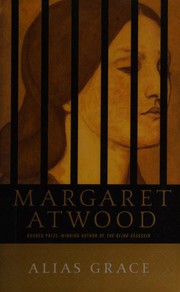
Alias Grace
2,788-word summary 12 min read 470 pages in the book
- First published
- 1996
- Publisher
- McClelland and Stewart
- Pages
- 470
- ISBN
- 9780385490443
Reading options
What's inside (8 sections)
I came to this book sideways. I had read The Handmaid's Tale years ago and thought I knew what an Atwood novel felt like, all cold control and warning lights. A friend told me Alias Grace was different, warmer in voice and stranger in shape, and built on a real murder case from 1840s Canada. That combination hooked me. True crime from before photography, retold by a writer who loves unreliable narrators. I started it on a weekend and finished it resenting every interruption.
The setup is simple to describe and hard to put down. In 1843, in Upper Canada, a wealthy farmer named Thomas Kinnear and his housekeeper Nancy Montgomery were murdered. Two servants were arrested for it: James McDermott, a handyman, and a teenage maid named Grace Marks. McDermott was hanged. Grace, sixteen years old, had her death sentence commuted and spent nearly three decades locked up, in the Kingston Penitentiary and for a stretch in the Toronto asylum. Then, in 1859, a young American doctor interested in the new science of mental illness arrives to interview her, because a committee of reformers wants her pardoned and needs an expert to say she is worth pardoning. The rest of the novel is Grace talking, the doctor listening, and both of them circling the one day Grace says she cannot remember.
An Irish girl in a cold new country
Grace tells her story from the beginning, and the beginning is grim in the way of so many immigrant stories from that century. She was born in Ireland, one of many children of a feckless, drinking father and a worn-out mother. When Grace is about twelve, the family sails for Canada. Her mother dies on the voyage and is buried at sea, wrapped and slipped over the side while Grace watches. Her father finds work when he feels like it, drinks most of what he earns, and treats his daughters as property he can shout at and worse. Grace goes into service young because there is no other option. She is thirteen or so when she starts working in other people's houses, sleeping in attics, learning which employers feed their maids and which ones count every candle.
The brightest part of her early life is her friendship with Mary Whitney. They work together in the Toronto household of a Mrs. Parkinson, and Mary is everything Grace is not yet: funny, bold, experienced, full of opinions about men and masters. Mary teaches Grace how to behave below stairs and how to think about the people above them. Then Mary takes up with a young gentleman, becomes pregnant, and dies after a desperate attempt to end the pregnancy, bleeding to death in a room Grace cannot forget. Grace holds her friend as she dies. She later says Mary spoke to her afterward, in dreams and in moments where the boundary between sleeping and waking goes soft. Keep that detail in mind. It matters enormously later.
After Mary's death Grace cannot stay in that house. She moves from place to place, competent and quiet, the kind of servant employers praise for being no trouble. Eventually she is hired at the farm of Thomas Kinnear, a Scottish gentleman farmer near Richmond Hill. The household is small: Kinnear himself, his housekeeper Nancy Montgomery, and the hired man James McDermott, an Irishman with a temper and a grievance against everyone. Nancy runs the house and shares Kinnear's bed, a fact the neighborhood knows and judges. Grace is the young maid caught between Nancy's jealous authority and McDermott's rough attention. She notices everything and says little, which becomes her habit for life.
The murders at Kinnear's farm
Atwood does something clever with the killings. She does not give you one clean scene. She gives you the event the way history actually delivers it: in layers. There are newspaper clippings, ballads, trial reports, and later accounts that contradict each other. Then there is Grace's own telling, offered years later to the doctor, calm and piecemeal. You have to assemble the picture yourself, and you keep noticing the gaps.
What is not disputed: in late July 1843, Kinnear was shot and Nancy was killed too, struck down and strangled, her body hidden under a wash tub while Kinnear's was put in the cellar. McDermott and Grace fled together toward the United States, traveling as a married couple of sorts, and were caught in Lewiston, New York, not far over the border. The newspapers went wild. A handsome young woman accused of murder was irresistible copy, and the press painted Grace by turns as a monster, a simpleton, and a victim led astray by a villain.
At the trial that autumn, McDermott was convicted and hanged. He made accusations against Grace from the scaffold, or so the papers said. Grace's lawyer argued her youth and suggested her mind was affected, and her death sentence was commuted to life imprisonment. She was sixteen. Think about that number when you read her scenes. Everything she does afterward, every careful sentence, comes from someone who learned as a teenager that one wrong word could hang her.
Grace's own account of the murder day is the hole at the center of the book. She remembers going to the farm that morning, remembers small things like what she wore and what was said at breakfast, and then her memory stops. She says the next thing she knew, she was on the road with McDermott, wearing Nancy's clothes and some of her jewelry. She does not deny being there. She says she does not remember the killing itself. Whether that is amnesia, guilt, madness, or strategy is the question the whole novel turns on, and Atwood refuses to hand you the answer.
The doctor who came to listen
Sixteen years later, Grace is still in Kingston, let out some days to sew for the prison governor's family, famous enough that strangers gawk at her. A committee of earnest reformers, including a young minister named Reverend Verringer, wants her released. They need a respectable medical opinion, so they engage Dr. Simon Jordan, an American in his late twenties who has studied the new theories of mental disease and wants to make his name. He is to interview Grace, write a report, and either open the door to a pardon or close it.
Simon is a wonderful creation because he is so ordinary in his vanity. He rents rooms from a widowed landlady, Mrs. Humphrey, and drifts into an affair with her that he enjoys and despises himself for. His mother writes him hearty letters urging him to marry well and come home. He keeps a journal of his dreams. He believes, as progressive young men of 1859 believed, that the mind works by association, that memories can be recovered if you find the right thread and pull gently. His method with Grace is to bring her objects, an apple, a piece of cloth, a drawing, and ask her to talk about whatever comes into her head. It is talk therapy before the name existed, mixed with a fair amount of flirtation he will not admit to.
The interviews are the heart of the book and the best reason to read it. Grace narrates her life in long, composed passages, and her voice is a marvel: plain, dry, watchful, funny in passing, always aware of what her listener wants. She sews while she talks, working on quilts whose patterns give each section its title. She tells Simon exactly as much as she decides to tell him, and she lets him see her deciding. She knows he is writing everything down. She knows the committee will read it. She has been interviewed, examined, preached at, and displayed for sixteen years, and she handles this handsome young doctor the way a cat handles a visitor: politely, at a distance, claws kept just out of sight.
Meanwhile Simon's own life starts to tilt. He grows obsessed, not just professionally. He dreams about Grace. He quarrels with the asylum superintendent, Dr. Bannerling, who thinks Grace is plainly malingering and says so with contempt. He argues with the spiritualists on the committee, who believe Grace is innocent because the spirits told them so. He spends money he does not have, neglects the landlady who loves him, and catches himself hoping Grace will turn out to be both innocent and available, a fantasy he is too educated to say out loud and too human not to feel. Atwood is merciless with him here, and funny. The man who came to dissect someone else's mind turns out to be a poor keeper of his own.
The evening with the hypnotist
The committee, impatient with Simon's slow progress, arranges a session with a traveling expert in what the age called neuro-hypnotism. The man calls himself Dr. Jerome DuPont, but Grace recognizes him at once. He is Jeremiah Pontelli, a Yankee peddler she knew years before, a cheerful charlatan who sold her buttons and told her fortune. Now he wears a professional beard and speaks with authority, and he proposes to put Grace into a trance and recover the lost memory directly.
The séance scene is the most famous in the novel and the one readers argue about most. The committee gathers in a darkened room. DuPont puts Grace under, or appears to. And then a different voice starts speaking through her mouth: crude, laughing, furious. It claims to be Mary Whitney, dead these many years, who says she slipped into Grace's body at the moment of her death and has been living inside her ever since. This voice describes the murders in detail, acting them out with relish, and explains that Grace herself remembers nothing because Mary did the killing through her hands while Grace slept, in a sense. It mocks the gentlemen in the room. It says what it came to say. Then Grace wakes, or comes out of the trance, claiming no knowledge of anything that was said.
I will not spoil the specifics of what the voice reveals, because the scene works best when you meet it cold. What matters is what happens next. The spiritualists are triumphant: here is proof Grace was possessed and is therefore innocent, or at least not responsible. Bannerling is disgusted: obvious fraud, the girl and the peddler in league. Simon, the man of science, is undone. He cannot explain what he saw. He knows Grace recognized DuPont, which suggests collusion, but the performance had a force that rattled him beyond argument. He writes his report in a state of confusion, recommends nothing clearly, and flees Kingston soon after, entangled in a scandal involving his landlady and unwilling to face what the Grace business has stirred in him.
It is worth pausing on how carefully Atwood constructed this. Every explanation of that evening is available to you and none is confirmed. Possession by a dead friend. A hypnotic state that loosened a buried memory. A clever woman seizing her one chance to give her supporters the story they needed, coached by an old acquaintance. A hysterical episode in a damaged mind. The novel lays out all four and endorses none. Readers who need a solution will be frustrated. Readers who enjoy sitting inside uncertainty will find it thrilling.
Freedom, marriage, and the parts that stay dark
Simon leaves Canada and essentially vanishes from Grace's life. News of him reaches the reader sideways, through letters and secondhand reports: he joined the American Civil War as an army surgeon, was wounded in the head, lost much of his memory, and married the nurse who cared for him, a quiet young woman who keeps him from the past he can no longer recall. It is a strange, sad mirror of Grace's own story. The doctor who tried to cure someone else's amnesia ends up with amnesia himself, and finds a kind of peace in it. Whether Atwood means this as irony or mercy is left for you to decide.
Grace waits much longer for her own resolution. Petitions come and go. Years pass in a paragraph. Finally, in 1872, after twenty nine years of imprisonment, she is pardoned, partly on the strength of the accumulated sympathy and partly because the world has moved on and keeping a middle aged woman locked up for a crime of her youth embarrasses the authorities. She travels to New York State, where she marries Jamie Walsh, a young man from the old days at Kinnear's farm who once gave evidence connected to the case and who has carried a torch for her ever since. It is not a grand romance. It is something better: a quiet, decent arrangement between two people who know exactly what the other is.
The closing chapters are among the most moving things Atwood has written. Grace, free, sets up a household and returns to her quilting, and the novel pays close attention to her hands and her patterns. She pieces a quilt called the Tree of Paradise, sewing into it scraps of fabric connected to the dead: a piece of Mary's petticoat, among others. She writes, or dictates, an account of a dream in which she addresses a letter to Simon, telling him things she never told him in person. Whether she sends it, whether he could even read it in his damaged state, is unclear. The final image is of a woman who has stitched the fragments of her life into something whole enough to sleep under, while keeping one square of the pattern turned to the wall. I found the ending genuinely haunting, not because it shocks but because it withholds exactly the right amount.
A word on sources, since Atwood includes an afterword about them. Grace Marks was real. The murders, the trial, the commutation, the long imprisonment, and the 1872 pardon all happened. Atwood worked from newspaper accounts, trial reports, and the writings of Susanna Moodie, a pioneer author who visited Grace and wrote about her with the confidence of someone who knew a murderess when she saw one. Simon Jordan, Mrs. Humphrey, Verringer, and DuPont are invented, as is most of the dialogue. The novel is honest about this division. It wants you to feel the friction between the documented facts and the invented interior, because that friction is the subject.
What drags and who should skip it
No book this long is perfect, and this one has a soft middle that some readers will not forgive. The interviews proceed at life's pace, with whole chapters given to Grace's childhood chores, her employers' kitchens, and Simon's letters home. If you came for the murder, you may fidget. I fidgeted once or twice myself, particularly during Simon's scenes with his mother and his landlady, which can feel like a second novel elbowing into the first. On a second reading I appreciated them more, since Simon's unraveling is the point, but the first time through I wanted him to stop mooning over his landlady and get back to the prison.
The ambiguity will also divide people. Atwood plants questions she never answers: did Grace remember more than she said, did she and Jeremiah plan the séance, what exactly happened in the cellar that day. Some readers feel cheated by this, as though the author owed them a verdict. I think the refusal is the achievement. The historical record itself is inconclusive, full of contradictory testimony and self serving memoirs, and a novel that pretended to settle it would be less honest than one that stages the uncertainty. Still, if you only enjoy mysteries that end with the detective explaining everything, borrow this one before you buy it.
Who is it for, then. Readers who like historical fiction with texture, the food and the fabrics and the freezing bedrooms, will be happy here. Readers who like character studies will find two excellent ones, Grace and Simon, plus a gallery of minor figures drawn with quick malice. Readers who loved the television adaptation from 2017 will find the novel slower and stranger, with more quilting and more doubt. Readers who want Atwood the prophet of dystopia should adjust expectations: this is Atwood the historian, patient and skeptical, interested in how women's testimony gets twisted by the men paid to record it. That theme hums under every page without ever becoming a lecture, and it is why the book still feels current more than a century and a half after the events it describes.
Pick it up for Grace's voice alone. Stay for the séance. Argue about the ending with someone afterward. That is the correct way to read this novel, and I suspect it is exactly what the author intended.
FAQ
Was Grace Marks a real person?
Yes. Grace Marks was convicted in 1843 for the murders of Thomas Kinnear and Nancy Montgomery, had her death sentence commuted, and was pardoned in 1872. Atwood drew on trial reports, newspapers, and Susanna Moodie's writings; Dr. Simon Jordan and his circle are invented.
When was Alias Grace published?
McClelland and Stewart published it in Canada in September 1996, with Doubleday publishing in the US that December. It won the 1996 Giller Prize and was shortlisted for the Booker Prize. The edition cited here runs 470 pages, ISBN 9780385490443.
Does the book reveal whether Grace committed the murders?
No. The novel offers several explanations for the murders, including the voice heard during the hypnosis session, and confirms none of them. The ending leaves Grace's memory and guilt for the reader to judge.
Similar books
The Blind Assassin
An old woman writes her sisters story while a novel inside the novel retells it as pulp science fiction.
1,963-word summary · 9 min read

Wide Sargasso Sea
Jean Rhys gives the first Mrs. Rochester a Caribbean childhood, a marriage built on money and suspicion, and a voice that Charlotte Bronte left in the attic.
2,021-word summary · 9 min read

Bleak House
Jarndyce and Jarndyce grinds through Chancery while Esther finds her family.
2,480-word summary · 11 min read

The Name of the Rose
Friar William and Adso investigate 1327 abbey deaths amid library labyrinth.
2,580-word summary · 11 min read
The Handmaid's Tale
Atwood's The Handmaid's Tale retold: Offred in Gilead, the Commander, Serena Joy, Mayday, and the van.
2,369-word summary · 11 min read

The Long Winter
Dakota Territory, 1880: seven months of blizzards cut a town off from the railroad, and a family survives on twisted hay, ground wheat, and a dangerous wheat…
2,210-word summary · 10 min read

The Crying of Lot 49
A California woman named executor of her ex-lover's estate follows a muted post horn into a possible centuries-old postal conspiracy, and Pynchon refuses to…
2,003-word summary · 9 min read
The Art Forger
A disgraced Boston painter agrees to copy a Degas stolen from the Gardner Museum, then begins to suspect the original she is copying is itself a forgery.
2,117-word summary · 9 min read

How the Light Gets In
Gamache investigates the murder of the last Ouellet quintuplet while the Sûreté he served is dismantled from inside by the man who took his protégé.
2,279-word summary · 10 min read

Bury Your Dead
Recovering from a failed raid that killed his officers, Gamache investigates a murder in a Quebec City library while Beauvoir reopens a case in Three Pines.
2,022-word summary · 9 min read

Anatomy: A Love Story
In 1817 Edinburgh, a noblewoman who wants to be a surgeon disguises herself to study anatomy and falls for the grave robber who supplies her with bodies.
2,031-word summary · 9 min read

Little Town on the Prairie
In the spring after the Long Winter, fifteen-year-old Laura sews shirts, studies for a teaching certificate, and helps send her blind sister Mary to college.
2,071-word summary · 9 min read

The Once and Future Witches
Three estranged sisters bring witchcraft back to an 1893 city where magic hides in nursery rhymes and the fight for the vote is also a fight for power.
2,132-word summary · 9 min read

The Black Dahlia
James Ellroy builds a fiction around the real Black Dahlia murder, following two Los Angeles cops whose partnership and obsessions destroy them.
2,533-word summary · 11 min read

The Agony and the Ecstasy
Irving Stone turns Michelangelo's seventy years of carving, painting, and arguing with popes into a novel about the cost of making something that outlives you.
2,260-word summary · 10 min read

Sophie's Choice
A young Southern writer in 1947 Brooklyn befriends a brilliant, unstable couple and slowly learns the story of the Polish Catholic woman at the center of their…
2,798-word summary · 12 min read

Only Time Will Tell
A Bristol dockworker's son wins a scholarship, falls in love with the daughter of the family that owns the shipyard, and learns that his father's death was not…
2,082-word summary · 9 min read

Once Upon a River
A wounded man stumbles into a riverside inn carrying what appears to be a drowned child who is not quite dead, and the story braids the guesses of everyone who…
2,173-word summary · 10 min read
The Moonstone
A cursed yellow diamond vanishes on the night of a birthday party, and eight witnesses tell what they saw.
2,603-word summary · 12 min read

The Echo of Old Books
Barbara Davis's 2023 novel sends a rare-book dealer in 1984 New Hampshire hunting for the authors of two unpublished volumes that tell opposite sides of one…
2,491-word summary · 11 min read

Last Night at the Telegraph Club
The 2021 National Book Award winner follows Lily Hu, a Chinese American teenager in 1954 San Francisco, as she falls for Kath and learns what it costs to be…
2,336-word summary · 10 min read

Ivanhoe
A disinherited Saxon knight, a great tournament, a besieged castle and a trial by combat. Scott's most famous novel, set in England in 1194.
2,834-word summary · 13 min read

Big Lies in a Small Town
A 22-year-old woman leaves prison to restore a 1940 mural, and Edenton, North Carolina, starts talking.
2,187-word summary · 10 min read

The Tuscan Child
After her father's death, Joanna follows a returned letter to Tuscany and uncovers his wartime love, a hidden painting and a village secret. A dual-timeline…
2,095-word summary · 9 min read

The Silence of the Girls
Briseis, queen of Lyrnessus, is captured by Achilles and narrates the Trojan War from inside the Greek camp, where women are prizes and survival is its own…
2,098-word summary · 9 min read
The Last of the Mohicans
During the French and Indian War, Hawkeye and two Mohican warriors try to save two British sisters from a Huron chief whose revenge will end the Mohican line.
2,017-word summary · 9 min read

The Diviners
In 1920s New York, Evie O'Neill's ability to read objects pulls her into an occult investigation that awakens something far older and more dangerous.
2,045-word summary · 9 min read

The Birth of Venus
A Florentine merchant's daughter trains as an artist, marries a man who hides a secret, and survives Savonarola's bonfire of the vanities.
2,404-word summary · 11 min read
Mother Night
Howard W. Campbell Jr., a Nazi propagandist and American spy, tells the story of his double life from an Israeli prison cell while waiting to be tried for war…
1,988-word summary · 9 min read

Doctor Zhivago
A doctor and poet lives through revolution, war, and love in Pasternak's novel of private life under the pressure of Russian history.
2,213-word summary · 10 min read